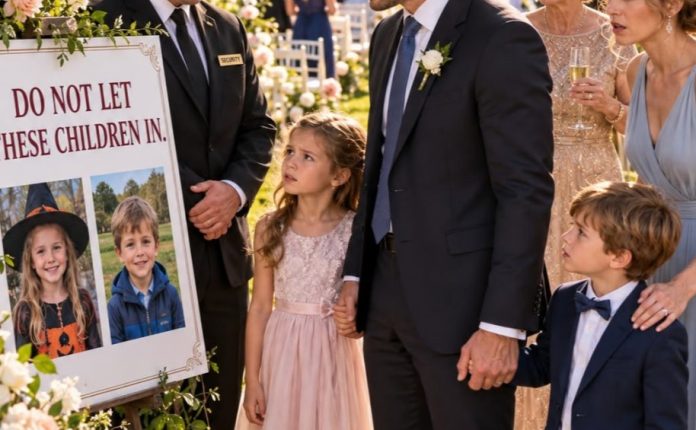
The guard stepped into our path before we reached the vineyard gate.
“I’m sorry,” he said, looking past me at my children. “I’ve been told they can’t come inside.”
Lucy tightened her fingers around mine.
She was eight, wearing a pale blue dress she had chosen three weeks earlier. That morning, she had asked Emily to redo her braid twice because she wanted it to look right in the wedding photographs.
My son, Evan, stood beside her in a shirt that still held the creases from its packaging. He was six. The little tie around his neck had taken me nearly ten minutes to straighten.
Behind the guard, beyond the iron gate, someone laughed.
I could see white tablecloths through the open reception doors. A florist was adjusting the arrangement beside the aisle. The photographer I had booked was lifting a camera toward the stone terrace.
Everything looked exactly as it should have.
Then I saw the paper taped to the entrance.
Two photographs.
My children.
Above them, a printed instruction telling staff to keep them out.
For a few seconds, my mind refused to put those things together. I knew the venue. I knew the wedding schedule. I had paid the invoices sitting in a folder on my desk at home.
But the pictures on that paper belonged to the small, ordinary life I had never expected anyone to use against us.
Lucy in her Halloween costume.
Evan at the park.
Photographs I had posted because I loved my kids.
“Is this supposed to be a joke?” I asked.
The guard glanced at the paper, then back at me.
“No, sir.”
Emily stepped closer.
“Those are our children.”
“I understand.”
“No,” she said. “I don’t think you do.”
He touched the radio clipped to his jacket, then lowered his hand.
I remember that movement clearly. He wanted somebody else to handle this. I couldn’t blame him. Whoever had hired him had handed him a humiliating task and left him to carry it out in front of two children.
My name is Daniel Harris. I was forty-one that morning, old enough to know that family could disappoint you in ways strangers never would.
Still, I had arrived feeling proud.
That was the part I struggled with afterward.
Not that I had failed to see Ava clearly. I had seen plenty. It was that I had convinced myself the occasion might bring out something better in her.
My stepsister was thirty. She was marrying Mark, a quiet man who listened before answering and usually looked as though he would rather be useful than noticeable.
I liked that about him.
At family meals, while Ava complained about a restaurant’s lighting or Carol corrected a server, Mark would thank the person bringing water. If a conversation grew uncomfortable, he never made it worse.
I mistook his quietness for a kind of protection.
I thought a decent man beside her might make the wedding a decent day.
Six months earlier, Carol had come to our house carrying a folder and a tissue already folded into her palm.
Carol was my stepmother, although there had been years when I called her Mom because it seemed easier than explaining the shape of our family to other people.
My father had died three years before the wedding.
During his final months, when the house smelled of medication and every conversation seemed to happen in lowered voices, I had promised him I would try to keep us together.
I didn’t know then how loosely a promise like that could be stretched.
Carol sat at our kitchen table, the same table where I would later spread out contracts bearing a signature that wasn’t mine.
“Ava has waited so long for something good,” she said.
I pushed the tissue box toward her.
“She and Mark seem happy.”
“They are. But she’s worried about the wedding.”
I asked what the problem was.
Carol opened the folder.
There were venue brochures, photographs of floral arrangements, menus printed on heavy paper. The vineyard appeared on the first page, sunlight falling across its courtyard.
“She doesn’t want anything ridiculous,” Carol said.
I looked at a photograph of a room full of suspended flowers.
“What does she want?”
“Just something beautiful.”
That was how the conversation began. Not with a total. Not with a clear request. With beauty, disappointment, my father’s memory, and the suggestion that I was the one person who could spare everybody more worry.
Emily was in the kitchen, slicing apples for the children. She looked over once, then returned to the cutting board.
Carol told me money was tight. She said Ava had suffered enough false starts and deserved to begin married life without shame or debt.
I asked what Mark’s family was contributing.
“They’ll help where they can,” she answered. “But I don’t want this turning into an argument between families.”
Looking back, there were questions I should have asked again.
At the time, I heard a woman embarrassed to admit she couldn’t afford her daughter’s wedding.
I understood that feeling.
After my father died, I had helped with things that came up around his house. Repairs. Bills Carol said she hadn’t expected. Small expenses that arrived wrapped in larger emotions.
I had a good income. Emily and I were careful. We weren’t wealthy enough to stop noticing money, but we could afford to be generous when it mattered.
I decided this mattered.
“I’ll cover the wedding,” I told Carol.
She stared at me, then pressed the tissue against her mouth.
“Daniel.”
“I’ll work directly with the vendors. That way everyone knows what’s paid.”
“And paying you back—”
“Don’t worry about that.”
She reached across the table and caught my wrist.
“Your father would be so proud.”
It was a powerful thing to say to someone who still sometimes reached for his phone before remembering there was nobody left to call.
I let it settle the question.
That evening, after Carol left, Emily put the children to bed and came downstairs.
“You’re sure?” she asked.
“I can manage it.”
“That wasn’t what I asked.”
I understood her.
Emily wasn’t worried about a flower invoice. She was worried about the way responsibility always found its way to me, while gratitude seemed to get lost somewhere between Carol’s house and ours.
“I know,” I said.
She leaned against the counter.
“I want Ava to have a good wedding too. I just want you to remember that helping her doesn’t mean agreeing to everything afterward.”
“I’ll set a budget.”
“And keep it?”
“Yes.”
She nodded, but her expression didn’t completely ease.
Over the next few months, I did what I had promised.
I booked the venue. I paid the caterer. I arranged the photographer and approved the flowers after Carol explained that the original plan looked a little too plain.
There were emails about table linens and calls about timing. I learned more than I ever wanted to know about chair rentals.
Whenever possible, I paid vendors directly.
I kept the confirmations, partly because I kept records of everything and partly because there was comfort in a receipt. A receipt said an obligation was finished. It didn’t sigh or change its mind.
Ava thanked me once near the beginning.
She sent a message with several hearts and said she couldn’t believe how lucky she was.
I showed it to Emily.
“See?” I said.
Emily smiled.
“I hope it stays that way.”
For a while, it seemed to.
Lucy asked if she could wear blue. Ava said that would be lovely.
Evan wanted to know whether weddings had cake before dinner or afterward. Mark explained the order to him with the seriousness of someone answering an important technical question.
The invitation arrived addressed to all four of us.
Daniel, Emily, Lucy, and Evan.
Emily filled in the response card and returned it. Four attending. No dietary restrictions.
Carol mentioned the children’s places when we discussed the meal count.
There was never a suggestion that they wouldn’t be welcome.
That matters.
Not because children must attend every wedding. They don’t.
Adults can choose an event without children. Families can make arrangements, decide whether to attend, and explain the situation kindly.
What happened to Lucy and Evan wasn’t a decision about an event.
It was a decision about them.
During the final week, Ava’s messages changed.
The first was about the wine.
“Mark’s relatives are used to better labels. We should probably upgrade.”
I checked the approved selection.
It was perfectly good wine, chosen with the caterer.
“We’ve already paid for the package,” I answered.
“I know, but we can still change it.”
“Then you’ll need to arrange the difference.”
She didn’t reply for several hours.
When she did, she asked about the flowers instead.
Carol called that evening and said Ava was under pressure.
“She just wants people to enjoy themselves.”
“I want that too.”
“Then don’t make every little adjustment difficult.”
I looked at the payment spreadsheet on my laptop.
“These aren’t little adjustments.”
Carol sighed into the phone.
“All right. I’ll talk to her.”
Two days later came the message about the seating plan.
“I don’t think the kids should be near the front. Evan moves around a lot.”
I read it twice.
Evan was a quiet child. When he felt uncertain, he rubbed the seam of his sleeve or moved his feet beneath his chair.
He didn’t shout during ceremonies. He didn’t knock things over for attention.
He was six.
I typed a reply, deleted it, and tried again.
“We can sit toward the back if that helps. Emily and I will take them out if they need a break.”
Ava sent back a brief acknowledgment.
I told myself the issue was resolved.
That night, Evan asked if he had to sit still for the whole wedding.
“Only during the ceremony,” I said. “And if you need a break, you tell me.”
“Will Aunt Ava be mad?”
The question made me look up.
“Why would she be?”
He shrugged.
“She gets mad when people move stuff.”
I was sitting on the edge of his bed, holding the book we had just finished.
“Your job is to be polite,” I said. “You don’t have to be perfect.”
He nodded, accepting an answer I was less certain about than I sounded.
At the rehearsal dinner, I began to understand how much I had been excusing.
The restaurant had given us a private room with narrow windows and warm lamps. The tables were close enough that conversation carried easily.
Mark arrived on time.
He shook my hand, thanked Emily for coming, and asked Lucy whether she had decided how to wear her hair.
Ava arrived late.
Carol came in behind her, explaining to anyone nearby that the salon appointment had run over.
Ava looked beautiful. I don’t resent that. She had every right to enjoy being a bride.
But she passed our table without looking at the children, who had been waiting to say hello.
Lucy lowered the hand she had lifted.
Emily touched her shoulder.
“She’s busy, sweetheart.”
I hated hearing my own excuses coming out of my wife’s mouth.
Dinner moved along. Glasses clinked. People asked about parking and the weather. Someone from Mark’s family told a harmless story about him losing his shoes as a child.
Mark laughed and corrected one detail.
Ava barely listened.
She was looking around the room as if checking how the evening appeared from every seat.
Near the end of the meal, she tapped her glass.
The conversations quieted.
“I wanted to thank everyone who’s made this possible,” she said.
I smiled.
She thanked Carol for supporting her. She thanked Mark’s parents for welcoming her. She thanked friends who had helped with planning and said she couldn’t wait to celebrate with everyone.
Then she sat down.
There was a brief pause at our table.
Mark looked at me.
I looked away before he could say anything.
I hadn’t paid for the wedding to receive a speech. I didn’t need applause beside the dessert plates.
But there is a difference between wanting credit and realizing somebody has deliberately removed you from the picture.
Emily leaned toward me.
“Let tonight pass,” she whispered.
“I’m fine.”
She didn’t challenge the lie.
Across the room, Carol raised her glass toward Ava. The two of them smiled at each other, pleased with something I could no longer name.
On the drive home, the children fell asleep almost immediately.
Streetlights crossed their faces in the rearview mirror.
“You’d think she could have said thank you,” I said.
Emily turned toward me.
“Yes.”
I appreciated that she didn’t tell me it shouldn’t matter.
“I sound petty.”
“No. You sound hurt.”
I kept my eyes on the road.
“Maybe she just forgot.”
Emily watched me for a moment.
“Maybe.”
She let the word remain between us.
The next morning, I woke early.
I checked the forecast, then checked the payment folder once more, because I wanted the day to go smoothly and because finishing practical tasks was easier than thinking about the dinner.
Everything I had approved was paid.
I put on my suit.
Emily helped Evan with his collar. Lucy stood on a chair so her mother could braid her hair without bending down.
There was breakfast on the counter, a half-finished cup of coffee, the ordinary rush of getting children ready for something special.
I remember Lucy asking whether Ava would keep her bouquet afterward.
“I think so,” Emily said.
“I’d keep mine forever.”
Evan wanted to know if Mark would cry.
“Sometimes people do,” I told him.
“Even grown men?”
“Especially grown men.”
He considered that, then carefully carried his empty bowl to the sink.
We drove an hour to the vineyard.
Near the entrance, Emily lowered the window. The air smelled of warm leaves and damp soil beneath the vines.
Lucy pointed out the white flowers.
Evan asked if that was where the cake would be.
I parked early because I wanted to be there in case anyone needed help.
That instinct makes me wince now.
I was still arriving as the person who would solve whatever went wrong.
Then the guard stepped forward.
Then I saw their faces on the paper.
And all the small discomforts I had kept separate suddenly belonged to the same thing.
“The bride gave us instructions,” he said.
I looked at the children.
Lucy was staring at her photograph. She had recognized it.
Evan was studying the guard’s radio, not yet understanding why we had stopped.
“Are all children being kept out?” I asked.
The guard’s hesitation answered before his words did.
“No, sir. I was given these photographs.”
Emily made a small sound beside me.
I turned toward the paper again.
The tape had been pressed flat at all four corners. Somebody had taken care with it. The pictures were clear, the instruction large enough to read from several steps away.
This wasn’t a thoughtless sentence spoken in a rush.
It had been prepared.
“Please get Ava,” I said.
“I can contact someone.”
“Do that.”
He spoke quietly into his radio.
I didn’t raise my voice. I didn’t touch the sign. I was aware of the children beside me, aware that whatever I did next would become part of their memory of that place.
Carol appeared through the gate a minute later.
She carried a champagne flute.
For one absurd second, I stared at the pale liquid in it. There was something unbearable about the normality of that glass.
“Daniel,” she said. “Let’s not do this here.”
I looked at her.
“Do what?”
“Make things awkward.”
Emily moved beside Lucy.
“Why are our children’s pictures on that sign?”
Carol glanced over her shoulder.
“Ava wants a ceremony without distractions.”
“That wasn’t my question.”
“She’s nervous. Everything has to be right.”
I felt Lucy’s grip tighten again.
“Carol,” I said, “look at that paper.”
She did, briefly.
Then she looked back at me.
“I know it seems harsh.”
“Seems?”
“She didn’t think you’d take it this way.”
“How else would we take it?”
Carol shifted the glass from one hand to the other.
“You know Evan can be restless.”
Emily’s expression changed.
“He’s standing right here.”
Carol looked at him then, but not long enough to speak to him.
“We could have arranged childcare,” Emily said. “You had months to tell us.”
“It was a last-minute decision.”
“Our names were on the response card.”
“I know.”
“You knew we were bringing them.”
Carol’s face hardened.
“Please stop turning this into an argument. It’s Ava’s wedding.”
I looked past her.
Inside, someone was adjusting a ribbon on a chair.
The photographer lifted his camera.
Life continued on the other side of the gate, comfortable and orderly, while my son began to understand that he was the problem everyone was discussing.
“Dad?” he said.
I looked down.
“Why are we waiting?”
That was enough.
I didn’t need to hear Ava explain it. I didn’t need Carol to admit that what she was defending was cruel.
My children needed to leave a place where adults were debating whether they deserved to enter.
I turned to Emily.
“We’re going.”
Carol frowned.
“Daniel, don’t be dramatic.”
I didn’t answer.
I took Evan’s hand with my free one.
Emily moved to Lucy’s other side, and we walked back across the gravel.
Behind us, Carol said my name once more.
I kept walking.
The children’s shoes sounded different from ours, lighter and quicker. I remember that because I was listening for any sign that one of them was crying.
Neither did.
That made it worse.
At the car, Evan stopped before climbing in.
“Did we do something bad?”
I crouched in front of him.
His tie had slipped sideways again.
“No.”
“Then why—”
“You didn’t do anything wrong,” I said. “Neither did Lucy.”
He looked toward the gate.
“Are we going to miss the cake?”
I swallowed.
“We can find cake somewhere else.”
Lucy stood very still while Emily opened her door.
I wanted to explain everything at once. I wanted words large enough to make the humiliation disappear.
There weren’t any.
I buckled Evan into his seat and checked the strap twice, giving my hands something useful to do.
The drive home was quieter than the drive there.
Emily sat turned slightly toward the children. At a stoplight, she reached back and held Lucy’s hand.
I kept imagining my phone ringing.
Ava apologizing.
Carol saying they had made a terrible mistake.
Someone asking us to turn around.
Nothing came.
By the time we reached home, I no longer wanted it to.
We changed out of our wedding clothes.
Emily put Lucy’s dress over the back of a chair instead of hanging it up immediately. Evan left his tie on the kitchen counter.
I made coffee.
It was an ordinary thing to do, and I needed an ordinary thing.
The children went into the living room with Emily. I could hear her talking softly, letting them answer in their own time.
I sat at the table.
The money crossed my mind. Of course it did.
The months of arrangements. The invoices. The beautiful flowers.
But every time I tried to feel angry about the expense, I heard Evan’s question again.
Had he done something bad?
About two hours after we left, my phone rang.
An unfamiliar number.
I almost let it stop.
Then I answered.
“Daniel? Richard here. Mark’s father.”
I straightened.
“Yes.”
He paused, and I heard distant voices behind him.
“I wanted you to hear this directly. The ceremony isn’t happening.”
My spoon stopped against the side of the cup.
“What?”
“Mark has left.”
I looked toward the living room.
“Why?”
“He saw what was done to your children.”
I didn’t speak.
Richard continued, his voice measured but tired.
“Someone took photographs at the entrance. They reached our family group. Mark asked Ava about them.”
“What did she say?”
“That it was meant to make a point.”
I closed my eyes.
“My son doesn’t want to marry someone who would make that point using children.”
The kitchen seemed unusually still.
I had spent the drive home trying to understand why nobody inside the vineyard had objected.
Someone had.
I just hadn’t been there to see it.
“Richard, I haven’t called anyone.”
“I know.”
“I didn’t ask Mark to—”
“I know that too.”
His certainty steadied me more than any apology could have.
“This is his decision,” he said. “You and your family have nothing to answer for.”
We ended the call.
I sat looking at the dark phone screen.
Then somebody knocked at the front door.
Three hard blows.
Emily appeared in the kitchen doorway.
“Daniel?”
I picked up my cup.
Another knock came, louder.
I stirred the coffee once more, slowly, because my hands had finally stopped shaking and I wanted to keep them that way.
Then I went to the door.
Ava stood on the step in her wedding dress.
The fabric dragged against the concrete. Her makeup had smeared beneath both eyes.
She looked past me, then directly into my face.
“What did you tell Mark’s father?”
END PART 1