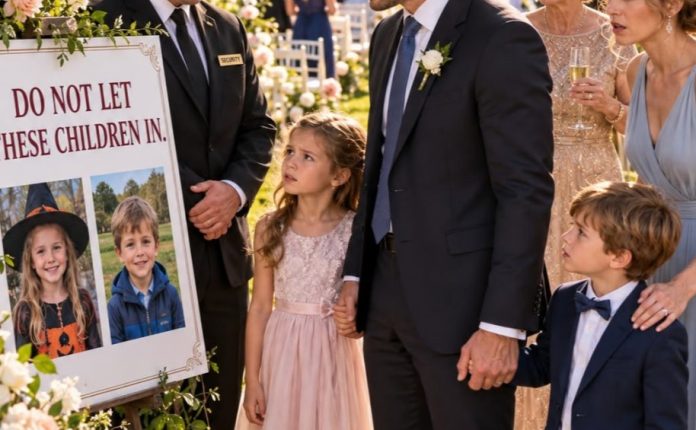
I left the door only partly open.
Behind me, I could hear the television in the living room. Emily had put on something familiar for the children, a program they could watch without wondering which adults were about to start arguing.
Ava stared at the coffee in my hand.
For some reason, that seemed to offend her as much as my silence.
“Are you seriously just standing there?”
“What do you want?”
“I asked what you told Richard.”
“I didn’t contact him. He called me.”
She shook her head quickly.
“No. Mark said his father spoke to you.”
“He did.”
“And then everything fell apart.”
“Everything had already fallen apart when he called.”
Her fingers tightened around the skirt of her dress.
The fabric was too heavy for the narrow step. A piece of lace had caught against the rough edge of the concrete, and she tugged it free without looking down.
I had seen Ava angry before.
Usually there was a performance to it. A wounded expression. A raised voice pitched for whoever might be listening. An explanation that made her sound patient and everyone else difficult.
This time, she seemed to be searching for the correct version of events while standing in the middle of them.
“What exactly did he say?” she demanded.
“That Mark had left.”
“Because of you.”
“Because of the sign.”
She looked away.
There it was: the moment when we could have had a different conversation.
She could have said she had done something ugly and didn’t know how to repair it.
She could have asked whether the children were all right.
Instead, she said, “You weren’t supposed to take it personally.”
I looked at her for a long time.
“You printed their faces.”
“It was about the ceremony.”
“You printed their faces,” I repeated.
Her mouth tightened.
“You always do this.”
“Do what?”
“Act like everything you do is so generous, and everybody else has to be grateful forever.”
I shifted the mug into my other hand.
“I paid because Carol asked for help.”
“You made all the bookings.”
“Because I was paying the vendors.”
“You kept checking things.”
“Because those were my contracts.”
She gave a short, angry laugh.
“Exactly. Your contracts. Your money. Your decisions.”
“Ava, you chose the vineyard. You chose the menu. You chose the flowers.”
“You still acted like the whole wedding belonged to you.”
I thought of the rehearsal dinner, of lowering my eyes while she thanked everyone except me.
“If that’s what you believed,” I said, “why did you keep asking me for more?”
She didn’t answer.
A car passed slowly on the street. Somewhere nearby, somebody was mowing a lawn.
It was strange how ordinary the neighborhood remained while a woman in a wedding dress accused me of destroying the wedding from which she had excluded my children.
“I wanted you to understand,” she said at last.
“Understand what?”
“That you don’t get to control everything just because you pay.”
I heard movement behind me.
Emily had come into the hallway.
Lucy was beside her, one hand resting against her mother’s sleeve.
Ava noticed them.
Her expression changed, but only briefly.
“Emily,” she said. “Tell him this has gotten out of hand.”
Emily looked at the dress, then at Ava’s face.
“Lucy and Evan were invited.”
“I know.”
“They got dressed. They drove there with us. They stood in front of their photographs while a stranger explained they weren’t allowed inside.”
Ava’s eyes moved toward Lucy.
Lucy looked down.
“You don’t need to say it like that,” Ava muttered.
“How should I say it?”
“I’m having the worst day of my life.”
Emily’s voice stayed low.
“Then you understand how much a day can hurt.”
Ava turned back to me.
“Mark’s relatives are talking about me like I’m some awful person.”
I waited.
“People were leaving before I even knew what he’d done. My friends were asking questions. Mom couldn’t get anyone to stop.”
Still, nothing about the children.
Only the room emptying. Only the people watching.
“What do you want me to do?” I asked.
She took a breath, relieved to hear something that sounded practical.
“Call Richard.”
“And say?”
“That we misunderstood. That it was handled badly, but we’re fine.”
“We’re not fine.”
“Daniel.”
“I won’t tell him that.”
“You don’t have to make a big speech. Just explain that you left because you were upset.”
“I left because my children weren’t welcome.”
“Say you reacted too quickly.”
“No.”
The word stopped her.
For a moment, she looked almost confused, as if I had spoken in a language she knew but had never heard from me.
I put my coffee on the small table by the door.
“Evan asked whether he’d done something wrong.”
Her eyes flickered.
“He’s six, Ava. He thought an adult had put his picture on that gate because he deserved to be punished.”
“I didn’t mean—”
“You don’t get to choose what he felt afterward.”
She pressed her lips together.
I wanted an apology. I admit that.
Not for me.
I wanted her to look at Lucy, standing quietly beside her mother, and understand that the girl could hear every word.
Ava glanced at her.
Then she said, “You’re turning them against me.”
Emily put her arm around Lucy.
“No one needed to do that.”
Ava’s face hardened again.
“Fine. Be like this.”
I picked up my cup.
“Go home.”
“Mom is coming.”
“All right.”
“She won’t let you get away with it.”
“Get away with what?”
But Ava was already turning toward the driveway.
I watched her gather the skirt again, watched her reach the car without once looking back at the child in our hallway.
Then I shut the door.
Lucy spoke before either of us did.
“Was she mad because we went home?”
Emily crouched.
“She’s upset about things adults need to deal with.”
“But she said we misunderstood.”
I leaned against the wall, trying to find an answer that was honest without asking my daughter to carry the whole truth.
“We understood enough,” I said. “You were uncomfortable there. We brought you home.”
Lucy considered that.
“Can I change now?”
She was still wearing the blue dress.
The question almost undid me.
“Of course.”
Emily took her upstairs.
I stood in the hall for another minute, looking at the place Ava’s shoes had left a faint mark on the step.
Less than half an hour later, Carol arrived.
I heard her car before I saw it.
She came up the path briskly, her formal shoes clicking against the concrete. I had opened the door by the time she reached it, hoping to keep the conversation outside.
She stepped past me.
“Where is Ava?”
“Not here.”
“She said she came.”
“She did. She left.”
Carol moved toward the kitchen as if she were entering my father’s house rather than mine.
I followed.
Emily was at the counter. The children were upstairs.
“Keep your voice down,” Emily said.
Carol ignored her.
“Do you understand what’s happened?”
“Yes.”
“The ceremony is cancelled.”
“I know.”
“Guests have driven hours. Some of them booked hotels. Ava can barely speak.”
“She spoke quite clearly here.”
Carol turned on me.
“Don’t be cruel.”
I stopped beside the table.
Cruel.
The word had traveled remarkably far from the gate.
“Would you like coffee?” I asked.
It wasn’t a joke. I needed to put something ordinary between us before I answered her.
“No, Daniel. I would like you to act like a member of this family.”
Emily set down the cloth she was holding.
“He did. For six months.”
Carol gave her a sharp look.
“This is between Daniel and me.”
“It involved my children.”
For a moment, Carol seemed ready to argue with that too.
Then she faced me again.
“You could have stayed and spoken to Ava privately.”
“The guard wouldn’t let the children in.”
“You could have left them with Emily.”
I looked at my wife.
She was staring at Carol in disbelief.
“Outside the gate?” I asked.
“They could have gone somewhere for the ceremony.”
“You wanted me to walk past a sign excluding my kids and enjoy the wedding?”
“I wanted you not to turn a difficult moment into a disaster.”
I pulled out a chair and sat down.
Carol remained standing.
It seemed important to her that I should have to look up at her.
“You’re leaving out the part where I didn’t do anything,” I said.
“You left.”
“Yes.”
“People noticed.”
“Yes.”
“Then somebody sent photographs around.”
“That wasn’t me.”
“You’re telling me you had nothing to do with Mark walking out?”
“I’m telling you I drove home with my family.”
She looked toward Emily, hoping perhaps to find uncertainty.
Emily didn’t give her any.
“The children’s names were on our invitation,” she said. “You discussed their meals with us.”
“Ava changed her mind.”
“Then somebody should have told us.”
“There was so much going on.”
“Enough time to download photographs and print a sign.”
Carol’s eyes dropped to the table.
That was the first point she couldn’t move around easily.
I let the silence sit.
Then she said, “I told her it was too much.”
I looked up.
“When?”
“It doesn’t matter.”
“It matters.”
“She was upset. She felt you’d been making her ask permission for everything.”
“For expenses outside the budget.”
“She’s the bride.”
“And I’m the person whose name was on the bills.”
Carol drew herself straighter.
“There it is. Money.”
“No. The sign is about my children. The money is about how you persuaded me to accept all of this.”
“We didn’t persuade you. You offered.”
“After you came here crying.”
Her expression closed.
I could see how the conversation would go if I let it.
We would debate every word from six months earlier. She would remember the parts that made her helpless and forget the parts that made me responsible. Eventually I would become tired, and she would call that agreement.
I had done it before.
I wasn’t doing it that afternoon.
“I’m not discussing the gift,” I said. “What I paid, I paid. But I’m done being the person you come to when there’s another expense.”
Carol stared at me.
“What is that supposed to mean?”
“It means there won’t be another one.”
“Daniel.”
“No more bills. No more emergencies that become mine because you’re upset.”
“We’re family.”
“I know.”
“Your father asked you to look after us.”
Emily went still.
I felt it in my chest, the familiar hook.
For three years, that sentence had been able to pull me almost anywhere.
I looked at Carol’s pearls, at the careful arrangement of her hair, at the hands she had used to hold a champagne glass while explaining why my son should stay outside.
“He didn’t ask me to teach my children that they have to accept this.”
Carol’s face changed.
Not dramatically.
Just enough.
She had expected grief to settle the argument again.
“Your father cared about keeping people together,” she said.
“So do I.”
“Then help Ava.”
“I can’t repair her relationship by lying about what happened.”
“You could at least try.”
“Not that way.”
Carol sat down at last.
For a second, she looked older than she had at the vineyard.
“Ava has lost everything.”
“She’s lost a wedding.”
“And Mark.”
“That was his choice.”
“Because of what he heard.”
“Because of what she did.”
She rubbed a finger along the edge of her handbag.
The kitchen clock clicked.
I had heard that clock every day for years. During that conversation, each sound seemed unusually distinct.
Finally, Carol looked at me.
“We’ve relied on you.”
“I know.”
“You’re making that sound shameful.”
“Relying on someone isn’t shameful. Treating them badly and expecting them to keep helping is different.”
Her eyes filled, but the tears never fell.
“Fine.”
She stood.
“Remember this conversation when Ava asks why you abandoned her.”
I stood too.
“I’ll remember it when Evan asks why I brought him home.”
Carol had no answer.
She walked out, closing the door hard enough to shake the small picture hanging beside it.
I straightened the frame after she left.
It was a photograph of the four of us at the beach.
I kept my fingers on its edge longer than necessary.
Emily came into the hallway.
“You all right?”
“I don’t know.”
She stood beside me.
“That’s a fair answer.”
I looked toward the stairs.
“How much did they hear?”
“Not much. I checked on them.”
“I should have kept her outside.”
“We’ll handle the next thing differently.”
The next thing.
Neither of us believed there wouldn’t be one.
For the rest of the afternoon, we tried to give the children something that belonged to them.
We made lunch late. Evan asked if he could put cheese in his sandwich himself. Lucy wanted the television turned off while we ate.
We let small decisions be small again.
I resisted checking my phone every few minutes.
There were messages from acquaintances asking whether we were okay, and one from a relative who wrote that she had heard something awful happened.
I answered only the question I could answer honestly.
We were home.
The children were safe.
I didn’t send photographs of the sign. I didn’t write an explanation for everyone who might be curious.
I wanted the day to stop moving through other people’s hands.
At bedtime, Evan asked if weddings could happen without the bride.
I sat beside him.
“No.”
“What about without the man?”
“No, not those weddings.”
He folded the corner of his blanket.
“Then nobody got cake?”
“I’m not sure.”
He looked troubled by that.
Children can hold a large hurt and a small practical question in the same hand. I was grateful for the practical question.
Lucy asked whether she should put her dress in the donation bag.
Emily glanced at me across the hall.
“You don’t have to decide tonight,” she told her.
“I don’t want to wear it to another wedding.”
“Then you don’t have to.”
After their lights were out, I went downstairs.
My phone vibrated on the counter.
An unfamiliar number.
There was a photograph attached.
Me at the vineyard gate.
My body angled toward the sign, my expression caught in the moment before I had managed to control it.
Underneath, someone had written that people would soon learn what kind of person I really was.
I sat down.
The picture had been taken from inside the entrance. It showed exactly what Carol had insisted nobody should make a scene about.
I didn’t know who had sent it.
I suspected Ava, but suspicion wasn’t proof, and I was beginning to understand how badly I needed to distinguish the two.
Emily read it over my shoulder.
“Save it.”
“I already am.”
“Don’t answer.”
“I won’t.”
The phone rang a few minutes later.
Richard again.
I braced myself for more news from the vineyard.
Instead, he asked whether we could meet privately the next afternoon.
“What about?” I said.
“The wedding payments.”
I looked at the phone as if his meaning might appear on the screen.
“They’re settled.”
“Some of them are. There are documents Mark thinks you should see.”
“What documents?”
Richard paused.
“I’d rather explain when we’re sitting down.”
That night, I slept badly.
Not because I expected Ava to appear again.
Because I had been certain of one thing all day: I had paid what I agreed to pay, and the worst they could do with that gift was behave badly afterward.
Richard’s call suggested there might be something beyond the humiliation.
Something I hadn’t yet thought to check.
The café he chose was near the edge of town, a place with wooden tables and a steady smell of roasted coffee.
He was already seated when I arrived.
Richard stood and shook my hand.
He looked tired.
Not angry in the obvious way. Not flushed or loud. Just a man whose son had come very close to a life he no longer trusted.
“How are Lucy and Evan?” he asked.
I hadn’t expected that to be his first question.
“They’re trying to understand.”
“I’m sorry.”
I nodded.
He waited until I sat down before placing a folder between us.
“Mark was collecting his things,” he said. “He found these in Ava’s wedding binder.”
I looked at the folder.
“What are they?”
“Copies of revised orders. Payment records. Some correspondence.”
“Revised how?”
“Additional catering. Different wine. Musicians.”
I opened the folder.
The first page was an order I recognized in format but not in amount.
The second bore my name.
I stopped turning pages.
“I didn’t approve this.”
Richard nodded once.
“That’s what Mark thought.”
The café’s espresso machine hissed behind us.
I lowered the paper to the table.
“I told her anything beyond the agreed package would be hers to cover.”
“There are several documents.”
I looked through them more carefully.
A signature appeared near the bottom of one page.
Mine, at first glance.
Not mine, when I looked again.
“How did she send these?”
“We don’t have everything yet. One invoice went to her address this morning, but your name is on it.”
I read the amount twice.
Twelve thousand dollars in additions.
I thought of Ava on my doorstep saying that I had ruined her life.
While she was demanding I fix her reputation, she had left my name attached to expenses I had never authorized.
Richard folded his hands.
“I didn’t want you finding out from a collection notice.”
“Thank you.”
My voice sounded strange to me.
I was angry, but the anger had lost its heat. It felt more like suddenly seeing the depth of water I had been standing in.
“Did Mark know?”
“No.”
“Are you certain?”
Richard met my eyes.
“He brought the papers to me because he didn’t understand why your name was on changes Ava had described as her own arrangements.”
I nodded slowly.
Richard didn’t ask me to forgive anyone.
He didn’t tell me that weddings made people irrational.
He let me read.
When I reached the last page, I put the papers back in order.
“I need to check my records.”
“Of course.”
“And the vendors.”
“Yes.”
He leaned back.
“If you need us to clarify what happened at the venue, we will.”
“That may matter.”
“It will matter,” he said.
I left the café with copies in a folder and an unpleasant new certainty.
This was no longer only about an insult at a wedding.
At home, I opened my laptop before taking off my jacket.
My legitimate invoices were exactly where I had left them.
Paid.
Confirmed.
Finished.
Then I opened the newest message from the venue.
Final balance outstanding.
My name appeared in the subject line.
Attached was a revised agreement.
Emily came into the room as I enlarged the signature.
“What is it?”
I turned the screen toward her.
She leaned closer.
“Did you sign that?”
“No.”
We stood looking at it together.
The date had changed.
The total had changed.
Someone had adjusted my initials beside a paragraph I had never approved.
At the bottom, the signature was close enough that a busy person might accept it.
I knew the shape of my own handwriting.
I knew where my pen hesitated.
And I knew, with a certainty that made my stomach settle rather than turn, that somebody had signed my name while expecting me to pay quietly afterward.
END PART 2