Emily remained beside the desk while I opened the original agreement.
I placed the two documents next to each other on the screen.
The first was familiar.
I remembered the evening I had signed it. Evan had been building something on the floor, and Emily had asked whether the deposit was refundable if the date changed.
I had read the paragraph before answering.
The revised document carried none of that memory.
Just my name, made to look as though I had been there.
“Could someone have reused the signature?” Emily asked.
“Something like that.”
“Then we need to establish exactly what happened.”
I appreciated the way she said we.
Ava and Carol had spent a full day insisting that I was making things difficult for the family. Emily made the problem smaller and more manageable simply by standing beside me.
She pulled out the second chair.
“Start with what you actually approved.”
I opened the emails.
We worked through them in order.
The initial venue agreement. The meal package. The photographer. The flowers. Each payment confirmation attached to an amount we recognized.
Then the messages about upgrades.
Ava asking for imported wine.
My reply explaining that she would need to cover the difference.
Carol’s request that I stop making small changes difficult.
Ava’s acknowledgment about the seating arrangement.
There was no authorization for the revised charges.
I knew that already, but knowing wasn’t the same as laying it out where somebody else could follow it.
We printed the original invoices.
I saved the new email and its attachment.
I copied the messages without trimming them into little pieces that made me sound better. If somebody was going to review this, I wanted the whole conversation there.
Emily looked at the stack growing beside the printer.
“This is a lot.”
“It was a lot before.”
She nodded.
We had just never put all of it on one table.
For months, the requests had arrived separately. One bill, one call, one emotional explanation at a time.
Together, they showed the amount of room I had allowed Carol and Ava to occupy in our lives.
The children came downstairs while we were still working.
Lucy paused at the doorway.
“Are those wedding things?”
I put a page facedown.
“Some of them.”
“Are we in trouble?”
“No.”
She glanced at Emily.
“Then why are you working on them?”
Emily pushed her chair back.
“Someone made a mistake with Dad’s paperwork. We’re checking it.”
It was enough truth for that moment.
Lucy nodded and asked for a snack.
Evan followed her, carrying the toy he had been repairing.
He climbed onto the chair at the end of the desk and watched the printer.
“Does it know all the words?”
“It gets them from the computer,” I told him.
“Can it print the wrong words?”
“Yes.”
He considered that.
“Then you have to check.”
I smiled despite myself.
“Yes. You have to check.”
After they returned to the kitchen with Emily, I looked at the signature again.
Ava had been so certain I would solve whatever happened.
She hadn’t even been careful enough to consider that I might stop and read.
I called the venue.
Elise, the manager, answered after someone transferred me.
Her voice carried the exhausted courtesy of a person whose weekend had gone very badly.
“Mr. Harris. I was about to follow up on the balance.”
“I received the invoice.”
“Thank you. I’m sorry it came after such an unfortunate day.”
“I need to discuss the authorization attached to it.”
There was a short pause.
“The revised agreement?”
“Yes. I didn’t sign that.”
She didn’t answer immediately.
I heard movement, perhaps papers shifting.
“The bride sent it through.”
“I understand. I’d like to come in and review what you received.”
“Certainly.”
We agreed on a time that afternoon.
Before leaving, I gathered the originals into one folder and the disputed documents into another.
Emily watched me place both in my bag.
“Keep this practical,” she said.
“I will.”
“I know you’re angry.”
“I’m trying not to let that decide anything.”
She touched my arm.
“That’s all I mean.”
The vineyard looked different without the wedding guests.
A few staff members were carrying equipment through a side entrance. The white flowers had been removed from the gate.
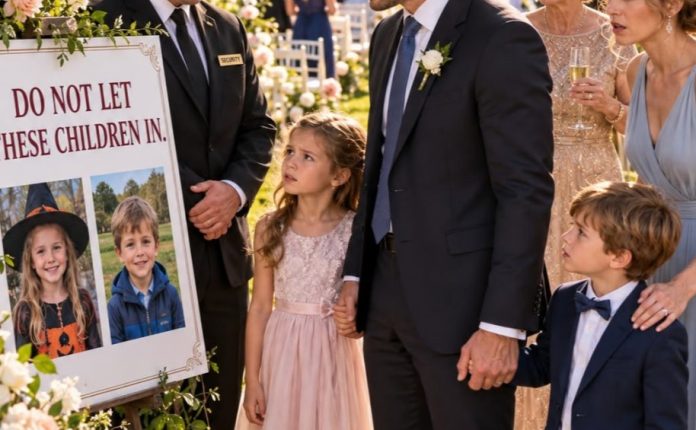
The sign was gone too.
I stopped briefly where we had stood.
There was still a pale rectangle of tape residue on the metal.
It shouldn’t have mattered.
A little adhesive on a gate.
But it confirmed something my mind had kept trying to soften since the day before.
We hadn’t imagined it.
We hadn’t misunderstood some vague remark.
It had been there.
Inside, Elise met me near the reception office.
She apologized before we sat down.
“I didn’t know about the entrance instructions until afterward.”
“Today I’m here about the contract.”
She nodded, relieved perhaps that there was one problem we could discuss at a time.
Her office was small. A calendar hung beside a cabinet, and a half-finished cup of tea stood near her keyboard.
I laid the original agreement on her desk.
“This is what I signed.”
She read the first page, then turned to the total.
“Yes.”
“And these are the payment confirmations.”
She checked them against her screen.
“Those payments are all recorded.”
“Now please show me the revised agreement.”
She opened the file.
I leaned closer.
There it was again.
My name.
The altered amount.
The signature somebody had trusted because it looked sufficiently like something they had seen before.
“The bride told us you were covering the changes,” Elise said.
“Did you speak to me?”
“No.”
“Did I send this from the address you had on file?”
She looked at the screen.
“It was forwarded with the bride’s message.”
“What did her message say?”
Elise read it silently, then looked up.
“That you had approved the upgrades and returned the signed amendment.”
I sat back.
“I didn’t.”
Her face had gone pale.
“I’m sorry.”
“I need copies of the correspondence and everything attached to it.”
“Yes.”
“And I need the balance marked as disputed while this is reviewed.”
She hesitated.
Not because she seemed to doubt me, but because the money had become her problem too.
“I’ll refer it to our accounts department.”
“Please include that I’m disputing the authorization, not asking for a favor.”
She nodded.
The distinction mattered to me.
I wasn’t asking the venue to forgive a bill I had agreed to pay.
I was telling them the agreement wasn’t mine.
She printed the correspondence.
While the printer worked, she looked from the revised signature to the original.
“I can see a difference,” she said.
“So can I.”
“The shape here?”
She indicated the beginning of my name.
“Yes.”
I didn’t feel triumphant.
A tiny variation in a line had become the thing standing between my family and twelve thousand dollars of unwanted obligations.
There was nothing satisfying about that.
Elise handed me the papers.
“We should have confirmed the changes directly.”
“I wish you had.”
“So do I.”
I thanked her for cooperating.
We walked back toward the entrance together.
Near the gate, she stopped.
“For what it’s worth, I’m sorry about your children.”
I looked at the empty patch where the sign had been.
“Thank you.”
She didn’t add an excuse.
I appreciated that more than she probably knew.
By the time I got home, the light had faded.
Emily was clearing the table. The dishwasher hummed beneath the counter.
I set the folder down.
“How did it go?”
“They accepted that I’m disputing it. I have the emails.”
“And?”
“Ava told them I’d approved everything.”
Emily closed her eyes briefly.
“Of course.”
I opened the folder again.
The messages were more difficult to read than the signature.
A signature could be lifted, altered, copied.
The email beside it showed the intention.
Ava had told a vendor to trust that I would pay. She had supplied something meant to end any questions.
I remembered her standing in the doorway asking me to call Richard and describe the sign as a misunderstanding.
It was the same request in a different form.
Make the words fit what she wanted.
Let the consequences belong to somebody else.
My phone vibrated while I was putting the pages away.
Ava.
This time, she used her own number.
“Mark’s family is calling me dishonest. You need to stop this.”
I showed Emily.
She read it and looked at me.
“What are you going to say?”
I considered not answering.
Then I typed a single sentence.
“I did not authorize the additional orders or sign the revised agreement.”
Her reply came quickly.
“You’re making me sound like a criminal.”
I wrote, “I’m describing what I did and didn’t agree to.”
Then another message.
“You won’t actually take this anywhere.”
I stared at the words.
A final message followed.
“We’re family.”
I put the phone down.
For most of my adult life, that sentence had meant something worth protecting.
At that moment, it sounded like a prediction.
She believed I would stop.
Not because she had apologized.
Not because the records were wrong.
Because she had successfully counted on my silence before.
Emily sat across from me.
“Call Maya.”
“I will in the morning.”
Maya had helped me with legal matters before. She was patient, precise, and uninterested in dramatic descriptions when a document would do.
I trusted that.
I didn’t need someone to tell me Ava was terrible.
I needed someone to tell me what happened next.
Before bed, I checked the photograph from the unknown number again.
The threat was vague, but the image was useful in a way the sender hadn’t intended.
It showed the sign behind me.
It showed the guard.
It showed the children standing close enough to see themselves.
I saved it with the other records.
The next morning, Maya’s assistant offered an appointment at nine.
I was there a few minutes early.
The waiting room was quiet. Somebody had straightened the magazines into neat rows.
I sat holding the folder on my knees.
For the first time since the wedding, I had a chance to ask myself what I wanted.
I didn’t want Ava arrested as some grand final scene.
I didn’t want Carol standing in front of relatives while I read out every dollar I had spent.
I didn’t want to be the subject of another photograph passed between people who barely knew me.
I wanted my name removed from orders I hadn’t placed.
I wanted the threats to stop.
I wanted my children to know that when something ugly happened to them, their parents would deal with it rather than explain why they should accept it.
Maya listened without interrupting.
I began with the wedding funding because she needed to understand how Ava had obtained the original paperwork.
Then the sign.
Then the visits.
Then Richard’s folder and the invoice.
Maya sorted the pages into groups while I spoke.
When I finished, she asked several questions.
Had I authorized anyone to sign on my behalf?
No.
Had I agreed orally to the upgrades?
No.
Had I ever sent Ava a version of my signature for this purpose?
No.
Was there correspondence showing that the original expenses were paid and the new ones were outside my commitment?
Yes.
She went through those messages carefully.
“This needs to be dealt with through the vendors first,” she said. “They need clear notice that you dispute these authorizations.”
“Elise knows.”
“We’ll put it in writing.”
I nodded.
“And the messages from Ava?”
“Save them. Don’t argue with her about legal conclusions.”
“She keeps saying I’m making her look dishonest.”
“You don’t need to persuade her. You need to preserve the record.”
That sentence helped.
I had spent years believing that if I could explain things properly, Carol and Ava would understand why I had reached a limit.
Maya was telling me understanding wasn’t the immediate task.
Accuracy was.
“Would you make a report?” I asked.
She looked at the revised agreement.
“I think documenting the unauthorized use of your name is sensible.”
“I’m not trying to destroy her.”
“I understand.”
“I want it to stop.”
“Then we should make it clear that there are limits to what can be done in your name.”
We discussed the next steps.
Maya would contact the vendors, obtain the relevant records, and dispute the unauthorized amounts.
A report would create a formal record of the documents and the messages.
She explained that making a report didn’t give me control over every decision that might follow.
I listened.
That mattered too.
I couldn’t spend a day insisting I wasn’t responsible for Mark’s choices and then pretend every institution involved would simply carry out mine.
All I could do was provide the truth.
I signed the papers Maya actually put in front of me.
I read them first.
When I left, the folder was thinner because she had retained copies, but I felt less burdened.
There was now someone between Ava’s demands and my response.
Someone who didn’t have a promise to my father sitting on her shoulder.
Over the next several days, Maya contacted the vendors.
The records showed more than a single revised agreement.
There were upgrade requests presented as though I had approved them.
There were messages written in a way intended to make vendors believe they were receiving my authorization.
The new catering arrangements, the wine, the musicians.
Each one had seemed harmless when Ava described wanting it.
Together, the records showed that wanting had become ordering, and ordering had become assigning the cost to me.
Maya sent me updates in careful language.
She didn’t exaggerate.
She didn’t call the situation a scheme when the documents could speak for themselves.
I was grateful for that restraint.
It let me separate what I knew from what I feared.
Meanwhile, the story at the vineyard kept moving without my help.
I learned that the photographs of the sign had reached Mark’s family before he confronted Ava.
Several guests had seen the paper in person.
People who had been standing near the entrance remembered Carol explaining it.
I didn’t have to invent witnesses or ask anyone to choose sides.
The facts had been public from the moment Ava taped them to a gate.
That had been her decision.
Not mine.
One evening, Richard called again.
His voice was quieter than usual.
“Ava came over today.”
I sat down.
“To see Mark?”
“Yes.”
“How did that go?”
“Not well.”
I waited.
“She said she’d been made to look bad. Said everyone had accepted your version without hearing hers.”
“What did Mark say?”
“He asked about the documents.”
There was a short silence.
I heard Richard breathe out.
“She said she never expected you to inspect the invoices.”
I closed my eyes.
He didn’t need to add much.
Ava had gone there to deny being responsible and, in the course of defending herself, admitted she had relied on me not looking.
“Was Carol there?” I asked.
“No.”
“Did Ava understand what she’d said?”
“Eventually.”
“And Mark?”
“He told her he couldn’t build a marriage around that.”
I looked through the kitchen window.
Evan was outside with Emily, helping move small pots away from the edge of the patio. Lucy was explaining where she thought each one should go.
They were busy with something that made sense.
A pot needed a place.
A plant needed light.
Nobody was asking them to carry an adult’s disappointment.
“Is he all right?” I asked.
Richard paused.
“He will be.”
“I’m sorry he’s dealing with this.”
“So am I. But I’m grateful he learned it before the ceremony.”
We ended the call.
I told Emily later, after the children were asleep.
She sat on the edge of the sofa.
“She admitted it?”
“Not in the way Maya would want written down. But she told them she expected me not to check.”
Emily rubbed her forehead.
“Every time I think she’s finally understood, it’s something else.”
“I don’t think understanding is what she’s after.”
“What is?”
“Getting the old arrangement back.”
Emily looked at me.
The old arrangement.
Ava made a demand. Carol made it emotional. I paid, explained, forgave, or stayed quiet.
Everyone moved forward, carrying only what they preferred to remember.
The records had interrupted that pattern.
So had the children.
Once Evan asked whether he had done something wrong, the cost of keeping peace was no longer something I could pretend belonged only to me.
A few days later, Carol called.
I let the phone ring twice.
Then I answered.
Her voice was tired.
“Ava is talking about suing you.”
I looked at the wall.
“For what?”
“She says you’ve damaged her reputation.”
“I haven’t made a public statement.”
“She thinks you’ve been telling people things.”
“I’ve told my lawyer what happened. The vendors have their own records. Mark saw the sign.”
“She’s very upset.”
“I know.”
Carol was silent for a moment.
It was the first time she hadn’t immediately added that being upset excused everything.
“She says you ruined her life,” Carol said.
I sat down at the table.
“Carol, she asked me to lie about the children. Then I discovered documents I didn’t sign. I’m not going to pretend those things didn’t happen.”
“You could have kept it inside the family.”
“Your daughter put it on a gate.”
She didn’t answer.
“And the vendors aren’t family. They’re businesses expecting payment.”
“I’m trying to calm her down.”
“Then don’t promise her I’ll pay.”
The sentence came out more gently than I expected.
Perhaps because I could finally hear the exhaustion in Carol’s voice without making it my assignment.
After a while, she said, “You sound like your father.”
I stared at the cup in front of me.
She had used him to ask for the wedding.
She had used him to argue that I should repair it.
Now she was invoking him because I wouldn’t.
“What do you mean?”
“He could be so certain once he decided something.”
I thought about him.
Not as the last conversation beside his bed.
As the man who had taught me to check a tire before a long drive, who kept spare screws in jars, who could be quiet for an hour and then say the one thing that clarified a problem.
“He wasn’t always wrong,” I said.
Carol gave a brittle sigh.
“Walking away doesn’t fix a family.”
“No.”
She seemed surprised by the agreement.
I continued.
“But pretending nothing happened doesn’t fix one either.”
There was a long pause.
I pictured her at her kitchen table, perhaps holding her phone the way she had held the champagne glass.
“You’ve made your decision,” she said.
“I’ve made this one.”
She didn’t ask about Lucy or Evan.
I noticed.
I didn’t point it out.
We ended the call without shouting.
Afterward, I sat for a while, letting myself feel the sadness I had been postponing while I handled paperwork.
I had wanted Carol to hear me.
Even then.
Even after everything.
There is no satisfying instant when that want disappears. You don’t draw a boundary and suddenly become a person who no longer wishes his family had behaved differently.
I still wished it.
I just wasn’t going to pay for the wish again.
That night, before switching off the kitchen light, I put the folder in a drawer.
Not hidden.
Just somewhere it no longer occupied the center of our table.
Then I went upstairs to check on the children.
Evan’s tie was still lying on his dresser.
I picked it up, folded it, and put it away.
For the first time, I didn’t wonder whether I should call Carol back.
END PART 3