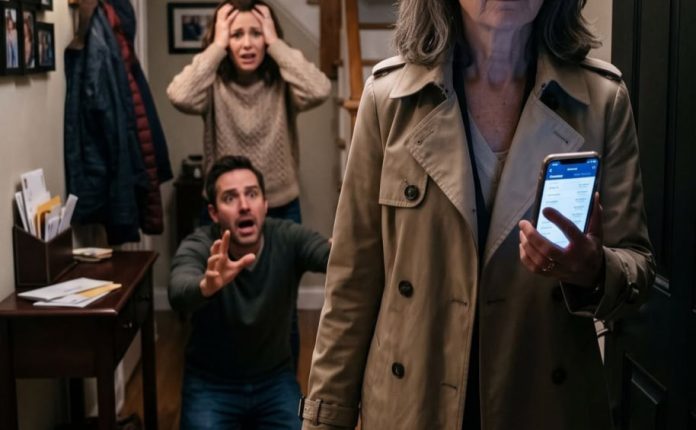
“You told Noah this wasn’t our family house anymore.”
Linda stared at me.
“That’s what all this is about?”
“No.”
I let the silence hold for a moment.
“This is about what you did to him. What you did to Eli. What you told the bank. What you tried to do to a house you didn’t own.”
“I was upset last night.”
“You weren’t too upset to smile at your guests.”
Her eyes filled.
I knew those tears.
Sometimes they were genuine.
Sometimes they were useful.
Often they were both.
I had spent years believing I had to determine which kind they were before I was allowed to keep a boundary.
That morning, I realized it didn’t matter.
She could be sincerely frightened and still be responsible.
She could feel hurt and still have hurt my children.
Her tears did not change the deed.
They did not change the date on the loan.
They did not change what the boys heard.
“You’re going to destroy this family,” she said.
I glanced toward Jason.
He looked down.
“No,” I said. “I’m going to stop asking my children to survive it politely.”
Mr. Keating stood a few feet away.
He did not praise me or urge me on.
He remained available.
That was more useful.
I looked at the sheriff.
“I want her and Jason off the property.”
Linda’s head jerked back.
“Claire.”
“They can collect personal clothing and whatever they need immediately. But they’re leaving.”
The sheriff glanced toward Mr. Keating.
They spoke briefly about the belongings, the investigation, and how to make the departure orderly.
I heard enough to understand that they were not promising every disputed possession or bank matter would be settled before breakfast.
That was fine.
I wasn’t asking for a magic ending.
I was asking for a door my mother could not continue holding against my children.
“Fifteen minutes,” I said.
Mom looked toward the house.
“You can’t mean that.”
“I do.”
“My things are inside.”
“Your personal clothes. Your medication. Your bag.”
“You’re treating me like a stranger.”
I almost told her that a stranger would have been kinder to Noah.
But I didn’t need the last sharp sentence.
I needed the decision to remain clear.
“You’ll be accompanied,” I said.
The deputy moved beside her.
Linda’s face changed again.
Not the dramatic collapse people imagine when consequences finally arrive.
Something smaller.
She looked as though she had reached for a familiar railing and found it missing.
“Robert,” she said.
Mr. Keating met her eyes.
“Claire owns the house.”
“I know you all keep saying that.”
“Because it determines who can make this decision.”
She looked at the sheriff.
He did not contradict him.
Then she turned toward Jason.
“Come help me.”
He hesitated.
For all his confidence the night before, he seemed unsure what helping her might now imply.
“Your clothes too,” I told him.
“I don’t live here full time.”
“Then you should have less to collect.”
His mouth tightened.
For a second, I saw the remark forming.
Something about my attitude.
Something about what Dad would think.
Then he looked toward the investigator and swallowed it.
He followed Linda inside.
A deputy went with them.
The front door stayed open.
I could hear Linda moving through the hall.
A cupboard closed harder than necessary.
Her voice carried down the stairs.
“Where is my case?”
Jason answered.
I did not listen closely.
Instead, I walked to the car and opened my door.
Noah leaned forward.
“Is she coming over here?”
“No.”
“Are we leaving again?”
“No.”
Eli sat upright.
“Are we getting our bags?”
“Yes.”
“And the picture?”
“Yes.”
I reached back and touched both their knees.
“I need a few more minutes.”
Noah looked toward the porch.
“Is Grandma crying?”
“Yes.”
“Did we make her?”
The question was so immediate that I felt anger flare again.
Not at him.
At everything that had taught him to connect an adult’s unhappiness to his own innocence.
“No,” I said.
I turned in my seat so he could see my whole face.
“You did not cause any of this.”
“But if we hadn’t brought the turtle—”
“The turtle did not make Grandma borrow money or say those things. It did not make that woman touch you.”
His eyes dropped.
I waited.
“You told the truth,” I said. “That was all.”
He nodded slowly.
Eli asked whether he could have his water.
I handed it to him.
Then I stepped out and closed the door.
Mr. Keating came toward me.
“We’ll inventory what remains,” he said. “And we’ll address the lender in writing.”
I looked at the binder.
“Will you go through every page with me?”
“Yes.”
“Slowly.”
“As slowly as you need.”
I let out a breath.
There was shame in admitting how little I had understood.
I felt it.
But shame had already kept too many questions unasked.
I wasn’t going to let it become another advantage for Linda.
“I signed things after Dad died,” I said. “I need to know what each one meant.”
“We’ll review those too.”
“Even if it takes hours.”
“It can take hours.”
I looked back toward the house.
“She made it sound like I wasn’t capable.”
Mr. Keating’s expression softened.
“Not being familiar with estate documents is not the same as being incapable.”
I nodded.
“Your father trusted you with this arrangement,” he added.
That was what finally made me cry.
Not loudly.
My eyes filled before I could stop them, and I looked down at the gravel.
Dad had trusted me.
Linda had spent the evening telling everyone I damaged reputations.
Jason had treated me as someone who could be pushed out for convenience.
But the pages said Dad had trusted me with something he wanted to protect.
I wiped my cheek.
“I wish he’d told me in words I couldn’t miss.”
Mr. Keating nodded.
“I understand.”
It mattered that he didn’t defend Dad against the feeling.
I could be grateful for what my father had done and still wish he had explained it more clearly.
I could love him and remember the times he tried to keep peace instead of confronting Linda.
Grief did not require making him flawless.
The deed did not erase every old hurt.
It answered one urgent question.
He had wanted us protected.
Inside, a suitcase rolled across the upstairs floor.
Linda called my name.
I did not go in.
A minute later, she appeared in the doorway wearing dark glasses.
Her robe had been replaced by pale trousers and a cardigan. She held a handbag against her side.
The change was so quick that I wondered how many mornings she had dressed while preparing a public face.
Jason followed with two bags.
The deputy remained close.
“Claire,” Mom said.
I stayed beside the car.
“You’re really doing this.”
“Yes.”
“After everything I gave you.”
I thought of answering with a list.
The dinners.
The rides.
The things she had provided.
Then the things she had demanded in exchange.
But a list would open another argument.
I would not prove that a childhood did or did not entitle her to use my property and frighten my children.
“The loan investigation is separate,” I said. “Mr. Keating will handle the property records. You can arrange the rest through him.”
“You won’t even speak to me?”
“Not about taking responsibility for something I didn’t do.”
She looked toward the car.
I moved into her line of sight.
“No.”
“I want to say goodbye.”
“Not today.”
Her lips parted.
Then pressed together.
“Those are my grandchildren.”
“And they need a quiet morning.”
Jason stepped down from the porch.
“You’re being hard.”
I looked at him.
“Last night, you suggested calling security on us.”
“That was a joke.”
“Noah didn’t hear it as one.”
He shifted the bag in his hand.
“I didn’t touch anybody.”
“You stood there.”
He glanced toward the deputies.
“I didn’t know Mom had borrowed against the house.”
“Then answer the investigator honestly.”
“That’s not what I meant.”
“I know.”
He wanted absolution for the part of the morning that frightened him.
He had not yet asked about Noah’s cheek.
He had not yet said Eli’s name.
I didn’t need to force those observations into a conversation.
I could see them.
Linda took one step toward me.
The deputy moved with her.
“Please,” she said. “I can lose everything.”
I felt the old reflex.
A tightening under my ribs.
The urge to make a plan for her, reduce the consequences, and prove I wasn’t cruel.
For years, her fear had become my assignment.
She worried about appearances; I dressed differently.
She disliked a conversation; I changed the subject.
She wanted an apology; I found words broad enough to cover something I hadn’t done.
I had mistaken that labor for loyalty.
Now the reflex was still there.
But my sons were behind me.
I could hear Eli tapping the valve cap against the turtle.
I let Linda’s fear remain hers.
“The sheriff will deal with the documents,” I said. “I won’t tell anyone they’re a misunderstanding.”
Her face hardened.
There she was again.
The woman from the patio.
“You’ll regret this.”
The sheriff stepped closer.
“Mrs. Evans, we need to leave the property now.”
Linda looked toward the neighboring house.
The woman on that porch had stopped pretending to adjust a planter.
A car slowed along the road.
I watched Mom notice both.
The audience she had counted on had become one she could not control.
She lowered her head.
The deputies escorted her down the drive.
Jason followed with the bags, turning his face away when the car passed.
I did not feel triumphant.
I felt tired in a way that reached down into old years.
The sheriff spoke to me before leaving.
The investigation would continue. The bank would need the verified title records. There could be further questions.
I gave him my contact information.
Mr. Keating confirmed that he would provide the documents.
No one told me to celebrate.
No one suggested the morning had solved everything.
But nobody asked me to restore Linda’s authority either.
The patrol cars pulled away.
The locksmith’s van was already gone.
A little after nine, the driveway was quiet.
I stayed where I was until I could hear the ocean again.
It had been there all along.
Under the voices.
Under the engines.
Under the sound of Linda telling everyone what she believed they owed her.
Now the waves sounded almost startling.
Mr. Keating gathered his binder.
“I’ll give you some time with the boys.”
“Thank you.”
“I’ll call this afternoon.”
I nodded.
Then I asked, “Did Dad say anything else?”
He looked at the house.
“About why he wanted this protected?”
“Yes.”
Mr. Keating considered how to answer.
“He talked about ordinary summers.”
I waited.
“Not a grand legacy. The boys learning to swim. You having somewhere to come without asking permission. A place that didn’t depend on anyone’s mood.”
I looked at the porch steps.
Dad had sat on the second one when Eli was learning to climb them.
He could have held him the whole way.
Instead, he kept one hand close and let him try.
I swallowed.
“That sounds like him.”
“It does.”
Mr. Keating left.
I opened the back doors.
For a moment, neither boy moved.
They had watched people come and go.
They needed to know the rules had changed before trusting the space.
“It’s okay,” I said.
Noah unbuckled first.
He helped Eli with his belt, then climbed down.
I held Eli’s hand while he stepped onto the gravel.
The turtle came with him.
They stood beside me looking at the house.
Noah’s eyes moved to the front door.
“Is Grandma coming back?”
“Not today.”
He looked up.
“Tomorrow?”
I crouched.
“Grandma won’t be staying here. And she won’t come near you without me deciding it’s safe.”
He studied my face.
Children can hear the places where adults are leaving themselves a way out.
I gave him none.
“Can she change the locks later?”
“No.”
“Why?”
“Because Grandpa made arrangements for the house. Mr. Keating found the records and explained them to everyone.”
He waited.
“The house belongs to us now,” I said. “I’ll take care of it. It’s the place Grandpa wanted you and Eli to have.”
Eli looked at the turtle.
“Can we put him by the pool?”
“Yes.”
Noah’s shoulders lowered.
It was a small movement.
It mattered.
I put an arm around each of them.
“We’re home,” I said.
Then we walked toward the porch.
I used Dad’s key.
It turned easily.
The door opened with the same slight scrape along the floor.
Inside, the house smelled of flowers, coffee, and the remains of last night’s food.
There were glasses on the dining table.
A napkin lay beneath a chair.
The party had ended without anyone making it disappear.
I was glad of that.
It meant I could see the difference between the house and what had been done inside it.
The walls had not laughed at my sons.
The porch had not rejected them.
People had.
Those people were gone.
Noah walked to the table near the stairs.
Dad’s photograph was still there.
He looked up at me.
“Can I get mine?”
“Of course.”
We went upstairs together.
Our bags remained in the back room.
Eli’s pajamas lay folded on one bed. Noah’s photograph was tucked safely inside his overnight bag.
He took it out with both hands.
For a moment, he stood in front of the window.
The ocean was visible beyond the roofs and dune grass.
“Grandpa could see the water from here,” he said.
“Yes.”
“He said it helped him know the weather.”
“It did.”
Noah carried the photograph downstairs.
I cleared the empty space beside Dad’s frame.
He set his picture there and adjusted it until both faces were visible.
Dad laughing.
Two boys holding shells.
A summer afternoon untouched by what happened afterward.
Eli put the turtle on the floor beneath the table.
“So he can see Grandpa too.”
I let it stay.
There were many things I could clean.
That wasn’t one.
I opened the curtains.
Noah followed me into the kitchen.
“Are we allowed to eat here?”
The question made me stop.
“Yes.”
“Without asking Grandma?”
“Yes.”
He looked relieved and embarrassed at once.
I pulled out a chair.
“Sit down.”
I found bread, fruit, and eggs.
Some belonged to the weekend groceries. Some had been delivered for the party.
I didn’t care which.
The boys watched while I made a simple breakfast.
Their motel toast had long since worn off.
Eli asked whether we could use Dad’s chipped blue mug for water.
He used to drink from it because Dad called it the smallest swimming pool in the house.
“Yes.”
I checked the rim.
The chip was on the handle, where it had always been.
I filled it and set it in front of him.
Noah watched.
Then he asked for the other blue mug.
We ate at the kitchen table.
No speeches.
No announcement about a new beginning.
Eli dripped egg onto his shirt.
Noah reminded him not to put the turtle near the toaster.
I listened to them argue gently about which shell in the photograph was bigger.
Those were the sounds Dad had wanted.
Ordinary summers.
Ordinary breakfasts.
A place where a child could spill something without being treated as a stain on the family.
Afterward, I washed the dishes.
Noah stood beside me with a towel.
“You don’t have to help,” I told him.
“I want to.”
I handed him a plate.
Helping was allowed.
Being responsible for everyone was not.
I would need to learn that difference with him, in a hundred small ways.
Eli fell asleep on the couch before noon.
The turtle lay beside his feet.
Noah sat on the porch with me.
The red mark on his face had faded.
I could still find it if I looked closely.
“Did Grandpa know Grandma could be mean?” he asked.
I took time before answering.
“He knew she sometimes made choices that hurt people.”
“Why did he live with her?”
That question had more years inside it than Noah could know.
“Adults can love someone and still have problems with how they behave,” I said. “Sometimes they don’t handle those problems as well as they should.”
“Did he handle this one?”
I looked at the front door.
“He tried to protect this place for us.”
Noah leaned against my shoulder.
“I wish he was here.”
“So do I.”
We sat without speaking.
I did not tell him that everything happened for a reason.
Dad’s death had no lesson that made it acceptable.
The night before had not been necessary so we could appreciate the morning.
My children deserved safety before anyone hurt them.
What mattered now was that I would stop negotiating it away.
Mr. Keating called that afternoon.
We arranged a time to review the papers properly.
He would document the lack of authorization to the bank and handle the title issues.
The fraud investigation belonged to the people responsible for it.
Linda’s debt would not become mine because she cried.
Her reputation would not become my children’s responsibility because she valued it.
I wrote down the appointment and put it on the refrigerator.
Then I put the motel receipt in a folder.
Not because I needed a souvenir.
Because I was going to keep records now.
I was going to read what I signed.
I was going to ask questions until I understood the answers.
There was no shame in that.
The shame belonged elsewhere.
Before dinner, Noah asked whether they could go outside.
I checked the pool gate.
I checked the latch.
Then I sat where I could see both boys.
They did not go into the water immediately.
Eli placed the turtle beside a lounge chair.
Noah touched the pool’s surface with his toes.
The evening light moved across his face.
Nobody told him he was embarrassing.
Nobody questioned whether he belonged.
After a while, he looked back at me.
“Can Eli use it first?”
“Yes.”
He carried the turtle to the shallow end.
Eli laughed when the water reached his knees.
The sound was tentative at first.
Then it grew.
I stayed in my chair with Dad’s key on the table beside me.
The house was mine in the records.
In the ways that mattered to the boys, it was theirs.
It held their photograph.
Their chipped mugs.
Their familiar beds.
The patched turtle nobody would make them defend again.
Dad had left more than a deed.
He had left me the means to say something I should have said with equal certainty anywhere.
You are safe here.
You belong.
And this time, I had closed the door on anyone who intended to prove otherwise.
END PART 4