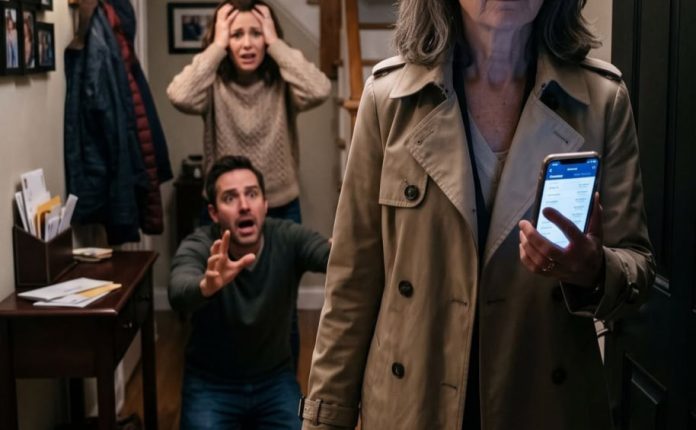
Michael came through first.
Jessica followed closely enough that the swinging door struck her hand.
“Where do you think you’re going?” he asked.
I had one arm inside my coat.
“Out.”
“Don’t be ridiculous.”
He looked at the suitcase, then at my bag.
There was calculation in that glance. Until then, he might have believed I was expressing anger. The luggage made it a plan.
“Put those away,” he said. “We can talk.”
“We’ve been talking.”
“Not like this.”
I drew the zipper up.
Jessica planted herself beside the narrow table where they kept unopened mail.
“What happens tomorrow morning?” she demanded.
I looked at her.
“The children’s parents will take care of them.”
“I have a class at eight.”
She said it with the certainty of someone presenting an immovable fact.
For weeks, her appointments had arrived on my schedule without asking. I had shifted meals, errands, rest, and sometimes medical calls around them.
At that moment, her class was simply something she might have to cancel.
“I’m sure you can make arrangements.”
“You can’t walk out without warning.”
“Your husband just showed me the door.”
“Oh, please.”
Michael lifted a hand toward her, as though he could manage the conversation if she would let him.
Then he turned back to me.
“You’re upset. Fine. But you need to think about what you’re doing.”
“I have.”
“No, you haven’t.”
The quickness of that answer would once have unsettled me.
He didn’t ask what I had considered.
He didn’t ask where I would go.
He simply rejected the possibility that my decision had been made carefully because it didn’t suit him.
“Hudson is gone,” he said.
“I know.”
“You sold it.”
“I remember.”
“So where exactly are you going to live?”
I didn’t answer.
Not because I lacked an answer.
Because I had finally recognized that he was not entitled to every detail of my next move.
He glanced at Jessica.
Then he lowered his voice, making it sound concerned.
“Mom, you can’t manage on Social Security alone.”
I looked directly at him.
“You seem to have managed quite a few things with my money.”
His face tightened.
“That isn’t fair.”
“Neither is asking me to pay four thousand dollars a month while treating me as household staff.”
“Family helps family.”
“Then perhaps you can begin.”
Jessica made an impatient sound.
Michael ignored her.
He was accustomed to getting past my resistance by changing his tone. Anger became concern. Concern became reason. Reason became injury when nothing else worked.
I had followed him through that progression so many times that I knew the next sentence before he spoke it.
“After everything we’ve done for you.”
I waited.
“We brought you into our home.”
“You invited me to help with your children.”
“You didn’t have to be alone anymore.”
“And I didn’t have to own a home anymore either.”
His eyes moved to the suitcase again.
The house was quiet around us.
From upstairs came a faint sound, perhaps a child turning in bed. I listened automatically, then made myself stay where I was.
Michael was closer to the stairs.
Jessica was closer to the kitchen.
Either could respond if one of the twins woke.
My body had become so accustomed to answering first that standing still felt like an action I had to learn.
“Take your coat off,” Michael said.
I took out my phone instead.
He watched the screen.
“What are you doing?”
“Making a call.”
“To whom?”
I didn’t answer immediately.
I opened the banking app, checked the standing transfer, and made sure I was looking at the correct account.
Four thousand dollars.
The next payment would go toward a life in which my son expected me to ask permission to rest.
I had authorized the earlier payments.
That was important.
Those were not the money Clare had described. Those were help I had given willingly, under promises that had become steadily less honest.
I could stop giving it.
The alleged diversion from the house sale was a separate matter.
It needed examination.
I would not confuse the two, and I would not let Michael confuse them either.
I found Evelyn’s contact.
I had her direct number because of the accounts she managed and the arrangements she’d helped put in place.
I had never used it for a Sunday evening emergency.
Until then, I had never needed to.
I pressed call and selected speaker.
Michael’s expression shifted.
“Mom.”
I held up one hand.
The call rang.
Jessica looked from the phone to him.
“What is she doing?”
He didn’t answer.
Evelyn picked up.
“Mrs. Vance?”
“Good evening, Evelyn. I’m sorry to call on a Sunday.”
“Is everything all right?”
“I need help protecting my accounts.”
Michael moved half a step toward me.
I stayed beside my suitcase.
Evelyn’s voice became more focused.
“Tell me what you need.”
“I want the recurring four-thousand-dollar transfer to Michael and Jessica Vance’s joint account stopped. No further monthly payments.”
“Let me confirm the instruction with you.”
She went through the necessary verification.
The small, ordinary steps steadied me. My identity. The account. The payment. The effective instruction.
There was no magic in the call.
There was a process.
For months, Michael had spoken as though money moved according to his needs. Here was someone reminding us all that my authorization mattered.
He tried to interrupt.
“Mom, wait. This is unnecessary.”
I continued answering Evelyn.
Once the payment instruction was clear, I said, “I also need restrictions placed on the primary trust while possible unauthorized transactions are examined.”
There was a brief pause.
“What has happened?”
“I’ve received records that may show fifty thousand dollars diverted from the equity payment on my house. There may also be transactions connected to my husband’s estate that I did not authorize.”
Michael went still.
Jessica’s hand dropped from the edge of the hall table.
I saw it without turning my head.
“My attorney will contact your fraud team tomorrow,” I continued. “For tonight, I need to know what can be protected immediately and what you require from me.”
Evelyn didn’t announce a verdict.
She didn’t call my son a criminal.
She asked what access other people might have, whether I believed credentials had been used without permission, and which accounts concerned me.
I answered what I knew.
Where I didn’t know, I said so.
That felt different from the life I had been living in that house.
There, uncertainty had been a reason to defer to Michael.
Here, it was a reason to preserve records and ask better questions.
“I’ll put the appropriate protective instructions in motion,” Evelyn said. “We’ll have the fraud team coordinate with your attorney. Please keep any original records intact.”
“I will.”
“Do not use any passwords you find to access accounts that aren’t yours.”
“I understand.”
“Are you somewhere you can speak privately?”
“I’m leaving now.”
“Call me again when you’re settled.”
“I will. Thank you.”
I ended the call.
The silence afterward lasted longer than the silence at the dinner table.
Michael had lost the expression he used when he believed an argument was beneath him.
His face had gone pale.
“How did you—”
He stopped.
I put the phone in my pocket.
“How did I what?”
Jessica turned to him sharply.
“Michael?”
He wasn’t looking at her.
He was looking at my bag.
Until that moment, he had seen a woman taking clothes away.
Now he knew there were records somewhere beyond his control.
“Mom, listen to me.”
“I’ve listened.”
“You don’t understand what you’re talking about.”
“Then the records will make that clear.”
“The house transfer was complicated.”
“I’ve asked for it to be examined.”
“You can’t just say fraud.”
“I said I have concerns about unauthorized transactions. I’ll provide what I have and let the proper people determine what happened.”
His jaw worked.
There was no answer he could give quickly enough to stop the process without revealing more than he intended.
Jessica found her voice first.
“The mortgage is due this week.”
I looked at her.
“That is why your bank expects a payment.”
“We can’t do this with no notice.”
“You’ve had months to arrange your own finances.”
Michael stepped closer.
“The business hasn’t stabilized.”
“That was what you told me when I began helping.”
“It’s still true.”
“Then you need a plan that doesn’t depend on taking mine.”
“I didn’t take—”
He cut himself off.
Again.
The unfinished sentences mattered less than the records in my bag, but I noticed them.
I noticed how carefully he was choosing words now that I had stopped accepting the easy ones.
Jessica’s breathing quickened.
“What about the car payment?”
Michael turned toward her.
“Not now.”
“When, then?”
She looked at me.
“You promised us.”
“I agreed to temporary help.”
“You can’t change your mind overnight.”
“I didn’t.”
That was the thing neither of them seemed able to comprehend.
They were experiencing a sudden change because I had stopped concealing a gradual one.
Every sleepless night, every withdrawn question, every four-thousand-dollar transfer had been part of the decision.
The packed suitcase was not an impulse.
It was the visible end of patience they had mistaken for permanence.
Michael reached toward my sleeve.
I stepped back.
“Don’t.”
His hand stayed in the air for a moment before falling.
“I’m trying to talk to you.”
“Then speak without stopping me from leaving.”
Jessica began listing practical problems.
The twins needed someone in the morning.
Clare needed transportation.
There were appointments.
There was laundry.
The house couldn’t run itself.
As she spoke, I heard the life I had been maintaining reduced to tasks they now feared doing.
Nobody mentioned my room.
Nobody asked whether I was tired.
Nobody said they were sorry.
I looked at the swinging kitchen door.
Behind it waited dishes, leftovers, the roasting pan.
I had once thought that if I did enough, they would notice the care inside the work.
Now I understood that work can become invisible precisely because it is reliable.
The person doing it can disappear with it.
“You’ll need to arrange childcare,” I said.
“A nanny costs money,” Jessica snapped.
I didn’t answer.
The sentence had already answered enough.
She knew care had a price.
She simply preferred mine to remain unpaid.
Michael rubbed his forehead.
“All right,” he said. “All right. We can discuss a schedule. We can fix the room.”
I looked at him.
Three months.
A storage room.
Now, with the payment stopped and questions heading toward a bank, the room could suddenly be fixed.
“What about the guest rooms?” I asked.
He frowned.
“What?”
“You needed them available.”
“That was Jessica’s arrangement.”
Jessica stared at him.
I felt no pleasure in watching them turn toward each other.
It only made the arrangement clearer.
When my discomfort cost them nothing, they were united.
When consequences arrived, responsibility became something to pass across the hallway.
“You don’t have to leave tonight,” Michael said.
“Yes, I do.”
“We can sort everything out in the morning.”
“I’ll be speaking to my attorney in the morning.”
“Without talking to me first?”
“I’ve been talking to you.”
“You’re making this hostile.”
“No. I’m making it documented.”
He looked at the bag again.
“Where did you get whatever you think you have?”
I held his gaze.
“I’m not discussing that in this hallway.”
“Did Clare—”
“Leave her out of this conversation.”
It came out more firmly than anything I had said yet.
Michael glanced toward the stairs.
I moved my suitcase slightly, drawing his attention back to me.
“This is between the adults whose accounts and transactions are involved,” I said. “If you have an explanation, provide it through the proper channels.”
He opened his mouth.
Then the phone in my pocket vibrated.
The driver had arrived.
I checked the message.
A black town car waited at the curb.
Michael looked toward the front window.
“You called someone?”
“Yes.”
“When?”
“Earlier.”
That was when he finally understood I had planned to leave before dinner.
His expression changed again.
Not to remorse.
To the anger of discovering I had made a decision he hadn’t approved.
“You’ve been planning this behind our backs?”
“I booked a ride.”
“While we thought everything was fine.”
I almost asked him what part he thought was fine.
But there was no purpose in giving him another opening to argue.
I had the bag.
I had the suitcase.
I had the phone.
The door was three steps away.
I put my hand on the brass knob.
Jessica said my name sharply.
Michael moved beside the threshold.
“Mom, please.”
There it was at last.
Please.
Not when he needed my agreement.
Not when he wanted my hours.
Not when I had asked him to treat me with respect.
Only now.
“You’ll ruin us,” he said.
I looked at him for a moment.
“I’m stopping payments I can’t keep making. I’m asking what happened to money that belongs to me.”
“The timing—”
“The timing is yours to manage.”
He lowered himself as I opened the door, one knee meeting the threshold as though the movement might keep me there.
His hand caught the frame.
“I’m your son.”
I felt those words where he intended them to land.
In the same place the earlier words had landed.
Mom, I need you.
I had not stopped being his mother.
That was why leaving hurt.
But being his mother could not require me to keep making theft possible, if theft was what the records showed. It could not require surrendering my security so he and Jessica could avoid the consequences of their choices.
“I know,” I said.
Then I stepped outside.
The evening air was cool.
Damp pine needles lay near the front walk, and I could smell them as I brought the suitcase down the steps.
Behind me, Jessica was speaking quickly. Michael answered her, then called after me.
I kept moving.
The driver got out before I reached the car.
He took the suitcase without asking questions and placed it in the trunk.
For a second, I stood beside the open passenger door.
I had pictured this moment during the afternoon.
I had thought freedom might feel simple.
Instead, it arrived with shaking knees and a bag that seemed heavier than luggage should.
That did not make it less real.
I sat down.
The driver closed the door.
Through the window, I saw the porch light fall across Michael’s shoulder.
Then the car pulled away.
I did not turn to keep watching the house.
For the first few minutes, I kept both feet planted on the floor and my bag against my lap.
The driver asked whether the temperature was comfortable.
“Yes,” I said.
A small question.
A simple answer.
Nobody challenged it.
I looked down at my hands.
I hadn’t cried in the dining room or the hallway.
Now tears came without warning.
I wiped them away because I didn’t want to lose sight of what I needed to do next.
Crying did not mean I had made the wrong decision.
It meant I had left my son’s house carrying more than I had expected.
When I reached the place I had arranged to stay, I called Evelyn again.
This time, I spoke privately.
I explained what Clare had said and how she had given me the notebook and drive.
I distinguished the voluntary support payments from the suspected diversion.
Evelyn listened carefully.
She told me the next steps, repeated that I should preserve the originals, and made sure I understood how the protective measures would be handled.
I wrote down what she said.
Then I sent my attorney a brief message asking for an urgent conversation in the morning.
No accusations spread through the family.
No photographs of the notebook posted anywhere.
No triumphant announcement.
I needed the records to remain useful, not become a spectacle.
Michael called repeatedly.
I let the phone ring.
He sent messages.
We need to talk.
You’ve misunderstood.
Please don’t involve outsiders.
I read that last one twice.
Outsiders.
People who could look at dates, permissions, account details, and transfers without being moved by the word Mom.
I placed the phone facedown.
Then I opened the notebook carefully.
The first pages were ordinary enough to make me doubt myself for a moment.
Notes.
Amounts.
Abbreviations.
Business reminders mixed with account information.
Michael’s handwriting was familiar. I had seen it on school forms, birthday cards, grocery lists years earlier.
That familiarity made reading it harder.
A page could look like my son and still contain something I needed to question.
I did not follow the passwords.
I did not try to enter any account.
I looked only at what was physically before me.
Dates that overlapped with the sale.
Amounts written beside short descriptions.
References to documents stored elsewhere.
Later entries that made me think of the estate paperwork Michael had offered to manage.
I couldn’t interpret every line.
I wasn’t supposed to.
I closed the notebook and put it back in my bag.
The following morning, my attorney asked the questions I had been too shaken to arrange in order.
What had I authorized?
What did I remember signing?
Who had helped me access the sale documents?
Where should the proceeds have gone?
What records did I already hold independently?
I answered slowly.
When I didn’t remember, I said so.
There was no benefit in filling a gap with certainty.
The notebook and drive would be assessed alongside closing records, bank statements, and documents that did not come from Michael’s safe.
That mattered.
A record needed context.
A password list did not prove where money came from.
A suspicious invoice did not explain itself.
But a transfer could be traced, permissions could be checked, and the story I had been told could be compared with what actually happened.
The first task was to protect what remained.
The second was to establish what had been taken.
Then, if the evidence supported it, recovery could begin.
I listened.
For the first time in months, no one asked me to solve a financial problem by sending more money.
My attorney asked for records instead.
I provided them.
As the examination began, my son’s messages changed.
They became longer.
He referred to transactions before anyone had asked him directly about them.
He described arrangements I had never agreed to.
He used words like advance and family understanding.
I forwarded the messages without replying.
They belonged with the other records now.
Before that day ended, I understood something I hadn’t understood in the hallway.
Walking out had removed me from the work.
It had not, by itself, removed me from the story Michael intended to tell about the money.
For that, I would need patience, documentation, and the willingness to hear facts even when they hurt.
I was prepared for the first two.
The third would take longer.
END PART 3