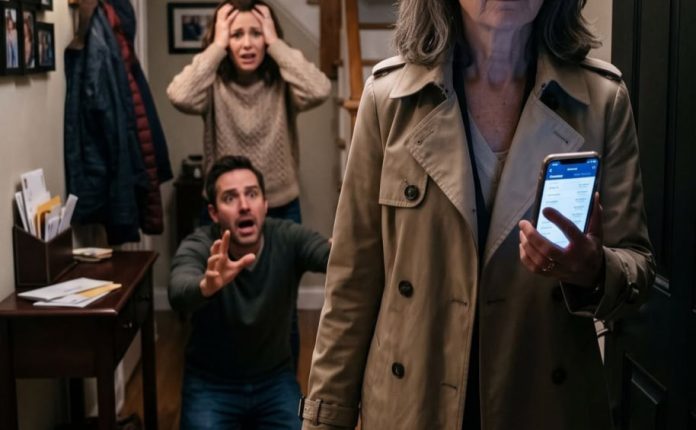
“Grandma, wait.”
Clare’s voice came from behind me, low enough that I almost mistook it for the scrape of the suitcase wheels.
I turned.
She stood several feet away, holding a black leather notebook against her chest. Something small protruded between the fingers of her other hand.
Her eyes were red at the edges.
I had seen her upset before. An argument about school. A sharp exchange with Jessica. The ordinary disappointments of being sixteen in a house where adults listened only after deciding what they wanted to hear.
This was different.
She looked frightened of what she had decided to do, but not uncertain about doing it.
“What is it, sweetheart?”
She glanced toward the dining room.
“Take these.”
When she stepped closer, I saw the flash drive.
I didn’t reach for it.
“Clare.”
“Please.”
The word came out thin.
I set the suitcase upright beside the wall.
“Tell me first.”
She drew a breath, then looked past my shoulder at the room I had just left.
The Christmas tree was still visible through the open door. Its plastic branches were pressed against one another, bound for storage until someone wanted them again.
Clare stared at it for a moment.
Then she looked back at me.
“He didn’t ask you here because they needed help with the twins.”
I waited.
“Not really.”
From the dining room came the faint sound of Michael moving something on the table.
My granddaughter lowered her voice further.
“He wanted you where he could watch your money.”
I felt the hallway air against my face.
I remember that sensation because my body seemed to notice small things before my mind could make sense of the larger one.
The lamp’s warmth.
The handle of the suitcase beneath my palm.
A slight roughness in the wallpaper where someone had brushed past carrying furniture.
“What makes you say that?”
“The money from your house.”
She held the notebook out again.
“Dad used your digital signature. He moved fifty thousand dollars.”
For a moment, I thought she must have misunderstood.
Not because Michael was incapable of wrongdoing. The dinner had cured me of any belief that motherhood guaranteed kindness.
But theft was something else.
Fifty thousand dollars was something else.
The amount had weight. It represented years of practical choices, the life my husband and I had built, the security I thought I was protecting when I sold our home.
“Moved it where?”
“An account connected to crypto. Not here. It’s in his name.”
“How do you know?”
“I heard him and Mom talking.”
Jessica.
I looked toward the kitchen.
She had asked me that afternoon to wipe the dining room doors because the children’s fingerprints showed in the light.
I had done it while the chicken roasted.
I pictured my hand moving over the glass while she stood nearby, knowing something about my money that I didn’t.
“Did you see a transfer?” I asked.
“There are files on the drive.”
Clare swallowed.
“And things in the notebook. Account details. Amounts. Passwords. I don’t understand all of it.”
That admission mattered.
She wasn’t presenting herself as an expert. She wasn’t telling me every number meant what she feared it meant.
She was bringing me what she had found because keeping it in the house seemed worse than taking it.
“Where did you get them?”
“His office safe.”
I looked at her more closely.
“You went into it?”
“An hour ago.”
“Clare, how—”
“He keeps the combination under his desk mat.”
She said it with a tired kind of disbelief.
The safe was in Michael’s office, a room I cleaned but was discouraged from entering when he worked. I had dusted around it. I had carried mugs out of the room.
I had never imagined that the lock concealed anything connected to me.
“Does he know you took these?”
“No.”
Her fingers tightened around the notebook.
I could have asked a dozen questions at once.
How long she had known.
What exactly she’d heard.
Whether she had seen my name.
Whether Michael’s records were clear enough to support what she was saying.
But Clare was watching my face as though she expected me to protect him.
That stopped me.
How many times had she seen me excuse his behavior?
How many times had I called him tired or worried while she watched him be cruel?
She might reasonably fear that I would put the notebook back, tell her she had misunderstood, and return to the kitchen.
I held out my hands.
She gave me the notebook first.
It was heavier than I expected, its leather softened along the spine. A narrow elastic strap held it closed.
The flash drive was warm from her palm.
“Thank you for telling me,” I said.
Clare’s mouth trembled.
“I should have done it earlier.”
“No.”
“But I heard things before.”
“You’re sixteen.”
“I’m not stupid.”
“I didn’t say you were.”
I stepped closer.
“I’m saying this wasn’t your responsibility.”
The distinction seemed to reach her slowly.
She looked down at the place where the notebook had been against her chest.
In the three months I had lived there, Clare had learned to measure the house’s moods with unsettling accuracy.
She could tell whether Jessica wanted company or silence from the way a kitchen drawer closed.
She knew when Michael’s friendly voice meant he wanted something.
She sometimes disappeared upstairs before either parent had mentioned a plan, as though she could sense the moment her presence would become inconvenient.
I had noticed.
I had tried to give her a small refuge where I could.
A cup of tea after school.
A plate held aside when dinner happened before she came home.
A conversation that didn’t begin with an instruction.
But I hadn’t understood how much she was carrying.
“What did you hear?” I asked gently.
She rubbed one thumb against the opposite wrist.
“They were talking about the sale. Dad said having you here made everything easier.”
“Easier how?”
“Because you trusted him. Because you weren’t watching every account.”
She hesitated.
Then she added, “Mom laughed.”
I looked at the notebook.
For months, I had supplied both labor and money while trying to prove I appreciated their invitation.
Now I was learning that the invitation itself might have been part of the taking.
The hurt came in layers.
My son’s words at dinner had been direct. I could answer them.
This went backward through time, changing the meaning of things I had thought were kindness.
The calls about moving.
The offers to help with forms.
The patient explanations of screens I hadn’t used before.
I remembered saying, “I’m glad you’re here to handle this.”
I remembered his answer.
“That’s what family’s for.”
The notebook’s elastic strap pressed into my thumb.
I wanted to open it.
I also knew a hallway, with Michael a room away and Clare watching me, was not the place to decide what financial records meant.
“Is this all connected to the house sale?” I asked.
Clare shook her head.
“There’s stuff about Grandpa too.”
My breath caught.
“What kind of stuff?”
“The estate. Bills. Transfers.”
She looked frustrated with herself.
“I don’t know the right words.”
“You don’t have to.”
“He kept records. That’s why I took the notebook. There are names and dates. Some invoices don’t look right.”
My husband’s estate.
Even after his death, I had been protective of the practical traces he left behind.
He had worked carefully, saved carefully, and worried about me more than I wanted him to. Near the end, he was relieved when Michael offered to help with paperwork.
Our son understood business.
Our son would spare me some burdens.
Those were the explanations we gave ourselves.
Michael had sat with documents at our kitchen table. He had offered to organize files, follow up on questions, and make sure nothing was missed.
My husband thanked him.
I remembered the relief on his face.
That memory hurt in a way the insult at dinner hadn’t.
A stranger could steal money.
Only someone trusted could reach into those last days and change what I remembered about them.
I closed my eyes briefly.
When I opened them, Clare was looking at me.
“Grandma?”
“I’m here.”
“I didn’t want to hurt you.”
“I know.”
Her shoulders dropped a fraction.
I made myself separate what I knew from what I had just been told.
I knew I had sold my house.
I knew Michael had helped with digital paperwork.
I knew I had transferred four thousand dollars a month voluntarily.
I knew the notebook and drive had come from his safe because Clare had told me where she found them.
The rest needed checking.
That did not make her warning less serious.
It made it serious enough to handle properly.
I had spent too long treating discomfort as something to smooth away.
I wouldn’t do that with an accusation of theft.
But I wouldn’t let fear turn every page into proof before someone qualified examined it either.
My granddaughter deserved to be believed without being made responsible for the conclusion.
“I’m going to have this looked at,” I told her.
“All of it?”
“All of it.”
“Not by Dad.”
“No.”
She nodded quickly.
That small insistence told me more about the atmosphere in the house than another hour of explanation would have.
Michael had made himself the interpreter of everything complicated.
If something involved money, contracts, technology, or the future, he positioned himself between the question and the answer.
I had mistaken access for authority.
There in the hallway, I decided I would ask my own questions.
I opened my bag and found space beside the photograph album.
The notebook fit tightly. I wrapped the flash drive in a folded tissue and placed it in the zipped inner pocket.
Clare watched until both were out of sight.
Then she let out a breath she seemed to have been holding for much longer than our conversation.
“Why tonight?” I asked.
She glanced toward the dining room.
“Because he said that to you.”
“The door?”
“All of it.”
I waited.
“He knew you’d spent the day taking care of everyone. He knew you’d cooked. He still talked like you were lucky he let you live here.”
Her voice roughened.
“And you stood up.”
I looked at her.
“I thought if you stayed, I might lose my nerve again.”
Again.
She had been preparing for this in her own way.
Not with a car booking or a suitcase, but with the difficult decision to tell an adult something the adults in the house would punish her for noticing.
“What happened before?” I asked.
“I kept thinking I needed to be completely sure.”
“About the money?”
“About saying anything.”
She rubbed at one eye.
“Dad always has an answer. Mom says I take things too personally. After a while, you start hearing them even when they’re not talking.”
I knew exactly what she meant.
I had been carrying their answers in my own head.
You’re overreacting.
It’s temporary.
You don’t understand.
We’re family.
The words arrived so reliably that I often supplied them before either of them spoke.
“You don’t have to argue with them about this,” I said.
“What if they ask?”
“Don’t try to handle the records yourself. Let me speak to someone who can.”
She looked toward my bag.
“What if Dad takes them?”
“He won’t have access to my bag once I leave.”
“What if he says you stole them?”
“I’ll explain how I received them.”
I didn’t promise there would be no trouble.
I couldn’t.
I didn’t tell her that everything would be easy because she had done a brave thing. Courage rarely controls what comes next.
What I could give her was steadiness.
And I could refuse to place the burden back on her.
Clare leaned against the wall.
For the first time since she called my name, she looked like a tired teenager.
There was a faint ink mark on one finger. Her socks didn’t match. One sleeve had slipped over the heel of her hand.
The ordinariness of those details nearly broke me.
She should not have had to think about safe combinations and financial records.
She should not have had to decide whether protecting her grandmother meant betraying her parents.
I set my bag down long enough to hold her.
She stepped into my arms immediately.
For several seconds, we stood beside the suitcase without speaking.
I could feel how tightly she was holding herself.
Then she began to shake.
Not dramatically. Just a small tremor traveling through her shoulders as the effort of staying composed finally loosened.
I rested my hand against the back of her head.
“You did the right thing telling me you were worried.”
“They’re going to hate me.”
The words were muffled against my coat.
I didn’t answer too quickly.
“They may be angry.”
She pulled back.
“That’s the same thing in this house.”
I let that settle between us.
Then I said, “Their anger doesn’t tell you whether you were wrong.”
Clare looked at me for a long moment.
I wished someone had said that to me three months earlier.
Perhaps I would have needed to hear it several times.
Perhaps I would have argued.
But I was saying it now, and I intended to live by it.
I brushed her hair away from her damp cheek.
“You can call me whenever you need to.”
“I know.”
“Not just when it’s convenient. Not just when you think I’m free.”
She nodded.
“If you need somewhere to go, you call me first.”
That made her glance toward the front of the house.
“Are you really leaving?”
“Yes.”
“Tonight?”
“Yes.”
She looked relieved, then guilty about the relief.
“What about the twins?”
I knew that question.
It was the hook that had held me through weeks when I should have reconsidered everything.
I loved those children. I loved their sleepy hands reaching for mine, their fierce opinions about breakfast, their joy at the smallest thing.
But they had parents.
Parents who were at home that evening.
Parents who could arrange care, change plans, get up early, and do the work they had been handing to me.
“Their mother and father are here,” I said.
Clare looked down.
“Mom will complain.”
“Probably.”
“Dad will say you’ve made everything harder.”
“I’m allowed to stop making everything easier.”
She let out a short breath that might have become a laugh in another room.
I checked the time.
The car would be there soon.
Until Clare stopped me, leaving had been a practical decision with an emotional cost. I had planned to end the payments because I could no longer afford to support an arrangement that was wearing me down.
Now there was a second reason.
I needed to protect what remained mine while the records were examined.
I would not send another payment into an account that might be connected to money already taken without my consent.
I thought of Evelyn.
My wealth manager knew my accounts, knew the trust arrangements, and had worked with me after my husband’s death.
Michael had occasionally treated her caution as unnecessary formality.
“Banks always want another form,” he would say.
I had accepted that comment as ordinary impatience.
Now I was grateful for every form that required my permission.
My phone was in my coat pocket.
I could call her once I reached the car.
Or I could call before I left.
I hadn’t decided yet.
Clare watched me thinking.
“What will you do?”
“Speak to the bank. Then my attorney.”
“Will they look at the drive?”
“I’ll ask them how to handle it.”
She nodded.
That was enough for the moment.
We didn’t need to turn the hallway into an investigation.
We needed to get the records somewhere they could be examined without Michael choosing what I was allowed to see.
“Are you safe here tonight?” I asked.
Clare’s expression changed.
“I’m okay.”
I waited rather than accepting the first answer automatically.
“I’m going to Aunt Sarah’s next week anyway,” she added. “For the college preparation stuff.”
I knew about the visit.
It had been on the calendar for some time, one of the few plans in the house that didn’t require my participation.
The knowledge steadied me.
Clare had somewhere familiar ahead of her. An adult outside these walls. Time away from the routines that made her shrink.
“If anything changes,” I said, “you call.”
“I will.”
“Promise me.”
“I promise.”
She glanced toward the dining room again.
Then, with a faint trace of the dry humor I knew, she said, “Don’t let him explain it all away.”
“I won’t.”
“Even if he sounds reasonable.”
“Especially then, I’ll ask for records.”
That brought the smallest smile to her mouth.
She had given me enough to change the course of the evening.
I would not repay her by making reckless promises.
I would not announce that I was going to ruin her father, as though her family’s collapse could be a gift to her.
What I wanted was the truth.
What I wanted was my money protected and, if her account was confirmed, recovered.
What I wanted was to stop helping people injure me and call it loyalty.
I picked up my bag.
The notebook’s weight shifted inside it.
Michael’s office safe had been close enough for me to dust and far enough from my concerns that I had never imagined looking inside.
Now a piece of its contents sat beside the album I had carried from my marriage.
The two belonged together more painfully than I could bear to consider for long.
I had trusted my husband’s son because he was our son.
Clare had trusted her own judgment because she had watched what that trust cost me.
I took the suitcase handle again.
“Go upstairs for a little while,” I told her.
“Are you going to tell them?”
“I’m going to tell them the payments are ending.”
“And the rest?”
“They’ll learn that I’m having questions investigated.”
She searched my face.
I wondered if she was afraid I would say her name.
“You don’t have to stand beside me while I do it,” I added.
That was the part she needed.
Her breath came easier.
She touched my arm once, briefly.
Then she stepped away from the suitcase.
I rolled it toward the foyer.
The house smelled of roast chicken and warm butter. Somewhere in the kitchen, a tap began running and stopped.
For years, I had associated those smells with family.
That evening, they belonged to a dinner I had prepared and would never eat.
I reached the coat peg and took down my coat.
My hands were steady as I slipped into it.
Behind me, Clare lingered at the end of the hallway.
I met her eyes once.
Then the kitchen door swung open.
END PART 2