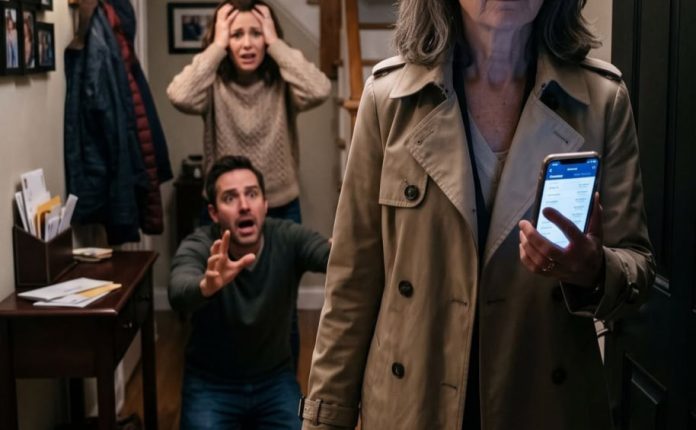
I turned off the engine but left the keys in my hand.
“Stay here,” I told the boys.
Noah nodded.
Eli watched the porch.
I stepped out and closed the door softly.
Linda lifted her coffee cup.
“Claire, I told you not to make this difficult.”
The locksmith looked over his shoulder.
Two deputies stood near the cruiser. One had a notebook open. The other watched me with the cautious expression of someone who had been given one version of a family dispute and expected another.
“My bags are upstairs,” I said.
“They’re being brought down.”
“Please leave them where they are.”
Mom’s mouth tightened.
“You do not give instructions here.”
Jason looked toward the black sedan.
“Oh, you brought a lawyer.”
I didn’t answer.
Mr. Keating stepped out carrying a leather binder that looked older than either of us. It was thick, worn at the corners, and secured with a strap.
He nodded to me.
“Are the boys comfortable?”
“They’re in the car.”
“We’ll keep this out here.”
Linda came to the top of the steps.
“Good morning, Robert.”
It was the voice she used when she wanted strangers to recognize an established relationship.
Warm.
Familiar.
Just loud enough.
“I wish Claire had called you before creating another problem.”
Mr. Keating looked at the locksmith.
“Please stop working.”
The man lifted his hands from the lock.
Linda turned sharply.
“I’m paying him.”
“He needs to stop until ownership is clarified.”
“It is clarified.”
“Then that will take very little time.”
Jason gave a short laugh.
“You were Dad’s lawyer. You don’t get to run the place.”
Mr. Keating unfastened the binder.
“I’m not here to run it.”
He drew out a document protected inside a clear sleeve.
“I’m here because someone is trying to exclude the owner.”
Mom looked at me.
For the first time that morning, she seemed uncertain what I had been told.
It lasted only a second.
Then she turned toward the deputies.
“As I explained, this is my late husband’s property.”
One deputy closed his notebook.
“Mrs. Evans, we need to review what Mr. Keating has brought.”
“I am the executor.”
“Executor of the estate,” Mr. Keating said. “This house was transferred out of the estate before Arthur died.”
Mom’s fingers tightened around the cup.
“No.”
The word came too quickly.
The black sedan’s door clicked shut behind us.
Then another cruiser entered the drive.
The county sheriff stepped out, followed by an investigator carrying a plain folder.
I saw Jason straighten.
Until then, he had been leaning as if the porch were a seat reserved for him.
The sheriff spoke briefly to the deputies before coming toward us.
“Mr. Keating.”
“Sheriff.”
Mr. Keating handed him the certified document.
“This is the recorded deed for 142 Ocean Drive, together with the supporting trust records.”
Linda laughed once.
It was an odd sound, abrupt and too high.
“Arthur would never have done that without telling me.”
Mr. Keating looked at her.
“He did tell you he was making separate arrangements.”
“He didn’t say this.”
“The document says this.”
The sheriff examined the page.
His attention moved slowly over the names, date, and seal.
There was nothing theatrical about it.
No one announced a verdict.
He read.
That simple act unsettled Linda more than anything I could have said.
For once, the room was not accepting the person who spoke most confidently.
It was looking at a record.
The locksmith remained kneeling, one hand resting on his thigh.
“Do you want me to take the old hardware off?” he asked.
“No,” the sheriff said.
Linda stepped forward.
“I hired him to secure my home.”
“Ma’am, let’s establish whose home it is first.”
“It was my husband’s.”
“Yes,” Mr. Keating said. “It was.”
The word settled between them.
Was.
Dad had been alive when he signed.
He had had the right to decide.
I looked toward the front window, remembering him behind it during rainstorms, watching the wind bend the dune grass.
He used to tell the boys that houses needed people paying attention.
Not just money.
Attention.
Who had a cough.
Who couldn’t sleep.
Which latch stuck.
Which floorboard creaked under the little bed.
Linda had treated the house as proof that she belonged among people with houses like it.
Dad had treated it as a place that should belong to the people inside.
Now his attention existed in pages I could barely read from where I stood.
Jason came down one step.
“Mom handled everything after he died.”
“She handled the estate,” Mr. Keating replied.
“That includes this.”
“No.”
“Then why has she been paying for it?”
“Expenses and ownership are separate questions.”
I saw the trap Jason was reaching for.
The familiar move from a fact to an obligation.
If Linda had paid anything, I should be grateful.
If I should be grateful, I should not object.
If I objected, whatever happened afterward would become my fault.
Mr. Keating did not follow him into it.
He opened another section of the binder.
“Arthur’s instructions permitted a period of occupancy. They did not permit a sale, a transfer, or borrowing against Claire’s property.”
Mom looked toward the investigator.
“What is that man doing here?”
“He has information we need to review,” the sheriff said.
“What information?”
“We’ll come to that.”
Linda’s coffee trembled.
A small amount spilled onto her wrist.
She looked down, irritated, as though even the cup had become uncooperative.
Then she held it out toward Jason.
He took it automatically.
For a moment, they looked exactly as they always had.
Linda handing over inconvenience.
Jason accepting the object but not the responsibility.
The sheriff looked up from the deed.
“The recorded title supports Mr. Keating’s explanation.”
Mom shook her head.
“That can’t be right.”
“The property is not yours to secure against Claire.”
“I’m his widow.”
“No one is disputing that.”
“I lived here with him.”
“No one is disputing that either.”
She looked at me.
“You know this was our home.”
I did.
That was what made the morning painful.
I had memories of Linda there that were not all cruel. Her walking barefoot through the kitchen when I was little. Her putting out sliced peaches on summer mornings. Her laughing once when Dad dropped an entire tray of hamburgers and tried to rescue them before anyone noticed.
I did not need to erase those memories to recognize what she was doing now.
“This was his home too,” I said.
She stared at me.
“And he made a decision.”
“You were always good at making him feel sorry for you.”
Jason shifted on the step.
The sheriff looked between us.
“Let’s stay with the documents.”
Linda ignored him.
“You came running to him every time your life fell apart.”
“I came here with his grandchildren.”
“You used those boys—”
“Stop.”
The word was quiet.
It still stopped her.
I had spent the previous night telling Noah he had nothing to defend.
I was not going to let Linda turn him into an accusation again.
“Leave my children out of it.”
Mom’s eyes flicked toward the car.
I moved slightly, blocking her view.
“They’re not part of this conversation.”
“They are if you’re claiming Arthur did this for them.”
“Arthur’s reasons are recorded,” Mr. Keating said.
He removed a page.
“He wanted Claire and the boys to retain a stable place. He was concerned the property would otherwise be sold or encumbered.”
“Concerned about what?”
Linda’s voice had gone thin.
Mr. Keating did not answer immediately.
He glanced at the sheriff.
Then he said, “Your spending.”
Jason looked at his mother.
I watched him calculate whether the morning still offered a position from which to joke.
It did not.
“Dad was worried about everybody,” he said.
“This concern resulted in a specific legal arrangement,” Mr. Keating replied.
The sheriff handed the deed back.
“Locksmith, please pack up.”
The man stood with relief so plain I almost felt sorry for him.
He had arrived to replace hardware.
He had found himself inside a family’s attempt to rewrite ownership through force of personality.
“I haven’t removed anything,” he said.
“Good.”
Linda turned toward him.
“You can’t just leave.”
He crouched again and began collecting his tools.
“I’m not changing a lock with disputed authorization.”
“It isn’t disputed.”
No one answered that.
The sound of metal pieces dropping into a case filled the gap.
I looked at the front door.
Dad’s key would still fit.
The knowledge brought a sharp, unexpected ache.
I wanted him to be there when I used it.
I wanted to hear his shoes on the hall floor, see him glance toward the boys, and watch his expression change when he noticed Noah’s cheek.
I wanted someone else to carry the anger for a minute.
Instead, I stood beside his attorney while my mother searched for another route around a document.
“Where is the original?” she demanded.
“Safely retained,” Mr. Keating said.
“I want to see Arthur’s signature.”
“You will have access to the relevant records through proper channels.”
“So you expect me to believe a photocopy?”
“The certified recording is not an informal photocopy.”
“You could have prepared anything.”
The sheriff spoke.
“Mrs. Evans.”
She stopped.
“The record has been verified.”
A gull cried overhead.
I heard a door open at the house next door.
Linda heard it too.
Her eyes moved toward the neighboring porch.
She had always known when she was being watched.
At the party, an audience strengthened her.
That morning, it had begun to cost her.
She lowered her voice.
“Can we go inside?”
Mr. Keating looked at me.
I shook my head.
The boys could see me from the car.
I had promised.
“We can finish here,” I said.
“You’re enjoying this.”
“No.”
I meant it.
Nothing about the morning felt enjoyable.
There was relief beneath the fear, yes.
And anger.
And a growing certainty that I would not surrender what Dad had protected just because Linda disliked being contradicted.
But watching her unravel on the porch did not repair Noah’s cheek.
It did not give Eli back the evening he thought he was going to have.
It did not bring Dad downstairs.
“We need to discuss the loan,” the sheriff said.
Linda went still.
Jason looked at him.
“What loan?”
The investigator opened his folder.
“Mrs. Evans, the bank’s fraud unit has provided information about a three-hundred-and-fifty-thousand-dollar line of credit secured against this address.”
Jason’s eyes moved to his mother.
She looked toward the neighboring porch again.
Then she smiled.
Not convincingly.
“There’s clearly an administrative issue.”
Mr. Keating closed the binder strap halfway, then left it loose.
“The recorded ownership predates the loan.”
“My husband’s estate—”
“Did not own this house when the loan was obtained.”
“It was for estate expenses.”
“That does not authorize you to pledge someone else’s property.”
Linda’s face had lost its color.
The investigator held one page apart from the others.
“We need to establish how these signatures were supplied and what was represented to the lender.”
“What signatures?”
Her question sounded rehearsed.
“The documents bearing Arthur Evans’s signature.”
Jason descended the remaining steps.
“Dad?”
Linda looked at him.
“Don’t start.”
“He was dead.”
The words came out with genuine disbelief.
I had never heard Jason say anything quite so unguarded in front of her.
Linda’s gaze sharpened.
“Lower your voice.”
The sheriff did not.
“The loan was obtained three months ago.”
Jason took a step away.
The movement was small but unmistakable.
Until then, he had stood beside her as though the morning were ours against theirs.
Now he had discovered that beside her might mean something more dangerous.
“Mom, what did you do?”
“Nothing that concerns you.”
“It concerns him if he’s been making claims about this property,” Mr. Keating said.
Jason looked at the binder.
Then at me.
For the first time, his expression held no amusement at all.
Linda clasped her hands in front of her robe.
The coffee stain on one cuff had dried dark.
“The bank approved everything.”
“The bank’s approval does not establish that the information submitted was accurate,” the investigator said.
“I gave them what they asked for.”
“Then we’ll review what you gave them.”
“There must have been confusion.”
“About your husband being alive?” Jason asked.
Mom turned on him.
“Do you think maintaining this place is free?”
The accusation came so quickly that I recognized her own fear underneath it.
She was trying to convert the loan into a sacrifice.
She had done something difficult.
Therefore, the rest of us owed her silence.
“There were bills,” she said. “There were events. Your father left obligations.”
“Galas?” I asked.
Her eyes snapped toward me.
“That is an ugly way to put it.”
“It’s the word you used.”
“I represent this family.”
No one answered.
I could see last night’s flowers through the window.
A white petal had fallen onto the table where Noah wanted to place his photograph.
The image made the numbers feel concrete.
The bank money wasn’t an abstraction.
It had passed through choices.
Invoices.
Deposits.
Checks.
Things selected while my mother dismissed me as incapable of managing my own life.
“How far behind are the payments?” Mr. Keating asked.
Linda’s lips parted.
“Robert, really.”
“The owner needs to know.”
“This is private.”
“It ceased to be private when you used her property.”
The sheriff spoke with the investigator for a moment.
I could not hear every word.
I stayed beside the car’s front fender.
Noah looked through the passenger window.
I lifted a hand.
He lifted his back.
That small exchange mattered more to me than Linda’s next argument.
She could still speak.
She could still choose.
But she no longer had the entire space.
A deputy stepped toward her.
“Ma’am, the sheriff needs you to answer some questions.”
“Am I being arrested?”
“We need to discuss the fraud information.”
She looked at me immediately.
Not at Mr. Keating.
Not at the sheriff.
At me.
As though I were the switch controlling every consequence.
“Claire.”
I said nothing.
She came down one step.
The deputy stayed close.
“Tell them this is a family matter.”
“It’s a loan against my property.”
“You keep saying that.”
“Because it’s true.”
“I’m your mother.”
The old sentence.
There was no argument inside it, only a claim that the relationship outranked every other fact.
I remembered the pool.
Noah’s hand against his cheek.
Eli behind the chair.
I remembered telling Linda that her guest had touched my child and watching her choose the crowd.
Being my mother had not made her stop.
Now she wanted being my mother to make me stop everyone else.
“What do you want me to tell them?” I asked.
“That we’ll sort it out.”
“How?”
“We can discuss it privately.”
“Will the bank’s documents change if we go inside?”
Her face hardened for a second.
Then softened again.
“I needed the money.”
“For what?”
“To keep everything going.”
“Whose everything?”
She looked away.
It was not a confession in legal language.
It was more revealing than one.
She could not say it had been for my sons.
She could not say I had approved it.
She could not say Dad had signed something three months earlier.
She could only insist that her need had made the rest permissible.
Jason stood near the railing, phone in hand.
He wasn’t calling anyone.
He was looking at the screen as if it might offer somewhere else to stand.
“Jason,” I said.
He looked up.
“Did you know about the loan?”
“No.”
Linda made a small, offended sound.
He repeated it.
“I didn’t know.”
I could not establish whether that was true.
I did not need to decide on the driveway.
The investigator heard the exchange.
It belonged with the other facts now.
Mom reached toward me.
I stepped back.
She let her hand fall.
“Don’t make me beg in front of everyone.”
I looked around.
The locksmith was closing his van.
One neighboring porch was occupied. A curtain moved in another house. The party audience had disappeared, but the people Linda cared about impressing still lived within sight.
I understood why that frightened her.
For years, she had made visibility into a punishment for me.
A remark at a dinner table.
A private failure retold where I could not leave without making a scene.
Now visibility meant other people could see that her confidence had depended on nobody checking.
“I didn’t bring this here,” I said.
“You brought him.”
I glanced at Mr. Keating.
“He brought the records.”
Linda pressed her palms together.
“Claire, please.”
The change in her voice unsettled me.
She had not said please when Noah was hurting.
She had not said it when she ordered us out.
But she said it now, when the morning began to threaten something she valued.
The sheriff told her that the loan documents required formal investigation.
Mr. Keating reminded me quietly that I did not need to agree to any debt, settlement, or transfer.
Then Linda said the thing I had known was coming.
“You can’t let them do this to me.”
I looked through the car window.
Noah had one arm across Eli’s shoulders.
They were waiting to see whether their mother would protect them or protect the person who had frightened them.
I turned back toward the porch.
For the first time in my life, I did not search for a sentence that would leave everyone comfortable.
END PART 3