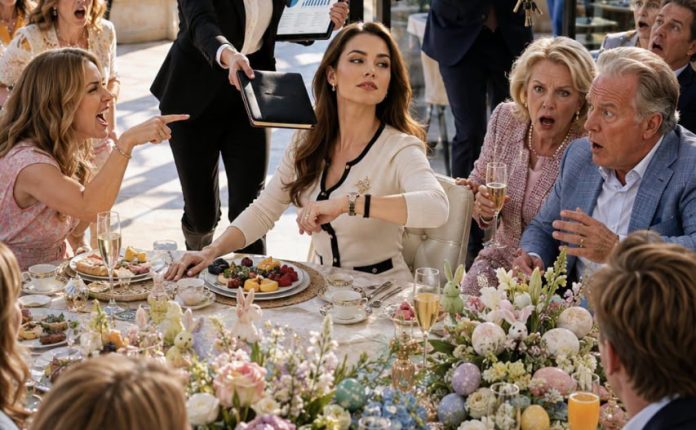
Mom spoke first. “Audrey, why didn’t you tell us?”
She had asked with real hurt in her voice. I believed she felt it. That made the question harder to answer. I had spent years wishing she would show even a little curiosity about my life; now she was looking at me as though I had deliberately shut her out. “I did tell you,” I said. “More than once.”
Dad gave an impatient shake of his head. “We would remember something on this scale.”
“Would you remember me telling you I got into Stanford?”
“I don’t remember that conversation,” he said.
“I know.” I could see it clearly: my phone pressed to my ear, an acceptance letter spread across the small kitchen table in my apartment. I had called Dad because I wanted to hear him sound proud. He had congratulated me, then spent most of the call explaining a problem with the seating plan for Vanessa’s engagement celebration. I had stayed on the line and helped him think it through. Afterward, I folded the letter and put it back in its envelope.
Mom said, “You could have brought it up again.”
“I did.”
Vanessa looked between us. She had gone quiet since Rachel’s announcement, but now she said, “This isn’t fair. You can’t expect everyone to remember every conversation from seven years ago.”
“I don’t,” I said. “I expected someone to ask how school was going while I was there.”
Ethan looked at his plate. Daniel reached for his water.
I took out my phone and opened a folder I had kept mostly because I had never found the heart to delete it. There was the invitation to the launch of Whitmore Technologies, sent ten years earlier. I had been nervous that evening. Our first product was not ready as early as we had promised, and Maya and Owen were still repairing a fault that appeared under heavy use. Even so, I had wanted my parents and sister in the room. I showed Mom her response. She had written that she and Dad were helping Vanessa choose nursery furniture that weekend and hoped to come to another event.
Mom read it slowly. “I remember this,” she said. “I didn’t realize it was the beginning of your own company.”
“The invitation said it was.”
Vanessa asked whether we could have celebrated on another day. “We could have,” I said. “That isn’t the point. You never asked afterward how it went.” I had phoned Mom the next week anyway. She had been busy getting ready for a visit from Vanessa’s in-laws. When she asked about my work, I began telling her that the launch had gone better than we expected. She interrupted to ask whether I had seen a photograph of the nursery. I remembered looking at it while sitting on the floor of our office, waiting for a server to restart.
Dad studied the invitation on my screen. “I knew you were doing something with technology. You said investors were involved. I thought you worked for them.”
“You could have asked who owned the business.”
He opened his mouth, then closed it. At Thanksgiving after our first major funding round, I had tried to explain how we planned to expand. He remembered that conversation once I mentioned it. He also remembered giving me advice on how to make myself useful to the investors. He had assumed they were my employers, and I had been too tired that night to correct him a third time.
Rachel returned from her call but stayed a respectful distance away. She had met Mom and Dad once, briefly, at an event where they arrived after my remarks. She had asked afterward why they seemed unaware that I had been the speaker. I had told her families did not always keep up with one another’s work. Rachel had looked unconvinced and had not pressed me. Now she watched me with the same careful concern she gave me before difficult board meetings.
Daniel cleared his throat. “My firm’s been trying to meet with you for years.”
“I know. Your office sent seventeen requests.”
He looked startled that I knew the count. Rachel tracked approaches from financial firms, and his had appeared more than once in our discussions. Their first presentation had addressed its subject as “Mr. Whitmore” throughout. The mistake alone was fixable. The larger problem was that the team seemed to know little about our customers or the risks our stores carried. “We didn’t see enough preparation to take it further,” I told him.
“I wasn’t on that presentation,” Daniel said.
“I know.”
Dad asked whether I had really declined a firm over a mistaken title. “I declined it because the presentation showed they hadn’t studied the business,” I said. “They wanted a meeting with the person on the headline. They had not learned much about the people doing the work.” Daniel looked again at the article on his phone. He did not argue.
Vanessa turned toward me. “When you say you work in a store, are you doing it to test us?”
“No. I go because I need to know what a shift is like.”
“Why can’t your managers report back?”
“They do. I trust them. I also learn different things by being there.” I told her about the previous Tuesday in Westchester. The new checkout system had passed its planned tests, but during real customer traffic the staff found three problems. One slowed returns for people who had paid with gift cards; another made it harder to see stock in nearby stores. A third appeared only when a customer changed sizes while an order was being held. The team could fix them because the store employees described exactly what had happened.
Dad listened closely. “That’s sensible,” he said.
I looked at him. Half an hour earlier, he had let Vanessa present the same store work as a reason to laugh at me. Now he admired it. I wanted the compliment; a small part of me still did. But I could not accept it without hearing his earlier silence. “It was sensible when you thought I was an employee, too,” I said.
He looked away. “I didn’t say otherwise.”
“You didn’t say anything.”
Ethan, who had been following every word, asked whether most software decisions could be tested that way. I answered him. He asked another question about stock forecasts, and for a few minutes we talked about what a shop manager needed to know before placing orders. He was interested in the problem rather than the headline. I could feel myself relaxing as I explained it. Vanessa watched us, turning the stem of her glass between her fingers.
Rachel approached with one further request from the communications team: they wanted to confirm the shareholding figure before responding to the press. I gave her the figure, thirty-four percent, and asked her to use the approved statement. Mom heard us. “Thirty-four percent of $4.2 billion?” she asked. I told her the value changed with the market, but yes, on that morning my holding was worth about $1.4 billion. Aunt Rebecca stopped doing the arithmetic in her head. A man at a nearby table raised his phone, then lowered it when Rachel looked his way.
Vanessa spoke so softly I almost missed it. “I called you stupid.”
“You did.”
“I’ve said things like that before.”
“Yes.”
She looked down at her hands. “You could have told me to stop.”
“I did.” I remembered Christmas evenings when I had asked her to leave my job alone, birthdays when I had gone outside for air after one of her jokes. “You said I was too sensitive. Then everybody moved on.”
Mom reached across the table. “We’re proud of you, Audrey.”
I looked at her hand. I wanted to believe her. I wanted to believe she would have said the same thing before Rachel came over. “I can see you’re impressed,” I said. “I need time to understand the rest.”
Her fingers drew back. Dad sighed and told me I was making the conversation harder than it needed to be. He sounded tired, as if the figures had settled the matter and I was keeping everyone at the table unnecessarily. I waited for him to ask what I meant. He reached instead for his phone. That, more than Vanessa’s insult, told me we had not yet had the conversation I needed.
Click here to continue reading: PART 4: When My Family Tried to Turn Years of Ridicule Into One Awkward Brunch, a Resort Bill Made Their Expectations Plain
My Sister Chose an Easter Table Overlooking the Pacific, Certain Everyone There Would Agree About What I Had Made of My Life
Part 3 of 8