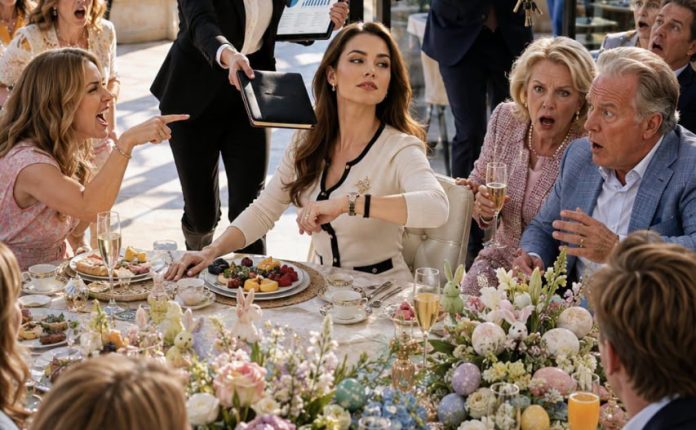
Vanessa repeated “Stanford” once more, as if the word might reveal its own flaw if she said it often enough. Then she gave up on disproving the degree and turned to what she considered the stronger point. People with impressive credentials, she said, generally made something of them. Dad nodded and offered a brief opinion about education and ambition. I watched a waiter steady a vase when the wind shook the table. My family had found a way to make my answer disappear without asking a single question about it.
Ethan tried again. “What did you study?”
“Operations, finance, and how technology changes the way companies work.”
“That’s close to what I’m interested in.” He pulled his chair an inch nearer. “Do you think it’s better to learn to build something first, or figure out whether anyone needs it?”
“I’d start by talking to the people who might use it.”
Vanessa heard the last part. “Ethan, Daniel could give you better advice.”
“I asked Audrey,” he said. He was quiet, but he did not take the question back.
I looked toward the fountain at the terrace entrance. Rachel was approaching with her tablet tucked against a leather portfolio. She moved quickly, then slowed when she saw the table. We had spent the preceding weeks in conference rooms and late calls, often communicating in fragments because each of us knew what the other needed. She knew I was at a family brunch. From her expression, I could tell the news had arrived and that she would give me the facts before anything else.
“Excuse me,” she said when she reached us. “I’m looking for Ms. Whitmore.”
Vanessa straightened. She was still using Whitmore professionally, and people often assumed she was the person to address in a room. “I’m Vanessa Whitmore.”
Rachel acknowledged her politely, then came around the table to me. “Audrey. Legal has confirmation. All of the merger documents are signed and cleared.”
Dad looked up. Daniel stopped speaking to Uncle Charles. I asked Rachel whether the final terms matched what we had approved the night before. “They do,” she said. “The valuation is $4.2 billion, and the integration team can begin Monday. The supply-chain group also wants time with you next week.”
“Tuesday afternoon,” I said. “Keep the morning open for the store teams.”
Rachel noted it on her tablet.
Vanessa’s fork slipped against her plate. “Sorry,” she said, though no one had spoken to her. Mom turned to Rachel. “Who are you?”
“Rachel Cole,” she replied. “I work with Audrey at Whitmore Technologies.”
She held a senior operating role, and had been beside me through five years of growth, setbacks, and decisions I could never have made alone. At that table she kept the introduction simple. Mom looked from Rachel to me. Dad asked what Whitmore Technologies did. Before I could answer, Daniel drew out his phone and searched the name. The color left his face as he read.
“You’re Audrey Whitmore?” he asked.
“Yes.”
“The founder?”
“Yes.”
He put the phone on the table and turned it toward Dad. There was a photograph of me taken outside one of our offices, with a headline about the morning’s transaction. Daniel had seen my name at work before, he said, though he had never connected it with the woman his wife called her sister. He knew our retail analytics platform. His firm had tried to arrange meetings with us. I saw him working backward through years of conversations in which he had accepted Vanessa’s account of what I did.
Rachel answered Dad’s question when he asked it again. Whitmore Technologies built systems that helped retailers understand demand, manage stock, and make decisions across their stores. The merger brought a large physical network into the company alongside the technology. The projected annual revenue of the combined business was just over $3.7 billion. She spoke plainly, without making any effort to impress them. Her matter-of-fact voice made the news harder for my family to dismiss.
Mom held her napkin in both hands. “How many stores?”
“Eight hundred and forty-seven,” Rachel said.
Vanessa shook her head. “That can’t be right. Audrey works at StyleHub.”
“I do,” I said.
“StyleHub has stores everywhere.”
“It does.”
She stared at me. I could see the moment she arrived at the thought and resisted it. “You’re saying you work for this company too?”
“I own StyleHub. I acquired it six years ago.”
Aunt Rebecca set down her glass. Dad asked how I had paid for a retail chain. I told him about the financing, investors, and equity arrangements in broad terms. It had been a difficult purchase. StyleHub was struggling then, and plenty of people thought the physical stores would become a burden. The people inside them had shown us where our software was still wrong. We changed the business by listening to them, and they changed the technology we built.
“You bought it six years ago,” Vanessa said. “And still go into the stores?”
“Of course.”
“But you told us you closed one last night.”
“I did. We were testing a checkout change, and the manager needed another person.”
She seemed troubled by the ordinary detail. It had been one thing to discover that I owned the chain; another to learn that helping in a store had never been evidence against me. Mom asked whether the employees knew who I was. Some did, I told her. Others met me as the person working alongside them that day. I did not conceal my identity, but I also did not make every visit into a ceremony.
Daniel was still reading. “Your company’s public.”
“For three years.”
Dad looked directly at me. “Why didn’t we know any of this?”
I could have answered sharply. Instead I asked whether he remembered the invitation to our public listing celebration. Mom remembered an event in the city that she thought had something to do with my office. “The invitation identified me as CEO,” I said. She looked down at the table. Dad frowned, as though the wording might have been less clear than I remembered.
Rachel laid her tablet beside me so I could review a message from the finance team. The price on the screen had drawn Dad’s attention; he asked a question about my ownership percentage. I answered that I still held thirty-four percent. Aunt Rebecca began a calculation under her breath, then stopped. I did not want to hear anyone announce my net worth across the terrace. A few diners were already glancing toward us.
Rachel saw them too. She closed the screen and reminded me that the general manager had confirmed our one o’clock meeting about the resort’s summer renovation. Vanessa looked up. “What would you be meeting with this resort about?”
The question took me back to the plate in front of me, to the extra lemon in the sauce. I had met with the kitchen and management team after buying Seaside Springs the previous month. We were considering a conference wing, though I wanted the property to retain the quiet that made guests come back. I had not been sure whether I would mention the purchase at brunch. Vanessa had chosen the resort herself, without knowing I owned it.
“We’re reviewing a renovation,” I said. “I bought Seaside Springs last month.”
For a moment Vanessa looked toward the terrace entrance, as if the general manager might appear and correct me. She had spent weeks presenting this place to the family as proof of her judgment. Her eyes moved over the lilies, the railing, the staff carrying plates. “You own the whole property?”
“Yes.”
Dad asked the purchase price. I told him it was eighty-nine million dollars, paid in cash. He repeated the figure softly. The breeze sent one loose lily petal across the table, and no one reached for it. I had imagined the reveal more than once over the years, usually after a particularly hard family dinner. In those imaginings I had something clever to say. Sitting there, I found I had no interest in a clever line.
Rachel leaned toward me. “The news team can wait until after brunch,” she said quietly. “There’s nothing you need to do this minute.”
I thanked her. She moved a few steps away to answer a call, leaving me with my family. Vanessa looked stunned; Mom looked close to tears. Dad’s face had settled into an expression I recognized from negotiations, attentive and newly interested. I knew they would have questions now. What I could not tell was whether anyone wanted the answers I had tried to give them before the numbers appeared.
Click here to continue reading: PART 3: My Parents Asked Why I Had Kept My Life From Them, So I Showed Them the Invitations They Had Chosen to Ignore
My Sister Chose an Easter Table Overlooking the Pacific, Certain Everyone There Would Agree About What I Had Made of My Life
Part 2 of 8