My name is Mara Whitmore, and the first time my parents told me education was wasted on girls, I was nineteen years old and holding an acceptance letter to Northwestern in both hands. Grandma Rose had died the previous winter. She had spent years telling me that knowledge was the one possession nobody could confiscate, so I believed the education trust she created would finally make college possible without drowning me in debt. Work became the bridge between what I had lost and what I still wanted. The family treated sacrifice like proof that the original decision had been wise.
Dad asked me to sit at the dining table after Sunday dinner. Mom placed a blue folder between us and would not meet my eyes. My younger brother Tyler leaned against the kitchen doorway, pretending not to listen. Dad said Grandma’s money had been reconsidered. Eighty-six thousand dollars was too much to spend on a daughter who would probably marry, have children, and stop working anyway. I did not yet understand how long that sentence would follow me. At nineteen, I still thought parental confidence meant parental authority. The injustice felt personal before I understood it could also be documented.
I remember asking whether he was joking. Dad looked offended. “Tyler has a real future to build,” he said. “You can study locally if you insist.” Mom touched my wrist and added the sentence that stayed with me longer than Dad’s cruelty. “Girls don’t need degrees to have good lives, sweetheart. Don’t turn this into a war.” Every shift at Bell and Finch made independence feel less theoretical. Grandma’s promise stayed with me whenever exhaustion made school feel impossible. I carried anger quietly because I had no time to perform it. I did not need their permission to keep learning.
The trust had always been described as Grandma’s gift to me. She mailed me brochures, circled scholarship deadlines, and once made me promise I would never choose a smaller life just to keep other people comfortable. After she died, Dad became the acting trustee with Mom listed as co-trustee. I had been grieving too hard to ask what that legally meant. At nineteen, I still assumed parents could be unfair without being dishonest. At first, survival mattered more than understanding the paperwork. I remembered Grandma whenever someone called my goals unrealistic. That silence shaped me long before law school did.
Tyler said almost nothing that night. When I asked whether he knew the money was supposed to be mine, he stared at the floor and said Dad had called it family education money. That answer hurt because it gave him somewhere to hide. Maybe he believed Dad. Maybe he wanted to. The next week, he accepted a transfer for his business-school deposit and a used BMW Dad said would help him “look established.” Tyler’s easier path became a family story I was expected to applaud. Nobody called my route ambitious while I was carrying plates at midnight. I stayed calm.
I declined Northwestern because the remaining aid package still left more than I could borrow safely. Two weeks later, I moved into a small apartment above a laundromat and started waiting tables at a restaurant near the commuter rail station. My parents told relatives I was being dramatic. Mom said I could come home whenever I was ready to apologize for accusing the family of stealing from me. I learned to survive first and ask legal questions later. Still, I kept moving because stopping would have made their decision final. I learned how easily unfairness can be disguised as practicality.
I never accused them publicly. I barely spoke about the money at all. Shame has a way of making the injured person feel like the scandal. When relatives asked why I changed schools, I said finances. When they praised Tyler’s ambition, I smiled. When Dad joked that I was “still figuring things out,” I carried plates to strangers and learned how long anger can stay hot without making a sound. The older I became, the less convincing that explanation sounded. My education became something I built in pieces instead of receiving whole. I held the boundary. I did not retreat.
The restaurant was called Bell & Finch, though there was no bell and nobody named Finch. I worked five evenings a week, brunch on Sundays, and picked up banquets whenever another server called out. I learned civil procedure from flashcards tucked beside the coffee station. I wrote essays after midnight with my shoes off because my feet throbbed too much to keep them on. I stopped waiting for my parents to recognize the cost. I did not apologize for asking. I chose not to soften it. I let the moment stand. I no longer doubted myself. I did not look away.
Community college became a state university after I earned enough credits and scholarships to transfer. I graduated with honors while working thirty hours a week. My parents did not attend because Tyler had an internship event in another state the same weekend. Mom mailed me a card signed by both of them. Inside, she wrote, “We knew you’d find your own way.” I kept that sentence for years. I let that settle. I stayed with reality. The pattern was clear. I refused to assume. I let evidence lead. The silence answered enough. I could breathe again. I trusted the record.
Law school was not part of my original plan. It began with a business-law professor who noticed I cared less about contract doctrine than about who controlled the paperwork. Professor Elaine Brooks asked why I always stayed after class to question fiduciary duties, trusts, and financial disclosure. I told her, for the first time outside my family, what happened to Grandma’s education money. I kept listening. I chose clarity. I kept my distance. I accepted the discomfort. I knew what mattered. The distinction became important. I refused the old role. I let the truth remain. I kept my answer simple.
Professor Brooks did not tell me whether my parents had broken the law. She asked questions instead. Was the trust revocable? Who were the trustees? Did I ever receive an accounting? Was the money restricted to my education? I knew almost none of the answers. She said, “Then your first lesson is this: family stories are not documents. Find the documents.” Work became the bridge between what I had lost and what I still wanted. I trusted myself. I wanted proof. That changed everything. I knew better. I kept going. I watched carefully. I stopped guessing. I understood the difference.
I requested copies from Dad. He called within ten minutes. “Why are you digging up old nonsense?” he asked. I said I wanted the trust records for my files. He told me the account had been closed years earlier and Grandma had given him discretion. When I asked for the closing statement, he said the bank no longer had it. That sounded wrong, but I was too busy surviving school to fight. I did not yet understand how long that sentence would follow me. The family treated sacrifice like proof that the original decision had been wise. The facts remained.
Professor Brooks helped me apply to law schools. I received partial scholarships, borrowed carefully, and kept working at Bell & Finch through my first year. My classmates complained about cold calls and reading loads. I measured semesters in table sections, bus schedules, and how many hours of sleep I could lose without forgetting the difference between personal jurisdiction and subject-matter jurisdiction. The injustice felt personal before I understood it could also be documented. I carried anger quietly because I had no time to perform it. Tyler’s easier path became a family story I was expected to applaud. I moved forward anyway.
Tyler’s life looked effortless from a distance. He finished his MBA, joined Caldwell Urban Partners, and began dating Madison Caldwell, the founder’s daughter. Our parents treated the relationship like a merger between royal houses. Dad sent me photographs of charity galas and rooftop dinners. Mom wrote, “Your brother is finally with people who understand ambition.” I wondered what that made me, then deleted the message. Every shift at Bell and Finch made independence feel less theoretical. Nobody called my route ambitious while I was carrying plates at midnight. Still, I kept moving because stopping would have made their decision final.
Grant Caldwell, Madison’s father, built luxury apartment projects across Illinois and Indiana. Newspapers described him as a visionary developer. Dad talked about him constantly after Tyler joined the firm. Apparently Grant had taken a special interest in my brother and promised him a path into senior leadership. Mom called it proof that investing in Tyler’s future had been the right decision. At nineteen, I still thought parental confidence meant parental authority. Grandma’s promise stayed with me whenever exhaustion made school feel impossible. My education became something I built in pieces instead of receiving whole. That mattered. I noticed. I remembered.
The name Leonard Pike appeared often in those conversations too. Pike had been my parents’ accountant for as long as I could remember. He prepared Grandma’s final returns, advised Dad during the estate, and later handled tax work for Caldwell Urban Partners. I noticed the overlap but attached no meaning to it. Wealthy families often share accountants, lawyers, bankers, and introductions. At least that was what I told myself. I learned to survive first and ask legal questions later. I did not need their permission to keep learning. I learned how easily unfairness can be disguised as practicality. I understood.
I saw my parents twice during law school. The first time was at Thanksgiving, when Dad asked whether I was “still doing the lawyer thing.” The second was at Tyler’s engagement dinner. Madison was gracious, polished, and kinder to me than I expected. Grant shook my hand and said Tyler had told him I was “very academic.” I wondered whether that was meant as praise or warning. Work became the bridge between what I had lost and what I still wanted. The older I became, the less convincing that explanation sounded. At first, survival mattered more than understanding the paperwork.
At the engagement dinner, Pike sat three seats from Dad. He looked older than I remembered, with silver hair and a habit of rubbing his thumb across his wedding ring whenever finances came up. When Mom introduced me as the family’s “future little lawyer,” Pike dropped his eyes toward his plate. It was such a small movement that I forgot it until years later. I remembered Grandma whenever someone called my goals unrealistic. I stopped waiting for my parents to recognize the cost. That silence shaped me long before law school did. I let the moment stand. I stayed grounded.
The bar exam nearly broke me. I stopped taking restaurant shifts for six weeks and lived on savings, rice, eggs, and coffee. Every practice test seemed designed to reveal a new category of ignorance. On the final morning, I carried Grandma’s old fountain pen in my bag even though I could not use it during the exam. It made me feel less alone. I did not yet understand how long that sentence would follow me. The injustice felt personal before I understood it could also be documented. The family treated sacrifice like proof that the original decision had been wise.
Results arrived on a rainy Thursday in October. I opened the website in Bell & Finch’s empty dining room before lunch service and searched my name three times because I did not trust my eyes. When I finally understood I had passed, I sat on the floor behind the host stand and cried into both hands while the dishwasher clapped from the kitchen. I carried anger quietly because I had no time to perform it. Tyler’s easier path became a family story I was expected to applaud. Work became the bridge between what I had lost and what I still wanted.
Professor Brooks called first. My best friend Lena called second. Mom called twenty minutes later, which surprised me because I had not told her when results would post. “We always believed in you,” she said through tears. I stared at the framed card she had mailed after my undergraduate graduation. We knew you’d find your own way. The difference between those sentences felt like a canyon. Every shift at Bell and Finch made independence feel less theoretical. Grandma’s promise stayed with me whenever exhaustion made school feel impossible. Nobody called my route ambitious while I was carrying plates at midnight.
I thanked her because I did not want the first hour of becoming a lawyer to belong to an argument from twelve years earlier. Mom asked where I had accepted a job. I told her Holloway Price & Benton, a Chicago firm known for fiduciary disputes, financial misconduct, and complex civil litigation. She sounded impressed when she recognized the name. Still, I kept moving because stopping would have made their decision final. My education became something I built in pieces instead of receiving whole. I did not apologize for asking. I chose not to soften it. I no longer doubted myself.
Then she asked what my first case involved. I looked at the intake folder my supervising attorney had emailed that morning. The defendant list included Leonard Pike, CPA. I told Mom, “It involves an accountant.” She laughed and said every family knows one. I did not tell her the second principal defendant was Grant Caldwell, Tyler’s future father-in-law. At nineteen, I still thought parental confidence meant parental authority. I learned to survive first and ask legal questions later. I did not need their permission to keep learning. The family treated sacrifice like proof that the original decision had been wise.
The case belonged to partner Naomi Benton, not me. Three retired investors alleged that money designated for protected real-estate escrow accounts had been routed through affiliated entities without proper disclosure. Grant Caldwell denied wrongdoing. Leonard Pike’s firm had prepared transaction schedules and tax documents. I was assigned basic document review because new associates start with boxes, spreadsheets, and the privilege of discovering how little they know. I learned how easily unfairness can be disguised as practicality. The older I became, the less convincing that explanation sounded. I stopped waiting for my parents to recognize the cost. I held the boundary.
On my second day, Naomi explained our rules. Facts first. No assumptions. No moral theater. If I recognized any party, witness, entity, or transaction from my personal life, I was to stop immediately and disclose it. “Conflicts are not shameful,” she said. “Hiding one is.” I almost told her about Pike then, but knowing a family accountant socially did not yet seem significant. At first, survival mattered more than understanding the paperwork. I remembered Grandma whenever someone called my goals unrealistic. That silence shaped me long before law school did. I did not look away. I refused the old role.
The first production included thousands of pages. Most were ordinary invoices, escrow ledgers, email chains, and corporate-formation records. I spent ten hours marking dates and entities. Near midnight, I opened a spreadsheet listing historical capital sources for one Caldwell project. A transfer reference in the left column made my stomach tighten before I understood why. The account name was Rose Whitmore Education Trust. I did not yet understand how long that sentence would follow me. The injustice felt personal before I understood it could also be documented. I did not retreat. I let that settle. I let the truth remain.
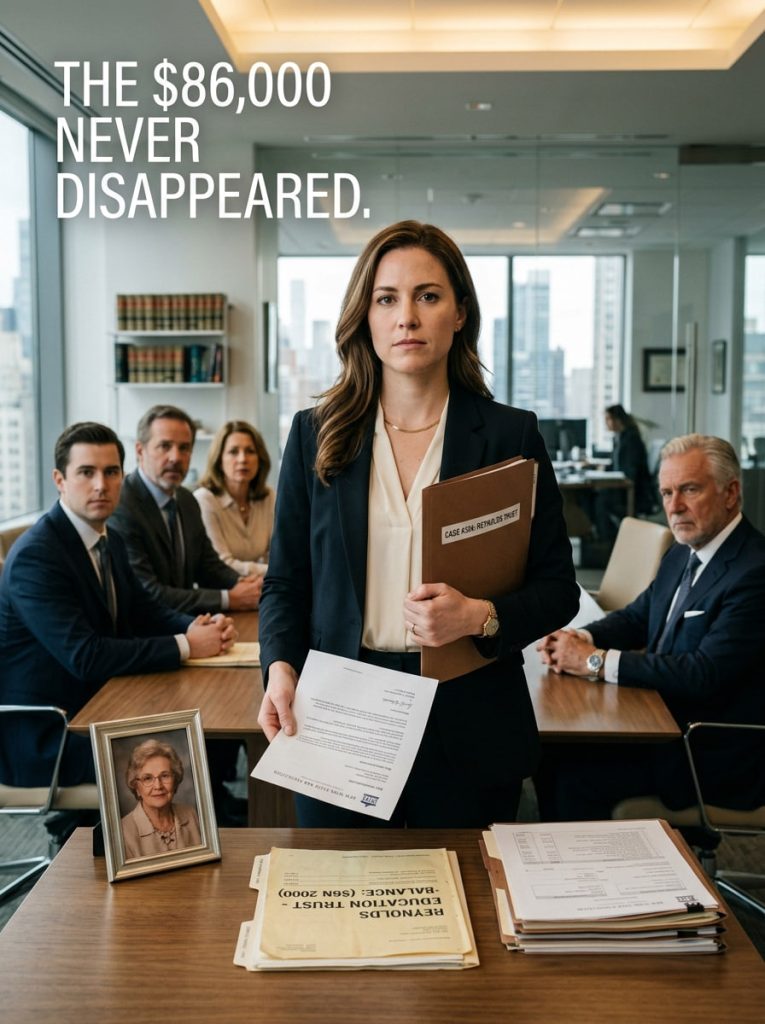
I stopped touching the keyboard. The transfer amount was $86,000 exactly. The date was eleven days after Dad told me Grandma’s money was going to Tyler. The recipient was not Tyler’s university. It was a limited-liability company called CWP River North I, an early Caldwell development entity. Leonard Pike’s initials appeared beside the transaction memo. I carried anger quietly because I had no time to perform it. Tyler’s easier path became a family story I was expected to applaud. Nobody called my route ambitious while I was carrying plates at midnight. I stayed with reality. I kept my answer simple.
I did not open another file. I walked directly to Naomi’s office even though it was nearly midnight. She was still there, eating almonds over a deposition outline. I told her the trust name was mine, the trustees were my parents, the accountant was my family’s accountant, and Grant Caldwell was my brother’s future father-in-law. Then I said, “I need to be screened.” Every shift at Bell and Finch made independence feel less theoretical. Still, I kept moving because stopping would have made their decision final. Work became the bridge between what I had lost and what I still wanted.
Naomi asked only enough questions to protect the case. Had I learned anything from family conversations that was not independently in the production? Possibly. Had I discussed the case with relatives? No. Had I downloaded or copied anything for personal use? No. She thanked me, removed my access before I left the room, and called the firm’s ethics counsel. By morning, a formal screen separated me from the matter. Grandma’s promise stayed with me whenever exhaustion made school feel impossible. My education became something I built in pieces instead of receiving whole. The pattern was clear. I refused to assume.
I was relieved and furious. The document had answered one question and created twenty more. Grandma’s money had not simply been handed to Tyler. It had been invested into a Caldwell entity, yet my parents had spent years saying they chose my brother’s education instead. I could not use confidential case materials to investigate my family. That meant finding my own lawful source. At nineteen, I still thought parental confidence meant parental authority. I learned to survive first and ask legal questions later. The family treated sacrifice like proof that the original decision had been wise. I let evidence lead.
I called the bank that had administered Grandma’s trust. The representative would not discuss details until I provided identification and proof that I was the named beneficiary. Professor Brooks helped me locate a copy of Grandma’s will from probate records. The trust article identified me by full name and stated the funds were for “postsecondary education and related professional training.” Dad’s discretion was limited, not unlimited. The discovery frightened me because professional ethics left no room for shortcuts. I wanted answers, but I wanted them lawfully and independently. That boundary made the truth harder to reach but safer to trust.
The bank said archived statements required a written request. I sent one the same day. Then I hired my own attorney, Rebecca Hale, who specialized in trust and fiduciary litigation. I told her nothing from my firm’s confidential case beyond the public identities of Pike and Caldwell. I described the family history, Grandma’s will, Dad’s refusal to account, and the possibility that the money had been redirected. Being screened from the case protected both the clients and me. Documents began replacing the family explanations I had heard for years. Each record separated what happened from what everyone claimed had happened.
Rebecca’s first instruction was simple: stop confronting anyone until we had independent records. Her second was harder: prepare for the possibility that Tyler did not receive what my parents claimed either. “Families often tell different lies to different children,” she said. I had spent twelve years treating my brother as the person who benefited most. I was not ready to imagine he might also have been used. I learned that suspicion feels powerful but evidence carries farther. The trust file turned an old wound into a precise fiduciary question. The signature issue forced everyone to confront what consent actually meant.
Three days later, an envelope from the bank arrived at my apartment. Inside were archived statements, trustee instructions, and the closing transaction. The trust contained $86,000 after Grandma’s final contribution. Dad and Mom jointly authorized a transfer of the entire balance to CWP River North I. The notation said “education-related family investment, beneficiary consent on file.” I had never consented. Rebecca kept me focused on proof whenever emotion tried to outrun it. Tyler’s uncertainty complicated a story I had once made simple. Professional restraint became part of reclaiming personal control. Every dated email narrowed the space where excuses could hide.
Attached was a one-page consent form bearing my name. The signature looked enough like mine to make me feel sick. But the date was a Wednesday when I had been working a double shift fifty miles away. Rebecca told me not to leap to forgery without examination. I heard Professor Brooks in my head: family stories are not documents. Neither are suspicions. We needed proof. My parents had controlled the narrative because nobody else held the paperwork. Once the records surfaced, certainty no longer belonged to the loudest person. The law did not erase betrayal; it gave the betrayal edges.
The form listed Leonard Pike as witness. Rebecca requested the trust’s complete file and began a separate inquiry. I informed Naomi through ethics counsel that independent records confirmed I might be a fact witness connected to Pike. Naomi thanked me and reminded me not to ask about the Caldwell case. Our conversations became carefully boring. That discipline protected both me and the clients. I refused to use confidential information even when it might have helped me. I began to understand how many people had relied on somebody else’s assurance. Facts grew stronger when they came from sources outside the family.
Mom called that weekend to discuss Tyler’s wedding venue. I listened while she described imported flowers, a country club, and Grant Caldwell’s generosity. Then she casually said Dad wanted me seated near “the professional people” now that I was finally established. I stared at Grandma’s forged consent form on my desk and wondered how much politeness a family can demand before it becomes another kind of lie. I wanted answers, but I wanted them lawfully and independently. I learned that suspicion feels powerful but evidence carries farther. That distinction kept the case from becoming another argument at the dining table.
I asked Mom one question. “When you gave Tyler Grandma’s money, did he know it was mine?” She went quiet. Then she said, “Mara, why are you doing this now?” I repeated the question. She said Tyler knew Grandma had set money aside, but Dad had explained the family needed to use it more intelligently. That answer was not yes, but it was not no. The discovery frightened me because professional ethics left no room for shortcuts. Being screened from the case protected both the clients and me. That boundary made the truth harder to reach but safer to trust.
I asked whether the money had gone to Tyler’s tuition. Mom said, “It supported his future.” The wording changed everything. For twelve years, Dad had said Tyler needed graduate school. Mom had said the same. Now she was avoiding the word tuition. I asked where the money went. She became angry and said my law degree had made me suspicious of everyone. The trust file turned an old wound into a precise fiduciary question. I refused to use confidential information even when it might have helped me. I began to understand how many people had relied on somebody else’s assurance.
I ended the call before she could pull me into the old argument. Rebecca later told me that evasive language can be emotionally revealing without being legally useful. “Do not build your case from tone,” she said. “Build it from records.” She was right. Still, I slept badly that night, replaying every family celebration where Tyler’s success had been presented as the return on my sacrifice. Documents began replacing the family explanations I had heard for years. Each record separated what happened from what everyone claimed had happened. Rebecca kept me focused on proof whenever emotion tried to outrun it.