My Daughter Took Me To The Bank, Then Moved My $65,000 Into Her Account And Told Me “You Can’t Use This Anymore.” I Looked At The Manager And Entered My Secret Second Password. Then Her Card Was Blocked…
My daughter smiled at me inside a freezing bank office and calmly announced that the $65,000 I had saved for retirement now belonged in her account because I was “too old to manage it.” She expected tears, confusion, maybe even gratitude when she promised to give me a grocery allowance from my own money. The bank was the first place where facts mattered more than Lauren’s explanation, and that changed everything. Once the security protocol appeared, the argument stopped being about age and became about authorization. Richard’s old safeguard had seemed excessive until the day it prevented a disaster.
Instead, I walked past her, sat across from the banker, and asked him to open a security protocol my late husband had created eight years earlier. Lauren had prepared for everything except the possibility that her mother had been watching her very carefully. The air conditioning inside Hearthstone Community Bank was cold enough to raise goose bumps along my arms, but my daughter’s smile made the room feel colder. Richard’s old safeguard had seemed excessive until the day it prevented a disaster. The red warning on Nathan’s screen created a record that did not care who was related to whom.
I sat on a dark leather chair with both hands resting on my purse while Lauren paced across the polished stone floor in a cream-colored suit, her narrow heels striking the tile with a hard little click every few seconds. Lauren had spent years turning small permissions into larger ones while presenting control as concern. I could love my daughter and still admit that love had made me slower to question her choices. Her confidence came from assuming I would choose family peace over confrontation as I had before. I did not need revenge; I needed the pattern to stop.
She looked irritated rather than nervous, which was almost impressive considering she was about to try stealing every dollar I had recently set aside for retirement. What Lauren did not realize was that I had been watching the tiny muscle beneath her left eye twitch since breakfast. My name is Evelyn Mercer, and I was sixty-eight years old when my only daughter decided age had transformed me from her mother into an opportunity. The hardest part was realizing how carefully Lauren had studied the places where convenience replaced caution. I was finally learning that patience has limits when respect disappears.
For nearly four decades, my husband Richard and I had operated a wholesale nursery behind our home, starting with two greenhouses, an old pickup truck, and enough debt to make us lose sleep for the first five years. Richard had always believed preparation was a form of love, even when I teased him for being overly cautious. His habits remained inside my life through passwords, files, routines, and the discipline of verifying before trusting. I missed him most when a problem appeared that would once have brought us together at the kitchen table. Nothing about family made entitlement more reasonable.
Richard died six years earlier, but I kept the business running until my knees finally convinced me that hauling soil and checking irrigation lines before sunrise was no longer a charming way to spend retirement. A month before that morning at the bank, I sold the nursery inventory and the adjoining greenhouse lot, leaving exactly $65,000 in savings after taxes and expenses. His habits remained inside my life through passwords, files, routines, and the discipline of verifying before trusting. Remembering Richard did not make decisions for me, but it reminded me that I knew how to solve hard problems.
That money was not a fortune, but it represented independence, and I had explained that clearly to Lauren. It would cover property taxes, home repairs, groceries, insurance, and the thousand boring little expenses that allowed me to remain in the house where Richard and I had built our life without asking anyone for permission. The sixty-five thousand dollars represented independence, not luxury, and Lauren had treated that distinction as irrelevant. What frightened me was not losing cash but needing permission to spend money that was already mine. I could care about everyone involved without volunteering to absorb the consequences again.
Lauren had responded by nodding sympathetically and saying, “Of course, Mom,” but during the weeks that followed, she suddenly became fascinated with my banking arrangements. She wanted to know whether I used online banking, whether my debit card had daily limits, whether anyone else was listed on my accounts, and whether I had updated my financial power-of-attorney documents. Once the security protocol appeared, the argument stopped being about age and became about authorization. I left the bank understanding that systems protect people only when those people still know how to use them. Nothing improved when I translated control into concern.
For three days before our visit to the bank, she insisted my accounts needed to be “modernized.” That morning she had stood over my kitchen table while I drank black coffee, explaining that everything was digital now and banks sometimes restricted older accounts when security information became outdated. The bank was the first place where facts mattered more than Lauren’s explanation, and that changed everything. The red warning on Nathan’s screen created a record that did not care who was related to whom. I had spent too many years softening facts so other people would not feel responsible for them.
“You barely check your email, Mom,” she said with the patient voice people use when explaining a television remote to someone they have already decided is helpless. “Let me link our profiles so I can handle the technical stuff before you accidentally get locked out.” I did not argue because arguing would have told Lauren I was suspicious, and I wanted to understand what she was actually trying to do. Every new detail forced me to separate the daughter I loved from the decisions she had made. I wanted honesty more than appearances because appearances had hidden too much already.
Instead, I nodded, finished my coffee, and noticed that familiar twitch beneath her left eye, the same one she had developed at sixteen whenever she came home late and invented an elaborate story about where she had been. Now, sitting inside the bank lobby, she suddenly stopped pacing and extended her hand toward me. That detail stayed with me because it connected earlier moments I had once explained away. I left the bank understanding that systems protect people only when those people still know how to use them. I did not need another promise before deciding what I would protect.
“Give me your debit card and driver’s license. I’ll go into the manager’s office alone and speed this up.” “Why would you go alone?” I asked. “Because if you come in, they’ll ask a hundred security questions, you’ll get frustrated, and we’ll be here all afternoon.” That moment became another line between the life I had tolerated and the one I was rebuilding. The red warning on Nathan’s screen created a record that did not care who was related to whom. I left the bank understanding that systems protect people only when those people still know how to use them.
Lauren sighed dramatically, glancing toward the glass office as though my presence had already embarrassed her. “Please, Mom. Just trust me for once.” I opened my purse, removed the card and identification, and placed them in her palm without another question. Lauren’s shoulders relaxed immediately, and that told me more than anything she had said all morning. Lauren had spent years turning small permissions into larger ones while presenting control as concern. I could love my daughter and still admit that love had made me slower to question her choices. Every new fact made the earlier explanations harder to believe.
“Sit right here,” she instructed before walking toward the office, using almost exactly the same tone she used when telling her golden retriever to stay. I leaned back in the chair and watched her through the glass. The branch manager was young, perhaps thirty, with neatly combed brown hair and a nameplate identifying him as Nathan Cole. Once I saw the pattern clearly, I could no longer pretend the latest incident stood alone. The truth did not become cruel simply because someone disliked hearing it without excuses. I had learned how expensive it could be to ignore my own uneasiness.
Lauren spoke rapidly while sliding my debit card across his desk, then pulled a folded document from her handbag and placed it beside the card. Even from twenty feet away, I recognized the paper because I had signed it two weeks earlier after Lauren told me it was required to help correct an insurance billing issue. Her confidence came from assuming I would choose family peace over confrontation as I had before. The hardest part was realizing how carefully Lauren had studied the places where convenience replaced caution. The facts were easier to trust than the shifting explanations around them.
Nathan frowned at the document, typed something, asked Lauren a question, and then listened while she leaned forward with both palms on his desk and laughed reassuringly. For a moment, I wondered whether I had misread everything. Lauren was my daughter, the child whose hair I had braided before school, whose college tuition Richard and I had worked extra weekends to help pay, whose first apartment I had furnished with mismatched pieces from our own house. Every boundary felt more natural once I stopped treating someone else’s disappointment as an emergency. The truth needed no dramatic speech to remain true.
Maybe she really was trying to simplify something complicated, and grief, age, and too many years of handling everything alone had turned me suspicious. Then Lauren glanced through the glass at me and smiled. It was not an affectionate smile. Every new detail forced me to separate the daughter I loved from the decisions she had made. The more calmly I looked at the facts, the less complicated the situation became. Lauren had spent years turning small permissions into larger ones while presenting control as concern. Clarity felt harsh only because denial had protected the wrong people for too long.
It was the smile of someone checking whether a door was still locked. Fifteen minutes later, Lauren emerged from the office and slipped my debit card into her own handbag instead of returning it. She crossed the lobby slowly, stopped in front of me, and spoke loudly enough for two customers nearby to hear. “All done, Mom. I stopped asking what explanation would keep the peace and started asking what the evidence showed. Every new detail forced me to separate the daughter I loved from the decisions she had made. That distinction became more important with every decision that followed.
I transferred the $65,000 into my personal account, so you can’t use it anymore.” I looked at her. She actually smiled wider. “It’s safer with me,” she continued. “Derek and I need some liquid cash for his property management business anyway, and once things stabilize, we’ll work out what you need each month. Groceries, utilities, little things like that. I no longer believed that keeping the family comfortable was a job assigned only to me. Some consequences feel cruel only to people who expected someone else to prevent them. This time I let the consequences remain where they belonged.
Think of it as an allowance so you don’t accidentally burn through everything.” For several seconds, all I could hear was the air conditioner humming above us and a printer spitting paper somewhere behind the teller counter. Lauren waited for me to cry, plead, or ask how much my allowance would be, and I could see the anticipation in her face. I had spent too many years softening facts so other people would not feel responsible for them. The silence after a firm answer often revealed more than another hour of arguing. Nothing improved when everyone avoided the obvious question.
Instead, I stood, adjusted my purse strap, and walked directly toward Nathan’s glass office. “Mom, where are you going?” Lauren hissed, hurrying behind me. She grabbed for my elbow, but I shifted sideways and pushed open the office door. Nathan looked up sharply. “Mrs. The bank was the first place where facts mattered more than Lauren’s explanation, and that changed everything. Once the security protocol appeared, the argument stopped being about age and became about authorization. The hardest part was accepting that one clear fact could expose years of assumptions. I had spent enough time negotiating against my own judgment.
Mercer, I was just finishing your—” “My mother gets confused,” Lauren interrupted, forcing a laugh. “We should probably go.” “Sit down, Lauren.” I did not raise my voice. I had used that tone with suppliers who tried changing prices after delivery, contractors who thought a widowed woman would not read invoices carefully, and employees who believed I did not notice missing inventory. The records kept pulling me back to reality whenever emotion threatened to blur it. I could feel the difference between compassion and surrender now. The truth did not become cruel simply because someone disliked hearing it without excuses.
Lauren stopped moving. I faced Nathan. “I am Evelyn Mercer, the primary account holder. My daughter just transferred $65,000 using an authorization document I signed for an insurance billing matter. Is that correct?” Nathan swallowed. “The document appeared to authorize administrative management of—” “It does not authorize asset transfers.” I leaned slightly closer. That moment became another line between the life I had tolerated and the one I was rebuilding. Richard’s old safeguard had seemed excessive until the day it prevented a disaster. Once I saw the pattern clearly, I could no longer pretend the latest incident stood alone.
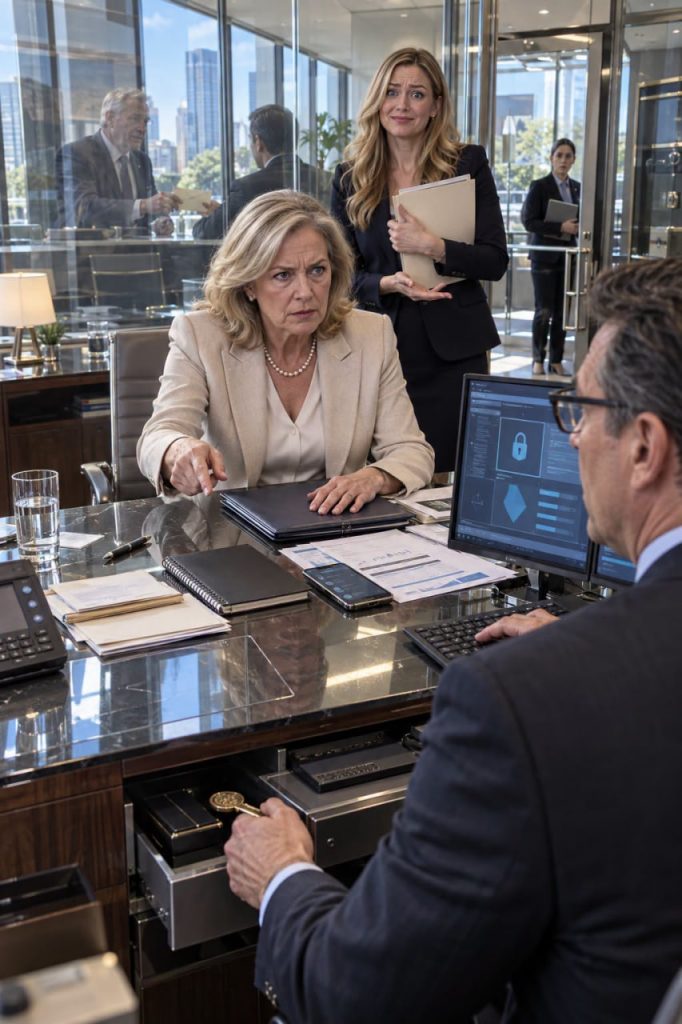
“Before that transaction clears the bank’s internal holding ledger, open the security section on my account and look for the manual override established in 2018.” . Lauren frowned. “What are you talking about?” Nathan typed rapidly, then suddenly stopped. His expression changed. “There is a secondary authorization requirement,” he said slowly. I stopped asking what explanation would keep the peace and started asking what the evidence showed. I no longer believed that keeping the family comfortable was a job assigned only to me. The red warning on Nathan’s screen created a record that did not care who was related to whom.
“Any outgoing transfer above $10,000 initiated by anyone other than the primary holder requires a separate verbal passphrase and manual confirmation.” “Exactly,” I said. Richard had created the protocol after one of our suppliers suffered an account takeover years earlier. Lauren knew about our savings, our business, our insurance, and almost every other financial detail in my life, but she had never known about that second security layer because there had never been a reason to tell her. I could care about everyone involved without volunteering to absorb the consequences again. Nothing improved when I translated control into concern.
I removed a silver pen from my purse, wrote eight characters on a sticky note, and slid it across Nathan’s desk. “Enter that.” Nathan typed. The screen flashed green for half a second. Then it turned red. His eyes widened. “Transfer reversed.” That detail stayed with me because it connected earlier moments I had once explained away. Every boundary felt more natural once I stopped treating someone else’s disappointment as an emergency. The more calmly I looked at the facts, the less complicated the situation became. Clarity felt harsh only because denial had protected the wrong people for too long.
Lauren went completely still. Nathan stared at the next line appearing on his monitor. “The system has also automatically frozen the receiving accounts pending review because the transaction triggered an unauthorized third-party transfer alert.” Lauren’s phone began vibrating inside her handbag. Once. . Twice. Then continuously. She pulled it out, looked at the screen, and every trace of color disappeared from her face. I wanted honesty more than appearances because appearances had hidden too much already. Some consequences feel cruel only to people who expected someone else to prevent them. I did not need revenge; I needed the pattern to stop.
“My cards,” she whispered. I said nothing. “Derek’s business account is linked to mine.” Her voice rose sharply as another notification appeared. “We have payroll tomorrow.” That was when I understood something far more important than the fact that my daughter had tried to steal my retirement savings. Derek spoke as if the survival of his business created a claim on everyone else’s resources. His panic was real, but real panic does not transform another person’s savings into emergency capital. I understood the fear of losing a company because Richard and I had faced it ourselves. That stayed with me.
Lauren had not moved my money because she wanted to protect me. She had moved it because she and Derek were already in trouble. And judging by the panic in her eyes, $65,000 might have been the only thing standing between them and something they had been hiding for a very long time. Once I reviewed the statements, every recurring charge looked different because the pattern was finally visible. Money had become the easiest way to convert my trust into access and access into entitlement. The silence after a firm answer often revealed more than another hour of arguing.
Lauren stared at her phone as though she could force the frozen accounts open by sheer anger. “You need to undo this right now,” she snapped, stepping toward Nathan’s desk. “Tell the system it was a misunderstanding, because Derek’s operating account is connected to mine and if payments bounce tomorrow, we could lose a major contract.” I had learned how expensive it could be to ignore my own uneasiness. I left the bank understanding that systems protect people only when those people still know how to use them. I did not need another promise before deciding what I would protect.
Nathan looked miserable, but before he could answer, I held out my hand and said, “First, I would like my debit card and driver’s license returned.” Lauren’s eyes flicked toward me. “Seriously?” “Yes.” She dug both cards from her handbag and tossed them onto Nathan’s desk with enough force to make the plastic skid across the wood. The bank was the first place where facts mattered more than Lauren’s explanation, and that changed everything. The hardest part was accepting that one clear fact could expose years of assumptions. The facts were easier to trust than the shifting explanations around them.
Nathan picked them up and handed them to me carefully, then explained that once the fraud flag had been triggered, he could not remove it himself. “The review usually takes three to five business days,” he said. “Possibly longer if linked commercial accounts are involved.” Lauren made a sound somewhere between a gasp and a laugh. “Three to five days? The records kept pulling me back to reality whenever emotion threatened to blur it. I was finally learning that patience has limits when respect disappears. Once the security protocol appeared, the argument stopped being about age and became about authorization.
We have a contractor deposit due tomorrow morning.” “Then perhaps you should have considered that before attempting to take my retirement savings,” I said. “You are being dramatic. I was managing your assets.” “No, Lauren. Management requires permission.” She stared at me with a kind of disbelief that almost made me smile. Her confidence came from assuming I would choose family peace over confrontation as I had before. The hardest part was realizing how carefully Lauren had studied the places where convenience replaced caution. Once I saw the pattern clearly, I could no longer pretend the latest incident stood alone.
My daughter had spent so long thinking of me as predictable that the possibility of resistance felt, to her, like betrayal. I turned away from her and walked out of the office while she followed me into the lobby, whispering my name with increasing fury because there were too many strangers nearby for her to shout. “Where are you going?” Lauren had spent years turning small permissions into larger ones while presenting control as concern. I could love my daughter and still admit that love had made me slower to question her choices. Nothing about family made entitlement more reasonable.
she demanded when I reached the automatic doors. “I drove you here.” “I’m getting another ride.” “You don’t even know how to use those apps.” I stepped into the warm afternoon sunlight, pulled out my phone, opened the transportation app Lauren had installed for me the previous Christmas, and requested a car. Her confidence came from assuming I would choose family peace over confrontation as I had before. Every new detail forced me to separate the daughter I loved from the decisions she had made. That detail stayed with me because it connected earlier moments I had once explained away.
Then I looked back through the glass doors and found her watching me. The expression on her face was no longer smug. It was frightened. During the twelve-minute ride home, I did not cry. I watched familiar streets pass the window and thought instead about access: Lauren had a house key, knew the code to my old garage keypad, was the primary account holder on our shared mobile plan, and had once helped me establish several automatic payments. I learned that independence is usually protected through boring habits rather than dramatic confrontations. Nothing improved when everyone avoided the obvious question.
Feelings could wait until the doors were secure. When the driver dropped me on Elmwood Lane, I walked straight into my kitchen, found the number for the locksmith who had repaired our patio lock years earlier, and called him. Independence had been invisible because I possessed it for so long, which made Lauren’s attempt to ration it shocking. Every account I moved and every authorization I revoked felt like reclaiming an ordinary piece of adulthood. The practical work was tedious, but each completed step made my life feel more firmly mine again. Nothing improved when I translated control into concern.
“Carl, this is Evelyn Mercer. I need every exterior lock changed today.” There was a pause. “Everything okay?” “It will be.” He arrived twenty-five minutes later with a metal toolbox and a concerned expression, and while he worked, I went into the guest bedroom. Independence had been invisible because I possessed it for so long, which made Lauren’s attempt to ration it shocking. I was not fighting for the right to be reckless; I was fighting to remain the person making my own decisions. I stopped asking what explanation would keep the peace and started asking what the evidence showed.
Over the years, Lauren had gradually turned that room into a private annex of her own house, leaving expensive clothes, cosmetics, running shoes, and a hair dryer there whenever she stayed after an argument with Derek or wanted what she called “quiet time away from responsibilities.” I found a cardboard box in the garage, folded everything neatly, and carried it to the covered patio beside the garden gate. I could love my daughter and still admit that love had made me slower to question her choices. The truth did not become cruel simply because someone disliked hearing it without excuses.
I felt surprisingly little anger while packing her belongings. Mostly I remembered all the times I had made excuses for her, especially after Richard died and Lauren began inserting herself into decisions I had always handled myself. She had offered to pay bills online, organize insurance renewals, combine our phone plans, and “simplify” financial paperwork, and I had mistaken control for concern because concern was easier to believe. The hardest part was realizing how carefully Lauren had studied the places where convenience replaced caution. I no longer believed that keeping the family comfortable was a job assigned only to me.