Three minutes before I was supposed to marry Vanessa Hart, I found my nine-year-old daughter sitting on the floor of a laundry room with her flower basket beside her. The door had been locked. And the woman waiting for me at the altar was the reason she was there.
My name is Andrew Mercer. I was thirty-six years old then, a colonel in the United States Army, and I had spent most of my adult life being trained to remain calm when circumstances changed without warning. I knew how to think when everyone else was panicking.
I knew how to assess a situation, separate emotion from fact, and make decisions when hesitation carried consequences. But nothing I had ever learned prepared me for the expression on my daughter’s face when I opened that door.
Five years earlier, Emily had lost her mother. My wife, Caroline, had been taken from us after a sudden illness turned our ordinary life into months of hospitals, uncertainty, and finally grief.
Emily had only been four. After Caroline died, there were nights when my little girl would crawl into my bed carrying one of her mother’s scarves and fall asleep clutching it to her chest.
There were mornings when I would stand in the kitchen staring at two coffee mugs because, for one disorienting second, my hands still remembered a life that no longer existed. Eventually, Emily and I learned how to become a family of two.
It wasn’t graceful. Our life consisted of school calendars stuck to the refrigerator, hurried breakfasts, missed buses, Army schedules, homework at the kitchen table, and more reheated dinners than I would ever admit. Emily learned far too young that plans could change.
She knew that when my phone rang late at night, I might have to leave the room. She knew that sometimes I came home exhausted and needed ten quiet minutes before I could become Dad again.
And somehow, she almost never complained. That was one of the things that frightened me about her. Emily had learned to accommodate adults before adults learned to accommodate her. Then Vanessa entered my life. We met two years before the wedding.
At first, she seemed to understand everything I feared another woman might resent. She understood that my schedule was unpredictable. She understood that Emily came first. Most importantly, she seemed to understand that Caroline would never simply disappear from our lives because she had died.
Vanessa never asked me to remove photographs. She never rolled her eyes when Emily mentioned her mother. She attended a school concert when I was delayed at work. She helped Emily finish a science project about weather systems.
She remembered that Emily hated thick frosting but loved strawberry filling inside birthday cake. Once, during the first year we were together, Vanessa said something that stayed with me. “I don’t ever want Emily to think caring about me means she has to love her mother less.”
Those words mattered more than Vanessa probably realized. They were part of the reason I eventually proposed. I thought I had found someone who wanted to join the family Emily and I already had rather than replace it.
Our wedding was planned for Willow Ridge Lodge outside Colorado Springs, a quiet property surrounded by pine-covered hills. The ceremony was supposed to take place on a garden terrace overlooking the mountains. White chairs lined the lawn.
Soft lights had been strung between wooden beams. Wildflowers surrounded the arbor. Emily had been more excited about the wedding than I was. She spent weeks choosing a pale-blue dress and practiced walking down the aisle with a flower basket.
“Not too fast,” she would remind herself while crossing our living room. Then she would deliberately slow down, take three exaggerated steps, and burst out laughing. “I don’t want to throw all the flowers before I even get to you.”
That morning, I saw Vanessa bend down, tell Emily she looked beautiful, and kiss the top of her head. At least, that was the part I saw. A little before the ceremony, my sister Laura came into the room where I was getting ready.
“Where’s Emily?” “I thought she was outside.” “She isn’t.” I looked at the clock. We had only minutes left. At first, I wasn’t worried. Emily had probably gone with the photographer, I thought. Or wandered toward the kitchen because someone had promised her something sweet.
I checked the terrace. No Emily. I checked the upstairs hallway. Nothing. I asked one of the bridesmaids. She shook her head. The coordinator hadn’t seen her either. Then I noticed her empty chair near the wedding party.
Something inside me changed. I went back through the lodge, calling her name. “Emily?” No answer. I checked the guest rooms, the kitchen entrance, and the hallway near the staff area. Then, as I passed the service corridor, I heard something.
A small sound. Almost like someone shifting against the wall. There was a laundry room at the end of the hallway. I tried the handle. It wouldn’t move. “Emily?” Silence. Then a tiny voice answered. “Dad?” My chest tightened.
“Are you in there?” “Yes.” I pulled on the handle again. “Why is the door locked?” There was a pause. Then she said something I will remember for the rest of my life. “She told me not to come out.”
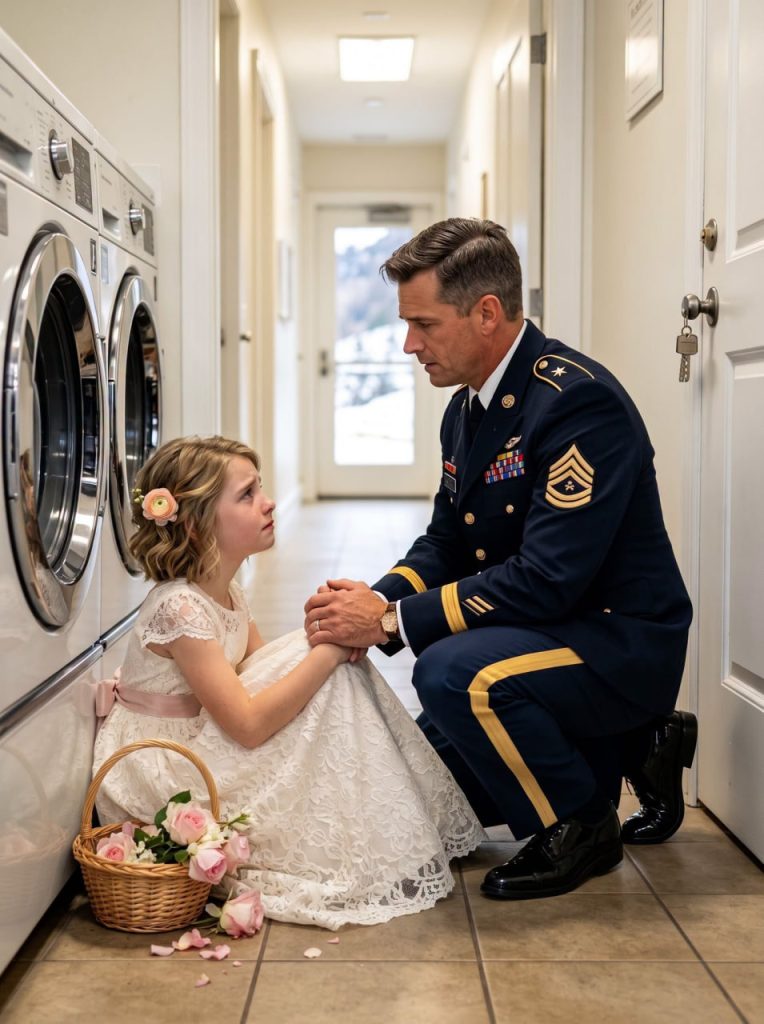
A spare key rested above the doorframe. My hands were steady when I reached for it, but I could hear my heartbeat. The lock clicked. I opened the door. Emily was sitting beside a washing machine, her knees pulled against her chest.
Her flower basket rested on the floor. Several crushed petals clung to the skirt of the dress she had been so proud to wear. I dropped to my knees. “Emily, what happened?” She wouldn’t look at me.
“Who told you to stay in here?” Her fingers twisted the ribbon around her waist. “Vanessa.” For several seconds, I couldn’t speak. “Why?” “She said I had to stay here until after the wedding.” My voice came out quieter than I expected.
“Why would she say that?” Emily looked toward the hallway before answering, almost as if she were afraid Vanessa might hear her. “She said today needed to belong to your new family.” My stomach turned. “What does that mean?”
“She said some people would feel uncomfortable if Mom’s daughter was standing beside you.” Mom’s daughter. Not Emily. Not my daughter. Mom’s daughter. Something cold settled inside me. “Did Vanessa say anything else?” Emily nodded. “She said things would be different after you married her.”
“How?” “She said I needed to understand I couldn’t keep acting like I was the most important girl in your life.” Her eyes finally lifted to mine. Then she asked me the question that ended my engagement before I had consciously admitted it was over.
“Dad… am I doing something bad when I talk about Mom?” I felt something inside me crack. I took her hands. “No.” “But Vanessa said—” “No. Listen to me.” I moved closer. “You have never done anything wrong by loving your mother.
You will never be punished for remembering her. You will never have to hide her pictures, stop saying her name, or apologize for being her daughter.” Tears filled Emily’s eyes. “She said after the wedding you’d understand.” “Understand what?”
“That husbands are supposed to choose their wives.” For one long second, I looked at the little girl sitting on the laundry-room floor. Then I looked at the blue dress. The crushed petals. The locked door. And suddenly the ceremony outside no longer mattered.
I stood and picked up the flower basket. “Come with me.” Emily hesitated. “Am I still allowed outside?” That question hurt almost as much as everything else. I held out my hand. “This is your family too.” She slipped her fingers into mine.
“No one is ever going to hide you from it.” And together, we walked toward the garden. Vanessa stood near the entrance to the terrace while the photographer adjusted her veil. She looked exactly as a bride was supposed to look.
Ivory gown. White roses. Perfect hair. Perfect makeup. A practiced smile as guests settled into their seats. Then she saw Emily beside me. The smile vanished. Not because Emily was crying. Not because she wondered why I looked furious.
The first words out of Vanessa’s mouth were: “Andrew, why did you bring her out here?” I didn’t need much more confirmation than that. I stopped several feet away. “Why was my daughter in the laundry room?”
Vanessa glanced quickly at the bridesmaids and photographer. “Can we not do this here?” “Answer me.” “She wasn’t being punished.” “That wasn’t my question.” Vanessa lowered her voice. “I simply asked her to stay somewhere quiet until the ceremony was finished.”
“You told a nine-year-old girl to hide during her father’s wedding.” “You’re deliberately making it sound cruel.” “How should I make it sound?” Her jaw tightened. “I was trying to avoid emotional confusion.” Emily’s hand tightened around mine. “What confusion?”
Vanessa glanced toward the guests. “This entire situation has always been complicated, Andrew.” “What situation?” “You know exactly what I mean.” “I want to hear you say it.” She exhaled sharply. “Emily represents your previous marriage.” I stared at her.
“She represents herself.” “You know that’s not what I meant.” “No. I’m beginning to think I never knew what you meant.” Vanessa’s eyes flickered toward Emily. “Every time she’s included in something between us, Caroline is included too.”
That was when Laura appeared behind us. She had apparently noticed the tension and come closer. I kept my attention on Vanessa. “Caroline is Emily’s mother.” “I know that.” “Then Caroline will always be part of Emily’s life.”
Vanessa shook her head. “And that is exactly the problem.” I felt Emily flinch. Vanessa continued. “You keep treating the past as though it deserves equal space with our future.” “Emily is not my past.” “I never said she was.”
“You put her behind a locked door because she reminded you of her mother.” “I asked her to give us one day!” “It was supposed to be her day too.” Vanessa looked genuinely frustrated now. “She mentions Caroline constantly. On holidays.
At birthdays. Whenever we make plans. There are photographs everywhere. Any time I talk about changing something in the house, she becomes emotional.” “She’s nine.” “And nine is old enough to begin understanding boundaries.” My voice dropped. “What boundaries?”
Vanessa tightened both hands around her bouquet. “Once we’re married, I don’t want our future children growing up in a house that feels like a memorial to your first wife.” For the first time, several people nearby went completely silent.
Even the photographer lowered his camera. I stared at Vanessa and remembered every moment I had interpreted as patience. Every time she had smiled when Caroline’s name came up. Every time she had told me she understood.
Suddenly those moments looked different. Vanessa noticed the growing audience and softened her voice. “We should talk privately after the ceremony.” “There isn’t going to be an after.” “Andrew—” “What else have you told Emily?” Her expression changed. “Excuse me?”
“Have you told her to stop talking about Caroline?” Silence. “Have you moved photographs?” Another silence. Emily spoke beside me. “She put Mom’s picture in a kitchen drawer.” I looked down at her. “When?” “Last month.” I remembered it immediately.
A photograph of Caroline and Emily had disappeared from the refrigerator. When I noticed, Vanessa said it must have fallen behind the counter. “She told me not to tell you,” Emily continued. “Because you were tired.” I looked at Vanessa.
“What else?” Vanessa shook her head. “Andrew, do not interrogate a child in the middle of our wedding.” But Emily was already speaking. “She said my room would probably be the baby’s room.” My stomach dropped. “What?”
“She said it has the best windows for a nursery.” Emily swallowed. “She said after you got married, I could move into the smaller guest room.” I turned toward Vanessa. “You planned to move my daughter out of her bedroom?”
“They were ideas.” “Without talking to me?” “We were going to discuss it.” “You discussed it with Emily first.” “She overheard an adult conversation.” Emily shook her head. “No. You told me.” “Emily—” “Don’t.” My voice stopped Vanessa instantly.
For the first time, I understood what I had failed to see. Vanessa had not suddenly become cruel that morning. The wedding had simply made her confident enough to stop hiding what she believed.
Her kindness toward Emily had always contained a condition. She could tolerate my daughter as long as she believed marriage would eventually give her the authority to reduce Emily’s place in my life. I had mistaken patience for love.
And Emily had been paying the price for my mistake. The ceremony music began. The coordinator, unaware of what had happened, had given the signal. Guests turned toward the aisle. Vanessa looked toward the terrace, then back at me.
For several seconds, I could actually see her trying to decide whether the wedding itself could restore control. She reached for my hand. “We are both upset.” I stepped away. “Andrew, listen to me. We can finish the ceremony and discuss everything privately afterward.”
“There will be no ceremony.” Her face went completely still. “What?” “You heard me.” “You are not canceling our wedding because a child misunderstood a conversation.” “I am canceling our wedding because you hid my daughter like she was something shameful.”
“I did not hide her.” “You told her to stay in a locked service room until after I married you.” “She locked the door herself!” “She is nine years old, Vanessa.” I could feel dozens of eyes turning toward us.
Vanessa lowered her voice. “You’re humiliating me.” That sentence reached some old part of me trained to avoid unnecessary public conflict. For a second, I wanted to move the conversation inside. Close a door. Handle it quietly.
Protect everyone’s dignity. Then I looked at Emily. If I protected Vanessa from embarrassment by hiding what she had done, Emily would learn that the real embarrassment was the truth. I wouldn’t teach her that lesson. Not again.
I took her hand and walked toward the microphone beside the arbor. The music stopped. Guests looked confused. I could hear chairs moving. Someone whispered my name. I picked up the microphone. “Thank you all for coming.” My voice sounded strangely calm.
“But there will not be a wedding today.” A ripple of confusion moved through the crowd. Vanessa hurried toward me. “Andrew, please don’t publicly describe a private family misunderstanding.” I looked at the people who had come to watch me promise Vanessa a future.
They deserved a brief explanation. More importantly, Emily deserved to see that I wasn’t ashamed to stand beside her. “Several minutes ago,” I said, “I found my daughter in a locked laundry room.” The guests went silent.
“Vanessa had instructed her to stay there until the ceremony ended because Emily’s presence supposedly interfered with the new family Vanessa believed we were creating.” “That isn’t fair,” Vanessa said. I turned toward her. “Did you tell her she could not participate?”
“I told her emotions were difficult today.” “Did you tell her she couldn’t continue being the most important girl in my life?” Vanessa stared at me. Then, instead of denying it, she said: “You can’t expect your wife to accept second place forever.”
The answer settled everything. I reached into my jacket. The wedding band I had been carrying all morning suddenly felt like something that belonged to another life. I placed it beside the microphone. “My daughter isn’t competing for first place with anyone.”
Vanessa stared at the ring. “You’re throwing away our entire future over one conversation.” “No.” I looked at Emily. “I’m protecting my future because my daughter finally felt safe enough to tell me the truth.” Vanessa’s mother approached, visibly shaken.
She pleaded with us to stop. To talk. To allow everyone to calm down. She said wedding stress could make people behave badly. She said blended families were difficult. She said Vanessa had probably expressed herself poorly. Laura responded before I could.
“Wedding stress doesn’t make someone lock a child away from her father’s ceremony.” Vanessa turned on her. “You’ve never wanted me in this family.” But I barely heard the argument. For me, it was over. Guests slowly began leaving.
Some approached Emily, but Laura protected her from questions. The coordinator started quietly dismissing staff. Vanessa followed me back into the lodge. “If you walk out today, I’ll never forgive you.” I stopped. “Your forgiveness isn’t what matters right now.”
Her face crumpled with anger. “I changed my life for you. I accepted your schedule. Your career. Every interruption. Caroline’s photographs. Emily’s moods.” Accepted. There it was. A single word that explained more than all the arguments before it.
She had accepted us. Tolerated us. Endured us. But she had never embraced the reality that loving me meant loving a life that existed before her. “You didn’t accept my daughter,” I said quietly. “I absolutely did.”
“No. You postponed rejecting her until you thought I couldn’t leave.” Vanessa pulled off her engagement ring and dropped it onto the reception table. “Someday Emily is going to grow up and leave you.” I said nothing.
“And then you’ll realize you sacrificed everything for someone who was never supposed to stay at the center of your life forever.” I looked at her. “A child doesn’t have to remain forever to deserve protection today.” Then I walked away. I took neither ring.
Only my daughter’s hand. At home, Emily changed out of her pale-blue dress. She put on gray sweatpants and an old Army T-shirt of mine that hung almost to her knees. That image somehow broke my heart more than the wedding dress, the rings, or the empty ceremony.
One moment she had been prepared to walk down an aisle with flowers. The next, she was curled on our sofa in clothes that made her look even smaller than she was. Laura stayed with us. I spent the first few hours making practical phone calls.
Venue. Coordinator. Attorney. Vendors. People asking what had happened. Money that couldn’t be recovered. Belongings left at the lodge. Practical problems were easier. You could make a list. You could finish one call and move to another. You could solve them.
The real problem was sleeping on the sofa. When Emily finally drifted off, Laura handed me coffee. Then she asked quietly: “How long has this been going on?” I knew exactly what she meant. “I don’t know.”
That was the answer that haunted me. Over the next several days, I began learning how much I hadn’t known. Vanessa had started removing Caroline’s photographs from common areas about six months earlier. Not all at once. One photograph moved from a shelf.
Another disappeared from the kitchen. One was placed in a drawer. Small changes. Easy to explain individually. Vanessa told Emily that hearing about Caroline made me sad. She said talking about her mother too often prevented me from moving forward.
And because Emily loved me, she believed silence was kindness. There was more. Whenever my work required me to travel, Vanessa told Emily that adults sometimes had to choose important relationships over what children wanted.
When Emily complained about wedding plans, Vanessa accused her of needing attention. Whenever Emily tried to ask whether things would change after the marriage, Vanessa said she was being selfish. Then came the part that made me feel sick.
Vanessa had warned her not to tell me. “If your dad thinks I’m making things difficult,” she had apparently said, “he might cancel the wedding. Then he’ll be alone again. You don’t want that, do you?”
Emily had believed she was protecting me. My daughter had tolerated months of fear because she thought speaking the truth might destroy my happiness. I had spent years telling myself I could protect her from anything. Meanwhile, she had been protecting me.
That realization was difficult to live with. Looking backward, there had been signs. Emily became quieter when Vanessa entered certain conversations. She suddenly stopped wanting to discuss changes around the house. She complained about stomachaches more often as the wedding approached.
There were evenings when I came home and found her unusually withdrawn. Every time, I supplied an explanation. School. Grief. Growing up. Wedding nerves. Anything except the possibility that the woman I loved was hurting her. We started counseling soon afterward.
During one session, Emily sat beside me and described the laundry-room conversation in more detail. “Vanessa said you deserved a normal family.” I felt my hands tighten. The counselor noticed. I forced myself to relax them. Emily continued.
“She said Mom dying made everything complicated.” My throat burned. “And she said sometimes I made it harder for you to have a normal life.” I wanted to leave the room, find Vanessa, and demand answers she could never give.
But anger would not help Emily. She had spent months believing her feelings caused adult problems. She needed to see that telling the truth did not create another one. I leaned toward her. “Your mother’s death was never your fault.” Emily watched me carefully.
“You did not make our family difficult.” “But what if you want to get married someday?” The question hurt. “Then anyone I marry will have to understand something from the beginning.” “What?” “That loving me means respecting you.” She waited. “And respecting Mom?” “Yes.”
I nodded. “Respecting your mother, your memories, and everything that existed before that person came into our lives.” Emily thought about that. Then, very seriously, she asked: “Would you cancel another wedding for me?” For the first time in days, I almost smiled.
“I hope I’m smart enough next time to figure things out before we get anywhere near another wedding.” A small smile appeared on her face. It was the first sign that she believed me. Vanessa tried repeatedly to contact me.
At first she denied what Emily said. Then she claimed Emily exaggerated. Later she argued that asking her to remain away from the ceremony had only been temporary. Finally, when the other explanations failed, Vanessa revealed what she truly believed.
She said marriage required a wife to become the primary family relationship in a man’s life. I answered only once, through my attorney. “No adult relationship requires humiliating a child or erasing the parent she lost.” After that, direct communication ended.
People eventually heard about the canceled wedding. Of course they did. A colonel walking away from his own ceremony minutes before it began was not the kind of story that remained private for long. Fortunately, most of my colleagues had enough respect not to ask questions.
My commanding officer eventually called me into his office. “You don’t owe me details,” he said. “But I need to know two things. Is Emily safe, and is this situation affecting your ability to do your job?” “Emily is safe.” He waited.
I stared at the floor for several seconds. “I failed to recognize what was happening in my own home.” He considered that. Then he said something I carried with me afterward. “Responsibility means responding correctly when reliable information reaches you.
It doesn’t mean pretending you knew something nobody had told you.” I understood what he was saying. But forgiveness was harder. I still replayed conversations. Expressions. Moments. What had I missed? What could I have noticed sooner?
What should I have asked? Eventually I realized guilt could become another form of selfishness if I allowed it to consume all the attention Emily needed from me. So I made changes. I reduced unnecessary travel for a while.
Laura helped more consistently when work required me to be away. Emily continued counseling. And gradually, our house started feeling like ours again. We returned Caroline’s photographs to the living room. But I didn’t want the house to become frozen in loss either.
Together, Emily and I created what she called “Mom’s cabinet.” Inside, we placed photographs, letters, several recipes in Caroline’s handwriting, small objects Emily remembered, and a few things I had kept packed away because opening the boxes had once hurt too much.
We weren’t building a shrine. We were giving memory somewhere it could breathe. There is a difference between living in the past and refusing to erase it. One evening, while Emily was doing homework, she looked up unexpectedly. “Dad?” “Yeah?”
“Do you still love Vanessa?” Children have a talent for asking questions adults avoid asking themselves. I sat across from her. “I think part of me still cares about the person I thought she was.” “But she wasn’t that person?”
“She was probably both.” Emily frowned. I tried again. “People can have good qualities and still make choices that make them unsafe to keep in your life.” She tapped her pencil against the table. “Does loving somebody mean you have to forgive everything?”
“No.” “Then what does forgiveness mean?” I thought about it. “It can mean different things. Sometimes it means deciding you don’t want anger to control your life anymore.” “Do you have to let the person come back?” “No.”
I shook my head. “Forgiveness does not require giving someone another opportunity to hurt you.” Emily nodded and returned to her homework. A small conversation. But months earlier, she would have been afraid to ask. That mattered.
Every direct question was proof that fear was losing its place in our home. Three months after the wedding, Willow Ridge Lodge called. They had found several items left behind that afternoon. One belonged to Emily. Her flower basket.
I almost told them to throw it away. Then I asked Emily what she wanted. “Can we go get it?” So, on a clear Saturday morning, we drove back. Without the wedding decorations, Willow Ridge looked completely different.
There were no rows of white chairs. No lights hanging between the beams. No guests. No flowers around the arbor. Just the mountains. The trees. The empty path where my daughter had spent weeks imagining herself scattering petals.
Emily held the basket. For a while, she said nothing. Then she stood at the beginning of the aisle. “I practiced this so many times.” “I remember.” “I never got to finish.” She looked toward the arbor.
I knew what she was asking before she said it. “Do you want to?” She opened the basket. Several silk petals were still inside. She handed me a few. Then we walked. Slowly. Exactly the way she had practiced. Emily scattered petals.
There was no music. No photographer. No bride. No guests watching us. Halfway down, she started smiling. When we reached the arbor, she looked up at me. “What happens after this part?” I looked beyond her toward the mountains.
“We decide where we walk next.” That sentence became something larger than I expected. On Caroline’s birthday that year, Emily and I decided to visit somewhere neither of us had been before. The first time, it was a museum.
Another year, it became a hiking trail. Another year, we drove to a small town and ordered dessert before dinner because Caroline had once joked that adulthood was wasted on people who followed restaurant rules. The tradition changed the way we remembered her.
Caroline no longer belonged only to hospitals, funerals, anniversaries, and grief. Her memory became connected to movement. Discovery. Laughter. Life continuing. Several months later, Vanessa sent a written apology addressed to Emily. It came through the attorneys.
Vanessa admitted that her jealousy of Caroline’s memory had gradually turned into resentment toward Emily. She acknowledged that Emily had done nothing to deserve the way she had been treated. Our counselor offered to review the letter before Emily made a decision.
Afterward, I asked whether she wanted to read it. Emily looked at the sealed envelope for a long time. Then she placed it in a drawer. “Maybe when I’m older.” “That’s okay.” “I don’t need to know why she did it right now.” “No.”
I nodded. “You don’t.” For months, adults had made decisions about what Emily should feel, what she should remember, where she should sleep, and whether she was allowed to speak. That letter belonged to her. So did the choice to leave it unopened.
A year after the canceled wedding, Emily’s class held a presentation about family history. Parents were invited. I sat near the back while Emily stood in front of her classmates beside a poster board. She had chosen three photographs.
One showed Caroline. One showed me in uniform. And the last showed Emily standing between Laura and me at a summer picnic. A boy in her class raised his hand. “Do you ever wish you had a normal family?”
For a moment, every instinct in me wanted to protect her from the question. Emily didn’t need protection. Not this time. She answered immediately. “My family is normal.” The boy looked confused. Emily continued. “People die. Things change.
Plans don’t always work. Then the people who are still there have to keep choosing each other.” I lowered my eyes. Suddenly I was back in the laundry room. I could see her sitting beside the washing machine.
Blue dress wrinkled. Flower basket on the floor. Fingers twisted into the ribbon around her waist. A little girl wondering whether her existence was making her father’s life worse. The child standing in front of her class was different.
Not completely healed. Maybe people are never completely healed from everything. But she knew she belonged. That afternoon, we went home and made one of Caroline’s chicken recipes from the memory cabinet. Emily took one bite and looked horrified.
“You used too much seasoning.” “I’m a colonel, not a chef.” “That sounds like an excuse.” “Military training does not include culinary precision.” She shook her head. “Maybe the Army should reconsider its priorities.” I laughed harder than the joke deserved.
And for the first time in a long time, our house sounded exactly the way a home should sound. Not perfect. Alive. There were still photographs of Caroline. There were homework assignments on the table. Laundry that nobody remembered to fold.
Occasional arguments over bedtime. Phone calls that interrupted dinner. Old grief. New memories. Ordinary affection. For years, I had believed I needed to give Emily something more. A mother figure. A conventional household. A complete family.
Vanessa had seemed to offer that possibility, and because I wanted it so badly, I had failed to consider the truth. Emily and I had never been incomplete. We had been grieving. There is a difference. Canceling the wedding didn’t make me feel brave.
People sometimes imagine moments like that as dramatic acts of certainty. They aren’t. It was humiliating. It was expensive. It was confusing. For weeks afterward, I wondered how I could have been so wrong about someone I intended to marry.
But necessary decisions do not always feel heroic. Sometimes protecting the person you love means destroying the future you thought you wanted. Sometimes it means believing a frightened child even when her truth is inconvenient.
Sometimes it means admitting that the danger isn’t outside your front door. Sometimes it is someone you invited inside. Three minutes before the ceremony, I thought the most important promise I was about to make was waiting for me beneath an arbor.
I was wrong. The promise that mattered had been made years earlier. After Caroline died, there had been a night when Emily couldn’t sleep. She was four years old, curled against me, asking what would happen now that Mommy wasn’t coming home.
I told her: “As long as I’m here, you will never face this world alone.” Five years later, I came dangerously close to breaking that promise. Not intentionally. Not because I stopped loving her.
But because love means very little if you become too distracted to notice when someone you love is afraid. Emily finally told me the truth with three minutes remaining before the ceremony. And I listened.
If I had ignored her… If I had told her we would discuss it later… If I had walked down that aisle because the guests were waiting, the deposits were paid, and the future had already been planned… Three minutes could have become months.
Then years. Maybe an entire childhood spent wondering why her father had chosen peace with another adult over protecting his daughter. Instead, we walked away. There was no wedding at Willow Ridge that afternoon. No vows. No first dance. No photographs beneath the arbor.
But something more important survived. A little girl learned that telling the truth would not cost her father’s love. And a father finally understood that the family he had spent years trying to complete had been standing beside him all along.
Emily held my hand as we left the lodge. And although neither of us understood exactly where life would take us next, one thing had become certain. We would walk there together.
THE END
Disclaimer:* This fictional story is inspired by situations from everyday life. Names, characters, businesses, and locations are created for storytelling purposes, and any resemblance to actual people or events is coincidental.*