The morning I pretended to leave for Canada, I kissed both my daughters at the front door and hated how easily they believed me. Lorelai, twelve, wrapped her arms around my waist without saying anything. Gemma, eight, asked whether I would be home before Friday movie night. I smiled, promised I would try, and carried a suitcase toward the waiting car. My fiancée, Sabina Vale, stood behind them in a cream sweater, elegant and composed, one hand resting lightly on Gemma’s shoulder. Rosamund, our housekeeper, remained near the breakfast room with a tray balanced against her hip. She lowered her eyes when I glanced back. To anyone watching, it looked like an ordinary departure from an ordinary wealthy home. Only my security chief, Adrian Cole, knew the truth. There was no Canada meeting, no flight, and no hotel reservation. I was leaving long enough for everyone inside my mansion to believe I was gone.
I had built Prescott Urban Systems from a six-person logistics company into a corporation worth more money than I had ever expected to see, yet that morning I felt less powerful than I had in years. My late wife, Elise, used to tease me that I could read a balance sheet faster than a human face. After she died from illness four years earlier, work became the place where I knew the rules. Parenting did not. Grief did not. I hired help, kept schedules, attended school events whenever possible, and told myself the girls were resilient because they rarely complained. Then Sabina entered our lives eighteen months ago. She was poised, charitable, attentive, and remarkably good at making my chaotic household feel organized. She remembered birthdays, knew which donors needed personal calls, and never seemed intimidated by my money. I mistook that confidence for safety. By the time I proposed, I believed I had finally found someone capable of helping us become a family again.
The doubts began with things so small that I was embarrassed to remember them later. Sabina mentioned that a bracelet had moved from her dressing table. A week later she said Rosamund seemed “too attached” to the girls. Then she wondered aloud why a housekeeper needed to know Gemma’s favorite lunch or Lorelai’s science-project schedule. “She acts invisible,” Sabina said one night, turning her wineglass by the stem. “Those are often the people who notice everything.” I laughed then, but she did not. She told me wealthy households became vulnerable when employees blurred boundaries, and that my daughters were young enough to confuse paid attention with real loyalty. The sentence bothered me, partly because it sounded cruel and partly because I knew the girls did run to Rosamund when they came home. Before Sabina’s comments, I had been grateful. Afterward, every sign of affection began to look like evidence I had somehow failed to investigate.
The night before my supposed trip, Sabina leaned across the dining table after the girls had gone upstairs and lowered her voice. “I think Rosamund is stealing from you.” I asked what she meant. Sabina listed a missing cashmere scarf, the bracelet, small cash discrepancies from the household envelope, and a silver frame she claimed had vanished from the guest suite. Then she added the accusation that mattered most. “She is manipulating Lorelai and Gemma. They listen to her more than they listen to you.” I felt the words land somewhere ugly. “They listen to Rosamund because she is with them every day,” I said. Sabina’s expression softened in precisely the way that made me feel defensive instead of angry. “Exactly, Chadworth. You’re gone constantly. She knows that. What if she’s making them dependent on her?” I should have asked my daughters. Instead, I decided to observe everyone without warning. That was my first failure.
Adrian objected when I explained the plan. He had run my personal security for nine years and possessed the rare privilege of telling me when an idea was foolish. “Hidden monitoring is already active in common areas for security,” he said, “but using it to secretly test household loyalty is different from reviewing an incident.” I asked whether the cameras were lawful. He said the common-area system complied with our notices and excluded bedrooms, bathrooms, and staff private quarters. “That isn’t what I’m asking,” he added. “I’m asking whether you want to become a man who watches his children instead of speaking to them.” I hated him for ten seconds because he was right. Then I said I needed certainty before accusing Sabina or Rosamund unfairly. Adrian finally agreed to accompany me, but only after I promised we would stop if anything crossed from suspicion into immediate risk. At seven thirty the next morning, my driver took me through the gates.
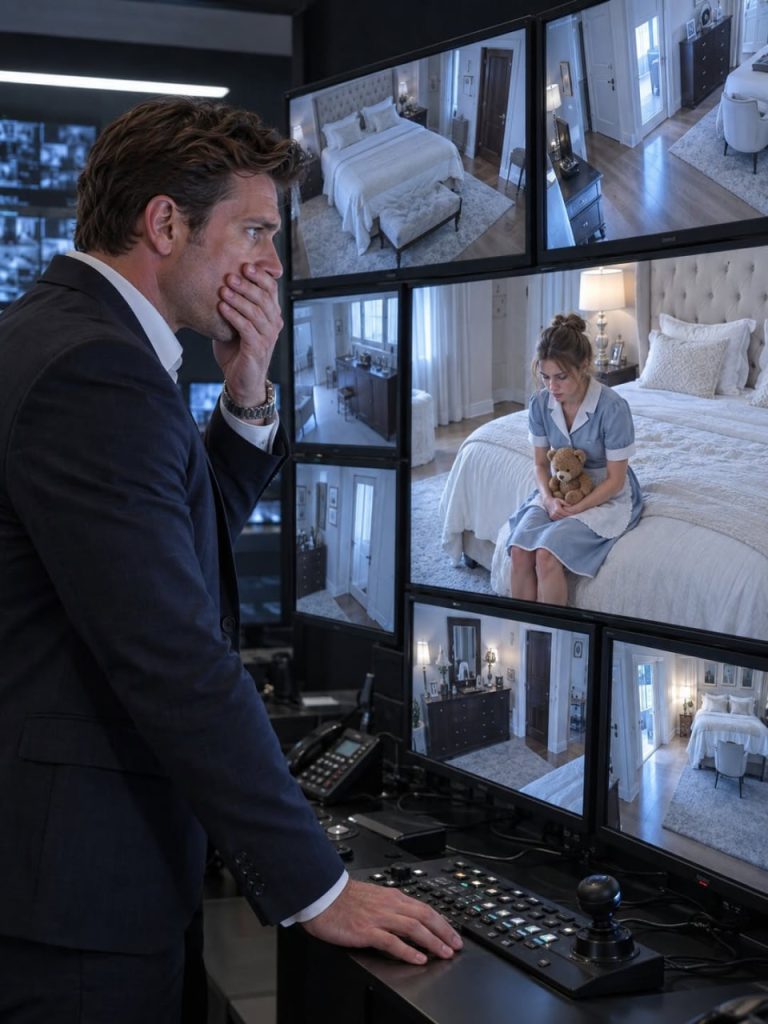
We switched cars behind a private hangar, waited thirty minutes, and returned through the service entrance at the rear of the estate. Adrian led me along a maintenance corridor to the monitoring room behind the wine cellar. I had approved the security upgrade years earlier and had visited that room perhaps twice. Now twenty-four screens showed pieces of my life I usually experienced only in passing: the foyer, kitchen, breakfast nook, library, playroom, hallways, terrace, garage, and exterior doors. I sat in front of them while Adrian checked the feeds. “Everyone believes you left,” he said. I nodded. For the first twenty minutes, nothing happened. Rosamund cleared breakfast dishes, Gemma practiced piano badly, Lorelai read on the living-room rug, and a gardener crossed the lawn pushing a cart. I began feeling ridiculous. Maybe Sabina had exaggerated ordinary household friction. Maybe I had allowed jealousy and money to make me suspicious of an innocent employee. Then the last morning contractor left.
The front door closed, and Sabina changed. There was no dramatic costume change, nothing theatrical enough to explain away later. Her shoulders simply dropped, her smile disappeared, and the warmth left her voice. She walked into the living room where Lorelai sat reading and Gemma hugged a stuffed rabbit against her chest. “What did I tell you about staying in here after breakfast?” she asked. Both girls moved instantly. Lorelai closed her book. Gemma lowered her eyes. Sabina snatched the rabbit from Gemma and tossed it onto the sofa. “When your father is away, I expect you to listen the first time.” Gemma’s mouth trembled. Lorelai shifted closer to her sister, one hand reaching behind her to touch Gemma’s wrist. I leaned toward the screen. The movement was tiny, almost invisible. Adrian saw it too. “That’s rehearsed,” he said quietly. I did not answer because I had already understood. My daughters knew how to brace together around Sabina.
Rosamund appeared from the hallway less than a minute later. She did not rush in or raise her voice. She simply walked between Sabina and the girls with a folded blanket in her hands and said, “Miss Sabina, they finished breakfast and their schoolwork schedule does not begin for another twenty minutes.” Sabina turned on her. “Did I ask?” Rosamund’s face remained neutral. “No, ma’am.” “Then remember your place.” On the screen, Lorelai watched Rosamund with a look I had mistaken for dependence. Now I recognized it as relief. Rosamund placed the blanket on a chair and asked Gemma whether she wanted to finish her milk in the breakfast room. Sabina blocked her path. “The girls are learning that employees do not overrule family.” Rosamund replied, still calm, “I’m not overruling you. I’m trying to keep the morning peaceful.” Adrian glanced at me. My hands were clenched so tightly that my wedding ring from Elise pressed into my palm.
I wanted to leave the monitoring room immediately. Adrian put one hand on the console and asked, “Do you want me to go upstairs?” Before I could answer, Sabina stepped away from Rosamund and smiled at the girls again. The transformation was somehow worse now that I had seen both versions. “Your father worries when you’re difficult,” she said. Lorelai stared at the floor. “We weren’t being difficult.” Sabina’s smile thinned. “Do you want him to hear that you’re arguing with me while he is traveling?” Gemma shook her head quickly. “Good. Then upstairs until I call you.” The girls left together. Rosamund watched them go, then turned toward Sabina. “Please stop using their father as a threat.” The room around me seemed to shrink. Sabina said, “You have become very brave lately.” Rosamund answered, “No. I’ve become worried.” Adrian whispered, “That wasn’t the first time they’ve had this conversation.” I knew he was right.
Sabina walked closer to Rosamund. “You are paid extremely well to clean this house and help with the children. You are not their mother.” Rosamund’s expression changed for the first time. “I have never said I was.” “You don’t need to say it. You make yourself necessary, then act wounded when someone notices.” Rosamund took a breath. “The girls lost their mother. Their father travels. They need adults who are predictable.” The sentence hit me harder than Sabina’s accusations. I had spent four years congratulating myself for providing stability through schedules, tutors, drivers, and staff. Rosamund had just described the absence hidden beneath all of it. Sabina’s voice became colder. “Careful. That sounds like criticism of Chadworth.” Rosamund replied, “It is concern for his daughters.” Sabina smiled. “Same thing, if I tell him correctly.” She walked away. Rosamund remained motionless for several seconds, then looked toward the upstairs hall with fear she was trying very hard not to show.
For another half hour, Sabina behaved normally whenever staff passed through. She thanked the cook, discussed flowers with the house manager, and answered a charity call in the soft public voice everyone knew. The moment she was alone, the edges returned. She opened the family calendar on a tablet and began deleting appointments. Gemma’s Saturday art class disappeared first. Then Lorelai’s counseling session. Adrian rewound the feed to make sure we had seen correctly. “Can she change those?” he asked. I nodded slowly. Sabina had volunteered to coordinate schedules after our engagement. She said duplicated calendars caused confusion. I had handed her administrator access because I considered organization harmless. On screen, she replaced Lorelai’s counseling session with “Bridal fitting with Sabina.” My stomach tightened. Elise’s death had sent Lorelai into years of careful therapy. Sabina knew that. She had once praised me for keeping the appointments consistent. Now she was quietly erasing one because I was supposedly out of town.
Then Gemma came downstairs alone. She hovered at the edge of the breakfast room until Rosamund noticed her. “What is it?” Rosamund asked softly. Gemma whispered something too low for the room microphone. Rosamund crouched beside her, and Gemma repeated it. This time I heard every word. “Did Dad really say we have to call her Mom after the wedding?” My chest went hollow. Rosamund answered immediately. “No one can make you call anyone Mom.” Gemma looked toward the hallway. “She said he would be disappointed if we didn’t.” Rosamund took her hand. “Your father loves you. A name does not change that.” Gemma’s eyes filled. “But Sabina said he wants a new family that isn’t sad all the time.” I stood so quickly my chair hit the wall. Adrian caught my arm. “Chad.” I could barely breathe. I had never said those words. Not once. Yet my eight-year-old believed my happiness required her to stop grieving her mother.
Rosamund did something that made my shame worse. She did not tell Gemma Sabina was lying. She did not recruit my daughter into an alliance or make herself the hero. She said, “I think that is something you should ask your father directly when he comes home.” Gemma shook her head. “She says he gets tired when we make everything emotional.” Rosamund’s face tightened. “Then I’ll be nearby when you ask, if that helps.” Gemma nodded. Before standing, Rosamund added, “You never have to protect grown-ups from your feelings.” Adrian looked away from the screens. I understood why. I had spent years saying the girls could tell me anything, then filling my calendar so completely that they learned every conversation needed an appointment. Sabina had not created that distance. She had recognized it and used it. That difference mattered. Blaming her for everything would have allowed me to avoid the part that belonged to me.
Lorelai joined them moments later carrying a small notebook. “She went into Dad’s office again,” she said. Rosamund glanced toward the hall. “Are you sure?” Lorelai nodded. “She told me I wasn’t allowed to walk past, but I saw her take the gold key from the drawer in the library.” Adrian immediately switched screens. My study camera showed an empty room. Then Sabina entered, closed the door, and pulled a key from her pocket. I felt Adrian become still beside me. The safe behind my desk contained no cash or jewelry. It held backup legal documents, property records, family trust summaries, and a hardware security token used for restricted corporate approvals. Only three keys existed: mine, Adrian’s sealed emergency copy, and one kept in a locked library drawer for my estate attorney during scheduled reviews. Sabina walked straight to the safe. “How does she know that key?” Adrian asked. I had no answer. She inserted it without hesitation and opened the door.
Sabina removed a red folder and the security token, photographed several pages, then placed everything back almost exactly as she found it. Almost. She kept one sheet. Adrian zoomed in as she folded it into her handbag. “That is the girls’ trust summary,” I said. After Elise died, I placed substantial Prescott shares into irrevocable trusts for Lorelai and Gemma. I served as investment adviser while an independent bank acted as trustee. Sabina had no authority over those assets, and marriage would not change that. The page she took listed trustee contacts, distribution standards, and successor guardians. Adrian asked whether she had ever been shown it. “No.” “Could she have found a copy elsewhere?” “Not legally.” We watched her close the safe and wipe the key with the edge of her sweater before returning it to the library drawer. That small motion changed the room. Curiosity does not usually erase fingerprints. Adrian reached for his phone. “I’m preserving this separately.” I nodded. The test had ended. The investigation had begun.
I told Adrian to contact Felicity Shaw, my estate attorney, but not to alert anyone upstairs. “And Sabina?” he asked. “Not yet.” Saying those words disgusted me, but I needed to know what she had already done with the information. If I walked into the living room furious, she could explain every isolated act as concern, misunderstanding, or wedding planning. The cameras had shown a pattern. I wanted the documents behind it. Felicity answered through an encrypted call within minutes. When Adrian described the safe footage, her voice became sharp. “Do not confront her until I check recent trust inquiries.” She asked me whether Sabina had ever received copies of our prenuptial agreement. “Her attorney has the final version.” “That may matter.” Our prenup waived any claim by Sabina to premarital property, company voting control, and the girls’ trusts. I had insisted on it because I thought clarity protected everyone. Felicity said, “Clarity only works when people accept the boundary.” I looked back at the screens. Sabina was texting someone.
Adrian’s security system could not read private messages, nor would I have asked it to. We did not need to. Sabina made a call in the sunroom ten minutes later, pacing beside the windows. “He left this morning,” she said. We could hear only her side. “No, the girls are manageable. Rosamund is the problem.” She listened, then laughed quietly. “Because she notices things.” My hands went cold. Sabina continued. “I have the trust contact now. I’ll send it when I’m alone.” A pause. “No, Chadworth still thinks the maid is stealing. That bought us time.” Adrian looked at me. I felt physically ill. There was no ambiguity left about at least one accusation. Sabina had deliberately aimed suspicion at Rosamund because Rosamund interfered with something else. Then Sabina said a name. “Victor, stop panicking. Once we’re married, the household authority changes.” Victor Vale was Sabina’s older brother, a financial consultant I had met twice. I had never liked him, but I had considered that irrelevant.
Felicity called back before Sabina ended her conversation. “Someone contacted First Meridian Trust four days ago claiming to represent your future spouse.” The bank had refused to discuss the girls’ accounts, but the caller asked what documentation would be required if a custodial parent became incapacitated after remarriage. “Incapacitated?” I repeated. Felicity said the inquiry alone proved nothing illegal, but its timing concerned her. “They asked whether a spouse could petition to replace a successor guardian.” My daughters’ successor guardian was my sister, Eleanor Prescott, a pediatric surgeon living in Boston. If I died or became unable to parent, Eleanor would step in. Sabina knew that generally, because we had discussed emergency planning before our engagement. She had never been given the trust mechanics. “Who made the call?” I asked. “The number traces to Vale Advisory Group.” Victor’s firm. My mouth went dry. Felicity added, “There was also an inquiry about whether your marriage would create standing to challenge Eleanor’s appointment.” I looked at the study screen again.
The girls went upstairs for schoolwork while Rosamund prepared lunch. Sabina disappeared into her suite. Adrian used the quiet to pull access logs from the library and study. The gold-key drawer had been opened electronically six times over the previous two months, always while I was traveling. Sabina’s personal access credential was present nearby each time. “She may have been walking past,” Adrian cautioned. “The camera archives will tell us.” I asked why nobody had flagged repeated access to a restricted drawer. He did not make excuses. “Because your old policy treated any resident-level credential as low risk in common areas. I wrote that policy before Sabina moved in.” Then he looked directly at me. “That is on me.” I appreciated the sentence because nobody in my childhood home had ever admitted fault without first negotiating its size. We began reviewing archived clips. On four dates, Sabina opened the drawer. On two, Victor entered the estate as her registered guest within an hour. I stopped thinking about a jealous fiancée. I started thinking about planning.
One archived clip from six weeks earlier showed Victor carrying a document tube into the library while Sabina watched the hall. They never entered my study together. Instead, Sabina brought papers out to him one at a time, avoiding the study camera. Adrian found them later on the library feed. Victor photographed a property survey, a corporate insurance schedule, and the cover page of the girls’ trust summary. “Why would he need those?” I asked. Felicity, still connected remotely, answered carefully. “A property survey could support financing. Insurance schedules could support valuation. Trust information could tell someone which assets are inaccessible.” The word financing struck me. Two months earlier, Sabina had encouraged me to purchase a waterfront estate in her name after our wedding because, she said, she wanted something that felt ours instead of living permanently inside Elise’s house. I refused to buy property before we married. She had acted disappointed but understanding. Suddenly that conversation looked different. I asked Adrian to pull every visit Victor had made since our engagement.
The pattern widened quickly. Victor had visited eleven times while I was away, usually for less than ninety minutes. Sabina had described those visits as wedding planning or charity work. On three occasions, he carried identical document cases. Adrian found no evidence that he entered restricted rooms, but he did not need to. Sabina had been bringing records to him. Then Rosamund appeared on an archived clip from the previous month. She paused outside the library while Sabina and Victor argued quietly inside. Rosamund did not enter. She set a tray on a side table and walked away. Later that night, Sabina told me Rosamund had been “lurking” near private family rooms. I remembered believing her. Worse, I remembered asking Rosamund the next morning why she needed to be near the library after dinner. She had looked confused, then said she had been collecting cups. I told her boundaries mattered. She apologized. Watching the footage now, I felt ashamed of how easily I had made an innocent woman defend an ordinary task.
Around noon, Sabina called the girls downstairs. Her public smile had returned because the cook and a delivery driver were nearby. She asked Lorelai whether she wanted to help choose flowers for the wedding. Lorelai said she had homework. Sabina’s smile remained in place. “You can do both.” When the staff moved out of earshot, her voice dropped. “I am trying very hard with you.” Lorelai straightened. “I didn’t say anything mean.” “You don’t have to. Your attitude says enough.” Gemma slipped her hand into Lorelai’s. Sabina noticed. “Stop doing that every time I speak to you.” The girls separated instantly. I felt something inside me break. Sabina was not merely demanding obedience. She was interfering with the way my daughters comforted each other. Rosamund entered carrying plates and changed the subject by asking whether anyone wanted soup. Sabina stared at her. “Actually, Rosamund, I need you upstairs.” “For what?” “There is something missing from my room.” Adrian and I looked at each other.
We switched to the upstairs hallway camera. Sabina led Rosamund toward her dressing room, then disappeared inside alone for several seconds. Because private bedrooms were not recorded, we could not see what happened there. When Sabina returned, she held a small velvet box. “My bracelet is gone,” she said. Rosamund’s face showed genuine confusion. “I haven’t handled your jewelry.” “You were cleaning yesterday.” “I changed the linens. I did not touch the vanity.” Sabina crossed her arms. “Then you won’t mind if I check the laundry room and your work locker.” Rosamund became very still. “I do mind.” Sabina smiled. “Interesting.” Rosamund replied, “If something is missing, call Mr. Prescott or security. I will cooperate with a proper search. I will not let you search my things alone.” Adrian exhaled softly beside me. “Good.” Sabina’s eyes hardened. “You think you have rights in this house?” Rosamund said, “I think everyone does.” I would remember that sentence for years.
Sabina walked away without calling security. Instead, she went into the guest sitting room carrying the empty velvet box. Five minutes later, she crossed the service hallway toward the laundry room. Adrian zoomed in. She looked both directions, opened an unlocked cabinet where staff kept aprons and spare gloves, and slid something behind a stack of folded towels. My mouth went dry. “Can you identify it?” Adrian replayed the footage frame by frame. A flash of gold appeared between Sabina’s fingers. The missing bracelet. She had planted it in a shared work area after announcing it was gone. “Preserve that clip,” I said. My voice no longer sounded like mine. Adrian was already doing it. Then Sabina returned to the living room and called Rosamund down. “I changed my mind,” she said pleasantly. “Let’s have security look.” Rosamund stared at her for a second too long. Something in her expression suggested she understood the trap before anyone opened the cabinet. I stood. “We stop now.” Adrian nodded and reached for his radio.
Before we left the monitoring room, Felicity called again. “Chadworth, wait thirty seconds.” I wanted to ignore her. My daughters were upstairs with a woman who had lied about them and planted evidence against the person protecting them. Felicity’s next sentence stopped me. “Victor filed a preliminary credit application yesterday using your mansion as a projected marital residence asset.” I sat back down. The house was mine through a family holding company and could not be pledged by Sabina. “How much?” “Eight million dollars.” “For what?” “A luxury rehabilitation development owned by Vale Advisory affiliates.” Adrian cursed under his breath. Felicity continued. “The application says collateral support is anticipated after your marriage and cites expected access to a spousal estate plan.” I stared at the screens. Sabina’s interest in the girls’ trusts, my insurance schedules, and the property survey suddenly fit together. She was not simply positioning herself inside my family. She and Victor had been modeling what my marriage could unlock, then learning which doors remained closed.
I told Adrian to call two uniformed members of his team to the main hallway, not because I wanted a spectacle, but because I no longer trusted Sabina to leave quietly. Then I walked upstairs. The moment I entered the living room, Gemma saw me and froze. Sabina’s mouth opened. Lorelai stood so quickly her book fell. For one horrible second, neither girl moved toward me. They looked afraid that my presence was another test. I dropped my suitcase by the door and opened my arms. “I’m home.” Gemma ran first. Lorelai followed half a second later, and both hit me hard enough to make me step backward. “You weren’t in Canada,” Lorelai whispered against my coat. “No.” “You lied?” “Yes.” I held them tighter. “And I am going to explain why, because you deserve the truth.” Sabina found her voice. “Chadworth, what is this?” I looked over my daughters’ heads. “A mistake I should never have needed to make.” Her face softened instantly. “Thank God. Rosamund has been acting strangely.”
Rosamund stood near the dining-room doors, pale and silent. Sabina pointed toward the laundry hall. “My bracelet is missing. I think we finally caught her.” Gemma clung to me harder. I felt that response before I understood it. “Nobody is searching Rosamund,” I said. Sabina blinked. “Excuse me?” “The bracelet is behind the towels in the staff cabinet.” Her face emptied. “How would you know that?” Adrian entered behind me. “Because we watched you put it there.” Silence spread through the room. Rosamund closed her eyes briefly. Lorelai looked from Sabina to me. Sabina laughed once. “Watched me?” “The common-area security cameras.” “You were spying on us?” “I returned after pretending to leave.” Her outrage arrived so quickly that another version of me might have followed it and forgotten the original problem. “You staged this?” she demanded. “You lied to me, watched me privately, and now you’re accusing me because I moved my own bracelet?” Adrian said nothing. Neither did I.
Sabina stepped toward me. “I can explain.” “Start with the bracelet.” “I was testing Rosamund.” “By planting it?” “Because things have been disappearing.” Rosamund finally spoke. “Nothing has disappeared.” Sabina spun toward her. “Stay out of this.” I said, “No. She stays.” Sabina looked at the girls. “You see what she’s done? She has turned your father against me.” Lorelai’s face changed. “She didn’t.” Sabina stared. Lorelai’s voice shook, but she kept going. “You told us Dad would send Rosamund away if we complained about you.” Gemma whispered, “And you said he wanted us to stop talking about Mommy.” Sabina turned to me. “They misunderstood.” I felt anger rise, but underneath it was something worse: recognition. I had heard that phrase in boardrooms when powerful people needed another person’s memory to become inconvenient. “Then explain exactly what you said,” I told her. Sabina opened her mouth. Nothing came out. Gemma buried her face against my side.
I asked Rosamund one question. “Have you ever taken anything from this house?” “No, sir.” “Have you ever asked the girls to keep secrets from me?” “No.” “Have you ever told them Sabina was dangerous?” Rosamund shook her head. “No.” Then she surprised me. “I told them to speak to you. They were afraid you would think they were being difficult.” I looked down at Lorelai. She stared at the floor. “Why?” I asked. “Because every time we complained, Sabina said you were already stressed and she would tell you we were having trouble adjusting.” I remembered those conversations. Sabina had repeatedly warned me the girls were struggling with my engagement. She said they needed consistency and that indulging resistance would make things worse. I had thanked her for handling it. Lorelai looked up. “We tried to tell you at dinner in March.” I remembered that dinner too. My phone had rung. I left before dessert for an investor call.
The realization was unbearable because Sabina had not isolated my daughters by locking doors or forbidding them to speak. She had used my habits. She knew work interrupted meals. She knew I trusted concise summaries. She knew I hated emotional conflict when I was tired. She stepped into those weaknesses and made herself the translator between my children and me. I looked at Rosamund. “Did you try to tell me?” Her answer hurt. “Three times.” The first was an email I never saw. The second was a written request for a meeting that Sabina told her I had declined. The third was through Adrian’s deputy, who forwarded it to my household office. Adrian checked his tablet. “The request was closed as resolved by family management.” Sabina had administrator access to household scheduling. I had given it to her. Rosamund said quietly, “After that, I started writing things down because I thought I was going to be dismissed and someone needed to know why.” Sabina’s expression changed.
Rosamund asked permission before retrieving the notebook from a locked drawer in the pantry office. It contained dates, exact phrases, canceled appointments, missing household items, and every time Sabina instructed the girls not to “burden” me. She had also recorded unusual visitors, including Victor’s repeated appearances while I traveled. “Why didn’t you give this to Adrian?” I asked. “I planned to if I was dismissed,” she said. “I was afraid handing it over earlier would look like I was attacking your fiancée.” Sabina laughed bitterly. “Convenient.” Rosamund looked at her calmly. “No. Frightening.” She turned back to me. “I needed to be certain I wasn’t misreading ordinary family tension.” The irony was almost painful. The employee Sabina accused of manipulation had spent months refusing to assume the worst without evidence. I, who ran companies by demanding verification, had accepted insinuations because they arrived from the woman sharing my bed. I asked Adrian to copy the notebook and return the original to Rosamund.
Sabina demanded a private conversation. I refused until the girls were upstairs with Eleanor, whom Adrian had already called. My sister arrived twenty minutes later, still wearing hospital scrubs under her coat because she had flown in the previous night for a conference. Gemma ran to her. Lorelai started crying before Eleanor even reached the stairs. Sabina watched from the foyer with her arms folded. “You’re making me look like some kind of monster,” she said. “No,” I answered. “I’m separating the children from an adult conflict.” Her face tightened. Once the girls were safely upstairs, Felicity joined us by video and Adrian remained in the room. I told Sabina she could have counsel present before discussing finances. She declined. “I have nothing to hide.” Felicity’s expression did not change. “Then this should be simple. Why did your brother submit an eight-million-dollar credit application referencing anticipated access to Mr. Prescott’s marital estate?” Sabina looked at me, not Felicity. “Victor gets ambitious.”
“Did you give him the property survey?” I asked. Sabina hesitated. “He asked for examples for a development model.” “Did you give him my insurance schedule?” “I may have sent a page.” “The girls’ trust summary?” “No.” Adrian said, “We watched you remove it from Chadworth’s safe this morning.” Sabina’s composure cracked. “I was trying to understand what would happen if something happened to him.” Felicity replied, “That is what estate planning meetings are for.” Sabina stood. “I am about to marry a man with two children and billions in complicated assets. Am I supposed to know nothing?” “You are supposed to know what he chooses to disclose,” Felicity said. “Marriage does not convert curiosity into authorization.” Sabina turned to me. “You told me this was going to be my family.” “It was.” “Then why was I excluded from every important document?” “Because the trusts belong to my daughters.” Her eyes flashed. “And where does that leave me?” There it was, finally, stripped of elegance.
I asked Sabina whether she loved me. She stared as though the question insulted her. “Of course I do.” “Did you love the girls?” Her answer came more slowly. “I tried.” “That isn’t what I asked.” She looked toward the staircase. “They never wanted me.” Rosamund spoke before I could stop her. “They wanted you until they became afraid of disappointing you.” Sabina snapped, “You have no idea what I sacrificed to fit into this mausoleum.” The word landed hard. This house had been Elise’s home. I had never asked Sabina to worship it, but I had not realized she resented living among memories she could not replace. “You could have told me,” I said. She laughed. “And hear you say the girls need more time? Elise needs more respect? The trusts need more protection? Everything here was decided before I arrived.” Her grievance was real. Her response to it was still hers. “Then you could have left,” I said.
Felicity asked about Vale Advisory’s financing problems. Sabina’s head turned sharply. That was answer enough. Victor’s firm had guaranteed a luxury rehabilitation project in Savannah that stalled after construction costs rose. The project needed new capital before lenders could force a sale. Sabina owned twenty percent through a family trust. If the project failed, she would lose most of her invested wealth. “So this is about Savannah?” I asked. “It is about protecting what my parents built.” “With my mansion?” “As temporary support.” “Without asking me?” “You would have said no.” The sentence arrived without hesitation. Adrian looked down. Felicity remained still. I asked, “Then why did you believe using it anyway was acceptable?” Sabina’s eyes filled. “Because eight million is nothing to you.” I had heard variations of that sentence from vendors, distant relatives, opportunists, and strangers. I had never expected it from the woman I planned to marry. “The amount is not the boundary,” I said. “My consent is.”
Sabina insisted Victor never expected the application to close before our wedding. It was only a term sheet, only modeling, only preparation. Felicity asked why the application included a draft spousal support letter carrying my typed name. Sabina stopped speaking. Adrian placed a printout on the table that First Meridian had sent ten minutes earlier. The document said I intended to support Vale Advisory obligations after marriage up to ten million dollars. There was no signature yet, but metadata showed it had been created on Sabina’s laptop. “You drafted a promise in my name,” I said. “A draft is not a promise.” “It becomes one if someone submits it.” “Victor was not supposed to send that version.” The room went silent. Sabina realized what she had admitted. Felicity asked calmly, “Which version was he supposed to send?” Sabina closed her eyes. For the first time all day, she looked tired instead of strategic. “The one without Chadworth’s name until we discussed it.” I almost laughed. Even her defense required hidden paperwork.
The deeper financial review took less than a day to begin because my corporate compliance team already monitored related-party risks around major executives. Victor had submitted invoices through two charities where Sabina served on advisory boards, billing event-planning and consulting costs to Prescott-linked foundations. Most were legitimate. Several were inflated. Three payments totaling four hundred eighty thousand dollars had flowed to a marketing firm owned by Victor’s college roommate, then partly returned to Vale Advisory as “referral income.” Sabina denied knowing about the return payments. Records later showed she knew one of them existed, but not the full structure. I forced myself to keep those distinctions clear. Anger wanted one villainous explanation for every bad act. Facts were messier. Victor had created the money loop. Sabina had concealed one payment and tried to use my future marital status as leverage. Neither required me to invent more. Felicity said, “We can end the engagement today without deciding the outcome of every investigation.” I knew she was right.
I removed my ring before Sabina did. It was not a wedding ring, only the plain platinum band she had given me after our engagement because she said men should receive visible promises too. I placed it on the console table. “The wedding is canceled.” Sabina stared at it. “You cannot decide our entire life based on one morning.” “This morning revealed months.” “Because you spied on me.” “Yes. And I regret doing it.” She blinked, surprised. “Then admit this is partly your fault.” “The surveillance was my decision. Your actions are yours.” Her face crumpled. “I was scared of losing everything.” “So were my daughters.” That ended her argument. Adrian arranged for Sabina to collect clothing and personal items with a neutral staff member present. I did not throw her onto the street. She owned a condominium downtown and had family nearby. When she left, she looked back once toward the staircase. Neither girl came down. I hated the relief I felt.
That evening, I sat on the floor outside Lorelai’s bedroom because she would not let me come inside yet. The door remained open three inches. Gemma was already asleep in my room with Eleanor nearby. “Are you mad at me?” Lorelai asked from behind the door. “No.” “You should be. I didn’t tell you properly.” I pressed my forehead against the wall. “You tried.” Silence. “Rosamund tried too.” “I know.” “You believed Sabina.” “Yes.” The word hurt, but I would not soften it. Lorelai asked, “Why?” I thought about every possible answer: Sabina was convincing, I was busy, grief had made me eager for normality, I trusted an adult over a child because adults use smoother language. None was enough alone. “Because I listened to the person who made things easiest for me to hear,” I said. “And I should have listened to you.” The door opened another inch. “Mom always listened.” “I know.” “You aren’t Mom.” “I know that too.”
Lorelai opened the door fully. Her face was swollen from crying, but her voice was steady. “Sabina said you liked that she wasn’t emotional.” I remembered telling Sabina once that I appreciated her calmness after years of chaos. The sentence had seemed harmless. In Sabina’s hands, it became evidence that my daughters’ grief made them less desirable. “I said I appreciated her being calm,” I told Lorelai. “I never meant I wanted you to stop having feelings.” She looked at me for a long time. “But you leave when we have them.” That sentence hurt more than any financial discovery. She was right often enough that intent did not save me. I sat on the carpet and said, “I’m going to change that, but I won’t ask you to believe me because I said it once.” She nodded. Then she sat beside me, not touching. After several minutes, her shoulder leaned against mine. It was a smaller forgiveness than I wanted and more than I deserved.
The next morning, Rosamund asked to resign. She stood in my study holding a typed letter and said she did not want the girls caught between gratitude toward her and loyalty to me. I refused to accept it immediately. “You protected them when I failed to notice.” She shook her head. “I did my job. Please don’t turn that into a debt.” I asked what she wanted. Rosamund thought. “Clear authority. If I am responsible for the girls, I need to contact you directly. If I report something serious, it needs to reach you.” We rewrote the household reporting structure that afternoon. No partner, assistant, or family member could close concerns submitted about the children. Rosamund stayed, not as a rewarded savior, but as an employee whose judgment I had finally learned to respect without pretending employment made her family property. That distinction became essential to the household afterward.
Adrian changed the security system too. Common-area cameras remained for safety, but monitoring permissions narrowed, and I created a rule that footage could not be used for personal loyalty tests again. “Including by you,” Adrian said. “Especially by me.” I told the girls what I had done. Lorelai asked why I had hidden in the security room instead of asking them directly. I answered, “Because I was afraid of hearing something I couldn’t control.” Gemma frowned. “But you heard it anyway.” “Yes.” “So hiding didn’t help.” Eleanor laughed from the sofa. Children have an irritating ability to summarize expensive lessons quickly. We restored Lorelai’s counseling appointment and Gemma’s art class. More importantly, I blocked two evenings each week from work. No investor calls. No dinners. No exceptions unless someone’s safety depended on me. The rule sounded simple because it always was.
The investigation into Victor lasted months. Regulators and charity boards reviewed consulting invoices, circular referral payments, and the credit application built around property he had no authority to pledge. He eventually agreed to restitution, financial penalties, and removal from advisory roles connected to the organizations. Sabina was not charged with every act because evidence did not support that. She did repay the concealed referral amount tied to her board work, resign from two charities, and withdraw the financing application. Her attorneys negotiated the rest through civil settlements. I followed the process only as much as necessary. I had spent enough of my life mistaking control for responsibility. Consequences did not need my supervision to be real. The canceled wedding cost money, embarrassed both families, and fed gossip for months. None of that mattered beside the fact that my daughters no longer lowered their voices when someone entered the hall. Their voices mattered more than the headlines outside.
Sabina wrote once, six months after leaving. She did not ask to return. The first page explained too much: childhood insecurity, her father’s failed developments, Victor’s pressure, the humiliation of living in a house filled with another woman’s memory. Then the tone changed. “I made your daughters compete with my need to feel chosen,” she wrote. “When they did not choose me quickly enough, I treated their grief as resistance. I used your absence because it was easier than earning their trust.” That was the first apology I believed. Believing it did not require reopening the door. I sent one reply through Felicity: I accept that you understand what happened. Please continue respecting the girls’ privacy. Sabina did. She never contacted them directly. Years later, I was grateful for that boundary more than for any dramatic request for forgiveness. Distance became the kindest boundary available to us.
My hardest repair was not financial. It happened on an ordinary Tuesday when Lorelai asked whether I would attend her school debate. I said yes. She replied, “Really yes or calendar yes?” Calendar yes was the promise I made before an emergency meeting replaced it. I opened my phone, canceled a dinner, and showed her. “Really yes.” She studied me. “What if work needs you?” “Then work can be disappointed.” I attended the debate. She lost in the semifinal and cried in the car. Every old instinct told me to analyze the judges or distract her with dinner. Instead, I listened. Halfway home she said, “You didn’t tell me not to be upset.” “I’m learning.” “Slowly.” “Very slowly.” She smiled toward the window. That smile felt more valuable than any acquisition I had closed. Showing up became my new measure of success.
Rosamund’s story changed once I started asking instead of assuming. She had not come to us as a career housekeeper. Elise met her through a scholarship program for young adults leaving foster care. Rosamund studied early-childhood development at night while working for a hotel. After Elise became ill, she hired Rosamund for household support, then increasingly for the girls. “Why didn’t I know that?” I asked. Rosamund almost smiled. “You never asked.” Two years later, she finished her degree. She left full-time household work and joined a nonprofit training caregivers who supported grieving children. I offered funding. She declined personal help but invited my foundation to apply through normal partnership channels. The proposal passed independent review. That mattered to both of us. Gratitude did not become ownership, and opportunity did not become rescue. Respect finally had structure instead of sentimental promises.
Gemma was ten when she asked whether the hidden cameras had saved them. We were making pancakes, and she asked with syrup on her wrist. I thought carefully. “The cameras showed me something I should have noticed sooner.” She frowned. “So yes?” “Not exactly. Rosamund speaking up helped. Lorelai speaking up helped. Aunt Eleanor coming helped. Adrian keeping records helped. The cameras were one piece.” Gemma considered this. “You helped eventually.” I laughed. “Eventually.” What I did not tell her was how much I hated the version where I became the clever billionaire who staged a test and rescued his daughters. That version was easier to tell. It was also false. I had created conditions Sabina exploited by being absent, impatient with conflict, and too impressed by polished explanations. Seeing the truth was only the beginning. I needed to become present after being informed.
I reduced my role at Prescott Urban Systems the following year. The board survived. Revenue did not collapse. Nobody stood outside headquarters begging me to return to fourteen-hour days. I had treated constant availability as evidence of importance when much of it was habit. I promoted two executives, delegated acquisitions, and stopped scheduling travel over the girls’ birthdays. We still had help. Drivers drove. Tutors tutored. Security remained. The difference was that I stopped using resources as substitutes for relationship. When Lorelai wanted to talk, I tried not to look at the clock. When Gemma complained about something that sounded small, I asked another question before deciding it was small. Sometimes I failed. The girls became excellent at telling me when I did. That, strangely, became one of our healthiest traditions. Presence became work I could no longer delegate.
Five years after the canceled wedding, Lorelai was seventeen and Gemma thirteen. Rosamund came to dinner with her husband and the director of the caregiver program where she worked. Adrian brought dessert. Eleanor arrived late and blamed surgery. Lorelai found the old stuffed rabbit in a storage basket and held it up. “This thing survived Sabina.” Gemma groaned. “Please don’t make the rabbit symbolic.” Everyone laughed. I watched my daughters argue over who had loved it first, loud and unafraid of taking up space. That was when I understood what recovery looked like. Not a courtroom victory. Not Victor repaying money. Not Sabina leaving. Recovery was noise returning to the house. It was doors opening without anyone listening for footsteps. It was my children believing disagreement would not cost them affection. I had once mistaken quiet for peace. I knew better now. Peace sounded different once nobody feared speaking freely.
I still think about the morning I pretended to leave for Canada. People focus on the hidden room or the instant Sabina’s expression changed after the front door closed. I remember something smaller: Lorelai reaching behind her for Gemma’s hand. That movement told me more than every accusation. Sabina tried to make Rosamund look dangerous because Rosamund noticed what I refused to see. Victor tried to turn marriage into financial access. I tried to replace conversation with surveillance because certainty felt safer than vulnerability. The cameras exposed all three failures. They did not repair my family. Repair came afterward, through apologies without demands, schedules that stayed protected, records that could not be quietly closed, and ordinary moments when my daughters learned I would remain in the room. I went looking for proof that my housekeeper was betraying me. Instead, I found proof that my daughters needed their father back for real.
THE END!
Disclaimer: Our stories are inspired by real-life events but are carefully rewritten for entertainment. Any resemblance to actual people or situations is purely coincidental.