My parents told Grandma Eleanor they were taking her to lunch, and three hours later a nursing facility in Ohio called me. “Is this Ivan Sterling?” a woman asked. “Your grandmother listed you as her emergency contact. Her suitcase is still in our lobby, but the family members who brought her left before the admission paperwork was finished.” I stood in my Pittsburgh apartment holding coffee I no longer wanted. “What do you mean, they left?” The administrator lowered her voice. My parents had walked Grandma inside, described her as forgetful, and promised to retrieve insurance documents from their car. They never returned. No deposit had been paid, no physician had approved admission, and Grandma refused to sign anything. I called my father, Arthur, then my mother, Wendy. Both calls went directly to voicemail. When I called again from my work phone, Dad answered, heard my voice, and disconnected. I grabbed my keys before anger could become paralysis inside me.
The facility was 190 miles away, and I drove every one of them with hands locked around the wheel. Rain polished the highway until truck lights smeared across the windshield. I kept hearing Dad’s click, the sound of someone choosing silence. For years, my parents had described Grandma as stubborn whenever she disagreed with them and confused whenever she remembered something inconvenient. I had believed it enough to stop pressing when visits were canceled. Dad said she tired easily after knee surgery. Mom said telephone calls overwhelmed her. Yet Grandma mailed birthday cards on time and remembered details I had forgotten telling her. Halfway through Ohio, the administrator called again. She said Grandma was calm but would not eat, and she kept her coat buttoned as if she expected another betrayal. I promised I was coming. Then I drove faster, ashamed that a stranger was giving my grandmother the reassurance her son had denied her that morning without explanation whatsoever.
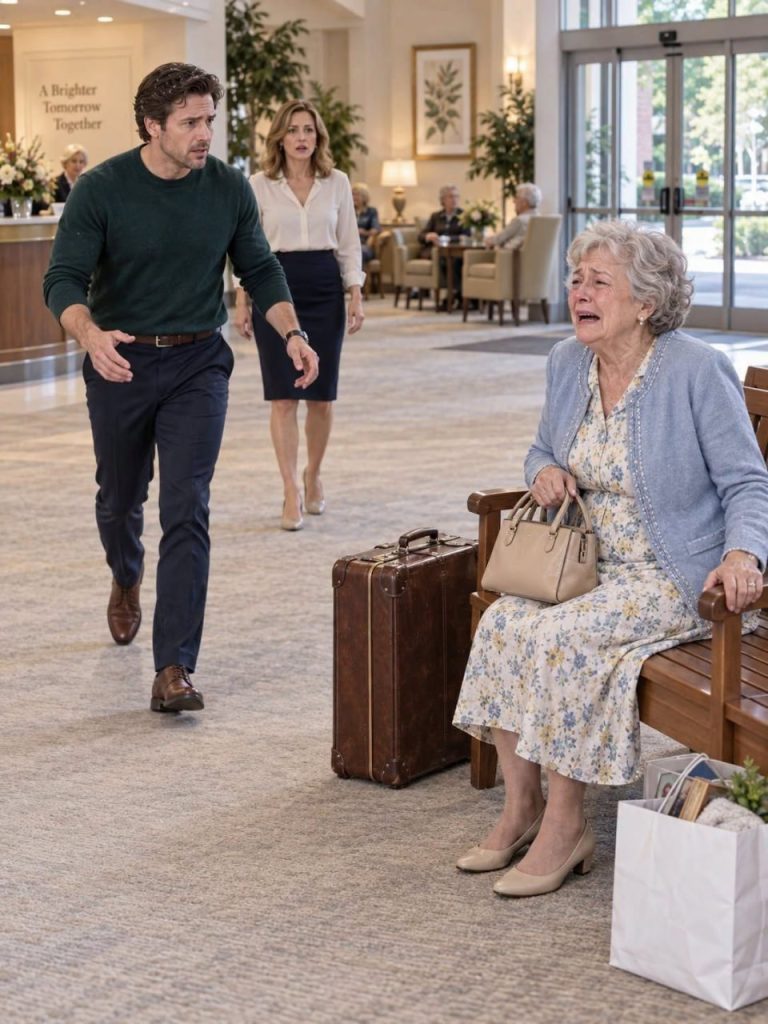
Grandma sat beside a brown suitcase and a grocery bag packed with medications when I entered the lobby. She still wore her navy church coat although the room was overheated. Her silver hair remained pinned neatly, and her hands rested on the carved handle of Granddad’s walking cane. Nothing about her looked confused. She looked furious in the contained, deliberate way I remembered from childhood, when she could silence a dinner table by setting down her fork. I crouched beside her and said, “Grandma.” She studied me for several seconds, testing whether I had arrived as family or as another person carrying instructions. Then she rose without tears or questions. The administrator offered discharge papers, but Grandma said, “I was never admitted.” She thanked the staff, took my arm, and walked outside. In my car, she fastened her seatbelt, placed the cane between her knees, and said, “Don’t call them. I’ll tell you exactly where we’re going.” No explanation came.
“Where?” I asked, still watching the facility doors in case my parents suddenly appeared with an explanation large enough to cover what they had done. Grandma adjusted the belt across her coat. “First, the county courthouse.” That answer pulled my attention from the mirror. “Are you filing a complaint?” She opened her purse and handed me a folded bank statement. Three withdrawals were circled in red ink: twelve thousand dollars, eighteen thousand, then twenty-five thousand. All had left her savings within six weeks. “Your father has temporary power of attorney,” she said. “I signed after surgery because I trusted him to pay bills while I recovered.” I asked whether the money had covered medical care. Grandma stared through the rain. “He said it did. My insurance statements say otherwise.” My phone buzzed in the console. Dad’s name filled the screen. Grandma reached over, turned it facedown, and repeated, “Courthouse first. Whatever he says now is meant to slow us down.”
She explained that a bank clerk had quietly printed the statement for her yesterday. Grandma had confronted Dad in her kitchen, placing the withdrawals before him. He claimed the money paid caregivers, repairs, and future nursing expenses. She asked for invoices. He produced none. Mom then entered carrying brochures from Willow Glen Residence and praised its gardens, music room, and “fresh start.” Grandma told them she was neither incapable nor moving. Dad smiled and said she was becoming forgetful about agreements already made. “He used the voice people use with a frightened dog,” she said. This morning, Mom arrived with lipstick, pearls, and a promise of lunch. Dad loaded one suitcase into their trunk before Grandma could ask why. They drove past every restaurant she knew and stopped at Willow Glen. Inside, Dad called the move temporary. When Grandma refused to sign, my parents pretended to fetch paperwork. Their car disappeared before the receptionist returned with water for her alone.
“Why didn’t you call the police?” I asked. Grandma’s mouth tightened. “Because your father would say I wandered, panicked, and invented the rest. I needed the authority removed before he used it again.” She telephoned the courthouse’s elder-services desk, but Dad entered the room during the call, so she pretended she had dialed the weather line. A clerk named Denise told her revoking the power required her signature before a notary and notice to every financial institution. The courthouse closed at five. My dashboard clock showed 3:41. Grandma told me to take the next exit and handed me a second envelope. Across the front, in Granddad’s blocky handwriting, were two words: HOUSE DEED. She had hidden it safely inside her coat. “I wanted to know whether they would search for it,” she said. I asked why the original deed mattered. Her answer came softly. “Because your parents did not only want me out today. They wanted my house completely empty.”
Granddad had bought the brick house in 1968, when the street ended beside cornfields. He added rooms himself, planted two maples, and paid the mortgage from factory checks that left grease beneath his fingernails. After he died, Grandma rejected every suggestion that she downsize. The property was worth nearly half a million dollars now, but she spoke of it as a container for lives: height marks inside a pantry door, Granddad’s tools, my childhood bicycle scar on the garage wall. Dad had pressured her to sell after surgery. He said stairs were dangerous and property taxes wasteful. Mom brought an agent for a written estimate. Grandma ordered both women out. Two weeks later, Dad requested power of attorney “for banking convenience.” She signed a limited document that was supposed to expire after ninety days. Her recovery lasted longer, and he persuaded her to extend it. “Trust makes intelligent people careless,” she said. “Especially when the thief still calls you Mom.”
We reached the courthouse at 4:27. Denise, a red-haired clerk wearing beaded reading glasses, remained at her desk because she expected Grandma. She led us into a small records office and asked Eleanor to state her name, address, the date, and why she had come. Grandma answered each question crisply. Denise then brought in an elder-law attorney named Lena Morales, who volunteered twice weekly for emergency cases. Lena read the power-of-attorney document, confirmed Grandma could revoke it immediately, and prepared notices for the bank, county recorder, and my parents. While a notary watched, Grandma signed every copy. Her hand never shook. I felt relief until Lena entered the property address into the county database. She leaned closer to the monitor, clicked twice, then looked at Grandma. “Mrs. Sterling, did you transfer your house this morning?” The room went still. Grandma did not look at the screen. She looked at me and said, “Now we know why lunch could not wait.”
The filed document was a quitclaim deed transferring Grandma’s home to Sterling Family Holdings LLC for ten dollars. Dad had registered the company six weeks earlier using his own address and Mom’s email. The deed carried Grandma’s apparent signature and the seal of Lorraine Beck, a notary who attended my parents’ church. It had been submitted electronically at 9:12 that morning, while Grandma was riding in their car toward Ohio. Lena printed the record and placed it beside Granddad’s original deed. “Did you sign this?” she asked. Grandma studied the crooked imitation of her name. “No. I was wearing winter gloves at 9:12, and Wendy was telling me about soup.” Denise searched the file history. A request to expedite certification was attached, along with an application for a large home-equity loan. The lender planned to release funds after receiving confirmation of title. Grandma’s fingers tightened around the cane. “How large?” Lena hesitated before answering. “Three hundred and sixty thousand dollars.”
Lena moved like someone who understood that paperwork could become a weapon if filed before truth arrived. She drafted an affidavit disputing the deed, recorded the revocation, and contacted the county fraud investigator. Denise flagged the property so no transfer could be certified without review. Grandma signed a sworn statement describing the morning’s route and abandonment. I supplied the nursing facility’s number, call log, and Dad’s disconnected call. A deputy named Marcus Hale arrived to take a preliminary report. He spoke to Grandma directly rather than asking me to answer for her, a courtesy that visibly steadied her. When he asked whether she felt safe returning home, she said, “Not until I know who is inside it.” Dad called again while the deputy was listening. This time, Grandma nodded for me to answer on speaker. My father skipped hello. “Ivan, you have interfered in a medical decision you do not understand. Bring her back now, before you make this criminal.”
“You left her in a lobby,” I said. Dad answered with the patient sigh he used whenever he wanted cruelty to sound reasonable. He claimed Willow Glen had agreed to admit Grandma, then blamed a clerical delay for their departure. Lena wrote questions on a legal pad and turned it toward me. Which physician ordered placement? Where was the signed application? Who had assessed Grandma’s capacity? Dad answered none of them. Instead, he said I had always encouraged her worst impulses because I enjoyed being the favorite grandchild. Behind him, Mom whispered urgently. I heard drawers closing and something heavy scrape across a floor. Grandma leaned toward the phone. “Arthur, are you inside my house?” Silence followed. Then Dad said, “It is my responsibility to secure your property while you are unstable.” Grandma’s expression hardened. “You abandoned me in another county and forged my name. Your authority was revoked twelve minutes ago.” For the first time, my father sounded afraid.
Mom seized the phone from him. “Eleanor, sweetheart, nobody forged anything. You signed documents last week, then forgot.” Grandma asked her to name the room, the day, and the witnesses. Mom said details were unimportant compared with getting her somewhere safe. “Safe from whom?” Grandma replied. Wendy began crying immediately, but the performance had no tears behind it. She told me Dad had sacrificed years managing Grandma’s appointments and deserved gratitude, not public humiliation. Lena quietly indicated that I should keep the call connected. Deputy Hale’s body camera recorded every word. I asked Mom why they had ignored the facility’s calls. She said Grandma had become combative, and staff advised them to leave. The administrator had already stated the opposite in writing. When I mentioned the bank withdrawals, Mom stopped crying. “That money is family money,” she snapped. Grandma’s eyes narrowed. “No, Wendy. It became family money only after you learned how to copy my signature.” The call abruptly ended.
Grandma authorized officers to check her property while we handled the bank. She agreed but insisted nobody enter without her consent unless they saw immediate danger. “I want witnesses when I open that door,” she said. Lena gathered the signed revocation, disputed-deed affidavit, and certified copies. The clock showed 4:49. Our bank branch closed at six, leaving seventy-one minutes to stop a loan secured by a stolen house. As we hurried downstairs, Grandma’s cane struck each marble step with fierce precision. I offered the elevator, and she refused. “Your father counted on my knee making me slow,” she said. “Today he can learn the difference between slow and stopped.” Outside, Dad sent me six messages. The first begged for privacy. The second threatened to report me for kidnapping. The last said simply: YOU HAVE NO IDEA WHAT YOU’RE DESTROYING. I showed Grandma. She read it twice, then said, “He means what belongs to him.” The threat sounded rehearsed, not spontaneous.
The bank’s guard was locking doors when we arrived that evening. Lena held up her credentials and asked for the branch manager and fraud officer. Minutes later, we sat in a conference room with Martin Harlan, a careful man whose questions carried no judgment. Grandma presented identification, revoked the power of attorney, and disputed every recent transfer. Martin verified her signature against records from before surgery. He enlarged the withdrawal slips on a monitor. Two had been completed online using Dad’s access. The third, for twenty-five thousand dollars, carried a scanned signature that looked convincing until Martin overlaid it with Grandma’s genuine one. Every curve matched perfectly. “Natural signatures vary,” he said. “This one is a duplicate image.” Someone had lifted it from an earlier check. Martin froze the remaining accounts, canceled Dad’s credentials, and telephoned the lender’s fraud department. Then he asked a question that made Grandma close her eyes: “Mrs. Sterling, did you authorize a second mortgage application?”
The loan file contained more than forgery. It claimed Grandma had moved permanently into assisted living, included a valuation of her house, and gave instructions to deposit proceeds into Sterling Family Holdings. Attached invoices purported to show fifty-five thousand dollars in caregiving expenses paid by my parents. The invoices came from Golden Years Home Support, a company registered to Mom’s cousin. No caregivers had entered Grandma’s house. During recovery, I had hired a licensed aide myself for mornings, and Grandma had paid her directly by check. Martin compared dates. Several fake invoices charged twelve-hour care on days Grandma attended church, physical therapy, and my cousin’s wedding. One billed overnight supervision during a weekend she spent at my apartment. “They used the exact amounts withdrawn,” Martin said. The theft had been disguised as reimbursement, building a paper trail to portray Grandma as dependent while converting her savings into evidence against her independence. She stared at the screen, lips colorless but steady.
Martin reached the lender before disbursement. Certification had been expedited, but funds were scheduled for the following morning, giving us a margin. He placed a fraud hold on the accounts and transmitted the revocation and affidavit. The lender suspended the loan pending title review. Relief moved through me so sharply my knees weakened. Grandma did not relax. “Where did the fifty-five thousand go?” she asked. Martin traced the transfers into the LLC, then outward to a commercial landlord, a luxury auto lender, and a credit-card company. Dad’s hardware store had been failing for months. He had used her savings to cover overdue rent, payments on Mom’s leased SUV, and balances accumulated during a Caribbean vacation they had described online as an anniversary gift from “years of hard work.” Grandma looked at me. “They sent me photographs from that ship,” she said. “I told them they deserved the rest.” Martin turned the monitor away, granting her dignity no relative had offered.
Dad emailed the bank while we were there. A letter from Dr. Neal Porter declared Grandma incapable of managing finances because of progressive cognitive decline. Martin asked whether she recognized the doctor. Grandma did. He had treated Dad’s shoulder once and played golf with him. He had never examined her. The letter was dated two days earlier and contained no test results, diagnosis code, or referral. Lena forwarded it to Deputy Hale and the state medical board. She then asked Grandma about risk. Had Dad taken her identification? Did he possess keys? Were valuables stored at home? Grandma named a jewelry box, Granddad’s coin collection, tax files, and a recorder kept in her desk. “The recorder matters most,” she said. The previous evening, after confronting my parents, she had switched it on beneath a stack of recipes. If they searched the desk, they might find more than the deed missing. The forgery turned their private betrayal into a documented conspiracy.
Grandma said she did not know; she had left it running when Dad insisted on discussing the facility again. “I went upstairs for my coat.” “They thought I could not hear from there.” She had caught pieces of conversation through the vent: Mom asking whether Willow Glen could hold her without signed papers, Dad saying they needed only one night, and both discussing someone named Beck. The recorder might have captured everything. Her memory assessment, completed by her physician fourteen days earlier, was also in the desk. It showed no cognitive impairment. Dad knew because he had driven her to that appointment. “He asked the doctor to write something different,” Grandma said. “She refused.” Lena called the physician, who confirmed the report and agreed to preserve her notes. Evidence was accumulating, but every piece still inside the house could disappear before we arrived. Deputy Hale texted that Dad’s SUV was parked in Grandma’s driveway. So was an unfamiliar black sedan.
Martin offered a nearby safe hotel, but Grandma shook her head. “They removed me from my house because they assumed I would be too embarrassed to return. I am returning.” Lena advised us not to enter until officers were present. Deputy Hale arranged to meet us on the street with a second unit. Dusk had settled by the time I pulled away from the bank. Grandma finally unbuttoned her church coat but kept Granddad’s deed inside it. Dad’s messages continued, changing tone constantly. He apologized, accused, promised explanations, then warned that police involvement would destroy the family. Mom texted that Grandma’s house had already become unsafe and said any confrontation might trigger a stroke. Grandma read the message and laughed once. “Your mother has predicted my death whenever I refused her since 1987.” Then she opened her medication bag, checked every bottle, and quietly asked whether I had eaten. Even betrayed and exhausted, she noticed hunger before anyone else did.
We turned onto Grandma’s street at 7:08. Her porch light was off, although she always left it burning after sunset. Dad’s SUV blocked half the driveway, and the black sedan idled near the curb. A man carrying a laser measure stood beside the garage while Mom pointed toward the roofline. Through the front window, I saw cabinet doors hanging open. Two cardboard boxes rested beside the entry. Grandma inhaled slowly. “That man evaluated the house last month,” she said. “Wendy claimed he was measuring for insulation.” Deputy Hale parked behind us without lights, then approached with another officer. Before we could reach the walkway, Dad stepped onto the porch holding a folder without greeting anyone. He looked past me toward Grandma, and irritation crossed his face before concern replaced it. “Thank God,” he called loudly enough for the neighbors. “Mom, Ivan took you without your medication. We have been terrified.” Grandma lifted the grocery bag. “You packed it yourself, Arthur.”
Dad glanced at the officers as if noticing them for the first time. His shoulders lowered, his voice softened, and he walked toward Grandma with palms raised. “Mom, you are overwhelmed. Let me bring you inside.” She did not move. Deputy Hale stepped between them and asked who owned the property. “My mother does, but I hold power of attorney,” Dad replied. Grandma removed the revocation from Lena’s folder. “Not anymore.” Dad barely looked at it. He said legal documents signed during confusion could not be trusted, then pointed at me. “He has been poisoning her against us for years.” That accusation stunned me because I had spent years defending my parents whenever Grandma complained. I had called Dad practical, Mom anxious, and every boundary disagreement a misunderstanding. Grandma answered before I could. “Ivan drove when I called. That is not poison. Abandoning me under a false name while stealing my home is poison.” A curtain moved across the street.
The man with the laser measure introduced himself as Calvin Bell, a real-estate investor. Mom had told him Grandma was entering permanent care and the family wanted a cash sale before repairs. He had been invited to inspect the house and its contents. Dad interrupted, saying discussions were preliminary and protected by his authority. Calvin opened an email on his phone. It included the forged deed, photographs of each room, and Mom’s promise that title would clear by morning. She had offered the house for three hundred and ninety thousand dollars, ninety thousand below appraisal, provided Calvin wired a nonrefundable deposit that night. “I was told Mrs. Sterling approved everything,” he said. Grandma asked whether he had ever spoken to her. He shook his head. Mom rushed forward, smiling too brightly. “Eleanor, this gentleman is helping us solve a problem.” Grandma replied, “The problem is that you expected me to remain wherever you dropped me.” Calvin lowered his measuring device.
Grandma handed Calvin the disputed-deed affidavit, then gave Deputy Hale permission to remove everyone except me and officers from her property. Dad refused. “You cannot throw out the people keeping this place together,” he said. Grandma looked through the doorway at upended drawers and packed boxes. “You are not keeping anything together.” Mom insisted they had merely organized valuables before burglars learned the house was empty. “It was empty because you stranded me,” Grandma said. Wendy turned on me. She accused me of manipulating a lonely widow to secure an inheritance. She reminded the gathering neighbors that I lived in an apartment, carried student debt, and had once asked Grandma for help with a security deposit. The details were true, arranged to make greed seem inevitable. I felt every watching face tilt toward me. Grandma tapped her cane once. “Ivan repaid that money in six months. Arthur has taken fifty-five thousand and tried to borrow three hundred sixty thousand more.”
Dad’s composure cracked. He said the withdrawals were reimbursement for errands, repairs, and labor. “She would have lost the house without us,” he shouted. Grandma asked him to name one repair he had paid for. He named the furnace. She said insurance covered it after lightning. He named the roof. I had driven her to the contractor and watched her write the check. Mom began listing groceries, rides, holiday meals, and hours spent waiting at appointments. Their generosity became an invoice assembled only after theft was exposed. Grandma listened until Wendy ran out of examples. “You could have asked for help,” she said. “You could have shown me your store’s books. Instead, you made kindness retroactively expensive and called my possessions payment.” Dad looked toward his SUV, then toward the open front door. Deputy Hale noticed. “Sir, do not enter the vehicle,” he said. Dad froze with one hand inside his jacket. His accounting reduced every relationship to a debt.
Grandma asked the officers to accompany us inside. The foyer smelled of cardboard and Mom’s perfume. Family photographs lay facedown beside the mantel. In the dining room, china lay carefully wrapped in towels inside a box marked DONATE, although Granddad had given it to Grandma on their twentieth anniversary. Upstairs, her bedroom drawers stood open. The jewelry box was empty. Dad claimed he had placed the contents in his SUV for safekeeping. Deputy Hale requested consent to inspect the vehicle; Dad refused, and the deputy began seeking a warrant. Grandma walked to her desk. Recipe cards covered the floor, and the bottom drawer was pulled free. The recorder’s casing lay in the wastebasket with its battery missing. Grandma picked nothing up. She pointed silently while the second officer photographed it. “They knew,” I said. She shook her head. “They suspected. If they knew what it captured, they would not still be here arguing.” Her certainty unsettled Dad more than accusation.
Mom entered despite the officer’s warning. “There was no recording,” she said. Nobody had yet identified the object. Deputy Hale turned immediately. “Recording of what?” Wendy’s mouth opened, but Dad answered from the hall that she meant Grandma’s confused threats to record everybody. The officer bagged the broken casing. Beneath it lay a folded receipt from an electronics store. Grandma recognized the date: Dad had bought replacement batteries that afternoon using her credit card. The receipt also listed a microSD adapter. The recorder’s memory card was gone. Dad said he had never touched the device. Mom said she had thrown it away because loose batteries were dangerous. Their explanations collided before either realized it. Grandma sat at her desk and opened the sewing basket beside the lamp. From beneath a cushion, she removed a second memory card. “Your father taught me to keep duplicates,” she said, looking at the photograph of Granddad above her. Her certainty finally trapped them both.
Dad lunged before anyone expected him to. He reached past me toward the card, striking Grandma’s cane from her hand. I caught his wrist, and Deputy Hale pulled him backward. My father and I stared briefly from inches away. His face held no embarrassment, only outrage that I had interrupted what he believed he deserved. “That recording is private family business,” he said. The deputy handcuffed him for safety and seated him in the hallway. Mom screamed that I had attacked my father, though the officer’s camera had captured every movement. Grandma retrieved her cane, but her hand shook now. I knelt beside her and asked whether she was hurt. “Not where he can see,” she whispered. She placed the card in an evidence envelope herself. The second officer inserted it into a protected reader. One audio file appeared, ninety-three minutes long, created the previous evening. Dad stopped demanding release. From the hallway, he told Mom to say nothing else.
The recording began with Grandma asking about the withdrawals, followed by Dad’s claim that she had authorized them. After her footsteps moved upstairs, Mom’s voice became clear. “Willow Glen says they cannot keep her without a signature.” Dad answered, “They need to keep her until the deed clears. Lorraine filed it already.” Mom asked what happened if Grandma called Ivan. Dad laughed. “Ivan believes whatever I tell him about her memory.” My face burned because that part was deserved. They discussed packing valuables, selling the coin collection, and using the loan to rescue the hardware store. Then Mom asked whether leaving Grandma at the facility counted as abandonment. Dad replied, “Not if everyone agrees she belongs there.” Nobody spoke while the file played. Even the neighbors gathered outside seemed silent. Grandma stared at the desk rather than at her son. The recording ended with Dad saying, “By tomorrow, the house will legally be ours, and she can complain from Ohio.”
Calvin handed his phone to Deputy Hale and showed messages Mom had sent throughout the week. She described Grandma as medically incompetent, said no relatives would contest the transfer, and offered furniture, jewelry, and coins with the house if he increased the deposit. Calvin had not wired money yet because the rushed terms worried him. He agreed to provide a statement and left without measuring another wall. As his sedan pulled away, a patrol supervisor arrived with authorization to secure Dad’s SUV while a warrant was reviewed. Through the rear window, we could see Grandma’s jewelry case, two canvas coin bags, framed photographs, and a box labeled TAX RECORDS. Mom began crying again, this time without performance. She told Grandma they had intended to return everything after the store recovered. Grandma asked, “Were you returning me too?” Wendy covered her face. Dad stared at the carpet. For once, neither parent could produce an answer that made theft sound like care.
The warrant arrived before nine. Officers opened Dad’s SUV and cataloged items before returning anything. Beneath Grandma’s jewelry and tax files, they found blank checks, her passport, two signed but incomplete bank forms, and a folder containing the loan application. Another envelope held photographs of Willow Glen rooms with monthly prices written beside them. Dad said he had gathered documents for her protection. Deputy Hale asked why protective work required a forged signature, stolen property, and a false medical letter. Dad requested an attorney. He was taken to the station for attempted evidence interference and financial-exploitation questioning. Mom was ordered off the property after officers copied her messages and photographed the rooms. At the curb, she turned to Grandma. “You are really choosing Ivan over your own son?” Grandma answered, “Arthur made the choice when he left me.” Mom searched my face for guilt, found none she could use, and climbed into a patrol car for transport to her vehicle.
Afterward, the house seemed wounded. Empty spaces marked where photographs, coins, and china had been packed. Drawers remained open like interrupted sentences. A locksmith arrived after ten and changed every exterior lock while I restored the porch light. Grandma stood in the kitchen, coat removed, staring at two place settings Mom had left on the table. One plate held a dried sandwich crust. The other was clean. “They ate after leaving me,” she said. I offered to take her to my apartment or a hotel. She refused both, but she asked me to stay. We carried boxes inside from the police inventory and found her nightclothes beneath Granddad’s tax returns. When I made tea, Grandma sat where she had confronted Dad the night before. “I raised him in this room,” she said. “I taught him never to steal.” I answered, “You taught him. He chose.” She held the cup without drinking, learning that distinction hurt even when it was true.
Dad was released pending further investigation. By breakfast, he had called twelve relatives and told them I had manipulated Grandma into revoking his authority during a paranoid episode. Mom posted a message about “the heartbreak of watching an elder be isolated by someone waiting for an inheritance.” She did not name me, inviting questions. My aunt Deborah called first. She said Dad had devoted years to Grandma and deserved private explanation. I played twelve seconds of the recording, ending after his promise that the house would become theirs. Deborah went silent, then said audio could be taken out of context. I realized context was not what she wanted. She wanted a version that allowed Sunday dinner to continue. Grandma took the phone. “If Arthur needs defenders, he can hire them,” she said. “Do not volunteer my dignity as his legal fee.” Deborah hung up. By noon, half the family had chosen a side without asking what happened at Willow Glen.
Lena returned with an emergency civil filing. She sought to void the quitclaim deed, freeze Sterling Family Holdings, preserve Dad’s business records, and prohibit my parents from contacting Grandma except through counsel. Before filing, a process server arrived at the house carrying a petition my parents had submitted at sunrise. They asked the probate court to declare Grandma incapacitated and appoint Dad as emergency guardian. Their affidavit accused me of kidnapping, coercion, and financial manipulation. Dr. Porter’s unsupported letter was attached as medical evidence. So were photographs of Grandma using a cane, missing a step after surgery, and sleeping in a chair during Thanksgiving. Mom had taken each picture. Ordinary aging had been curated into a diagnosis. The petition demanded that I return the deed, surrender Grandma’s telephone, and disclose any gifts she had given me. Grandma read every page. “They could not steal the house quietly,” she said. “Now they will ask a judge to hand it over loudly.”
The guardianship filing transformed private betrayal into a public contest over whether Grandma’s voice counted. Lena warned that even a weak emergency petition could briefly restrict accounts or permit an evaluator into the home. We assembled records before the hearing: her recent cognitive assessment, medication list, tax payments, church volunteer schedule, and correspondence showing she managed her own affairs before Dad gained access. Willow Glen’s administrator provided security footage of my parents leaving. It showed Grandma seated in the lobby while Dad placed her suitcase beside her, checked his watch, and walked away. Mom never looked back. The facility’s intake notes quoted Dad calling Grandma forgetful but also recorded her correct address, birth date, prescriptions, insurance number, and firm refusal to consent. Lena watched the footage once, then closed the laptop. “Their entire case depends on confusing disobedience with incapacity,” she said. Grandma replied, “That confusion has served men like Arthur for generations.” The hearing was scheduled for Monday morning.
Martin’s forensic audit uncovered seven additional attempts to use Grandma’s money. Two transfers had failed because Dad entered an outdated security code. A credit application sought business financing secured by her investment account. Mom had requested a replacement debit card sent to their address. Golden Years Home Support had no employees, insurance, or service records, yet issued polished invoices after each withdrawal. Mom’s cousin, Celeste, claimed Wendy asked her to register the company for future caregiving. When investigators showed her the invoices, Celeste cooperated. She admitted Mom created them on a home computer and paid her five hundred dollars to sign a statement confirming services. The hardware store owed vendors nearly two hundred thousand dollars. Dad had received foreclosure warnings on its building. His desperation explained urgency, not entitlement. Grandma studied the audit and said, “He could have told me the truth.” She would not say whether she might have helped. That unanswered possibility was another consequence Dad had created.
Lorraine Beck, the notary who sealed the deed, resisted until investigators showed her Willow Glen’s timestamped video. She then admitted Grandma had never appeared before her. Wendy brought the document to Lorraine’s kitchen, saying Eleanor’s knee hurt too much to travel and promising the signature was genuine. Lorraine notarized it as a favor, backdated the journal, and ignored the empty witness line. Dad paid her church retreat fee through the LLC. Her admission connected my parents directly to the false transfer. Dr. Porter’s position collapsed next. Facing the medical board, he acknowledged writing the incapacity letter based entirely on Dad’s description. He claimed Arthur said it was needed only to arrange home support, not seize property. Grandma’s actual physician provided notes documenting Dad’s earlier request for a different assessment. Evidence no longer formed scattered warnings. It formed a sequence: manufacture incapacity, remove Grandma, transfer title, borrow against the house, sell valuables, and rescue the store before anyone listened to her.
Sunday brought a large, unrequested family gathering. Six cars arrived after church, carrying Aunt Deborah, two cousins, Mom’s brother, and neighbors who had known Grandma for decades. They filled the front yard because the protective filing barred my parents from entering. Dad stood on the sidewalk with an attorney and called the event an intervention. He told everyone Grandma needed care and I had exploited her anger after a misunderstanding. Mom held a framed photograph of our family at Christmas, presenting unity like evidence. I wanted to shut the door, but Grandma put on her church coat and stepped onto the porch. Conversations stopped. She carried no cane because she refused to let another photograph turn support into incapacity. Dad opened his arms. “Mom, come home with us, and we can end this spectacle.” Grandma looked at the house behind her. “I am home. You created the spectacle when you invited witnesses to pressure me.” Several relatives lowered their eyes.
Dad’s attorney warned Grandma that public statements could damage everyone’s case. She replied that abandonment had already damaged his clients’ case. Then she asked the Willow Glen administrator, whom Lena had invited as a witness, to step forward. The woman described how my parents arrived without completed papers, refused to pay, ignored calls, and vanished. She handed Aunt Deborah a copy of the intake note because Deborah had repeated Dad’s claim that staff advised them to leave. Deborah read it, face reddening. Martin stood beside Lena with a summary of the fraudulent transfers. Calvin Bell provided printed messages about the rushed sale. Grandma did not play the recorder. She simply told Dad that enough evidence existed without turning his voice into entertainment. “This is your final chance to stop lying voluntarily,” she said. Dad looked around at relatives who had defended him for forty-eight hours. Then he accused every witness of misunderstanding. The last uncertain faces in the yard changed.
Mom broke ranks. She shouted that the store employed eleven people and losing it would destroy eleven families. She said Grandma had money, a house, and no reason to hoard either while her son’s life collapsed. “We planned to repay everything,” she insisted. Grandma asked when. Mom said after refinancing, after the store recovered, after they sold the house, and after settling Grandma somewhere affordable. Each answer placed restitution beyond another act Grandma had never approved. Dad ordered Wendy to stop talking. She turned on him. “You said the facility had agreed. You said the deed was safe. You said Ivan would not come.” The yard went silent. Dad’s attorney closed his folder. Mom realized she had confirmed the conspiracy before relatives, neighbors, and two investigators standing near Lena’s car. Grandma did not smile. “You keep explaining why my life was convenient to spend,” she said. “Neither of you has explained why it belonged to you.” Mom dropped the photograph.
Monday’s emergency hearing filled the probate courtroom. Relatives occupied the back benches, suddenly interested in facts they had dismissed on the telephone. My parents sat beside separate attorneys after Sunday’s collapse. Their marriage had become another account each hoped the other would pay. Dad’s petition described him as a devoted caregiver protecting an impaired widow from an opportunistic grandson. Lena began with Grandma’s real physician, who testified that Eleanor understood her finances, choices, and legal risks. A court-appointed evaluator agreed, reporting no basis for incapacity. Dad’s attorney emphasized age, surgery, missed appointments, and her reliance on me for transportation. The judge asked whether needing a driver made every person without a license legally incompetent. Laughter started in the gallery and died under his stare. Then Willow Glen’s administrator authenticated the footage. On the courtroom screen, my parents walked away while Grandma waited beside her suitcase. Dad watched himself leave and still tried to call it responsible placement under oath today.
Martin Harlan testified next, explaining the duplicated signature, withdrawals, fabricated invoices, LLC transfers, and suspended loan. He used no dramatic language. Numbers made their own accusation. Dad’s attorney suggested the payments could represent informal reimbursement. Martin answered that reimbursement requires authorization and genuine services, not invented companies and copied signatures. Lorraine Beck then admitted notarizing the deed without Grandma present. Dr. Porter acknowledged that he had issued an incapacity opinion without an examination. Each witness removed another support from my parents’ story. Lena displayed Grandma’s original deed beside the forged transfer and asked why an incompetent woman had hidden the one document her caregivers urgently needed. Dad’s attorney objected to the word forged. The judge looked over his glasses. “Counsel, your own notary has admitted the principal never appeared. Choose your objection carefully.” In the gallery, Aunt Deborah began crying. Grandma remained upright beside Lena, hands folded, refusing to perform either frailty or triumph for people who had doubted her.
Then the recording played. Dad’s laughter filled the courtroom when his voice said I believed whatever he told me about Grandma’s memory. I wanted to disappear, but she reached beneath the table and firmly pressed two fingers against my wrist. The audio continued through Lorraine’s name, the plan to pack valuables, and the promise that Grandma could complain from Ohio after the house became theirs. Dad stared straight ahead. Mom’s attorney requested a recess, claiming Wendy had been coerced inside her marriage. The judge denied it until the file ended. Silence followed Dad’s final sentence. Lena did not fill it. She allowed everyone to understand exactly what had been planned. Finally, the judge asked Dad whether he still sought appointment as guardian. He whispered with his attorney, then said yes. Grandma’s fingers left my wrist. Whatever grief remained in her face hardened into acceptance. Her son was not defending a mistake. He was still asking the court to reward it.
Dad blamed sudden panic over the store. He said eleven employees depended on him and Grandma possessed more assets than she needed. He insisted the facility was comfortable, the loan temporary, and the deed merely a tool for emergency financing. Lena asked whether he had told Grandma any of that. He admitted he had not. She asked why he copied her signature instead of requesting help. He said she would have refused. “So you knew her decision,” Lena replied. “You simply considered it inconvenient.” Dad’s attorney objected, but the answer had landed. Lena then asked where Grandma would live after the discounted sale. Dad mentioned a long-term room at Willow Glen. The administrator corrected him: no room had been reserved. No payment, application, medical order, or consent existed. Dad looked toward Mom as if she had failed him. Wendy stared down. Eleven workers had become his shield, yet he had never offered the court payroll records showing only four remained.
Grandma chose to testify despite Lena saying the documents were enough. She gave her name, age, medications, account balances, property-tax due date, and the exact amount missing from savings. Then she looked at Dad. “Arthur, when you were nine, you stole five dollars from my purse. You returned it because I made you understand that wanting something did not make it yours.” Dad’s face crumpled briefly. Grandma continued. “You did not place me in care. You left me where you assumed nobody would question you. You did not borrow my money. You constructed permission after taking it. And Ivan did not turn me against you. He answered the telephone.” Lena asked what outcome she wanted. “My name restored to my home, my money returned, and my decisions respected,” Grandma said. “I do not want revenge disguised as protection. I want protection from people who disguise control as love.” Even the court reporter stopped typing for a beat before catching up.
The judge immediately denied the guardianship petition from the bench. He found Grandma competent, ordered the fraudulent deed voided, froze Sterling Family Holdings, and barred my parents from contacting her outside counsel. He referred the record to prosecutors, the medical board, and the notary commission. Then he addressed Dad. “Financial distress may explain motive. It does not create ownership over another adult’s assets or body.” He addressed Mom next. “Marriage does not excuse participation.” Finally, he turned to me and said transport, assistance, and affection did not give me authority either; every future decision remained Grandma’s. I appreciated that warning because rescue can become control when gratitude is treated as consent. Outside court, reporters waited after someone shared the filing. Grandma declined every interview. Dad tried to approach her, but his attorney stopped him. “Mom, please,” he called. She kept walking. At the car, she buckled her seatbelt and asked me to drive home by the road passing Granddad’s factory.
Criminal charges followed weeks later: exploitation of an older adult, forgery, attempted theft by deception, conspiracy, and evidence tampering. Mom accepted a plea first and agreed to testify truthfully. Dad held out until prosecutors produced store emails showing he had promised creditors money from “the family property” before Grandma ever signed the temporary power. Both pleaded guilty. Dad received a prison sentence followed by restitution supervision; Mom received a shorter custodial term, probation, and mandatory repayment. Lorraine lost her commission and entered a diversion agreement. Dr. Porter’s license was suspended pending discipline. The judge ordered my parents’ SUV sold and placed liens on their home and business interests. None of it immediately restored fifty-five thousand dollars. It did restore the public record. Grandma was not confused, abandoned by accident, or rescued from herself. Two people had targeted her trust, and a third person answered when she called. That accurate sentence mattered more to her than every apology that arrived afterward.
The hardware store closed before winter. Dad’s former employees found work with a competitor that bought the inventory but refused his debts. Mom filed for separation, describing herself as manipulated, although her messages showed initiative whenever profit was discussed. Relatives began sending careful apologies. Aunt Deborah admitted she had defended Dad because accepting his guilt forced her to reconsider years of smaller cruelties. Grandma accepted the apology but not immediate closeness. “Forgiveness is not a spare key,” she told her. “It does not automatically let you back inside.” We changed her accounts, installed cameras she controlled, and hired the same licensed aide for three mornings weekly. Lena became her financial agent under a tightly limited document requiring monthly independent review. Grandma named me health-care proxy only after making me promise, in writing, that disagreement would never become diagnosis. I signed gladly. Trust returned as structure, not as a sentimental demand that everyone forget why safeguards existed, without excuses or conditions.
Grandma proudly kept the house. She restored photographs to the mantel herself but left the empty hook where my parents’ Christmas portrait had hung. The gap was an honest inventory. She sold Granddad’s coin collection on her own terms and used part of the proceeds to establish a transportation fund through the county elder-services office. It paid for rides when older residents were stranded at hospitals, facilities, banks, or courthouses. She called it the Open Door Fund and refused to attach our family name. Willow Glen’s administrator attended the announcement, carrying the brown suitcase my parents had abandoned. Grandma donated it to the office for emergency clothing. “I do not need luggage chosen for my disappearance,” she said. The room laughed gently, and she did too. Later, she revised her estate plan. The house would eventually support the fund, while personal gifts were divided by relationship rather than obligation. She showed me everything, leaving no secrets for grief to weaponize.
A year after the call, I drove 190 miles again for Grandma’s riverside lunch. She wore the same church coat, carried Granddad’s cane, and brought no suitcase. We ordered soup, argued about dessert, and watched barges move beneath the bridge. On the return trip, she clicked her seatbelt into place and studied me with the expression she had worn outside Willow Glen. “Do you remember what I said?” she asked. I repeated it: do not call them; she would say where we were going. Grandma nodded. “That day, I thought home was an address they were stealing. Now I know it is any place where my no remains no.” She directed me toward the county office because the Open Door Fund had purchased its first van. I drove where she chose. In the parking lot, she opened her own door before I could circle the car. Then she smiled and said, “Come on, Ivan. Someone is waiting for a ride.”
The first passenger was an eighty-two-year-old widower named Samuel Price, stranded outside a rehabilitation center after his nephew stopped answering calls. When the van arrived, Grandma sat beside the driver, not as rescuer or victim but as the woman who had insisted the ride exist. Samuel placed one paper bag on the floor and asked whether anyone would be angry about the distance. Grandma said, “The distance is why we came.” I watched him buckle his seatbelt, and that click carried me back to Willow Glen. Once, the sound had marked the moment Grandma took control of a day designed to erase her. Now it marked somebody else being returned by choice. My parents had treated age as silence, trust as access, and family as ownership. Grandma answered them with records, witnesses, boundaries, and an open door for strangers needing help. As the van pulled away, she waved through the glass. Nobody decided where Eleanor Sterling belonged again. She did.
THE END!
Disclaimer: Our stories are inspired by real-life events but are carefully rewritten for entertainment. Any resemblance to actual people or situations is purely coincidental.