“Poor Olivia, Still Running Her Tiny Shop,” My Sister Mocked At Christmas Dinner. But When Her Boss Walked In And Called Me “CEO,” She Learned Who Really Owned Half Of Wall Street.
The first thing my sister did when I walked into my parents’ Christmas dinner was look at my dress, then at my shoes, then smile like she had just confirmed something important. “Still shopping on a Brooklyn budget, Claire?”
Vanessa lifted her champagne glass as she said it. The diamonds at her wrist flashed beneath the chandelier, and three of my mother’s friends laughed politely because they weren’t sure whether she was joking. I set the bakery box I was carrying beside the silver punch bowl.
“Merry Christmas to you too.” The townhouse smelled like pine needles, roasted rosemary, and the expensive candles my mother bought every December but never burned at any other time of year. Somewhere upstairs, an old Frank Sinatra record was playing.
My father stood beside the fireplace with two men from his country club, discussing interest rates as though the Federal Reserve had personally asked for his advice. Nothing had changed. Which was exactly why I had worn a forty-dollar black dress.
My mother appeared from the dining room in emerald silk. “Claire, sweetheart.” She kissed the air near my cheek. “You made it.” “I said I would.” “Yes, but you’re always so busy with the shop.” There it was. The shop.
Not my work. Not my company. Not my career. The shop. Ten years earlier, I had opened a vintage clothing store in Brooklyn called Second Story. It occupied a narrow brick storefront between a coffee shop and an old locksmith.
The floorboards creaked in winter. The radiator hissed like an angry cat. There was a brass bell above the door that rang every time someone entered. My family considered it the physical manifestation of my wasted potential. I considered it home.
What they didn’t know was that Second Story occupied only a very small corner of my professional life. They also didn’t know about Meridian Capital Partners. That was intentional. “Vanessa was just telling us about her promotion,” Mom said.
“Again?” I asked. Vanessa smiled. “Senior vice president of strategic operations.” “Congratulations.” “Thank you.” She stretched the words out. “You know, Sterling Whitmore is expanding its retail investment group. I could probably get you an interview for an administrative role.”
One of my father’s friends glanced into his drink. My mother pretended to rearrange cocktail napkins. Vanessa smiled at me with open generosity. That was her favorite way to insult me. Make it sound like charity.
“I’m good,” I said. “You always say that.” “Because I am.” She gave a little laugh. “Claire, you work behind a counter selling used jackets.” “Vintage jackets.” “Right.” My father joined us. “Your sister means well.”
Of course he did. Vanessa had always meant well while explaining why my apartment was too small, why my clothes were too simple, why my refusal to join a major investment bank after business school had been “emotionally immature.”
My father poured himself another scotch. “You know what I still don’t understand?” I already knew. “How someone finishes near the top of her class at Wharton and opens a clothing store.” “Dad, it’s been ten years.”
“Exactly. Ten years.” He looked around at the room full of people. “Imagine where you’d be if you’d applied yourself.” I almost laughed. That morning, at 7:15, I had signed the final approval on a $4.8 billion acquisition.
At 9:00, I had spoken with our London managing director about a distressed infrastructure portfolio. At 11:30, our legal team had confirmed that Meridian Capital would become the controlling shareholder of Sterling Whitmore after markets reopened following Christmas.
At 2:00, I had left my Midtown office, changed into my inexpensive dress, stopped at the bakery, and become disappointing Claire Bennett again. I had gotten very good at switching lives. Dinner began at seven.
My mother had seated Vanessa near the center of the table beside her fiancé, Grant, while I was placed near my aunt and an elderly family friend who spent twenty minutes describing a knee replacement. I preferred it.
Being ignored gave me time to listen. Vanessa spent most of the first course talking about Sterling Whitmore. “We had an incredible quarter,” she said. “Three billion in transactions through my division.” “Your division?” I asked. She narrowed her eyes.
“The division I oversee.” “Right.” Grant grinned. “You have to admit, Claire, she’s crushing it.” “I never said she wasn’t.” Vanessa took a sip of wine. “Some people are comfortable playing small. I’ve learned not to judge.” I looked at her.
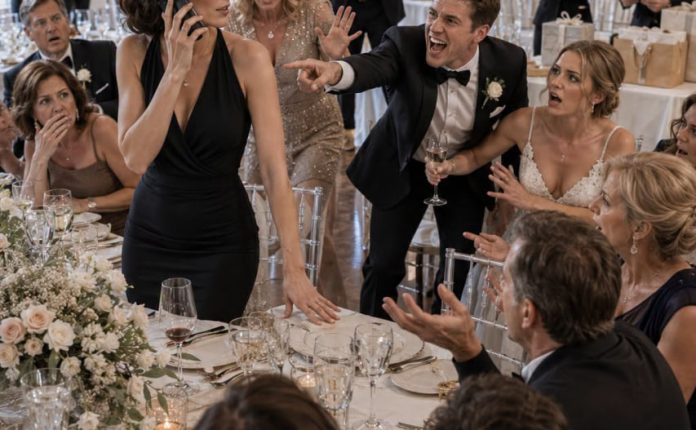
“That sounds exactly like judging.” My aunt coughed into her napkin to hide a laugh. Vanessa’s smile tightened. Then dessert arrived. That was when she decided humiliation wasn’t enough. She wanted an audience. “I actually brought something,” she announced.
She reached for the large designer handbag hanging from her chair. My mother brightened. “A gift?” “Sort of.” Vanessa pulled out a folder. My stomach gave a small, unpleasant turn. Not because I was afraid. Because I knew that expression.
She had worn it when we were teenagers and she discovered I had failed my first driving test. She had worn it when my college boyfriend dumped me. She liked information when it could be used as a weapon.
“I did some research on Second Story,” she said. The room became quieter. I put down my fork. “Why?” “Because somebody needed to be realistic with you.” She slid several printed pages onto the table.
“I asked one of our retail analysts to pull market estimates.” I stared at her. She had asked an employee at Sterling Whitmore to investigate my private business for a family dinner. The irony was extraordinary. “Vanessa,” Grant murmured.
“What? She deserves honesty.” She tapped one page. “Based on foot traffic, lease rates, public records, and industry comparisons, Claire’s store probably produces less revenue in a year than some of my teams generate before lunch.” My mother’s face tightened.
“Perhaps Christmas isn’t the time.” “It’s exactly the time. She’s thirty-six.” Vanessa looked directly at me. “How long are we supposed to pretend this is working?” Nobody spoke. I could hear ice settling inside a water glass. Vanessa continued.
“You went to one of the best business schools in the country. Dad offered introductions. I offered introductions. You refused everything because you wanted to prove some point.” She pushed the papers toward me. “This is the result.” I looked down.
The analysis was actually decent. Wrong, but decent. Second Story had been valued as an independent retail operation. Which was exactly how I had designed it to appear. I folded the report once. Then twice. “So you assigned one of your analysts to investigate me?”
“I was trying to help.” “No. You were trying to embarrass me.” Her face hardened. “If the truth embarrasses you, maybe the truth isn’t the problem.” That one earned silence. Even Dad looked uncomfortable. Then the doorbell rang. My mother exhaled in relief.
“Oh, thank God.” She stood. “That must be Daniel.” Vanessa immediately changed. Her shoulders straightened. Her expression softened. She checked her hair in the reflection of a silver serving tray. “Daniel Cross?” Grant asked. Vanessa nodded proudly. “The CEO.”
My father looked impressed. “You invited your CEO to Christmas?” “He said he had another dinner nearby and might stop in.” That wasn’t exactly what Daniel had told her. I knew because he had called me at 4:20 that afternoon.
“Claire,” he’d said, “I believe your sister invited me to your parents’ holiday dinner. I declined twice, but she was persistent.” I had stared out my office window at the East River. Then I had said, “Go.” “Are you sure?”
“Yes.” There had been a pause. “Does she know?” “No.” Another pause. “This could become uncomfortable.” “I know.” Now footsteps crossed the foyer. Vanessa rose quickly. I stayed seated. Daniel Cross entered wearing a dark wool overcoat over his suit.
At fifty-eight, he had spent three decades in finance and had the calm expression of a man who had survived several recessions, two hostile takeovers, and more boardroom coups than most people knew existed. Vanessa hurried toward him. “Daniel! I’m so glad you came.”
He smiled courteously. “Merry Christmas.” “My parents have been dying to meet you.” She turned. “This is my mother, Eleanor, and my father, Richard. My fiancé, Grant. And over there is my younger sister, Claire. She owns a little vintage—”
Daniel saw me. He stopped walking. Not slowed. Stopped. His expression changed so quickly that Vanessa noticed. “Daniel?” He looked at me, then at the folded analyst report beside my plate. I could practically see him calculating. “Ms. Bennett,” he said.
Vanessa laughed. “You can call her Claire. She’s not one of your executives.” Daniel didn’t laugh. Instead, he removed his coat, straightened, and extended his hand toward me. “Merry Christmas, Ms. Bennett.” I stood and shook it. “Merry Christmas, Daniel.”
My father frowned. “You two know each other?” Daniel glanced at me. I could have stopped him. For ten years, I had protected the secret because hiding gave me freedom. Freedom from my father’s expectations. Freedom from my mother’s social climbing.
Freedom from Vanessa turning everything into a competition. But looking at the financial report she had placed beside my dessert plate, I realized something. I wasn’t hiding anymore. I was shrinking myself to make other people comfortable. There was a difference.
Vanessa crossed her arms. “How exactly do you know my sister?” Daniel looked genuinely confused. Then he said the sentence that ended the life my family thought I had. “Your sister?” His eyes moved from Vanessa to me.
“I’m sorry. I didn’t realize Claire Bennett was your sister.” Vanessa gave a nervous laugh. “Why would you?” Daniel’s gaze returned to me. “Because Ms. Bennett is the founder and chief executive of Meridian Capital Partners.” Nobody moved.
Vanessa’s champagne glass remained halfway to her mouth. My mother stared at Daniel. My father stared at me. And then Daniel added quietly: “As of tomorrow morning, Meridian will also be the controlling owner of Sterling Whitmore.” Vanessa’s glass slipped from her fingers.
It hit the tablecloth, spilling red wine across the white linen like a spreading stain. For the first time in my life, my sister looked at me without superiority. She looked afraid. And I knew Christmas dinner had just become the least important part of her evening.
“No.” Vanessa said it softly at first. Then louder. “No. That’s not possible.” Daniel remained standing near the dining-room entrance while red wine dripped from the edge of the tablecloth onto my mother’s antique rug. Nobody bent down to clean it.
Vanessa looked at me. “You own Meridian?” “I founded it.” “You own Sterling Whitmore?” “Meridian will own a controlling stake.” “Tomorrow?” “The announcement goes out before the market opens.” Her eyes jumped toward Daniel. “Is this some kind of joke?”
Daniel’s expression remained careful. “No.” “How long have you known?” “That Meridian was acquiring us?” “Yes.” “Senior leadership has been involved in transition planning under confidentiality restrictions for several weeks.” Vanessa looked wounded. “I’m senior leadership.” “You’re a senior vice president.”
The distinction landed hard. For years, Vanessa had described herself at family dinners as though she personally directed the company. Now her own CEO had reminded her exactly where she stood. My father finally spoke. “Meridian Capital.” His voice sounded different.
He had spent enough years working around finance to know the name. “But that company manages—” “Just under forty-two billion,” I said. He blinked. My mother sat down slowly. “Forty-two billion dollars?” “Assets under management.” Vanessa shook her head over and over.
“No. You work in Brooklyn.” “I do sometimes.” “You sell clothes.” “I also do that.” “You told us you owned a vintage store.” “I do.” “You lied.” That irritated me. “No, Vanessa. I answered the questions you asked.” “What does that even mean?”
“It means every time you asked how the shop was doing, I told you the shop was doing fine. You never asked whether I had other businesses because you’d already decided I wasn’t capable of having them.” “That’s ridiculous.” “Is it?”
I lifted the report she had brought. “You spent company resources investigating my retail store so you could humiliate me over dessert.” Her face reddened. “I was trying to make you face reality.” “Whose reality?” She opened her mouth. Nothing came out.
Daniel looked like he wanted to disappear into the wallpaper. I almost felt sorry for him. Almost. My mother found her voice. “Claire, darling, why would you hide something this enormous from your own family?” The question bothered me more than Vanessa’s anger.
Because Mom sounded hurt. Not apologetic. Hurt. As though my success had somehow been done to her. “Do you remember my first Christmas after I opened Second Story?” I asked. She frowned. “Not specifically.” “I do.” I remembered everything.
The freezing rain against the windows. The silver dress Vanessa wore. Dad asking whether the store was “a phase.” “I had been open eight months. The shop was barely profitable. I was sleeping four hours a night and working from a folding desk in the stockroom.”
My father nodded impatiently. “Yes, and we were concerned.” “I told you I was building something else.” Mom frowned deeper. “You said you were working on investments.” “I said I was raising capital for an investment partnership.” Vanessa scoffed.
“You never said Meridian.” “There was no Meridian yet.” I looked at my father. “You told me I was wasting time on ‘internet finance nonsense’ and offered to call one of your friends at Morgan Stanley.” His expression shifted.
A tiny memory surfaced. I saw it. “You didn’t listen,” I said. “So I stopped explaining.” My mother touched her pearls. “But forty-two billion…” “It didn’t start there.” Of course it didn’t. Meridian began with $1.6 million. Not mine. Mostly.
I had saved aggressively during school, sold a small software model I developed with two classmates, and convinced five small-business owners I knew through Second Story to invest in a fund focused on neglected commercial properties and distressed local companies. The first year nearly destroyed me.
The second nearly did too. I lived in a studio with pipes that knocked all night. I took client meetings in hotel lobbies because I couldn’t afford a proper conference room. I changed clothes in the back of Second Story before pitching investors.
Then one acquisition worked. Then another. Then a family-owned logistics company we backed tripled in value. Institutional money followed. By the time my family decided I was permanently unsuccessful, Meridian was already managing hundreds of millions. Their certainty became useful.
Nobody asked questions. Nobody requested favors. Nobody introduced me at parties as their brilliant financier daughter. For once, something belonged entirely to me. Vanessa suddenly laughed. It was a strange, sharp sound. “This is insane.” She pointed at me.
“You let me talk about Sterling for years.” “Yes.” “You let me give you career advice.” “Yes.” “You let me offer you a receptionist job.” “Administrative role.” Daniel coughed into his hand. I tried not to smile. Vanessa turned on him.
“You think this is funny?” “No.” “You knew she was buying us.” “Yes.” “And you came here knowing she was my sister?” “I did not know that until five minutes ago.” She looked back at me. “You planned this.”
“I allowed it.” “What’s the difference?” “You invited Daniel. Not me.” Her face tightened. That part mattered. I had not orchestrated some theatrical revenge. Vanessa had created the stage herself. My father stood. “All right. Everybody calm down.” I almost laughed.
That was his reflex whenever he felt control slipping. “Claire, perhaps we should discuss what happens next.” “We?” “With Sterling Whitmore.” “You don’t work there.” “No, but Vanessa does.” There it was. The first pivot. Not “How did you build this?”
Not “We were wrong about you.” Not “We’re sorry.” The moment my success became real, it became a family asset to manage. I looked at Vanessa. “Your employment will be reviewed exactly like everyone else’s.” Her eyes widened. “You’re going to fire me?”
“I didn’t say that.” “You bought my company and now you’re threatening my job.” “I’m telling you I won’t protect it simply because we share parents.” My mother gasped. “Claire.” “What?” “Don’t be cruel.” I stared at her. Cruel. I thought of the analyst report.
The receptionist offer. The decade of jokes. “You know what’s interesting, Mom?” She looked uneasy. “You were fine with cruelty when you thought it only traveled in one direction.” The room went still. Daniel looked at his watch. “I should probably go.”
“Yes,” I said. “Thank you for stopping by.” He nodded to my parents, then Vanessa. “We’ll see everyone tomorrow.” Vanessa flinched at the word everyone. After he left, I got my coat. My mother followed me into the foyer. “You’re leaving?”
“I think dinner’s over.” “Claire, please.” She lowered her voice. “Whatever happened in the past, we are your family.” I slid my arms into my coat. “That sentence usually means someone wants something.” Her mouth fell open. “That is an awful thing to say.”
“Is it inaccurate?” Behind her, Dad entered the foyer. “We want to understand.” “No. You want to catch up.” He frowned. “What’s that supposed to mean?” “It means you had ten years to understand me. You chose a story you liked better.”
Vanessa appeared behind them. Her makeup had begun to smudge beneath one eye. “What happens tomorrow?” I looked at her. “Come to work.” “What time?” “Eight.” She stared. “You expect me to report to you?” “No.” A little relief appeared.
Then I finished. “I expect you to report to your existing chain of command until the restructuring is announced.” Relief vanished. “At which point?” “We’ll see.” I opened the door. Cold air rushed into the foyer. “Claire,” Vanessa said. I turned.
Her face was pale now. Not angry. Calculating. “If you embarrass me at that office because of something that happened between us as sisters—” I interrupted her. “You still don’t understand.” “What?” “I don’t need to embarrass you.” I nodded toward the dining room.
“You already did that yourself.” I stepped onto the sidewalk. Snow had begun falling over Manhattan, thin flakes disappearing against black pavement. My car waited at the curb. Inside, my phone vibrated. It was Maya Chen, Meridian’s general counsel. I answered.
“Merry Christmas.” “Sorry,” she said. “We have a problem.” That got my attention. “What kind?” “One of the Sterling transition files was accessed tonight by someone who wasn’t authorized.” I stopped beside the car. “Which file?” A pause. “The post-acquisition restructuring plan.”
My hand tightened around the phone. “And who accessed it?” Maya exhaled. “Someone using Vanessa Bennett’s credentials.” I looked back at the glowing windows of my parents’ townhouse. My sister was still standing behind the glass. Watching me. Christmas wasn’t over after all.