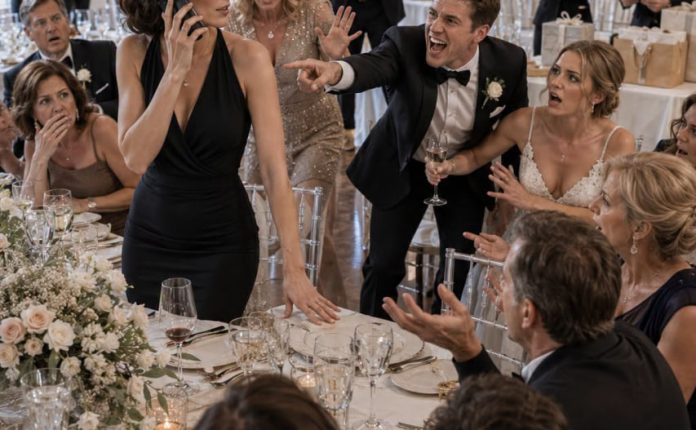
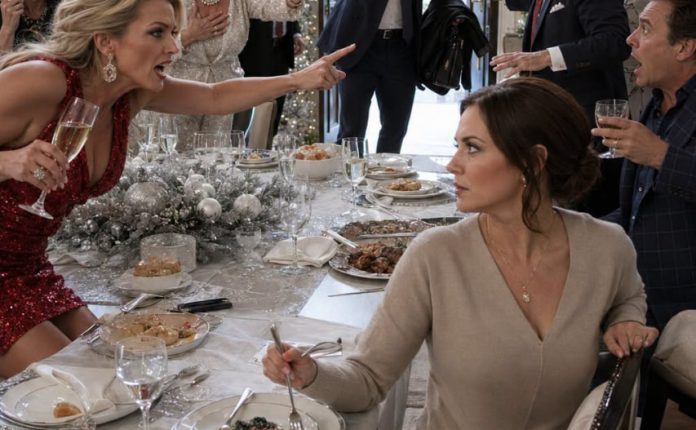
I Arrived Late To Christmas And Overheard My Parents Celebrating My Absence. Dad Said, “Best Gift Tonight? Luna Didn’t Show.” Mom Laughed, And My Sister Added, “Nobody Wants Her Here Anyway.” I Smiled, Stepped Outside, And Called My Lawyer. “Go Ahead.” Exactly 15 Minutes Later, The Music Stopped, And Every Face Went Pale.
My hand was still six inches from my parents’ apartment door when I heard my father raise his glass. “Best gift tonight?” he said over the soft Christmas music. “Sloane didn’t show.” For half a second, I thought I had misunderstood him. Then my mother laughed.
My younger sister, Brooke, joined in. “Nobody wants her here anyway.” That got an even bigger laugh. I stood motionless in the hallway, holding a bottle of Cabernet that had cost me eighty-seven dollars because my mother had once complained that I always brought “practical” gifts.
The hallway smelled faintly of pine cleaner and somebody’s roasted garlic dinner. A gold wreath hung on my parents’ door, perfectly centered. Warm light spilled through the narrow gap beneath it. Inside, twelve people were eating the dinner I had helped pay for.
Outside, I was apparently the joke. I was thirty-four years old, yet for one humiliating instant I felt fourteen again, standing at the kitchen counter while my father explained that Brooke was “more sensitive” and therefore needed more patience than I did.
I could have opened the door. I could have walked in holding the wine and watched their faces collapse. A younger version of me would have. She would have demanded an explanation. She would have cried somewhere private afterward.
Then she would have accepted an apology that sounded suspiciously like an accusation. “You know how your father jokes.” “You take everything so seriously.” “Brooke didn’t mean it.” Instead, I looked at the closed door and felt something inside me become very quiet.
I backed away. By the time I reached the elevator, I had my phone out. My attorney, Nathan Cole, answered on the second ring. “Sloane?” “Send them.” There was a short silence. Nathan knew exactly what I meant. “Are you certain?”
I watched the glowing numbers above the elevator descend toward my floor. “Yes.” “All three notices?” “All three.” “Sloane, once they’re delivered, you can’t pretend this is still an informal disagreement.” “I know.” Another explosion of laughter came from behind my parents’ door.
I pressed the elevator button. “Send them.” I ended the call. Nathan had been waiting seven days for those words. The first notice informed Hartwell Property Group’s lender that I had never agreed to renew my personal guarantee on the company’s revolving credit facility.
The second demanded financial records I was entitled to receive as a thirty-five-percent owner. The third called an emergency meeting of Hartwell’s voting members to address undisclosed related-party transactions, management authority, and the upcoming refinancing.
None of those documents had anything to do with Christmas. Christmas had simply become the night I stopped protecting everyone from them. To understand why that mattered, you have to understand Hartwell.
My grandmother, Margaret Pierce, had started buying small apartment buildings in the late 1970s. She was five feet three inches tall, wore the same pearl earrings every day, and could remember the purchase price of every property she had ever owned.
By the time I graduated college, Hartwell owned apartment buildings, retail properties, and two mixed-use developments across New York and Connecticut. When Grandma died, ownership passed to four people. I received thirty-five percent.
My father, Richard Pierce, received twenty-five. My mother, Diane, held twenty. My uncle Grant owned the remaining twenty. Brooke owned none. You would never have guessed that from the way our family operated.
Brooke had office space at Hartwell headquarters for her luxury event-planning company, Brooke Lane Events. Hartwell provided her with a vehicle for “client development.” Hartwell hired her company for tenant events, property openings, corporate dinners, and holiday parties.
Meanwhile, if I asked to see quarterly cash-flow reports, Mom sighed as though I had requested DNA samples. “Sloane, can you not turn everything into business?” That sentence became especially irritating because I was the person they called whenever business became frightening.
Three years earlier, several major tenants had left one of Hartwell’s commercial properties during the same quarter. Cash got tight. My father called me at eleven at night. He sounded older than I had ever heard him.
“If we lose the revolving facility, we may have to sell into a terrible market.” The bank wanted additional support. I signed a temporary personal guarantee. Not because I wanted control. Not because anyone forced me.
Because Hartwell was my grandmother’s life’s work, and because my father told me hundreds of employees, tenants, vendors, and family assets depended on us getting through one difficult year. We recovered. I assumed my guarantee would expire with the facility.
My family apparently assumed something else. Nine days before Christmas, I received an email from Hartwell’s lender thanking me for my “anticipated continued support” during the January renewal. I read that sentence three times. I had anticipated nothing.
Attached was a financing summary listing me as a continuing guarantor whose signature was expected before closing. Nobody had forged my signature. That would have made everything simpler. Instead, management had done something more slippery. They had behaved as though my consent was inevitable.
I called the bank. “Has anyone told you that I agreed to renew my guarantee?” The representative paused long enough to make my stomach tighten. “Hartwell management indicated there was no expected change in guarantor support.”
“Who specifically?” “I’d prefer to refer you back to company management regarding internal communications.” That afternoon, I called Nathan. He advised me not to accuse anyone of anything. “Facts first,” he said. “Family later.”
So I spent the next several nights at my dining table with shareholder reports, operating agreements, board notices, reserve statements, and related-party disclosures spread across the wood. Around midnight on the second night, I found Brooke Lane Events.
Then I found it again. And again. Marketing. Tenant engagement. Event development. Design consulting. Over eighteen months, Hartwell had paid Brooke’s company nearly half a million dollars. That alone wasn’t automatically improper. Brooke did real work. The problem was disclosure.
Hartwell’s operating agreement required significant transactions with businesses controlled by immediate family members to be disclosed to voting owners and approved above specific thresholds. I had never approved them. Neither, according to Nathan, had Uncle Grant. Then we found the refinancing issue.
My parents planned to pledge additional Hartwell assets to secure the renewed credit facility. That required a member vote. No vote had been held. Yet the bank’s internal materials treated the refinancing as nearly complete. Nathan prepared the notices on December twenty-third.
“Send them now,” he suggested. I didn’t. That embarrasses me slightly now. I wanted to believe there was an explanation. I wanted my father to call me before Christmas and say, “I got ahead of myself with the bank. I’m sorry. We need to discuss this.”
I wanted Mom to admit Brooke’s contracts should have been disclosed. I wanted my family to prove my suspicions wrong. Instead, on Christmas afternoon, Mom texted me three times asking when I would arrive. Dad wrote, “Don’t be late. Grant will be here.”
A year-end issue at work delayed me, and I texted that I was running behind. Nobody replied. Then I arrived and heard my family celebrating the possibility that I wouldn’t come at all. Seven minutes after my call to Nathan, the notices began landing.
At eleven minutes, my phone started vibrating. Dad. Mom. Dad again. Brooke. At exactly fifteen minutes, the music inside the apartment stopped. Completely. Through the door, I heard a chair scrape across hardwood. Then Uncle Grant’s voice.
“What the hell is this?” My father said something too low for me to catch. Grant spoke again. “Who else received this?” “The lender,” Dad said. His voice was different now. No warmth. No humor. Just calculation. I should have left.
Instead, I stood beside the elevator with the Cabernet still in my hand and realized something unpleasant. If I walked away, my father would tell everyone I had launched a legal attack because I was offended by a Christmas joke.
He would control the story before I reached the lobby. So I turned around. When I opened the apartment door, twelve people looked at me. Uncle Grant stood near the fireplace holding his phone. Mom had gone pale.
Brooke’s champagne glass was frozen halfway between the table and her mouth. Dad stared at me. “You were here?” Not Merry Christmas. Not Sloane. Not even Where have you been? “You were here?” I set the wine bottle on the dining table.
“Long enough.” Brooke frowned. “What does that mean?” “I heard the toast.” Mom moved first. “Sloane, that was—” “Which part?” She stopped. “The part where my absence was the best gift? Or the part where nobody wanted me here?”
Three guests suddenly became fascinated with their plates. Brooke rolled her eyes. “Oh, come on. We were joking because you were late.” “Then keep laughing.” Nobody did. Dad lifted his phone. “What is this?” “A clarification.”
“You sent a legal notice on Christmas?” “My attorney sent notices concerning a January first financing deadline.” “You could have spoken to me.” “I did.” He stared at me. “Last month I asked whether the refinancing required anything from me. You said no.”
Grant turned toward him. “You told me the renewal was routine.” “It is routine,” Dad snapped. “Sloane is overreacting.” There it was. His favorite solution to any problem I discovered. Not an explanation. A diagnosis of my personality.
I took off my coat. “Then the emergency meeting should be simple.” Dad’s jaw tightened. “Show Grant and me the approvals, disclosures, and financing authorizations. If everything is routine, we’ll be finished before lunch.” Mom lowered her voice.
“Can we please not discuss company matters in front of everyone?” I looked around the room. These same people had been allowed to hear jokes about how pleasant Christmas was without me. Apparently humiliation could be public. Accountability required privacy.
“I agree,” I said. “That’s why the meeting is at Nathan’s office on the twenty-seventh.” Brooke slowly lowered her glass. “Why is my company mentioned in that notice?” Nobody answered quickly enough. That was when I knew Christmas had only uncovered the first layer.
And judging by the look my parents exchanged, there was something else they desperately did not want Uncle Grant—or me—to see. Brooke was still staring at my father. “Why is my company in a legal notice?” Dad stepped toward her.
“This has nothing to do with you.” “That’s interesting,” I said, “because Hartwell paid Brooke Lane Events approximately four hundred eighty-six thousand dollars over the last eighteen months.” Brooke’s face changed. Not guilt. Confusion. “For work.” “Possibly.” Her eyes snapped toward mine.
“What is that supposed to mean?” “It means some payments have contracts and supporting records. Others need explanation.” “I did the work.” “Then the paperwork will establish that.” Dad moved between us. “Enough.” He had one of those voices that had shaped my childhood.
Low. Controlled. Designed to make everyone else feel immature for speaking. “This family is not tearing itself apart because Sloane wants to play auditor.” Uncle Grant looked down at his phone again. “This notice says related-party transactions may not have been properly disclosed.”
Dad’s shoulders stiffened. Grant continued. “Did Hartwell pay Brooke’s company?” “You know we use her for events.” “I know that,” Grant said. “I’m asking whether the payments crossed the disclosure threshold.” Mom placed her champagne flute on the mantel.
“Can everyone please stop behaving like something criminal happened?” “I never said anything criminal happened,” I replied. “You’re implying it.” “No. I’m asking for records.” Brooke folded her arms. “You planned this.” “I prepared for it.” “And waited until Christmas?”
I looked at her. “I waited because some pathetic part of me still hoped Dad would tell the truth before I had to send anything.” My father’s face hardened. “You’re willing to jeopardize Hartwell because your feelings got hurt.”
That landed exactly where he intended. For years he had used the company as a moral weapon. If I questioned him, I endangered employees. If I questioned expenses, I didn’t understand relationships. If I refused to help, I didn’t respect Grandma’s legacy.
“The existing facility remains in place through December thirty-first,” I said. “I haven’t canceled anything. I informed the bank that I never agreed to renew my personal guarantee.” “The lender may reduce our line.” “Then negotiate honestly.” “You know what that could do.”
“No, Dad. You know what you’ve been telling people it could do.” Grant gave him a sharp look. “What does that mean?” I turned to him. “Dad has been representing my continued guarantee as expected even though I never committed to it.”
Grant looked at my father. “Richard?” Dad’s nostrils flared. “We had every reason to believe she would support the company.” “Why?” I asked. Mom answered before he could. “Because you always do.” Five simple words. They hurt more than the toast.
Because you always do. Not because we discussed it. Not because you agreed. Not because we appreciated what you risked. Because you always do. I picked up my coat again. “The meeting is Tuesday at ten.” Brooke stepped toward me.
“You’re really going to embarrass Mom and Dad over accounting paperwork?” I stopped at the door. “No.” I looked directly at her. “The records will either embarrass them or they won’t.” Then I left. My hands started shaking only after the elevator doors closed.
Not from regret. From adrenaline. For years I had imagined standing up to my family would make me feel powerful. Instead, I felt nauseated. The Christmas lights reflected in the elevator’s brass panel, stretching my face into a warped version of itself.
I had spent most of my adult life trying not to become the difficult daughter my parents described. Now, apparently, I was done trying. The next morning my best friend, Hannah Reed, arrived at my apartment carrying two coffees and a paper bag of cinnamon rolls.
She walked in, kicked snow off her boots, and said, “Before you tell me anything, I have one rule.” “What?” “If you say the phrase ‘maybe I overreacted,’ I’m throwing this coffee at you.” I laughed despite myself. “That feels wasteful.”
“I bought a backup.” We sat at my kitchen island while pale winter sunlight came through the windows. I told her everything. The toast. The notices. The bank. The contracts. The meeting. When I finished, Hannah tore off a piece of cinnamon roll.
“What do you want?” “I want the truth.” “That’s lawyer language.” “It isn’t.” “Yes, it is. Do you want your father publicly humiliated? Your mother apologizing? Brooke broke? Do you want to run the company?” “No.” “Then what?”
I stared into my coffee. “I want them to stop using my name, my money, and my silence as resources they own.” Hannah nodded. “That sounds more useful.” Later that afternoon, I met Nathan at his office.
He had brought in an independent forensic accountant named Dr. Evelyn Park, a calm woman in her early fifties who wore thin silver glasses and treated every question as though precision were a moral obligation. She placed a folder in front of me.
“We have concerns,” she said. “We do not have conclusions.” That distinction immediately made me trust her. She had reviewed only records I had lawful access to as an owner. No secret searches. No stolen emails. No dramatic detective work.
Most of the problems were sitting inside ordinary financial statements because nobody expected me to examine them closely. The first issue was Brooke Lane Events. Hartwell had paid it $486,000 over eighteen months. Roughly $214,000 had clear contracts, invoices, and deliverables.
The remaining amounts weren’t necessarily illegitimate, but documentation was inconsistent. Several invoices used nearly identical descriptions. Others were approved immediately before quarterly reporting deadlines. Some payments were classified as marketing one month and tenant relations the next. “Could it be sloppy bookkeeping?” I asked.
“Absolutely,” Evelyn said. “And the less innocent explanation?” “Preferential treatment combined with failure to follow related-party approval procedures.” Nathan leaned back in his chair. “Again, that’s a governance issue unless evidence proves something worse.” The next folder concerned executive expenses. Club memberships. Vehicle leases.
Luxury travel. Meals. Entertainment. Some might be valid business expenses. Others would be difficult to justify. The timing bothered me more than the amounts. During the same period, my parents had repeatedly delayed shareholder distributions, claiming Hartwell needed to preserve cash for capital improvements.
I had accepted that. Meanwhile, the company had been spending freely in categories broad enough to hide almost anything. Then Evelyn showed me the refinancing documents. An internal presentation described the January renewal as effectively approved. My guarantee was listed as continuing.
No voting member had approved the collateral package. No formal vote had occurred. “What happens if I refuse to renew?” I asked. Nathan answered. “Hartwell may need a smaller facility, additional company collateral, another guarantor, or different terms.” “So the company doesn’t automatically collapse?”
“No.” I felt heat rise into my face. For years, Dad had spoken as if my guarantee were the only beam holding up the roof. “It may create inconvenience,” Nathan added. “Inconvenience is not the same as catastrophe.” Evelyn turned another page.
“There’s one more issue.” The paper showed a series of reserve transfers. Nothing illegal on its face. But three large transfers had been approved within twenty-four hours of payments to vendors connected to my parents. One was Brooke’s company.
Another was a consulting firm run by one of Dad’s golf friends. The third was an entity I didn’t recognize. “Who owns that?” Evelyn closed the folder. “We don’t know yet.” Nathan looked at me. “That’s why Tuesday matters.”
That evening Mom called. “Sloane, can we please talk without lawyers?” “We’re talking now.” “Your father is furious.” “I assumed.” “Grant left Christmas early. Your aunt is asking questions. Brooke is devastated.” “Mom, you laughed when Dad toasted my absence.”
Silence. “That was different.” “You’re right.” She exhaled, relieved too soon. “One was a joke about me. The other concerns a company I own.” Her voice sharpened. “Why do you always talk like this?” “Like what?” “Like a lawyer.”
I stared out my window at traffic moving below. “Because when I talk like your daughter, you dismiss me.” She went quiet. Then she tried fear. “Your father says the bank could make things very difficult if you withdraw support.”
“Then he should have asked me before telling them I would continue.” “He assumed you would help.” “Because I always do?” Silence again. I almost smiled. “Bring the records Tuesday.” “Sloane—” “All of them.”
When we ended the call, I finally understood what I wanted. I didn’t want revenge. I didn’t even want an apology anymore. I wanted my family to experience one problem they could not solve by making me responsible for fixing it.
Tuesday morning, I entered Nathan’s conference room ten minutes early. Uncle Grant was already there. He looked exhausted. At exactly ten, my parents arrived. Dad wore a dark charcoal suit. Mom carried a leather folder pressed tightly against her chest.
Brooke followed. Nathan glanced at her. “She isn’t a voting owner.” “She’s here because her company is being discussed,” Dad said. Nobody objected. I opened the meeting with the simplest sentence I had rehearsed.
“I will not renew my personal guarantee under the current credit arrangement.” Mom immediately said, “Sloane—” “My decision is final.” Dad stared across the table. “The lender may reduce the facility.” “I know.” “We may need to postpone two acquisitions.”
“Then postpone them.” His face tightened. “You’re willing to damage Hartwell to prove a point.” “No. I’m unwilling to pledge my personal assets so management can avoid answering questions.” Uncle Grant nodded. “She has that right.” Dad turned on him.
“Stay out of this.” Grant actually laughed. “This meeting exists because you kept me out of it.” Evelyn opened the first spreadsheet. And within twenty minutes, the story my parents had spent years telling both their daughters began to collapse.