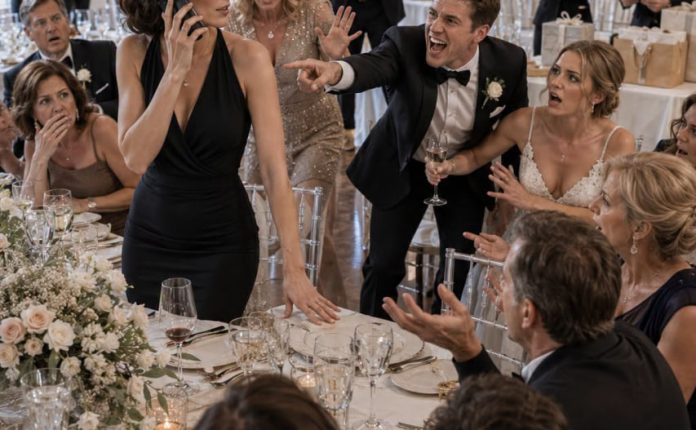
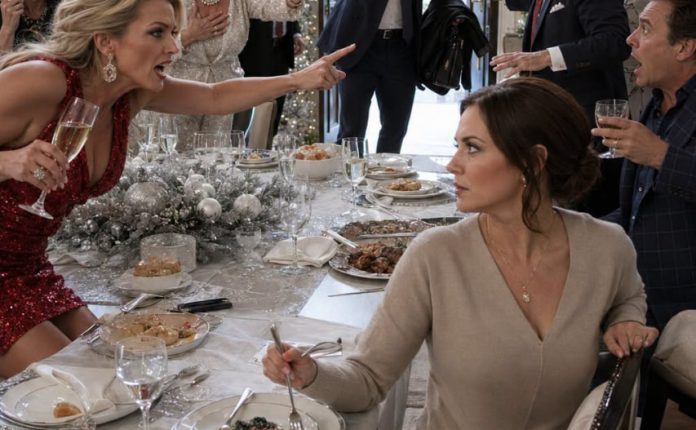
Hannah hosted Christmas that year. Her apartment was smaller than my parents’ old place and louder by a factor of ten. Someone burned the first tray of dinner rolls. Her uncle argued that he had definitely explained the rules of a card game correctly, although nobody else agreed.
A six-year-old nephew spent twenty minutes wearing an empty gift bag as a helmet. Nothing matched. The glasses were different sizes. The napkins came from two packages because Hannah had underestimated how many she needed. It was perfect.
Nobody asked me about Hartwell. Nobody asked me to review a contract. Nobody slid a document toward me and said, “This should only take a second.” Nobody joked that the evening was better before I arrived.
At one point Hannah’s mother handed me a bowl of potatoes and said, “You’re too far away. Come sit over here.” Such an ordinary sentence. It nearly made me cry. At around quarter to eight, my phone buzzed. Dad.
For a moment, the room around me disappeared. One year earlier, I had been standing outside his apartment at almost the same time, holding expensive wine while he celebrated my absence. I opened the message. Merry Christmas. I hope you’re doing well.
That was all. No apology. No explanation. But also no demand. No accusation. No emergency disguised as family obligation. I typed back. Merry Christmas. I hope you are too. Then I put the phone away. Hannah noticed. “You okay?”
“Yeah.” She narrowed her eyes. “Actual yeah?” I looked around the room. Someone was arguing about pie. A dog was sleeping beneath the table. Christmas music was playing slightly too loudly from a speaker in the kitchen. “Actual yeah.”
Around nine, the buzzer rang. Hannah looked at me. “You expecting somebody?” “No.” She opened the apartment door. Brooke stood there carrying two bakery boxes. I stared at her. “You’re here?” “I spent dinner with Mom and Dad.” “And survived?”
“Barely. Dad complained that the ham was dry. Mom said it wasn’t dry. They argued for ten minutes.” “That sounds festive.” Brooke smiled. Then her expression softened. “Mom asked if you were coming.” “What did you say?” “I told her she should ask you herself.”
“Good answer.” “I’m learning.” Hannah appeared behind me. “Does she have dessert?” Brooke lifted the boxes. “Cheesecake and chocolate tart.” Hannah immediately stepped aside. “She may enter.” Later, Brooke and I ended up sitting beside each other on the floor while everyone argued over the card game.
She leaned toward me. “Mom cried after dinner.” I kept looking at my cards. “I’m sorry she was upset.” Brooke waited. “That’s it?” “What do you want me to say?” “I don’t know.” I put down one card.
“I can care that she’s sad without volunteering to fix the reason she’s sad.” Brooke nodded slowly. “I’m still learning that part.” “So am I.” And that was the truth. Distance did not make me stop loving my parents overnight.
Some mornings I missed my mother. Sometimes I remembered Dad teaching me to ride a bike or Grandma laughing at one of his terrible jokes, and for a few seconds I wanted the old family back. Then I reminded myself that memory is selective.
The same father who held the bicycle seat until I found my balance later used my sense of responsibility as leverage. The same mother who sat beside my bed when I was sick spent years teaching two sisters to distrust each other.
People can love you and still harm you. Understanding that does not obligate you to keep standing close enough for them to do it again. I never reconciled with my parents in the way they wanted. We became civil.
There were occasional birthday messages. Short phone calls. A few lunches in public places. But I did not give Dad back informal influence at Hartwell. I did not guarantee another company loan. I did not discuss my personal finances with either parent.
I never again accepted the sentence “because we’re family” as a substitute for a clear request. And I never attended another holiday dinner simply because absence would make somebody uncomfortable. Brooke and I continued rebuilding slowly. There were setbacks.
Once she repeated something Mom had told her about me, and I immediately said, “If you want to know whether that’s true, ask me.” She apologized. Another time I assumed Brooke had received another favor from Hartwell and discovered she had actually won the contract through a competitive bid.
I apologized. That mattered too. Boundaries without accountability can become another form of self-righteousness. Neither of us wanted that. By the following summer, Brooke Lane Events was smaller than it had been under our parents’ protection but more profitable. Brooke stopped chasing appearances.
She hired fewer people. Took fewer projects. Charged sustainable prices. When she landed a major hotel group without Hartwell’s help, she called me first. “I got it.” “You got what?” “The three-property launch contract.” I stood up from my desk.
“You’re kidding.” “No.” I could hear her smiling. “They chose us over four other firms.” “That’s huge.” “I know.” Then her voice became quieter. “For the first time, I know they chose me.” I understood exactly what she meant.
Hartwell changed too. Under professional management, the company became painfully normal. Quarterly reports arrived on time. Member votes happened before major financing decisions. Related-party transactions were documented. My uncle Grant remained involved but stopped treating disagreement as disloyalty.
At one meeting he looked around the table and said, “Your grandmother would probably be furious that it took us this long to behave like adults.” He was right. Dad continued owning his shares but rarely attended operational meetings.
At first I thought he was staying away to punish us. Later, I realized he simply did not enjoy Hartwell once he could no longer control it. That realization helped me understand something important about our relationship too.
For years I had confused being needed with being loved. Dad called most when he required something. Mom praised me most when I agreed. When I solved problems, I was responsible. When I declined, I was cold.
When I asked questions, I was difficult. I had spent years trying to earn a form of love whose conditions changed whenever I developed a boundary. There was no winning that game. So I stopped playing.
The bottle of Cabernet from that Christmas stayed in my apartment for almost a year. I had taken it home without thinking. One night, shortly before the next Christmas, Hannah noticed it on my wine rack. “Is that the famous bottle?” I laughed.
“That sounds ridiculous.” “You carried it through the most expensive family meltdown I’ve ever heard of. It’s famous.” We opened it. It wasn’t particularly extraordinary. After all that money, it tasted like dark cherries, oak, and something slightly bitter. Hannah raised her glass.
“To being unwanted.” I looked at her. “That’s a terrible toast.” “I’m getting there.” I lifted mine. “To knowing when to leave.” “That’s better.” We drank. For months after that first Christmas, I had imagined what perfect sentence I might someday deliver to my father.
Something devastating. Something he would remember forever. I wanted him to understand exactly how it had felt to stand outside that apartment and hear people I loved celebrate because they thought I wasn’t coming. Eventually I realized I had already answered him.
I stopped showing up where I was merely useful. I stopped signing documents because refusing would make dinner uncomfortable. I stopped accepting guilt disguised as loyalty. I stopped hiding facts so people who mistreated me could preserve a flattering version of themselves.
My parents did not lose everything. Dad still had money. Mom still had friends. They traveled. They attended dinners. They lived comfortably. Brooke still had a company. Hartwell still had the same name on the building. That was important to me.
Revenge stories often end with the people who caused harm losing every dollar while the protagonist walks away untouched. Real consequences are usually less dramatic. My parents lost something more specific. They lost automatic access to me.
They lost the ability to use my assets without explicit permission. They lost the assumption that family relationships overruled written agreements. They lost control of the company because of choices they had made while they controlled it.
Mom lost authority because she treated required disclosures like annoying formalities. Dad lost his management position because he acted as though consent could be assumed. Brooke lost guaranteed business because favoritism had prevented her from discovering whether she could actually compete.
None of those consequences required me to invent a punishment. I only stopped preventing reality from reaching them. And the strangest part was that once I stopped trying to make them understand my pain, I became happier.
I bought a small house outside the city the following year. Nothing enormous. A brick place with a deep porch, old hardwood floors, and a kitchen window overlooking maple trees. The first Christmas I hosted there, Hannah arrived early carrying enough food for twenty people.
Brooke came later with dessert. Uncle Grant brought terrible wine and insisted it was excellent. My parents were not invited. That decision caused some relatives to whisper. I heard about it. I didn’t respond.
I had finally learned that other people’s discomfort was not proof I had done something wrong. After dinner, I stepped onto the porch. Snow had started falling. Through the window behind me, I could see Brooke laughing at something Hannah had said.
Warm light spread across the floorboards. For a second, I remembered another Christmas door. The polished wreath. The laughter behind it. The wine bottle in my hand. My father saying, “Best gift tonight? Sloane didn’t show.”
Back then, those words felt like proof that something was wrong with me. Now I understood them differently. My absence had been their best gift because my presence required honesty. I asked questions. I noticed numbers. I remembered promises.
I made it harder for everyone to pretend. They thought the problem was that I had arrived fifteen minutes late. The real problem was that I had finally arrived at the truth. Fifteen minutes after one phone call.
Their music stopped because the people laughing inside that apartment realized something they had taken for granted for years. The daughter they called difficult was the person whose signature had been helping support their financing. The sister they called selfish was one of the people protecting the company.
The woman they treated like an inconvenience had quietly carried obligations that belonged to everyone else. When I stopped carrying them, they did not collapse. They learned to stand on their own. So did I. And that was the only ending I needed.
THE END!
Disclaimer: Our stories are inspired by real-life events but are carefully rewritten for entertainment. Any resemblance to actual people or situations is purely coincidental.