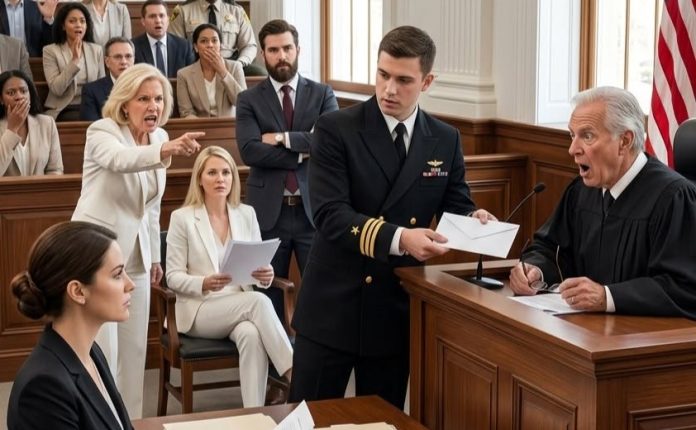
The sentencing hearings took place almost a year after the dinner. By then, TriArc had lost its federal contracts, several employees had pleaded guilty, and restitution calculations filled binders. I attended only Luke’s hearing, not because anyone asked me to, but because I wanted the story to end somewhere real.
The courtroom was smaller than I expected. Luke wore a dark suit that hung loosely on him. Mom sat behind the defense table clutching tissues. Dad was not there; his own case had been resolved separately weeks earlier.
When Luke saw me, his eyes widened. I sat in the back beside Merritt, who had insisted on driving himself despite my offer to arrange transportation. “Figured somebody ought to show up for you this time,” he whispered.
The prosecutor described Luke’s conduct without drama: false invoices, cash transfers, coordinated lies, attempted destruction of records. His attorney emphasized cooperation after arrest, restitution efforts, addiction treatment, and his eventual assistance identifying others involved.
Then Luke spoke. He did not look at Mom. He looked at the judge. “I spent years letting my family save me from consequences. Eventually I thought being rescued was the same as being innocent.”
He continued. “My sister was the person we used most because she was reliable. When she stopped protecting us, I called it betrayal. I understand now that I was asking her to betray herself.”
The judge imposed a substantial prison sentence, lower than prosecutors initially sought because of Luke’s cooperation but long enough that no one could pretend the outcome was symbolic. Restitution followed. Several personal assets were forfeited.
Mom cried into both hands. Luke nodded once as if he had already rehearsed receiving the number. Before marshals led him away, he turned toward me. I gave him the smallest nod I could manage.
Dad’s sentence included incarceration followed by supervised release. The attempted coercion and evidence conduct had transformed what he considered parental pressure into something a federal judge described as “calculated interference.”
The house in Branton was eventually sold. Legal bills, restitution obligations, and years of poor financial decisions had stripped away the illusion that Dad controlled anything. Mom moved into a small apartment near her sister in Toledo.
She mailed me a change-of-address card without a message. I placed it in a drawer. Six months later, she sent a birthday card containing only two handwritten sentences: I should have protected you too. I am sorry I didn’t.
The apology was incomplete. It arrived years late. It did not mention the alibi request or the blackmail. Yet it was the first sentence Mom had ever written that placed responsibility on herself without adding “but.”
I did not rush to reconcile. I sent a brief reply thanking her for the apology and telling her I needed distance. She respected it, at least then. That small respect did more for our future than any dramatic reunion could have.
My career continued. The procurement investigation produced reforms in vendor screening and conflict reporting. Because of my family connection, I received no credit tied to arrests, and I wanted none. My work was reviewed separately and continued on its own merits.
Months later, I briefed senior leaders on weaknesses the case had exposed. Nobody introduced me as the woman whose brother went to prison. Nobody asked about my therapy records. I was Major Cerise Vale, presenting findings I understood better than anyone in the room.
After the briefing, a young captain waited near the door. She looked nervous. “Ma’am, can I ask something personal?” I told her she could ask, and I would decide whether to answer.
She said she had started counseling after a deployment and worried people would question her readiness. The old shame tried to rise in me, but it had nowhere left to stand.
“Getting help is not the opposite of readiness,” I told her. “Ignoring a problem because you fear appearances can become one.” Her shoulders dropped with visible relief as she thanked me.
That night, I realized Dad’s threat had failed in the deepest possible way. He had tried to make my treatment a weapon. Instead, the experience made me less afraid to speak honestly about it.
He believed a town’s gossip could define me. He believed rank was costume jewelry. He believed family loyalty meant absorbing whatever damage the loudest person demanded. Most of all, he believed I would always choose their comfort over my own integrity.
Two years after my promotion, another ceremony brought me back to the same Maryland auditorium. This time, I was presenting an award to a junior officer on my team. I arrived early and noticed the second row.
Then the doors opened. Merritt entered with his cane, moving slower now. Behind him came three friends from my command, Colonel Saye in retirement, and the captain I had once encouraged to stay in counseling.
After the ceremony, Merritt handed me a gas-station coffee. “Tradition,” he said. I laughed and took it. Outside, sunlight flashed across rows of parked cars, bright enough to make everyone squint.
My phone buzzed with a message from Mom. Hope today went well. Proud of you. No demand followed. No crisis. No reference to Luke. I read it twice before replying, Thank you.
Some relationships do not heal through one grand conversation. They change by inches, through what people stop demanding and what they finally learn to respect. Mom and I spoke occasionally after that, carefully, with boundaries I no longer apologized for.
Luke served his sentence and entered treatment programs while incarcerated. His letters became shorter and less defensive. Eventually he stopped asking whether I could help with appeals, money, or favors. He began telling me what he was doing instead of what he needed me to fix.
Dad remained the hardest. His letters were angry until they stopped coming. I did not chase them. I had spent enough years trying to earn warmth from a man who interpreted sacrifice as weakness.
One summer evening, I returned to Branton for Merritt’s seventy-fifth birthday. His backyard was crowded with folding chairs, barbecue smoke, neighbors, and grandchildren running through sprinklers. Nobody cared about rank.
Merritt raised a paper cup and tapped it with a plastic fork. The sound instantly transported me back to Dad’s dining room. My body tensed before my mind caught up.
Then Merritt grinned. “I got one announcement. Cerise brought the potato salad, and if any of you complain, you can leave.” Everyone laughed. So did I, harder than the joke deserved.
That tiny moment felt like a reclamation. A glass being tapped did not have to mean a demand. A family gathering did not have to become a trial. A room full of people could look at me without asking what I would sacrifice.
Later, sitting on Merritt’s porch, he asked whether I regretted going to that dinner. I thought about Dad’s face, Luke’s handcuffs, Mom crying, and fifteen thousand dollars scattered across the carpet. “No,” I said. “I regret that it had to happen. That’s different.”
He nodded. “Your granddad used to say consequences are expensive because people usually buy them on credit.” I laughed. “That sounds like him.” Merritt sipped his coffee. “Sounded like your father too, once. Before he forgot.”
Driving back to Maryland that night, I passed my parents’ old house. A young couple had bought it. The porch had been painted white. Children’s bicycles lay near the steps. Warm light filled the windows.
For years, I thought leaving that house meant abandoning my family. Then I learned that sometimes leaving is the first honest thing you do after years of pretending harm is love.
At a red light outside town, I caught my reflection in the rearview mirror. No Dress Blues. No medals. No rank visible. Just me, older than the daughter who once stood dripping rainwater onto warped floorboards and begged her parents to attend one ceremony.
Behind me was a house that had taught me how easily loyalty could be twisted into obedience, and how quickly love became leverage when people believed your boundaries were negotiable.
I had not arrested my brother. I had not destroyed my father. I had not broken my family by refusing to lie. They had made choices, and the law had given those choices names, evidence numbers, hearings, sentences, and consequences.
I had protected the oath I took, the career I built, the privacy they tried to weaponize, and the frightened younger version of myself who once believed survival required keeping everyone else comfortable.
And when Dad raised that beer glass and demanded one more sacrifice, he expected the daughter who always paid. Instead, he met Major Cerise Vale, and she finally let consequences enter through the front door.
THE END
Disclaimer: This fictional story is for entertainment purposes. It portrays child abuse as harmful and criminal, and it does not endorse violence, coercion, or unsafe medication practices.