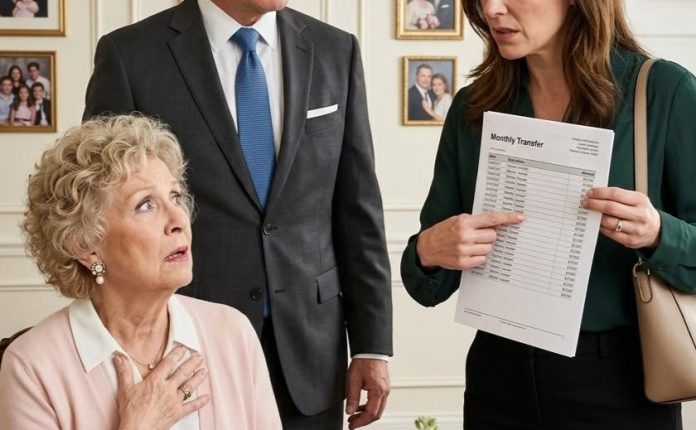
I was nine when Corinne dropped a glass casserole dish and blamed me. She made me kneel among the fragments, collecting them with bare hands while she complained about waste. When a shard sliced my palm, she pressed a towel against it and warned me not to embarrass her.
Dad loved us, but he was absent too often and trusted the wrong narrator. Voss Agricultural Supply kept him driving between counties, negotiating seed contracts and repairing equipment. Corinne managed the house, the books, and the emotional weather. By the time he noticed damage, she had prepared an explanation.
At sixteen, I discovered our family business had a scholarship partnership with the Navy’s youth outreach program. A visiting chief petty officer described service as structure, education, and belonging earned through responsibility. For the first time, adulthood sounded like a door rather than another room controlled by Corinne.
I enlisted two weeks after turning eighteen. Dad drove me to the processing station before sunrise. Corinne refused to come, saying I was performing another selfish rebellion. Dad handed me his old fountain pen and whispered, “Build a life nobody can rewrite for you.”
My early Navy record was ordinary: language training, technical schools, evaluations, deployments, and long watches fueled by terrible coffee. I discovered I could remain calm while information moved quickly. Supervisors trusted my judgment. Opportunities expanded, and eventually ordinary records stopped describing the whole work.
I entered an intelligence specialty supporting maritime operations. Later assignments involved interagency teams, protected facilities, and identities that could not be connected casually to public addresses. My service remained legal, documented, and paid, but portions of its trail were deliberately shielded from commercial databases.
Dad knew enough to know I served. We communicated through approved channels and occasional secure calls whose timing I could not control. I never described missions. He never asked. He told me about crop prices, broken tractors, and the maple tree he planted after my grandmother died.
Corinne intercepted several ordinary letters, though I learned that only years later. She told Dad I rarely wrote and told me Dad found military life embarrassing. The distance between us seemed mutual because one person carefully edited both sides. Liora knew some of this and said nothing.
When Dad developed heart disease, he contacted me through an attorney rather than the house. I visited twice under leave arrangements, meeting him at a clinic in Richmond. He apologized for accepting Corinne’s stories. I apologized for believing his silence meant rejection. Neither apology recovered the lost years.
He showed me a draft of his trust. The employment clause worried me because Liora’s history was unstable. Dad said Corinne insisted Liora had worked consistently for the company, often remotely. He planned to request payroll verification. I advised independent review but could not become involved in estate planning.
“Your mother says you have no records,” he told me. I explained that proof existed, though access might require federal authorization if challenged. Dad nodded and wrote something in a small notebook. “Then truth has records,” he said. “Even when people don’t.”
His death came during an overseas assignment. My commander obtained emergency travel permission, but a transportation delay prevented the public funeral. Dad’s attorney arranged a private graveside service before my departure. Rowan attended because he was then advising my command on administrative matters and understood the restrictions.
When court resumed, the jurors returned without knowing what the judge had seen. Judge Reade explained that he had reviewed protected federal records under the court’s order. He could not disclose operational details, but he could state that the Department of the Navy authenticated my identity and service.
The unclassified certificate confirmed eighteen years of continuous active-duty employment, honorable standing, current rank as commander, and multiple overseas assignments. It also confirmed that gaps in ordinary databases resulted from authorized security protections rather than unemployment or fabricated identity.
The judge denied Miles’s request for a directed verdict. He instructed jurors that federal service had been established as a matter supported by authenticated evidence. They could consider credibility on remaining issues, but they could not treat the absence of public records as proof that I had never served.
A sound moved through the gallery, less like a gasp than a room rediscovering air. Mr. Hensley lowered his head. Mrs. Pike covered her mouth. The retired bus driver removed his VFW cap and held it against his chest. I felt no triumph, only exhaustion.
Rowan called his first witness, a civilian records officer from Navy Personnel Command. She appeared by secure video and explained the certification process without discussing assignments. Miles asked whether documents could be forged. She answered that the court received them directly through authenticated federal transmission and physical courier.
Then Rowan asked the question that shifted the case beyond my service. “Did the plaintiff or her counsel seek verification before alleging fraud?” The records officer reviewed her log. Corinne had submitted no inquiry. Miles’s office requested verification only three days earlier, after trial preparations were complete.
The officer testified that a standard confirmation of active service could have been obtained months before, with my consent and the protective order. Rowan had offered that route during discovery. Miles declined, arguing only public documents should count. The accusation survived because they avoided the answer.
Miles objected that his litigation strategy was not evidence. Judge Reade sustained part of the objection but allowed questions concerning reasonable verification because Corinne sought damages for alleged fraudulent conduct. If she claimed I knowingly lied, her own efforts to determine truth were relevant.
During cross-examination, the records officer revealed another detail. An inquiry had been made under my birth name seven months before Dad died. The requester used Voss Agricultural Supply credentials. The response confirmed active federal employment but required my authorization for more information.
Rowan turned toward Corinne. Only the company’s financial administrator and trustee had access to those credentials. Corinne had known before Dad’s death that a federal database confirmed my service. She later swore in her lawsuit that she found no evidence I had ever served.
My mother’s attorney requested a break. Judge Reade denied it until the witness finished. Corinne stared straight ahead, her carefully fragile posture collapsing into rigidity. Liora began twisting her tissue into a narrow rope, a childhood habit that appeared whenever Mom’s certainty became dangerous.
Rowan introduced the inquiry log as an unclassified exhibit. It showed the date, company account, requester address, and response. Corinne claimed a clerk might have submitted it. The company employed only four office workers then, and each denied using the trustee’s personal credentials.
The federal envelope did more than prove my career. It proved Corinne had searched for that career, received confirmation, and built her accusation anyway. Yet Rowan warned me during lunch that lying about my service might not decide whether Liora met the trust condition.
“We still have to prove her records are false,” he said. Our forensic accountant, Elena Shaw, had examined company payroll and trust transactions for three months. Corinne resisted subpoenas, claimed damaged computers, and produced paper summaries instead of source data. That resistance had generated its own trail.
Elena testified the next morning. Liora’s employment file contained regular pay stubs beginning ten years before Dad’s death. At first glance, the record appeared complete. However, the payroll software that supposedly created the earliest stubs had not been purchased by the company until four years later.
Metadata showed all ten years of statements were generated during one weekend, seventeen days after Everett died. The employee identification number followed a format introduced recently. Tax withholdings listed on the older stubs did not match quarterly filings originally submitted to state or federal agencies.
Miles argued that Corinne reconstructed lost records from paper ledgers. Elena agreed reconstruction was possible but explained that the trust required proof of actual employment, not newly designed documents. Bank statements showed no wages paid to Liora during seven of the claimed ten years.
Corinne produced canceled checks she said represented cash wages. Elena traced the check numbers. Several had originally paid fertilizer suppliers and were altered in photocopies. Two checks were issued after the bank account closed. One displayed Everett’s signature six months after a stroke made writing impossible.
The jury stopped looking at me. Their attention settled on the plaintiff’s table, where the story of a faithful daughter and grieving widow was being dismantled by dates. Liora leaned toward Mom, but Corinne pushed her away without breaking eye contact with Elena.
Elena then described transfers from the estate. While serving as temporary trustee, Corinne paid 186,000 dollars to a consulting company owned by Liora. Invoices claimed inventory management, property maintenance, and litigation support. Photographs showed the supposedly maintained warehouse remained closed and deteriorating.
Another 94,000 dollars funded renovations to Liora’s home, described in trust records as repairs to estate property. Corinne reimbursed herself 63,000 dollars for caregiver expenses unsupported by receipts. Some care was real, but bank records showed much of the money went toward travel and jewelry.
Together, the questionable payments exceeded 340,000 dollars. Rowan did not call every dollar stolen. He asked Elena to distinguish unsupported, misclassified, and clearly personal expenses. Precision mattered. Exaggeration would have allowed Corinne to portray accountability as another daughter’s revenge.
On cross-examination, Miles suggested Dad often paid Liora informally. Elena agreed he sometimes gave both daughters gifts. Gifts were not wages, however, and occasional errands did not establish continuous employment. Nothing in the original tax records showed the decade Corinne certified under oath.
That afternoon, Liora requested separate counsel. The judge allowed her attorney time to appear and instructed Corinne not to discuss testimony with her. In the hallway, Mom grabbed Liora’s sleeve. A deputy stepped between them. Liora looked at me, frightened in the same way she had under the kitchen table.
Liora’s new attorney negotiated permission for her to testify without Corinne’s counsel controlling the examination. She admitted helping create payroll summaries after Dad died. Corinne told her the documents merely corrected Dad’s careless bookkeeping and protected the inheritance he intended her to receive.
She also admitted she never worked full-time for Voss Agricultural Supply. She answered occasional emails, designed advertisements, and attended holiday events. During several years, she received no wages. Corinne promised the trust would repay personal debts if Liora signed the certification and supported the lawsuit.
Rowan asked whether Liora believed I had never served. She stared at her hands. “Mom said Mara was probably doing government contract work and pretending it was the Navy.” Rowan displayed messages where Liora wrote, “If she can’t show it, we can make the town finish her.”
Liora began crying without looking toward the jury. She said she had been angry that Dad discussed the trust with me privately. Corinne convinced her I planned to take everything. The forged employment records felt, in Liora’s words, like “balancing what Mara had already stolen.”
What had I stolen? Attention, perhaps, simply by remaining unknowable. In Corinne’s family structure, any life outside her control became an accusation against those who stayed. Liora spent years competing with an invented version of me while I spent those years trying to survive the distance.
That evening, someone removed the word TRAITOR from my windshield and left a small American flag beneath the wiper. The gesture made me angrier than the insult. Both treated my service as the condition for basic dignity. I deserved fairness before anyone knew what uniform I wore.