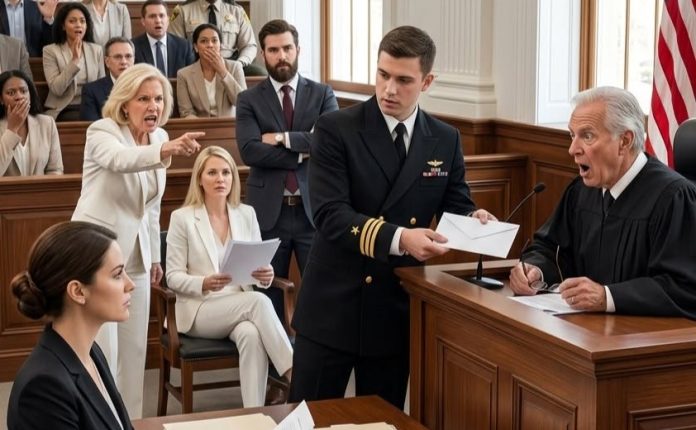
Sophia received a substantial prison sentence. At sentencing, she apologized to Andrew but spoke about Valerie only after the judge asked whether she wished to address the child directly through a written statement. Celeste received a shorter but still significant sentence.
She insisted until the end that she had only tried to help her daughter manage an impossible household. The judge answered with a sentence Andrew remembered clearly: “An adult’s inconvenience does not transform a child’s fear into discipline.” He sold the Hamptons house the following spring.
Valerie never asked him to keep it. When he told her they could stay if she wanted, she immediately shook her head. “That house has bad rooms,” she said. Andrew understood exactly what she meant. They moved permanently into the smaller Southampton property and renovated it slowly together.
That became one of their quiet measures of recovery. Valerie started making ordinary mistakes. She forgot homework once. She spilled juice on the kitchen floor and burst into tears. Andrew handed her a towel and said, “We clean it up.”
She stared at him. “That’s all?” He nodded. “That’s all.” Valerie began crying harder, not because she was afraid but because nothing terrible happened. Her grades changed too. She stopped bringing home perfect scores every week.
Once she received an eighty-seven on a math test and walked into the kitchen holding it openly. There was nothing more. That evening she asked for ice cream. Andrew realized an eighty-seven had become a milestone because it meant his daughter no longer believed love depended on perfection.
He also changed his relationship with work. Salgado Capital had been his identity for almost twenty years. He reduced travel, delegated decisions, and appointed a chief operating officer with authority he previously refused to surrender. More importantly, Valerie stopped asking, “Are you working tomorrow?” with anxiety in her voice.
His calendar became visible on the refrigerator, including school pickup days marked with purple stars. The first time Andrew missed one because of a genuine emergency, he called Valerie himself rather than having an assistant explain.
He apologized, arranged for Marisol to collect her, and returned home before dinner. Valerie was disappointed. She was also angry. She told him, “You promised.” Andrew resisted the instinct to defend himself. “You’re right. I did.” They talked about it. Valerie stayed angry for almost fifteen minutes.
Andrew later told Dr. Reyes it was one of the happiest arguments of his life. “She knew she could be mad at me and still be safe,” he explained. Dr. Reyes smiled. “That is exactly what healthy attachment allows.”
Andrew also rebuilt ties with Elena’s sister, Maria, after telling her the truth. She came the next weekend carrying photographs, old videos, and Elena’s old recipe notebook. Valerie spent hours asking questions about her mother. What was Elena’s favorite song? Did she hate broccoli?
Was she scared of thunderstorms? Did she ever get bad grades? Maria answered everything. Elena hated folding laundry, sang badly, loved thunderstorms, and once failed a college economics exam because she stayed up watching movies instead of studying. Valerie laughed so hard she nearly fell off the couch.
Her mother stopped being a forbidden saint and became a real person again. On the second anniversary of the day Andrew came home early, Valerie asked whether they could go for ice cream after school. Andrew checked his calendar theatrically. “I may have a very important meeting,” he said.
Valerie narrowed her eyes. “Daddy.” Andrew smiled. “The meeting is with you.” They drove to a small shop near the beach. Valerie ordered strawberry, changed her mind to chocolate, then asked whether she could switch again. Andrew laughed. “You are abusing the privilege.”
Valerie grinned because she knew he was joking. She chose mint chip. They ate outside while gulls fought over something near the parking lot. Valerie told him about a classmate who was mean during recess, a science project she wanted to build, and a teacher who gave too much homework.
Halfway through her cone, Valerie asked, “Why didn’t you know?” The question arrived so quietly Andrew almost pretended not to hear it. Instead, he put down his spoon. “Because I wasn’t paying enough attention, and Sophia worked very hard to hide it.
Both things are true.” Valerie looked at the melting ice cream. “Did you love her more than me?” Andrew felt pain move through his chest. “No,” he said. “But I acted like work and keeping everything calm were more important than asking hard questions.
I’m sorry.” Valerie considered that answer. “I thought you would be mad if I made you choose.” Andrew shook his head. “Adults are supposed to protect children. You were never supposed to protect my marriage.” She nodded slowly and returned to her ice cream.
Andrew knew the conversation would probably return in other forms for years. Healing did not move in straight lines. By age nine, Valerie had become louder. She laughed with her whole body, argued about vegetables, complained when homework felt unfair, and left shoes in places Andrew repeatedly tripped over.
He treasured every irritating sign of ordinary childhood. Sometimes, after reminding her for the fourth time to put away a backpack, he caught himself smiling. “Why are you smiling?” Valerie asked once. “Because you’re being annoying,” he replied. She threw a cushion at him.
The house slowly filled with noise. Friends came over. Music played upstairs. Valerie joined an art class and covered the refrigerator with paintings. One picture showed three figures standing under a yellow sun.
Andrew, Valerie, and Elena. In the corner was a small purple bottle crossed out with a thick black X. Andrew stared at it longer than the others. Valerie noticed. “I don’t like purple medicine,” she said matter-of-factly. Andrew nodded. “That makes sense.”
She did not need him to collapse every time she referenced what happened. Dr. Reyes had taught him that children often look to adults for cues about whether their memories are survivable. So Andrew learned to stay present. “Do you want to talk about it?” he asked.
Valerie shook her head and taped another drawing beside it. Years after that Thursday, Andrew found the old school uniform while sorting storage boxes before a move. The blouse was sealed inside an evidence return bag that had been released after all appeals ended.
Near the cuff remained the tiny faded stain. Andrew sat on the floor holding the bag, overwhelmed by how ordinary it looked. A small mark. Easy to miss. Easy to explain away. Yet once he noticed it, the entire false story around his daughter began collapsing.
Valerie, now nearly grown, appeared in the doorway and saw what he was holding. “You kept that?” she asked. “It came back with the case files,” Andrew said. “I forgot it was here.” Valerie stepped closer but did not take the bag.
For several moments they looked at the uniform together. Then Valerie said, “I don’t want it.” Andrew nodded. “Neither do I.” They carried it outside and placed it in the trash. There was no ceremony. No speech. No need to preserve an object merely because it had once mattered.
Valerie closed the bin and looked at him. “Can we get lunch?” Andrew smiled. “Absolutely.” She pointed toward his car. “And I’m driving.” “That seems reckless.” Valerie held out her hand for the keys. “You said children are allowed to inconvenience their parents.”
Andrew laughed and handed them over. “I deeply regret teaching you that sentence.” She drove them toward town, complaining about his directions even though the navigation system was clearly visible. Andrew watched the road, listened to her talk, and felt the strange gratitude of an ordinary afternoon.
For years, he had thought his greatest duty was building enough wealth that Valerie would never struggle. He understood now that money could purchase houses, tutors, doctors, security systems, and excellent schools. It could not replace noticing the fear in your child’s face.
It could not ask the second question when the first answer sounded too easy. It could not sit beside a bed after a nightmare. Presence was not glamorous. Most of it looked like repetition, inconvenience, patience, and conversations that interrupted whatever adults believed was urgent.
Andrew had learned that lesson later than he wished, but not too late to change the life that followed. Valerie had once been the perfectly behaved child who never complained, never argued, and never brought home anything less than excellence because she believed mistakes were dangerous.
Years later, she became wonderfully imperfect. She argued, laughed too loudly, changed her mind, forgot things, asked difficult questions, and trusted that love would still be waiting afterward. That was how Andrew knew she was finally safe. Not because she was quiet. Because she no longer had to be.
THE END
Disclaimer: This fictional story is for entertainment purposes. It portrays child abuse as harmful and criminal, and it does not endorse violence, coercion, or unsafe medication practices.