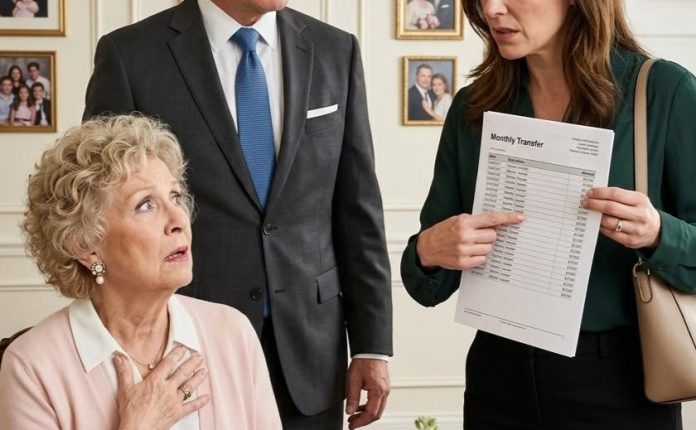
Rain ran down my face while I stood on the stone steps of the house I had bought six years before I met Brent. Ivy slept against my chest, only three days home from the hospital, while the keypad beside the front door blinked red again.
My code no longer worked. I tried once more because exhaustion makes you bargain with obvious things. Six digits. Red light. I checked the garage app. Access denied. I called Brent. Straight to voicemail.
Then I saw his message from forty minutes earlier: Mom and I had to handle something in Miami. Stay with Molly this weekend. We’ll talk Monday. Stay with Molly. As though I had asked permission to leave my own house.
As though my sister’s guest room had somehow become the natural place for a woman recovering from childbirth while her husband flew to Florida. I looked through the glass beside the door and saw warm lights, fresh flowers, and Ivy’s bassinet.
“Sell it,” I said when Jennifer Hart finally answered. My attorney went silent. Jennifer had represented me through eight years of contracts, acquisitions, and one ugly partnership dispute. She had heard me negotiate under pressure without raising my voice.
She had never heard me talk about Redwood Crest Drive as if it were an object I could release. “Tessa,” she said carefully, “the property is still titled solely to you?” “Yes.” “Brent was never added?” “Never.” “Mortgage?” “Paid off last spring.” “Prenup?”
“Signed, independently reviewed, and very specific.” She exhaled. “And Ivy is three days home?” I looked down at my daughter’s pink blanket. “Yes. Three days after bringing her home, I’m outside in the rain because my husband changed the entry codes and went to Miami with his mother.”
Jennifer’s voice changed. “I’m opening every file.” Behind me, the house glowed through tall windows. I had bought it after selling my first healthcare software company, then spent two years renovating it room by room. Brent later called it our estate.
Diane called the guest suite her room. Karen hung family photographs along my staircase without asking. Their language had bothered me, but I had treated it as harmless enthusiasm. Our house. Our terrace. Our wine room. Our mountain view.
I had told myself marriage naturally changed pronouns. Standing outside with my newborn, I finally understood that some people use words as rehearsal before they use paperwork. Jennifer called back within minutes. “Elliot says his buyer is still interested. All cash. They made the offer before Ivy was born, remember?”
I remembered. A technology executive from Denver had offered four million eight hundred thousand dollars after hearing I might eventually downsize. I declined because I wanted Ivy to grow up there.
“Tell him I’ll review a serious offer tonight.” “Tessa, don’t make a permanent decision because Brent behaved horribly today.” “I’m not. I’m making it because I no longer want him to think the walls are leverage.” “Where are you going?”
“Molly’s.” “Call her. And do not go back inside alone until we understand what he changed besides the keypad.” I called Molly. She answered on the first ring. “Are you home?” “I’m outside.” “Outside where?” “My house. Brent changed the code.”
There was a two-second silence. Molly had distrusted Brent from the beginning, but she had stopped saying so after I accused her of looking for flaws because our father had been unreliable. “I’m coming.” “I can drive.”
“You gave birth less than a week ago. Sit in your car, lock the doors, keep Ivy warm, and let me be useful.” My throat tightened. “He went to Miami with Diane.” “Of course he did.” “Please don’t start.” “I’m not starting anything. Apparently Brent already did.”
Twenty minutes later, Molly pulled behind me. She took one look at my soaked coat, opened her back door, and said, “Baby first. Anger later.” I climbed into the passenger seat while she moved Ivy’s carrier carefully.
For the first time all afternoon, I felt the smallest edge of safety. At Molly’s townhouse, I fed Ivy, changed clothes, and sat beneath a blanket while Jennifer joined by video. She had pulled the deed, prenup, insurance records, security contract, and property tax history.
Every document said the same thing: Redwood Crest was mine before marriage and remained my separate property. “Then how did he change the security account?” I asked. Jennifer frowned. “That is what concerns me.” The system had been installed in my name.
Brent had secondary access because I added him after our engagement. Secondary users could create temporary guest codes, not replace the primary owner’s credentials. Yet someone had managed to remove my phone and assign Brent as administrator.
Jennifer asked me to call the security company while she listened. The representative sounded embarrassed within five minutes. Two weeks earlier, someone had submitted a “household ownership update” showing Brent as co-owner and primary resident. The attached document appeared to be a deed transfer.
“I never transferred anything.” The representative immediately froze remote changes and escalated the account. Jennifer asked for preserved copies of every submitted document, login record, and phone recording. Then she looked at me through the screen. “Do not call Brent yet.”
My stomach turned. “You think the deed is fake.” “I think a document exists that you did not sign.” Molly sat beside me. “That is not the same as changing a door code.” “No,” Jennifer said. “It isn’t.”
Elliot sent the buyer’s written offer that evening. Four million seven hundred fifty thousand dollars, all cash, ten-day due diligence, flexible closing. I stared at the number without feeling anything. Six years earlier it would have represented the greatest success of my life.
That night it looked like an exit. I signed the authorization allowing Jennifer and Elliot to proceed, but not the final sale contract. Jennifer wanted a title search first. “If someone created a false deed, we need to know where else they used it.”
At eleven, Brent finally called. I let it ring twice before answering. “Tess, why are you at Molly’s?” I almost laughed. “Because you changed my door code.” “It was temporary.” “Why?” “Mom’s security consultant found vulnerabilities. I was going to explain.”
“From Miami?” His silence lasted too long. “Give me the new code.” “I can’t right now.” “You can’t or you won’t?” “Tessa, you are exhausted. Ivy just came home. Can we not turn this into a war?” The sentence sounded almost reasonable.
That was one of Brent’s gifts. He could place a calm frame around something outrageous until objecting made you look unstable. “I asked for the code to my house.” “Our house.” “No. My house.” His breathing changed. “There it is.”
“What?” “The reason Mom said we needed to fix this before it became a problem.” Cold moved through me. “Fix what?” “The way you think everything is yours because you bought it before we met.” “Brent, what did you file?”
“What are you talking about?” “The security company received a deed showing you as co-owner.” Silence. Then he said, “Talk to my mother.” “No.” “Tessa—” “Did you sign or submit a document claiming you own my house?”
“You’re asking the wrong question.” “Then give me the right one.” He lowered his voice. “Why did you marry me if you intended to keep building walls between us?” I ended the call. Jennifer called at seven the next morning.
“Tessa, we found the document.” I had slept ninety minutes in fragments. Ivy was against my shoulder while dawn light filled Molly’s kitchen. “What is it?” “Not a recorded deed. A marital property contribution agreement.” “I’ve never heard of it.”
“It says you contributed Redwood Crest to a family holding company called BKM Legacy Partners three weeks after the wedding.” My mouth went dry. “BKM?” “Brent, Karen, and Diane Mercer.” I closed my eyes.
Jennifer continued. “The agreement carries your signature. It also says the house may be pledged for family investment obligations.” “I never signed it.” “I know.” “How?” “Because the signature appears copied from your prenup acknowledgment page. The compression pattern is nearly identical.” Molly swore quietly.
I asked the question that mattered. “What obligations?” Jennifer paused. “That is where this gets worse.” She had found BKM Legacy Partners in state records. Diane formed it eleven months before Brent proposed to me. Brent owned forty percent.
Diane owned forty. Karen owned twenty. The company had no meaningful assets. But six weeks before our wedding, BKM applied for a nine-hundred-thousand-dollar private credit line. Collateral listed: future contributed real estate at Redwood Crest Drive. I stared at the wall.
“They planned to use my house before I married him.” “We need more records before we say who planned what.” “The lender scheduled a final collateral inspection for tomorrow,” she continued. “Brent locked me out so an appraiser could inspect the house without me.”
“That is one possibility.” “Why is he in Miami?” “BKM owns an interest in a condominium development there.” Molly sat forward. “Diane’s development.” I looked at her. She nodded. “I heard Karen talking about it last Christmas. Their investors were threatening to walk.”
Jennifer confirmed it within an hour. BKM’s credit line was intended to refinance debt connected to a struggling Miami luxury-condo project. The lender expected Redwood Crest to support the loan after my supposed contribution.