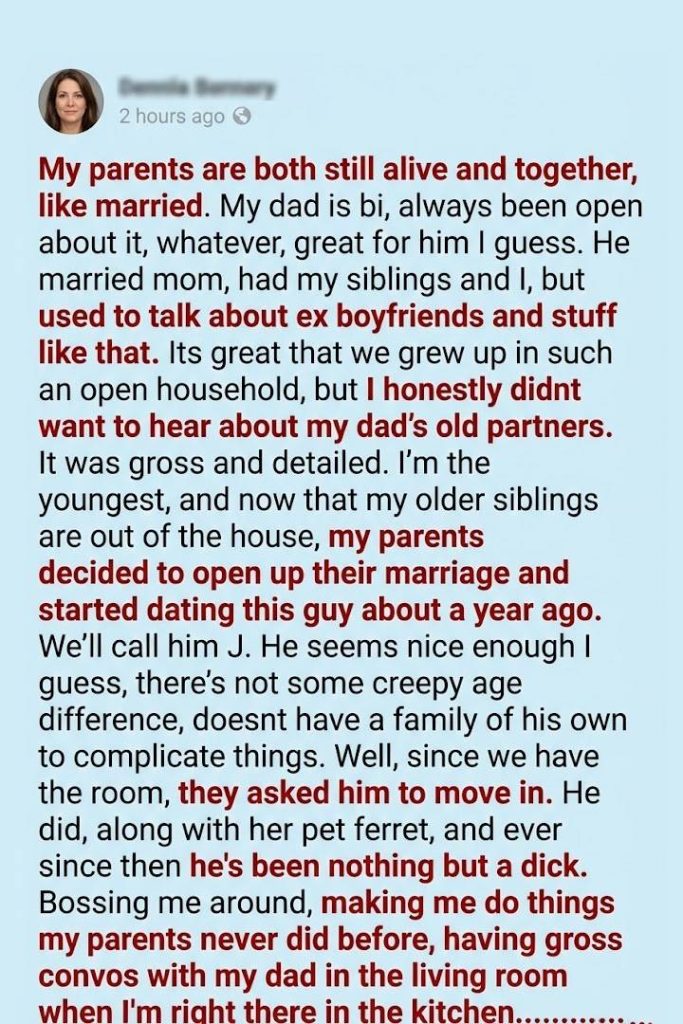
I grew up in a household where openness about relationships was the norm. My dad has always been openly bisexual, and my parents never hid anything from us. They talked freely about past partners, ex-boyfriends, and personal experiences. For the most part, it was fine, even educational in its own weird way.
But being the youngest of my siblings, there were times when I felt it was a bit much. I didn’t want to hear all the details about my dad’s past partners. It was gross and uncomfortable, and I didn’t have the experience or maturity to process it. Yet, my parents never seemed to notice my discomfort.
Now that my older siblings are out of the house, my parents decided to open up their marriage. About a year ago, my dad started dating a man we’ll call J. At first, I thought it might be fine. He seemed polite, friendly, and not dramatically different in age. He had no kids or other complicated family ties.
Because we have the extra room in our house, my parents invited J to move in. Along with him came his pet ferret. At first, it seemed like a minor change. I tried to be welcoming and gave it a chance. I wanted to be supportive because my parents are happy.
But soon, things started changing in ways that made life uncomfortable for me. J began bossing me around, expecting me to do things that my parents never asked of me. Simple chores suddenly became his responsibility to assign. It felt intrusive and controlling.
Even worse, he started having inappropriate conversations with my dad in shared spaces, like the living room, while I was right there in the kitchen. The topics were personal, explicit, and uncomfortable to overhear. It was a clear violation of boundaries.
I tried to ignore it at first, thinking it would pass. I reminded myself that my parents were happy and that maybe I just needed to adjust. But over time, the behavior became consistent, and my discomfort grew.
The problem is not my parents’ choices or their relationship. The problem is J’s behavior and lack of consideration for me as a household member. Living under the same roof doesn’t give him the right to treat me disrespectfully.
I realized I needed to take action before it affected my mental health. One of the first steps is establishing boundaries. I need to make it clear what is acceptable behavior in shared spaces, including conversations, chores, and personal interactions.
Next, I need to talk to my parents. They might not fully understand how uncomfortable J’s behavior makes me. Approaching the conversation calmly and explaining my feelings can help. I might say something like:
“I want to respect your relationship, but some of the things J says and does in the house make me uncomfortable. Can we set some boundaries so it works for all of us?”
It’s also important to protect my personal space and mental health. This could mean spending more time in my room, using headphones, or creating a safe zone in the house where I don’t have to interact with J.
I’ve also considered coping strategies outside the home, like spending time at a friend’s place, focusing on hobbies, or journaling about my experiences to process the stress. These help me feel less trapped in the situation.
Ultimately, I know that I do not have to tolerate disrespect, even in the name of family harmony. If J continues to disregard my comfort or boundaries, I have the right to speak up and insist on changes or reconsider the living arrangements.
Living in a blended household with an open marriage can be challenging, even under the best circumstances. The key is communication, respect, and setting clear expectations for everyone involved. My parents’ happiness is important, but so is my comfort and well-being.
In conclusion, navigating this new family dynamic has been eye-opening. I’ve learned that boundaries are not optional, even with family members or their partners. Protecting my mental health and personal space is essential, and it’s possible to support my parents while still asserting my rights in the household.