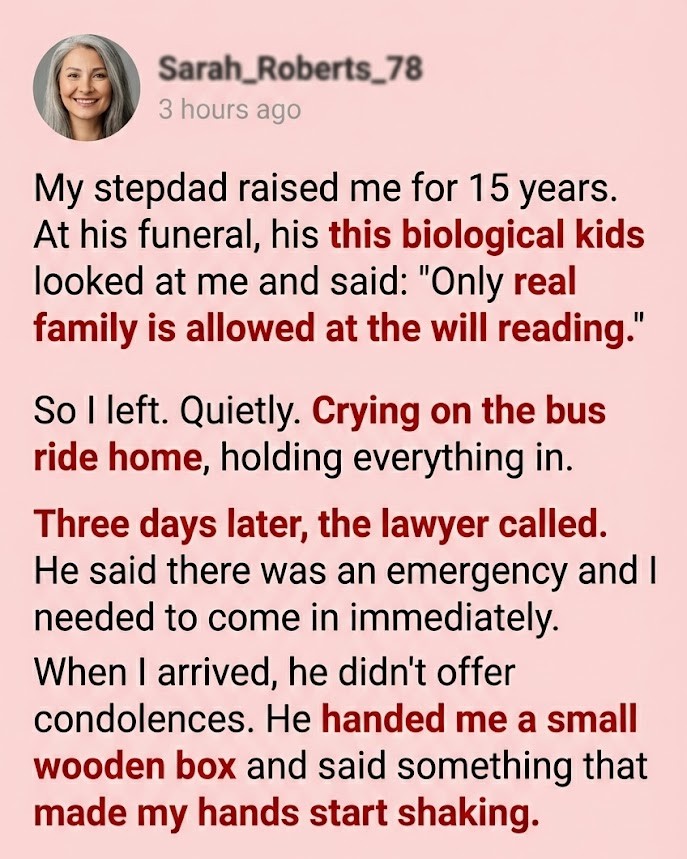
My stepdad raised me for fifteen years, and in all that time, he never once made me feel like I was anything less than his own. He wasn’t perfect, and he definitely wasn’t rich, but he showed up in all the ways that truly mattered. When my biological father disappeared early in my childhood, leaving behind nothing but confusion and unanswered questions, my stepdad stepped forward without hesitation. He didn’t make a big speech or try to replace anyone — he just quietly stayed.
He was there the day I wobbled down the sidewalk learning to ride a bike, running behind me with one hand on the seat and the other ready to catch me if I fell. He was there at the kitchen table night after night, still in his work clothes, helping me untangle math problems even when he looked completely exhausted. He showed up to school plays, sports days, and parent meetings, always clapping the loudest, always smiling like he couldn’t have been prouder.
When I got sick, he was the one who sat beside my bed in the dim light, pressing a cool cloth to my forehead and telling me I’d feel better soon. He knew how to make soup exactly the way I liked it. He knew which cartoons made me laugh and which fears kept me awake at night. He learned me, in all the small, patient ways that build real love.
What mattered most was something he did without even trying. He never introduced me as “my wife’s kid.” Never “stepchild.” Never anything that created distance. Whenever someone asked, he would smile and say simply, “This is my child.” No hesitation. No explanation. Just certainty.
So when he passed away suddenly, the grief hit me like a wave I couldn’t outrun. It wasn’t just sadness — it was disorientation, like the ground had shifted beneath my feet. The person who chose me, who stayed when others didn’t, was gone in a single, cruel moment. I felt small again, like the abandoned kid I used to be.
At the funeral, I sat quietly in the back row, numb and exhausted, watching people move through their grief in different ways. Some cried loudly, some whispered in tight circles, and others stared ahead in silence. I felt like I was underwater, everything muted and far away.
After the service, his biological children — people I had grown up alongside but never truly connected with — approached me. We had shared a house once, shared holidays and dinners, but never the kind of bond that comes from shared understanding. Their faces were polite, but distant. Careful. Controlled.
“There’s a will reading tomorrow,” one of them said, voice measured and cool. “But only real family is allowed.” The words were delivered gently, but they landed like a blow to the chest.
That moment hurt more than the funeral itself. Grief I expected. Exclusion, I didn’t. It reopened an old wound I thought had healed — the feeling of not quite belonging anywhere. For a second, I almost argued, almost demanded recognition, but the exhaustion was too heavy.
I didn’t cry in front of them. I didn’t protest. I just nodded, turned, and walked away before my composure cracked. I took the bus back to my small apartment, staring out the window as the city blurred past, biting the inside of my cheek to keep the tears from falling in public.
I told myself it didn’t matter. That money wasn’t love. That paperwork couldn’t erase fifteen years of bedtime talks, school runs, and quiet support. What we had was real, whether or not it was written in legal language.
Three days later, my phone rang. The number was unfamiliar, and for a moment I considered ignoring it. When I answered, a man introduced himself as the lawyer handling my stepdad’s estate. His voice sounded uneasy, like he was stepping carefully through something fragile.
“There’s… an issue,” he said after a pause. “An emergency, actually. I need you to come in.” My stomach tightened. I had no idea what that meant, but I agreed and took the next bus across town, my thoughts racing the entire way.
When I arrived at his office, the atmosphere felt heavy. The blinds were half-closed, the air too still. He didn’t ask how I was holding up or offer condolences. He simply opened a drawer and placed a small wooden box on the desk between us.
“This was addressed to you,” he said quietly. My hands trembled as I lifted the lid. Inside was a handwritten letter and an old watch — scratched, worn, and deeply familiar. The same watch my stepdad wore every single day, the one he used to joke would “outlive us all.”
I unfolded the letter slowly, afraid of what I might feel when I read it. His handwriting was unmistakable, steady and warm, like hearing his voice again. He wrote that he knew his biological children might try to exclude me. He had seen the distance growing over the years and didn’t want me to feel hurt or humiliated after he was gone.
Then came the words that broke me completely: “Family isn’t blood. Family is who stays.” The tears finally came, falling freely as I read. He explained that the watch had been his father’s, and now it was mine — not because of tradition, but because he wanted me to carry something that proved I belonged.
The lawyer cleared his throat and told me the rest. My stepdad had arranged a separate inheritance for me — modest, but intentional — and had legally structured it so I would receive it directly, no matter who objected. He had thought ahead, protecting me one last time.
When his biological children found out, they were furious. They argued, protested, tried to challenge it. But there was nothing they could do. His decision was final, written clearly and legally binding.
I walked out of that office with tears in my eyes, clutching the wooden box to my chest. Not because of the money, but because even in death, he had shown up for me. He had made sure I would never question what I meant to him.
He made sure I knew what I had always known deep down, even when others tried to deny it. Love isn’t defined by bloodlines or last names. It’s built in moments, in presence, in choosing someone again and again.
I was his child. And nothing — not time, not paperwork, not anyone’s opinion — could ever take that away.