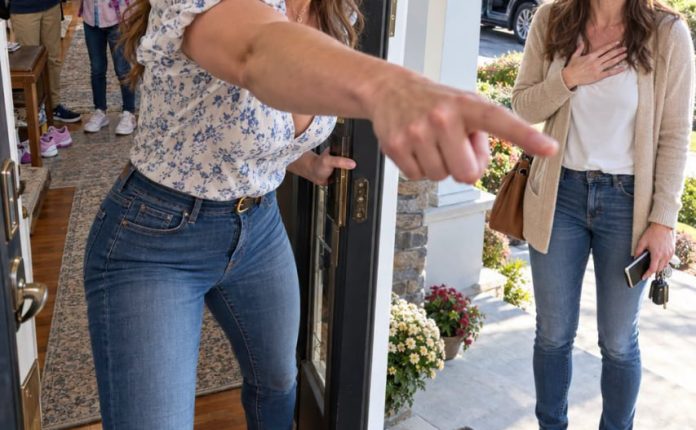
Derek waited until the door closed before speaking.
“Have you lost your mind?”
The small meeting room contained a polished table, six chairs, and a bowl of mints nobody touched. Through the wall, I could hear the quartet finish a piece.
Miriam set her bag on a chair.
“Olivia agreed to a conversation. Not to being insulted.”
“This doesn't involve you.”
“It does. I'm her lawyer.”
Brenda stood near the door with her evening bag held in both hands. Catherine remained beside me.
Derek looked from one woman to the next.
Then he tried a smile.
“Mrs. Wilmington, I don't know what Olivia has told you, but every marriage has disagreements.”
Catherine tilted her head.
“I expect that's true.”
“She gets overwhelmed. I handle the finances because numbers make her anxious.”
I heard the old explanation with three people beside me.
It sounded smaller.
“I handle the library's program expenses,” I said. “I've done it for four years.”
He glanced at me sharply.
“That isn't the same thing.”
“No. At work, I can see the accounts.”
Miriam pulled out a chair.
“Perhaps we should sit.”
“I don't need to sit.”
“Then stand. Olivia, would you prefer a chair?”
I sat.
Derek's expression tightened.
It was a tiny shift in authority, almost invisible. He was no longer the person deciding the conditions under which I could answer.
He turned to Catherine again.
“I appreciate that you helped her. Truly. But taking her into your home, putting ideas in her head—”
“She arrived with ideas,” Catherine said. “I supplied soup.”
Brenda made a brief sound that might have become a laugh in another room.
Derek looked at her.
She looked away.
I set my hands flat on the table.
“I want my thirty-two dollars back.”
He blinked.
“What?”
“The cash you took from my wallet.”
“Olivia, this is ridiculous.”
“Where is it?”
“I don't know. In the car, probably.”
“Then return it through Miriam.”
He stared at me as though I had spoken in a language he had never expected me to learn.
Miriam made a note.
“There are larger financial matters to address,” she said. “Including the loan application.”
Derek's face changed before he could stop it.
Brenda noticed.
“What application?”
“Nothing to do with you.”
“Eighteen thousand dollars,” I said. “In both our names.”
He rubbed his forehead.
“It wasn't going to be a problem.”
“That isn't an answer.”
“I was consolidating things.”
“What things?”
“Household debt.”
“Then why didn't you ask me?”
He looked toward the door.
I continued before he could change the subject.
“The verification code went to my phone at three seventeen on Monday. You had it. I was still at the bus stop.”
Silence settled around the table.
Derek finally said, “You would have agreed if you'd listened.”
I heard Miriam's pen stop.
Brenda lowered her bag onto a chair.
“You applied without her?”
Derek rounded on her.
“Don't act shocked. You know how tight things have been.”
“I knew you were having cash problems.”
“Because of us.”
The words came out before he seemed to weigh them.
Brenda's mouth closed.
I looked at her, then at him.
I had imagined this moment many times over the previous days. In those versions, I demanded dates, names, a precise inventory of betrayal.
Now I found that I needed very little.
“How long?” I asked.
Derek stared at the table.
Brenda answered.
“Since January.”
Six months.
I thought of the jewelry charge in February.
The nights my mother asked whether Derek would join us for dinner.
The way he had accused me of being distracted when he was the one checking his phone beneath the table.
“Did you know he was taking money from our savings?”
Brenda's eyes shifted.
“He said your finances were separate.”
“My wages went into the same account as his.”
She pressed her lips together.
“He told me you were separating.”
Derek laughed harshly.
“Don't rewrite this now.”
I looked at Brenda.
“You met me at Christmas.”
“He said things changed afterward.”
“Did he tell you I was buying a house with him?”
She didn't answer.
There were things she had believed because they suited her. I recognized the habit well enough not to confuse it with innocence.
Miriam opened her folder.
“Olivia isn't here to resolve your relationship. She's here to make her position clear.”
Derek turned back to me.
“We can fix this.”
“What are you offering to fix?”
“All of it.”
“The money? The application? Leaving me?”
“I said all of it.”
“Then say what you did.”
He looked offended by the request.
“Not with an audience.”
I thought of every midnight conversation in our kitchen.
There had never been an audience for those.
Only me, tired enough eventually to accept his version.
Miriam placed a copy of the filed petition on the table.
“These proceedings are underway. Formal service will be completed separately. Please direct financial and legal communications through counsel.”
Derek stared at the document.
“You filed?”
“Yes.”
“Without talking to me?”
“I've been talking to you for years.”
He pushed the papers back.
“You can't afford this.”
The sentence landed in the room with all its usual meaning.
I knew my wages. I knew rent. I knew how quickly an unexpected bill could turn an ordinary month into a frightening one.
Money still mattered.
But it no longer belonged only to his side of the table.
“I've arranged advice,” I said. “And I have a job.”
He looked at Catherine.
“So this is what you do? Buy somebody's wife?”
Catherine didn't answer immediately.
When she did, her voice was tired rather than sharp.
“No, Mr. Carter. Olivia is leaving you. I expect you'll find that distinction inconvenient.”
A knock came at the door.
The hotel manager opened it slightly. Behind him stood Charles Baines, the dealership's owner.
He had been seated near the bar when the glass broke.
“Brenda? Derek? We need a word when you're finished.”
Brenda straightened.
“Charles, we'll be right out.”
He looked at me.
“Mrs. Carter, are you all right?”
“Yes. Thank you.”
His gaze moved to Derek, then to the papers.
“I heard enough outside to understand this isn't something to discuss in the ballroom.”
Nobody contradicted him.
He stepped back.
Miriam closed her folder.
“We're finished for tonight.”
Derek moved toward me as I stood.
“Olivia.”
I stopped at a distance I chose.
He lowered his voice.
“You're letting strangers destroy our marriage.”
I looked at the bowl of mints, the empty chairs, the crease in his jacket where he had gripped it.
For a second, I could see the man I married. Nervous outside the courthouse. Smiling over takeout in our first apartment. Telling me we would make a good team.
I had not invented every good memory.
That made leaving sadder.
It did not make staying safer.
“You left me on a bench,” I said. “You took away every way I had to get home. I kept waiting because I thought that was what a good wife did.”
He opened his mouth.
“I won't wait like that again.”
I left before he found another explanation.
Outside the meeting room, the ballroom had resumed its ordinary sound.
People were curious. A few looked away too quickly.
Nobody applauded.
I was grateful.
A volunteer asked Catherine whether she was ready for dinner.
“Very,” she said. “Though I reserve the right to complain about the chicken.”
At our table, she asked me whether I wanted to leave.
I looked toward the exit.
Then toward the stage, where a pediatric nurse was arranging notes beside the microphone.
“I'd like to hear her.”
So we stayed.
The nurse spoke about a family sleeping in chairs beside their child's bed. About the difference a nearby room and a working washing machine could make during a long hospital stay.
I listened.
The evening had a purpose larger than my husband's embarrassment.
It was a relief to remember that.
Across the room, Charles Baines spoke with Brenda and Derek near the doors. Their conversation was quiet, serious, and brief.
They left before the main course.
I didn't follow them with my eyes.
When we got home, I took off the emerald dress and hung it carefully.
Margaret had left a tray upstairs with tea and two slices of toast.
I ate sitting on the edge of the bed.
My telephone vibrated.
A message from Derek.
I hope you're happy with what you've done.
I forwarded it to Miriam.
Then I put the phone on silent and finished the toast.
On Monday, consequences arrived in envelopes and scheduled calls.
The lender acknowledged the disputed consent and confirmed that no money would be released while its review continued.
Miriam advised me about reporting the unauthorized application. I made the report, supplied the timeline, and answered questions without trying to make Derek sound better.
The officer taking the information asked whether I wanted a copy.
“Yes.”
I had begun keeping copies of everything.
Not because I wanted to live inside a file.
Because I had spent too long letting important facts exist only in someone else's telling.
Charles Baines contacted Miriam separately.
Derek had claimed certain hotel and restaurant expenses as business costs. The gala confrontation had prompted Charles to look more closely at records already causing concern.
He asked whether I would permit comparison with the joint-account transactions I had identified.
Miriam explained the request carefully.
“You don't have to volunteer your private financial history. We can provide specific records relevant to the dates.”
“Will it help him understand what happened?”
“It may.”
I authorized the limited disclosure.
One restaurant bill had been charged to our joint card, then submitted for reimbursement at the dealership.
The reimbursement had not returned to our household account.
There were other discrepancies.
I did not discover them myself. The company's accountant did, over the following weeks.
That distinction mattered to me.
I wasn't becoming an investigator whose life revolved around catching my husband.
I was answering questions about what belonged to me, then returning to my own day.
Derek and Brenda were placed on leave while the dealership reviewed the records.
Their affair was part of the workplace problem because they had concealed a relationship involving a direct reporting line. It was not the only problem.
Approvals had bypassed required review. Personal expenses had appeared under business descriptions. Money had been handled in ways Charles could no longer accept.
Catherine did not telephone him to demand a firing.
When I asked whether she had, she seemed almost offended.
“Charles employs his own accountants.”
“I just wondered.”
“I know. People enjoy imagining wealth as a remote control.”
She stirred her tea.
“It is extremely useful. It doesn't eliminate the need for evidence.”
Derek blamed me anyway.
He wrote that I had gone after his livelihood.
He wrote that the loan had been intended to save us.
He wrote that Brenda meant nothing.
Brenda, through a separate message Miriam preserved, said she had not known about the loan application.
Their accounts no longer fitted together.
I stopped trying to make them fit.
The hardest call came from a mutual friend named Peter.
He sounded uncomfortable.
“Derek says you're staying with someone who's paying for everything.”
“For now, I'm staying in a guest room.”
“He says she's encouraging you to take him for whatever you can.”
I looked at the library returns trolley beside me.
There were thirty books to check in before closing.
“What did he say about leaving me without my phone?”
Peter was quiet.
“He said you got out during an argument.”
“Did he explain why he had my wallet?”
Another pause.
“No.”
“Then you should ask him.”
Peter said he would.
I didn't wait for his verdict.
That evening, Hannah brought takeout to Catherine's small sitting room.
She had been invited properly, by me.
Catherine joined us for ten minutes, stole a spring roll, and left us to talk.
Hannah sat cross-legged on the rug.
“I wanted to call you so many times.”
“Why didn't you?”
“Sometimes I did.”
I looked at her.
“You'd say everything was fine. Then he'd answer from the background. Eventually, I thought I was making it worse.”
“I thought you had given up.”
“I didn't know how to help without making you defend him.”
We sat with that for a while.
Then I said, “I'm sorry.”
“I'll accept one apology for the canceled birthday dinner. The rest can wait.”
I smiled.
“You bought a cake.”
“I ate most of it. There were compensations.”
The conversation moved gradually toward ordinary things.
A colleague's disastrous haircut.
Her landlord's conviction that radiator noises were caused by improper furniture placement.
A book we both hated and had pretended to admire.
I hadn't realized how much of friendship was built from subjects that required no defense.
Two weeks after the gala, Derek came to the library.
He arrived just before closing, carrying flowers wrapped in clear plastic.
Ellen saw him before I did.
She came to the desk.
“He's by the entrance. What would you like?”
My stomach tightened.
“I'll speak to him there. Please stay nearby.”
She nodded.
The doors opened and closed behind him as patrons left.
He looked thinner. His tie was loose.
“I called,” he said.
“I asked you to go through Miriam.”
“I wanted to see my wife.”
“I'm working.”
“Five minutes.”
I stayed on my side of the security gates.
He held out the flowers.
“I made mistakes.”
“Yes.”
The answer seemed to unsettle him.
“I was under pressure.”
“I know you've said that.”
“I didn't know how to tell you.”
“About Brenda?”
“About the debt.”
I waited.
Some of the missing money, he admitted, had gone toward personal credit-card balances. Some had funded weekends and gifts. He had planned to replace it with commissions.
Then sales slowed.
The loan would have covered enough that I might not notice.
“Why leave me at the stop?”
His eyes moved toward Ellen.
“Can we not do this here?”
“No.”
He lowered the flowers.
“I needed you to calm down.”
“I wasn't shouting.”
“You kept asking about the account.”
“So you took my phone.”
He said nothing.
“Did you know a verification message was coming?”
He rubbed his mouth.
“I had started the application earlier.”
“That isn't what I asked.”
The doors opened behind him. A woman guided a little girl toward the returns slot.
Derek waited until they passed.
“Yes,” he said.
The word was barely audible.
I felt the cold bench beneath me again.
The useless timetable.
Every bus I had watched leave.
I had blamed myself for not asking a driver for help. For not walking farther. For sitting there waiting.
Meanwhile, he had used the silence he created.
He looked at my face.
“I wasn't going to hurt you.”
“You were going to make me responsible for debt I didn't agree to.”
“I was going to pay it.”
“With what?”
He had no answer.
For a moment, I wanted him to understand so badly that I nearly began explaining from the beginning.
Then I saw how easily five minutes could become another midnight in our kitchen.
“Don't come to my workplace again.”
“Olivia—”
“Send anything else through Miriam.”
I turned.
He said my name once more.
Ellen stood beside the desk, close enough that I could hear her set down a book.
I kept walking.
I cried in the staff room afterward.
Not because I doubted the decision.
Because I had finally received an honest answer, and it was worse than the excuses.
Miriam asked me to write down the conversation while it was fresh. I did.
Then I went home.
Catherine was listening to an audiobook in the sitting room.
“Bad day?” she asked when I came in.
“Yes.”
“Company or quiet?”
I considered.
“Company. No questions yet.”
She moved a cushion from the chair beside her.
The narrator continued reading.
For half an hour, nothing was required of me.
The legal process took months.
There were forms I didn't understand until Miriam explained them. There were requests for documents, delays, replies that answered questions nobody had asked, and mornings when I resented how much effort was required to disentangle a life I had once entered with two signatures and a small bouquet.
The lender eventually closed the disputed application without funding it. Its records supported my account of the verification and the device used.
The joint accounts were addressed through the divorce proceedings. Not every expense could be recovered. Not every dollar spent during a marriage could be separated neatly into mine and his.
But the documented withdrawals and concealed spending mattered.
So did Derek's messages.
So did the application he had submitted without my consent.
The eventual settlement gave me a greater share of the remaining marital savings and a repayment arrangement for an agreed portion of the money he had diverted.
It wasn't a fortune.
It was enough to begin without pretending the loss had never happened.
The dealership dismissed Derek after its review.
Brenda left as well after the company established failures in her approvals and conduct. I heard later that she was contesting some of the findings.
I did not follow the dispute.
Their jobs had depended on trust they had broken in ways the company could document.
My role ended with the records I had provided.
One afternoon, a local social column published a photograph from the fundraiser.
Catherine stood beside me at the entrance. I was looking toward the doors, not at the camera.
The caption identified me correctly.
Olivia Carter, a guest of Catherine Wilmington.
Not Alexandra.
Not an heiress.
Not a mysterious replacement granddaughter.
Just my name, attached to my face.
I saved the picture.
Then I closed the page before reading the comments.
By August, my mother was walking without holding furniture.
She invited Catherine for lunch.
“I can't offer a house like yours,” she said over the telephone.
“Can you offer lunch?”
“Yes.”
“Then we appear to have an arrangement.”
My mother cooked too much. Margaret sent a pie despite being told not to. Thomas stayed because Catherine insisted he should not be expected to smell roast chicken for an hour and eat a sandwich in the car.
We crowded around my mother's small table.
The blue blanket lay folded over the sofa.
At one point, Catherine reached for her water and found a bowl instead.
My mother apologized.
“Nothing wrong with a bowl,” Catherine said. “I merely prefer to know before drinking the gravy.”
Thomas laughed hard enough to put down his fork.
I looked around the table.
Nobody was waiting for me to make an error.
Nobody was measuring how much I cost.
For the first time in months, I ate without noticing how quickly.
I moved out of Catherine's house in September.
She offered to let me stay longer.
I knew she meant it.
I had also begun wanting a front door I could open with a key that nobody else expected to inspect.
The apartment was on the second floor of a brick building near a bus route and a grocery store. The kitchen window stuck. The bathroom tap required a firm twist.
I could afford it on my wages.
Before signing, I sat with the lease and read every page.
Miriam answered two questions.
Hannah helped measure for curtains.
My mother brought the blue blanket and left it folded on my new sofa.
“I thought you liked it,” I said.
“I do.”
“Then keep it.”
She touched the edge.
“I'd like you to have something warm too.”
Catherine gave me no deed, trust fund, or envelope large enough to change the story into something simpler.
She gave me a talking kitchen timer.
“Useful when distracted,” she said.
“And a hint about my cooking?”
“I've eaten your eggs. Consider it an investment in public safety.”
I laughed.
At the door, I asked whether she had ever regretted sitting at the bus stop.
“Several times,” she said.
I stared.
“You borrow my books and return them with the bookmarks in the wrong places.”
“I'll improve.”
“I should hope so.”
Then her expression softened.
“No, Olivia.”
I hugged her carefully, mindful of the cane between us.
She held me with surprising strength.
The library expanded its accessible reading sessions that autumn.
I helped organize transport information, large-print materials, and a quiet hour for people who found crowded programs difficult.
Catherine attended the first session and complained that the biscuits were too far from her chair.
I moved the plate.
She approved.
There was no foundation named after me. No speech in which I announced that one afternoon had made me fearless.
I still checked the bank balance more often than necessary.
I still sometimes began explaining a purchase to an empty room.
When a man raised his voice near the circulation desk, my body reacted before I could remind it where I was.
I found a counselor.
I kept going.
Slowly, the space between fear and action became large enough for a choice.
The divorce was final in November.
Miriam called while I was standing in the grocery store comparing two jars of coffee.
“It's entered,” she said.
I held the more expensive jar in one hand.
“How do you feel?” she asked.
I looked at the shelf.
“I'm not sure yet.”
“That's allowed.”
After we hung up, I checked my budget.
Then I bought the coffee I liked.
At home, I put it in the cupboard and sat at my kitchen table.
No one had been required to approve it.
The quiet felt different from the silence in my old apartment.
There, silence had often meant Derek was deciding whether to speak.
Here, it meant the refrigerator humming, a bus braking at the corner, someone upstairs moving a chair.
A world continuing without waiting for his mood.
Derek sent one final message through Miriam.
He said he hoped we might someday speak without lawyers.
I read it.
Then I asked her to confirm that practical matters should remain in writing.
There was nothing I needed from a private conversation with him.
An apology might have been welcome once.
It was no longer a condition of my future.
In December, Catherine asked me to accompany her to another meeting at the community center.
Thomas parked around the corner.
The roadworks were finished.
When we came out, I saw the bus shelter.
Someone had replaced the timetable. The cracked panel remained.
For a moment, I stood very still.
Catherine heard the pause in my steps.
“Would you like to keep walking?”
“No.”
I guided her to the bench.
We sat.
Traffic moved past the boarded shop. A new sign hung above the community center doors. The air smelled of rain on concrete.
“I thought you were going to solve everything,” I admitted.
“At first?”
“Yes.”
“Understandable. The car is persuasive.”
I smiled.
“You didn't.”
“No.”
“You made it possible for me to start.”
She rested both hands on her cane.
“That was the intention.”
A bus approached.
I opened my purse.
My wallet was there. My cards. My telephone. A folded receipt for groceries I had bought that morning.
I counted none of it.
I only looked.
Then I took out the fare.
“Thomas will be offended,” Catherine said.
“I'll call him.”
“From your own telephone?”
“Yes.”
She nodded gravely.
“A remarkable invention.”
The bus stopped, and the doors opened.
This time, when the driver looked toward me, I stood.
I hugged Catherine before stepping aboard.
“Dinner Sunday?”
“Only if you bring the coffee.”
“The expensive one?”
“Obviously.”
I paid my fare and chose a seat by the window.
Catherine remained on the bench until Thomas came into view. She lifted one hand when I called goodbye.
As the bus pulled away, I watched the stop grow smaller.
For months, I had remembered it as the place where my husband left me with nothing.
Now I could see the rest of that afternoon.
A woman asking whether there was room.
A question I had never permitted myself to answer.
An offered arm.
I turned toward the front as the driver called the next stop.
When mine came, I would press the bell.
END PART 3
Disclaimer: This fictional story was created with AI assistance for entertainment. Names, characters, dialogue, and events are fictional. Any resemblance to actual people or events is coincidental.