I read Owen’s note twice because the first time, I could only see his handwriting.
The careful circles over the i’s.
The place where he had erased because hard enough to roughen the paper.
He stood in front of me with his hands tucked beneath his arms.
“I know the conference days now,” he said.
Lauren was beside the kitchen doorway.
I looked at her.
Then I sat on the bottom stair so Owen didn’t have to look up at me.
“Come here a minute.”
Ellie pushed against my shoulder. I made room for both of them.
“You didn’t get me in trouble,” I said.
Owen looked doubtful.
“I can check the folder.”
“Your folder belongs in your backpack. The grownups’ arrangements belong to the grownups.”
“But if I’d told you—”
“You were at school. You were supposed to learn things, eat lunch, and probably argue about whose turn it was on the swings.”
He glanced at me.
“It was the basketball.”
“All right. Basketball.”
Ellie touched the folded note.
“We waited good.”
“I know you did.”
I could feel Lauren standing behind us.
I didn’t turn around.
“If a pickup changes, adults need to tell each other. If adults disagree, they need to speak respectfully. None of that was your job.”
Owen stared at the stair tread.
“Mom was mad because we got scared.”
Lauren moved then.
“No.”
She sat on the step above us, awkwardly, with one knee against the railing.
“I was scared too,” she said. “But being scared didn’t make what I did right.”
Owen looked up.
“I shouted at Aunt Mara. I called her something unkind. And I pushed her out.”
The words sounded stark in the ordinary hallway.
Ellie stopped fidgeting.
“I should not have done that,” Lauren continued. “You didn’t cause it.”
For once, she didn’t add anything about what I should have done differently.
I let her finish.
“Aunt Mara is still your aunt. She isn’t picking you up every day anymore, but that doesn’t change who she is.”
Owen considered her.
“Are you still mad?”
Lauren looked at me.
“I have things to apologize for.”
“That’s different from you being responsible,” I told him.
Ellie leaned farther into my side.
“Can we show you the worms?”
I blinked.
“What worms?”
“The school compost worms,” Owen said. “I made a whole thing.”
Within a minute, he was pulling a shoebox display from the dining room table. Paper tunnels crossed the bottom, with brown yarn glued along them.
Children could return to ordinary life with a speed adults sometimes mistook for forgetting.
I knew better.
Owen kept checking our faces as he explained the bedding material.
Ellie asked twice whether I was staying until lunch.
I answered each time.
For an hour, we looked at worms, played a card game, and watched Ellie demonstrate a dance she insisted had seventeen moves.
There were nine.
I didn’t correct her.
Before I left, Owen asked whether I wanted his note.
“Yes,” I said.
“I can make a nicer one.”
“This one matters.”
I folded it along the lines he had made.
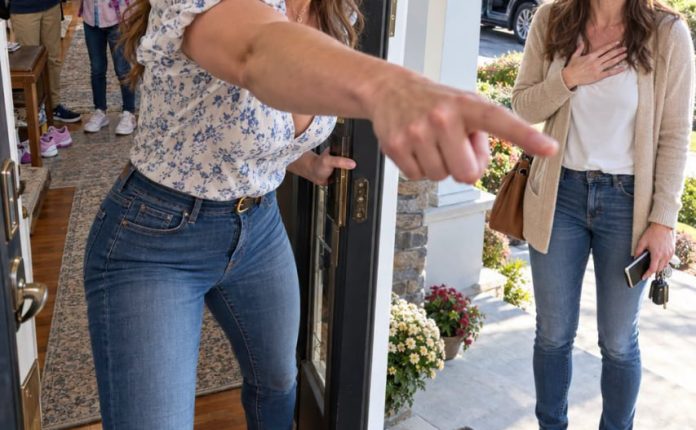
Lauren walked me outside.
The afternoon was cool enough that we could see the neighbors’ dryer vent breathing against the brick.
“Can you stay a minute?” she asked.
I stood on the porch, leaving room between us.
She noticed where I had positioned myself.
“I’m sorry I pushed you.”
I waited.
“And for what I said at school.”
A lawn mower started somewhere down the street.
Lauren rubbed her hands over her sleeves.
“I saw the notice on Sunday.”
I looked at her.
“The conference notice,” she said. “I saw it. I meant to forward it.”
“Why didn’t you tell me that Wednesday?”
“Because the school called while I was with a client. Then Tara called. By the time I got there, I felt like everyone was looking at me.”
“They were looking at the children.”
“I know.”
“Do you?”
She swallowed.
“I knew I’d forgotten to tell you. And you were standing there with Ellie, and she was reaching for you, and I—”
She stopped.
I didn’t help her finish.
“I made it your failure because I couldn’t stand that it was mine.”
The admission didn’t erase the curb or the porch.
It did give us something real to stand on.
“I was late,” I said. “They waited. I regret that.”
“You didn’t know.”
“No. I didn’t.”
Lauren looked toward the front window.
“You always handle things.”
“I know how to handle some things. That doesn’t mean you can hand me anything.”
She nodded.
Then, almost despite herself, she said, “I really thought you’d come back.”
“That’s why I didn’t.”
Her face changed.
Not because I was being cruel.
Because she understood what I meant.
For years, every argument had ended with my return. Every unreasonable request had eventually become a problem I could solve. She had been able to say almost anything because the next school day still brought my car.
“I shouldn’t have sent your name to the school,” she said.
“No.”
“I thought if it was normal again, we could stop doing this.”
“You wanted the work to resume before the conversation.”
“Yes.”
She pulled one loose thread from her cuff.
“I don’t know what you want me to do now.”
“Arrange care without counting on me. Tell the truth when people ask. Don’t make the children carry messages between us.”
“I can do that.”
“And don’t ask me to decide today whether I forgive everything.”
Her eyes shone.
“All right.”
I went home.
There was no embrace on the porch.
I wasn’t ready.
That night, I put Owen’s note in the drawer where I kept important papers.
I didn’t display it as evidence against his mother.
I kept it because it reminded me that children had been listening while adults congratulated themselves for keeping the peace.
On Monday, Lauren called the after-school program again.
She told me later that the coordinator walked her through the enrollment process twice. Ellie’s allergy plan required particular attention, and the program needed to confirm staffing and space for both children.
Until they could start, Lauren paid the sitter for three afternoons and adjusted her own schedule for two.
One client visit moved.
Another went to a colleague.
Her manager was irritated about the short notice.
The world did not end.
The children came home.
Nobody needed to pretend that the inconvenience proved I should have continued.
Mom helped on a Friday she had agreed to in advance.
When Lauren asked whether she could also cover Monday, Mom checked her calendar.
Then she said no.
She told me about it afterward with the anxious expression of somebody admitting to a small crime.
“I have my appointment.”
“You’re allowed to go to your appointment.”
“I know.”
She paused.
“I’m learning to say it before I give six reasons.”
The family did not transform all at once.
An uncle called the situation a shame and wondered whether everybody could just move forward.
I told him we were.
A cousin said she had never known I handled pickup every day.
“I thought you did a couple of afternoons.”
“That’s what people usually thought.”
She didn’t offer a speech. She asked whether I wanted to meet for dinner on a Thursday.
For the first time in years, I could say yes without checking another household’s schedule.
At work, Denise showed me the position she had mentioned in spring.
It involved checking large orders, training seasonal staff, and staying until the afternoon shipments were complete.
The pay was better.
The hours would have made school pickup impossible.
I accepted.
For several days, I felt disloyal whenever I thought about the new schedule.
Then the first full paycheck arrived.
I paid the tire bill without moving money out of savings.
I booked a dental cleaning I had postponed twice.
Ordinary things, almost embarrassingly ordinary.
They showed me how much of my life had been waiting for permission.
A week after the school meeting, Tara sent a message asking whether I minded if she corrected what she had told another parent.
What did you tell her? I asked.
That you’d stopped because you couldn’t manage the children anymore.
I sat with that for a moment.
Please tell her that isn’t what happened.
I did, Tara replied. I should have asked you first.
There was no grand public reckoning.
There were smaller corrections, made in the places where the wrong story had traveled.
Lauren told the parent who organized the class volunteer list that I was no longer the person to contact about her children’s availability.
She replied to a relative’s comment by saying I hadn’t abandoned the children.
At the next school event, she stood beside me when another mother asked whether I was back on pickup duty.
“No,” Lauren said. “Mara helped us for four years. We have an after-school arrangement now.”
I looked at her.
She kept talking to the other mother.
It mattered that she didn’t glance at me for approval.
The new arrangement began on a Tuesday.
Ellie disliked it immediately.
The snack was different.
The room was louder.
A girl she didn’t know had taken the chair she wanted.
Owen reported that the basketballs were better than the ones used at recess, which made him willing to reserve judgment.
Lauren called me that evening.
I listened while she described Ellie’s tears.
For a moment, I could see the old path opening.
I could collect her.
Just until she settled.
Just one afternoon.
Instead, I asked, “What did the coordinator suggest?”
Lauren was silent.
Then she said, “They’re pairing her with a girl from her class tomorrow.”
“That sounds worth trying.”
“Yes.”
Another silence.
“I wasn’t calling to ask you.”
“All right.”
“I think I was calling because it was a hard afternoon.”
I leaned back in my kitchen chair.
“I can listen to that.”
It was a small distinction.
It changed the conversation.
She told me about the paperwork she had misplaced and the argument over Ellie’s shoes. I told her about a delivery of damaged tulips and a driver who insisted the warehouse had changed addresses when he had simply turned into the wrong lot.
For fifteen minutes, we sounded like sisters.
Not employer and worker.
Not petitioner and rescuer.
Just two women describing their day.
I didn’t trust the change enough to surrender the boundary.
I didn’t need to.
Near the end of October, we agreed on the first Saturday breakfast.
I would take the children from nine until noon.
Lauren would bring the seats and collect them afterward.
If I needed to cancel, we would choose another day. It would not create a debt.
We discussed those details plainly, without pretending love made planning unnecessary.
Lauren arrived at eight fifty-seven.
She carried the purple booster in one hand.
The fox sticker still peeled at the corner.
“Do you want me to put it in?” she asked.
“Yes, please.”
She fitted both seats while I waited with the children.
Owen climbed into his old place and inspected the back of the passenger seat.
“You cleaned.”
“I do that sometimes.”
“There used to be a cereal thing down there.”
“There used to be several.”
Ellie leaned forward as far as her belt allowed.
“Can we get pancakes?”
“That’s the plan.”
Lauren stood beside the open car door.
“Thank you,” she said.
Not a rushed thank-you tossed over her shoulder.
Not thanks followed by another request.
I nodded.
At the diner, Ellie chose strawberry pancakes and asked whether whipped cream was possible.
I checked the allergy information with the server before ordering.
Owen brought a book about space.
He read a paragraph, frowned, and closed it.
“If sound doesn’t travel in space, how do astronauts talk?”
I smiled before I could stop myself.
“Through their radios.”
“But what if their helmets touch?”
“That is an excellent question.”
He looked pleased.
For a while, nothing needed repairing.
There was a sticky syrup bottle, a waitress who called everyone honey, and Ellie arranging sliced strawberries around the edge of her plate.
When my phone vibrated, my hand moved toward it automatically.
Then I saw the time.
Eleven forty.
Lauren had sent: Still on for noon. Hope breakfast was good.
I put the phone away.
We had twenty minutes.
At noon, she arrived.
No late meeting.
No quick favor.
No request that I keep them through dinner because they were already with me.
Ellie hugged me around the middle.
“Next month?”
“We’ll choose a day.”
Owen lingered.
He looked toward his mother, then back at me.
“I don’t check the schedule anymore.”
“The school schedule?”
He nodded.
“Mom puts it on the fridge.”
I crouched to straighten the hem of his jacket.
“That sounds like a good place for it.”
“I still look sometimes.”
“You can look. You don’t have to be in charge.”
He seemed to test that sentence before accepting it.
Then he went to the car.
Lauren waited until they were buckled before speaking.
“He told me he was trying to keep us from arguing.”
“I know.”
“I’m talking with someone about that. About how I handle things.”
I didn’t ask for details.
“I’m glad.”
She glanced down the street.
“I keep wanting to explain how hard everything got.”
“You can tell me it’s hard.”
“But it doesn’t excuse it.”
“No.”
She nodded.
We stood there a moment longer.
Then she said goodbye and drove away with her children.
I went upstairs to my quiet apartment.
There were dishes in the sink from the tea I had made before leaving. A load of laundry waited in the basket.
For years, quiet on a Saturday afternoon had seemed like evidence that I was missing something other people had.
That day, it was simply my apartment.
My afternoon.
I washed the cup.
In November, Maple Ridge held an evening display of class projects.
Owen asked me to come.
Lauren sent the invitation herself, including the time and parking instructions.
I arrived after work with a small stain of flower dye on my wrist.
Ellie ran across the classroom, then slowed as she approached, suddenly remembering some school rule about walking.
I opened my arms.
She came the last few feet quickly.
Lauren watched from beside the art display.
She didn’t pull her away.
Owen showed me a project about water filtration. We examined jars of cloudy water while he explained which materials worked best.
Mom arrived carrying her reading glasses in one hand.
The three of us listened.
Nobody needed to decide which adult mattered most.
On our way out, Mrs. Alvarez was locking a cupboard in the office.
“Good evening, Mara.”
“Evening.”
“How’s the new position?”
I smiled.
“Busy.”
“The good kind?”
“Mostly.”
She wished us a safe drive.
She didn’t mention the call.
She didn’t need to.
I would always remember her beginning with the fact that the children were safe. It had given me enough room to make a decision without being driven by panic.
Outside, the parking lot shone with recent rain.
Lauren was helping Ellie into her coat.
Owen came to stand beside me.
“Are you coming Thursday?”
My body supplied the old answer before my mind understood the question.
Then he added, “For the play. I’m the narrator.”
“I know. Your mom sent me the time.”
He smiled.
“Good. I have the longest bit.”
“I’ll be there.”
This promise was mine to make.
It belonged to a school play, a child I loved, and an evening I had chosen.
Lauren closed the car door and turned toward me.
For a moment, I saw the curb as it had been that Wednesday: Ellie crying, Owen withdrawing his hand, my sister so sure she could put me outside and still expect me waiting the next afternoon.
That afternoon had happened.
Nothing good that came later required me to pretend otherwise.
But now Lauren held her own keys. The children’s backpacks were in her car. Tomorrow’s pickup had a name attached to it that had been confirmed by the person doing it.
I hugged Mom goodbye.
I told Lauren I would see her Thursday.
Then I walked toward my car.
There were no booster seats in the back.
There didn’t need to be.
END PART 3
Disclaimer: This fictional story was created with AI assistance for entertainment. Names, characters, dialogue, and events are fictional. Any resemblance to actual people or events is coincidental.