I left the photograph open until my screen went dark.
The ink didn’t prove a conspiracy. It proved something smaller and older: my help was permanent in Lauren’s mind. Other people filled gaps. I was the arrangement beneath them.
I called Mom from the parking lot after work.
“Are the children home?”
“Yes. Lauren got them.”
Only then did I let my shoulders drop.
“What did she tell you?”
“That things were settled.”
“Did she say we’d spoken?”
“She said you’d had enough time.”
I watched a forklift move behind the warehouse windows.
“That isn’t the same thing.”
“I know that now.”
Something in her voice made me look away from the building.
“Do you?”
Mom hesitated.
“She was very upset when the school called.”
“She found time to call me six times.”
“She thought you’d go.”
“She told me never to come near them.”
“I thought that was said in anger.”
“It was sent in writing after I asked about tomorrow’s pickup.”
Mom said nothing.
I heard a television somewhere behind her.
Finally, she asked, “Why didn’t you show me?”
“I told you what happened.”
“That’s different from seeing it.”
I let that sit between us.
Then I sent her the screenshot.
She read it while we remained on the phone.
“Oh.”
It was a small word. I had waited eleven school days to hear anything like it.
“What does the school want?” I asked.
“A meeting tomorrow morning. Lauren asked me to come.”
“Has she asked me?”
“Not yet.”
After we hung up, I stayed in the car.
The sky above the warehouse had the flat silver color that came before a Michigan rain. Water from the loading area ran toward a clogged drain, carrying small pieces of torn leaves.
My phone lit up.
This time, Lauren sent a message.
We need to fix this before tomorrow.
I typed, What needs fixing?
The school situation.
I waited.
Can you come at eight fifteen?
I looked at the message for a long time.
Then I replied that I would attend to clarify my role. I would not be agreeing to restart daily care.
Her answer was a thumbs-up.
I didn’t trust it as agreement.
I saved it anyway.
At home, I searched my calendar for the year Owen started kindergarten.
The first entry read: Kids, until Lauren sorts sitter.
Six weeks later, the entries continued.
I had appointments moved, shifts exchanged, and reminders about soccer equipment. There were school breaks, sick days, and one Tuesday marked simply: Ellie fever. Lauren in Grand Rapids.
I didn’t total the hours.
I wasn’t preparing an invoice.
But I needed to see the shape of what I had given, because my sister’s version had reduced four years to one failed afternoon.
In an old message thread, I found Lauren asking me to keep the children overnight after an out-of-town presentation ran late.
You’re the only reason I can do this job, she had written.
I remembered receiving it while cutting grapes into quarters.
At the time, it had felt like gratitude.
Now I wondered why that gratitude had never translated into asking whether the arrangement still worked for me.
I made a short list for the meeting.
I was not resuming daily pickups.
My name could remain as an emergency contact only if the school understood that availability had to be confirmed.
The children needed a clear explanation that none of this was their fault.
I wrote the last line twice.
The next morning, I asked Denise to move my start time.
“You want the morning off?”
“An hour, probably.”
“Take two. Schools run on their own clocks.”
I thanked her.
Then I said something I had never said before.
“I’d like to talk next week about a steadier full shift.”
She glanced up from her schedule.
“The position we discussed in spring?”
“If it’s still a possibility.”
“It is.”
I drove to Maple Ridge with that small piece of my own future beside me.
Lauren stood near the front entrance when I arrived. Mom was with her, holding a folded scarf even though it wasn’t particularly cold.
Parents crossed the walkway with forgotten lunchboxes and permission slips.
Tara was coming out as I reached the steps.
She stopped.
“Morning, Mara.”
“Morning.”
Lauren turned at my voice.
For a moment, she looked relieved.
Then she saw Tara.
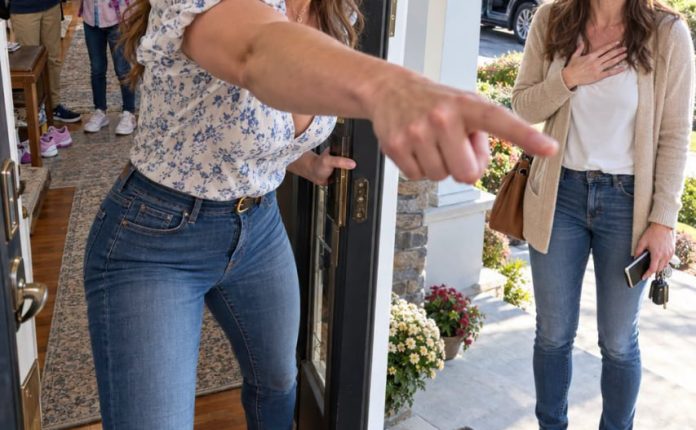
“I hope we can finally put this behind us,” she said.
Her voice carried farther than it needed to.
I kept walking.
“Mara, honestly. The kids can’t keep getting caught in your point.”
I stopped beside the railing.
Tara’s hand tightened around her car keys.
“I’m here for the meeting,” I said.
“And we could have avoided it if you’d answered yesterday.”
“I spoke to the school.”
“Instead of helping.”
The old reflex rose so quickly I could almost feel myself shrinking around it.
Say something soothing.
Get her indoors.
Prevent the scene.
Behind Lauren, Mom looked from one of us to the other.
I said, “You told me to stop collecting them. I confirmed that in writing. I did not agree to restart.”
Lauren’s jaw tightened.
“You knew I was angry.”
“You knew I wasn’t coming.”
A parent slowed near the door.
I hated having an audience. I also knew silence would now be heard as agreement.
Tara spoke before Lauren could answer.
“You told me Mara needed a break.”
Lauren turned.
“I wasn’t going to discuss family business.”
“You discussed enough for me to think she’d stopped without warning.”
“Tara—”
“I covered the days you asked me to cover. I didn’t know there was no arrangement after that.”
Lauren’s face colored.
Mom unfolded her scarf.
“Mara’s message was clear,” she said.
Lauren stared at her.
It wasn’t a triumphant moment. Nobody clapped. The parent at the door hurried inside, and a little boy dropped a water bottle down the steps.
But the account of what had happened changed in front of people who had heard the first version.
I hadn’t raised my voice.
I hadn’t needed to.
Mrs. Alvarez opened the office door.
“They’re ready for you.”
The principal’s room smelled faintly of coffee and dry-erase markers. A child’s ceramic bowl held paper clips on the desk.
The assistant principal, Mr. Patel, joined us.
He had been outside that Wednesday.
He greeted each of us by name, then explained the purpose of the meeting.
“We need a reliable collection plan and accurate information about who has agreed to provide it.”
Lauren sat forward.
“My sister has always been the pickup person.”
“Has that arrangement resumed?” he asked.
“We’re working through something.”
He looked at me.
“No,” I said. “It has not resumed.”
His pen moved.
Lauren made a small sound of frustration.
“I’m trying to explain the background.”
“We’ll discuss the background,” he said. “First, we need to establish what happens this afternoon.”
That question cut through everything.
Not who had sacrificed most.
Not who was hurt.
Who was coming at three oh five?
Lauren opened her handbag and took out her phone.
“I have a client visit.”
“Then someone else needs to agree to collect them,” Mr. Patel said.
Mom spoke.
“I can do today.”
Lauren began to nod.
“Today,” Mom repeated. “Not every day.”
I looked at her.
She kept her eyes on the principal.
They wrote down her name.
Then Mrs. Alvarez reviewed the previous afternoon.
Lauren had emailed the office shortly after noon saying I would return to regular pickup. No one had contacted me before updating the daily note because I remained authorized to collect the children.
“Being authorized means she may collect them,” Mr. Patel said. “It doesn’t mean she has agreed to be here.”
Lauren rolled her phone between her palms.
“I expected her to come.”
“What led you to expect that?”
“She loves them.”
The room became very quiet.
I could hear someone outside asking where to put a box of copy paper.
“I do love them,” I said. “That isn’t permission to make plans for me.”
Lauren looked toward Mom.
Mom examined the folded scarf in her lap.
Mrs. Alvarez explained how future changes would be confirmed. The office needed the name of the adult responsible each day. Any after-school program would require its own completed enrollment, allergy information, and acceptance.
No one promised an immediate place.
There were forms.
There was a coordinator to call.
There were actual steps between needing care and having it.
Lauren stared at the paperwork as if it had been invented to inconvenience her.
Then Mr. Patel asked about the conference Wednesday.
Lauren straightened.
“The children waited thirty-seven minutes.”
“They did,” he said. “Mara arrived at three oh two. The schedule notice went through our regular channels. We understand the information did not reach her.”
“I can’t be expected to tell everyone every single thing.”
“Who had responsibility for forwarding schedule changes?” he asked.
Lauren didn’t answer.
“We had always done it that way,” I said. “School messages went to Lauren. She sent me anything affecting pickup.”
Mrs. Alvarez had printed the early-dismissal notice for our reference.
It was orange. Across the top, in large letters, were the conference dates and the revised bell time.
I recognized it only from the photograph Lauren had finally included in a family message after the argument.
“She should check for herself,” Lauren said.
“Then that needed to be an agreed change,” I replied.
“You’re acting like a hired service.”
“No. I’m asking why being unpaid meant you could speak to me that way.”
Her mouth opened.
For the first time, nothing came out.
Mr. Patel set his pen down.
“The children were frightened that afternoon. I’m not here to settle family disagreements. But the adults need to keep those disagreements away from the children and our collection area.”
Lauren crossed one ankle over the other.
I remembered Ellie’s hands over her ears.
“I agree,” I said.
The meeting continued.
Practical details made it harder for Lauren to retreat into outrage. Mom could cover that afternoon and Friday. Tara had already said she could not add more days. Lauren would call the sitter she had used earlier in the month.
She would contact the after-school program.
She would speak to her manager about shifting two afternoon appointments.
At one point, she looked at me.
“Could you at least cover until—”
“No.”
My voice surprised me with its steadiness.
“I can’t offer a transition period that becomes the same arrangement again.”
“You don’t know that would happen.”
I thought of the calendar.
“I know what happened before.”
When the meeting ended, there was a written plan through Friday and a requirement that Lauren confirm the following week by the office deadline.
It was less elegant than my four years of invisible flexibility.
It was also the first plan that didn’t depend on pretending I had said yes.
In the hallway, Mom touched my elbow.
“Can we talk later?”
“Yes.”
Lauren stood near a display of paper pumpkins.
“I need to get to work.”
“So do I.”
She looked at me then, really looked, as though it had only just occurred to her that I had somewhere else to be.
Outside, Tara waited near the steps.
“I owe you an apology,” she said.
“You helped the kids. Thank you.”
“That doesn’t cover it.”
She rubbed one thumb along the edge of her keys.
“When Lauren called that first day, I assumed you’d forgotten. Then I heard her talking to you and didn’t say anything.”
“There were children there.”
“I know. Mine was watching too.”
We stood in an awkward silence that felt more useful than a quick reassurance.
“I’m not asking you to take sides,” I said.
“I can avoid repeating something I don’t know is true.”
“That would help.”
She nodded.
I went to work.
At noon, a message appeared in the family group.
Lauren had written it.
Pickup has been sorted. There was a misunderstanding about Mara coming back.
I read it while eating soup from a container.
A misunderstanding.
The word was wide enough to hide anything.
Mom replied first.
Mara told Lauren clearly that she was no longer doing daily pickups. Please contact Lauren directly about arrangements.
I put my spoon down.
An aunt sent a thumbs-up.
Then my cousin asked whether the children needed anything.
For once, the question did not arrive addressed to me.
I wrote one message.
I love Ellie and Owen. I did not agree to resume pickups after being told to stop. I’m glad they now have a confirmed plan.
I didn’t attach the screenshot to the group.
The people who needed to see it had seen it.
That evening, Mom came to my apartment with a grocery bag.
She had bought the mushrooms and cream for the pasta the children liked.
“I thought you might not have eaten properly.”
“I’ve eaten.”
“I know.”
She set the bag down and removed her coat.
We sat at the kitchen table.
For a while, she talked about traffic and a loose button on her sleeve.
Then she stopped.
“I shouldn’t have called you that afternoon.”
“You could have called. You could have asked if I was all right.”
Mom pressed her lips together.
“Yes.”
It was a better answer than an explanation.
“She said she barely touched you.”
“She put both hands on me and pushed.”
“I believe you.”
I stared at the grain in the table.
I had not realized how badly I needed that sentence until it was there.
Mom took a breath.
“I kept thinking she had more to manage.”
“She does have a lot.”
“You can say that without making it your responsibility?”
“I’m trying.”
Her eyes filled, but she didn’t ask me to comfort her.
“I got used to asking you to understand. It worked.”
“For whom?”
She looked down.
“That’s what I’m beginning to see.”
We didn’t solve our entire childhood at the kitchen table.
She apologized for calling my boundary pride.
I told her I wouldn’t discuss Lauren through her anymore.
When she left, she took the empty grocery bag with her instead of finding something else to tidy.
On Friday, Lauren messaged me about a phone call with the children.
Seven o’clock. Ten minutes, if you want.
I replied yes.
At seven, Ellie filled the screen with one eye and the top of her forehead.
“Aunt Mara?”
“Hi, bug.”
She began crying before I could say anything else.
I waited while she carried the phone into the kitchen, where Lauren’s face appeared briefly.
“She’s been tired,” Lauren said.
Ellie shook her head.
“I thought you weren’t allowed to like us.”
My hand went still around the phone.
Behind her, Owen stood beside the refrigerator.
Lauren said, “Nobody said that.”
Ellie looked toward her mother.
“You said she couldn’t come near.”
I closed my eyes for half a second.
Then I opened them.
“I have liked you every single day,” I told her. “Loved you, actually. Even when you put stickers on my dashboard.”
A wet little laugh escaped.
Owen came closer.
“I have something for you,” he said.
He held a folded sheet toward the camera.
“I can give it to you if Mom says you can come Sunday.”
Lauren nodded behind him.
I said I would like that.
On Sunday, I arrived for an agreed visit, carrying a packet of the crackers Ellie could eat.
Lauren opened the door and stepped aside.
I noticed myself pausing at the threshold.
She noticed too.
“I’m inviting you in,” she said quietly.
The children came running.
For several minutes, there was only the weight of them against me.
Then Owen pulled the folded paper from his pocket.
He had written carefully, leaving a blank line between each sentence.
I can remember the early days.
I can help Ellie wait.
We can be quiet in your car.
At the bottom, he had added one more line.
Please don’t get in trouble because of us again.
END PART 2