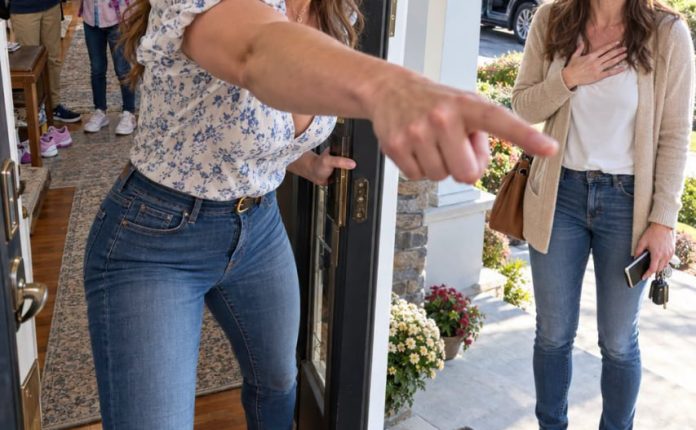
Derek reached across my knees, opened the passenger door, and told me to get out. We were miles from any street I recognized, and he had already taken my phone.
“Derek, stop. What are you doing?”
“Making sure this conversation stays with you.”
His seat belt dug across his chest as he stretched farther, pushing the door until it struck its stop. Cold air came through the opening. Somewhere behind us, a loose piece of metal rattled against the bus shelter.
I put one hand over my purse.
He looked at it.
“Give me that.”
“No.”
The word surprised both of us.
His expression went flat. He held out his hand and waited, using the silence that usually made me surrender before an argument began.
I let go.
He removed my wallet, opened it, and placed its contents beside the gearshift. My debit card. The two credit cards we shared. Thirty-two dollars I had saved from small cash purchases because sometimes I wanted to buy lunch without explaining it.
Then he checked the purse again.
“Now get out.”
“My mother is waiting for me.”
“Your mother should have taught you how a household budget works.”
That morning, he had spread our bank statement across the kitchen counter and circled three purchases.
Groceries. Gas. Eighty dollars at a bookstore and a shop next door.
The eighty dollars had bought my mother a soft blanket and two novels. She was recovering from surgery, confined mostly to her sofa, and tired of television. I had spent twenty minutes choosing books without hospital scenes.
Derek hadn't asked what I bought.
He had asked who gave me permission.
“My wages go into that account,” I said.
“And who pays the serious bills?”
I worked four days a week at the public library. My paycheck covered more than he admitted, but I had learned that bringing numbers into a disagreement about numbers could somehow make the disagreement worse.
At home, I had apologized for not mentioning the gift.
In the car, he had decided the apology sounded insincere.
Now his fingers closed around the phone he had taken from my jacket.
“You need to appreciate what I provide.”
“I can't get home from here.”
“Then you'll have time to think.”
I stepped onto the pavement because the alternative was sitting there while his anger grew. He pulled the door shut before I could turn.
“Call me when you're ready to apologize properly.”
I looked at my phone in his hand.
For an instant, his eyes followed mine.
Then he put the car into gear.
I watched his brake lights at the corner. I expected them to brighten, expected the car to turn back.
They disappeared.
The stop stood beside a boarded liquor store and a narrow road leading toward warehouses. An old timetable hung behind scratched plastic, its bottom half bleached almost white.
I tried to read it.
The route numbers meant nothing.
A bus arrived eight minutes later. I knew because I had started counting, as if measuring his absence could make it temporary.
The driver opened the door.
“Getting on?”
I touched my empty purse.
“No. Thank you.”
He waited another moment.
I couldn't say it.
My husband had taken my money and left me because I bought my mother a blanket.
The sentence seemed too foolish to belong to an adult woman.
The doors folded shut.
I sat on the bench and tried to remember telephone numbers.
My mother's came easily. The library's did not. My friend Hannah's number had changed two years earlier, and by then we had mostly stopped talking.
Derek called her intrusive.
When she asked why I canceled dinner so often, he said she was trying to create trouble between us.
I had stopped answering because explaining my marriage to someone outside it was exhausting. Eventually, she stopped asking.
The convenience store two blocks away had a shutter over its door. The community center farther down the road looked open, but every time I considered walking there, I pictured Derek returning to an empty bench.
He would say I had made things difficult again.
That thought kept me seated longer than the missing money.
At some point, shame became a practical obstacle. I knew I could ask someone for help. I also knew Derek would want an account of every person I had spoken to.
I kept preparing for his return.
A second bus came. Then another.
The afternoon cooled. I tucked my hands into my sleeves and watched a damp receipt scrape along the gutter.
Across the road, a man rolled down a metal shutter. A delivery truck reversed somewhere out of sight. Ordinary work continued around me.
I wondered whether my mother had warmed her own soup.
The sound of a cane reached me before the woman did.
She approached from the direction of the community center, wearing dark glasses and a navy coat. Her white cane moved carefully across the pavement.
“Is this the bench?”
“Yes.”
“And is there room for a troublesome old woman?”
I moved my purse.
“Plenty.”
She sat with a small breath of effort, folded one gloved hand over the other, and rested her cane against her leg.
She smelled faintly of lavender soap.
For several minutes, we listened to traffic.
Then she said, “You've been crying.”
I wiped my cheeks although I knew she couldn't see the movement.
“I'm all right.”
“Good. Then I won't need to ask why you keep holding your breath.”
I looked at her.
Her mouth curved slightly.
The kindness in that small, unsentimental joke undid me.
“My husband left me here.”
She turned toward my voice.
“How long ago?”
“I don't know. A few hours.”
“Did he intend to come back?”
“He said it was a lesson.”
The woman's fingers stopped moving.
“What sort of lesson?”
I told her about the statement. The eighty dollars. The way he had taken everything from my purse.
She asked whether I was injured.
I said no.
She asked whether I wanted the police.
“No. Please.”
“Because you don't want them, or because he wouldn't?”
I couldn't answer immediately.
“That can wait,” she said. “What is your name?”
“Olivia.”
“I'm Catherine.”
She said it simply, without the surname that would have meant something to almost anyone else in the city.
I told her more than I intended.
How Derek had suggested managing our finances after we married because I disliked spreadsheets. How shared passwords had gradually become passwords only he knew. How my salary arrived in the account, then vanished into categories he explained too quickly.
I told her about standing in our kitchen at midnight while he repeated the same question until I gave the answer he wanted.
Had I been selfish?
Yes.
Had I embarrassed him?
Probably.
Would I do better?
Of course.
“When you get home,” Catherine asked, “what will you do?”
“Apologize.”
“For buying food?”
“For making him angry.”
She waited.
I heard what I had said.
A bus passed without stopping. Its wake lifted grit against my shoes.
Catherine touched my sleeve.
“Olivia, someone can be angry without having the right to punish you.”
“He works hard.”
“So do you.”
“He worries about money.”
“That doesn't explain taking your telephone.”
I looked down at my purse. Its zipper was still open.
She spoke carefully.
“He removed your money, your transport, and your way to contact anyone. That is control. You don't have to decide everything about your marriage tonight to recognize what happened this afternoon.”
I began crying again, silently this time.
She let me.
When a black car appeared at the corner, she lifted her chin toward the engine.
A man in a gray suit got out.
“Mrs. Wilmington. They've finally cleared the road.”
“Then the city may survive another day, Thomas.”
His eyes moved to me.
“Everything all right?”
“We have a guest.”
I stood too quickly and caught the edge of the shelter.
Catherine held out her arm.
“Pretend you're my granddaughter until we're in the car.”
I stared at her.
“What?”
“People stare less when an old woman leaves with family. You can explain nothing at all.”
Thomas glanced between us.
“Should I be concerned?”
“Only about the soup getting cold.”
She lowered her voice.
“Your husband seems to think you have nobody. He is mistaken.”
I looked toward the corner one final time.
“Who are you?”
“Catherine Wilmington.”
When my expression didn't change, she gave a short laugh.
“How refreshing. People sometimes call me the wealthiest woman in this city. You needn't be impressed. Tonight, it means a driver, a telephone, and a spare room.”
I took her arm.
“Thomas, meet Alexandra. She's staying with us.”
He opened the door without asking anything further.
Inside, the seat was warm. I held my empty purse against my ribs while Thomas handed back a telephone.
“Who would you like to call?”
The question should have been simple.
I had spent years thinking first about whom Derek would approve of.
My mother's number came to me.
While it rang, Catherine settled her cane beside her.
“You owe me no performance,” she said. “The name included.”
My mother answered breathlessly.
“Hello?”
“Mom. It's me.”
“Olivia? I've been trying your phone.”
“I know. I'm sorry.”
“Where are you?”
“I'm safe.”
That was when her voice changed.
“What happened?”
I could hear the television behind her, turned too loud because she had probably dozed with the remote beside her.
“Derek took my phone.”
A pause.
“And?”
“My cards. He left me somewhere. Someone helped.”
“Come here.”
She could barely get out of a chair without holding her incision. Still, she offered the only solution that occurred to her.
“I'll come tomorrow.”
“Tell me who you're with.”
I did.
“Catherine Wilmington?”
Across the car, Catherine raised an eyebrow.
My mother knew the name. She had worked in a small manufacturing office before retirement and remembered when Wilmington Industries expanded its employee scholarship program.
“Let me speak to her.”
I handed over the phone.
Catherine introduced herself, gave my mother the address, and offered Thomas's number.
She didn't describe me as hysterical or confused.
She said, “Your daughter is making arrangements for tonight.”
As though I were a person managing a difficulty.
Not the difficulty itself.
The gates opened onto a long drive. Beyond them stood a white house with columns, broad windows, and warm light spilling beneath a covered entrance.
I nearly asked Thomas to stop.
Catherine heard me shift.
“Still here?”
“Yes.”
“Good. Margaret makes enough soup for a regiment.”
The housekeeper met us at the door. She had silver hair pinned neatly at the back and reading glasses hanging from a cord.
“Tea or something to eat?” she asked me.
“Either is fine.”
“One preference,” she said gently. “We'll begin there.”
“Soup.”
“Excellent.”
The hall smelled of polished wood and something baking. Catherine moved through it without Thomas's arm, her cane finding familiar edges.
I followed Margaret upstairs.
The guest room was blue, with a chair by the window and a bathroom larger than our kitchen. A folded nightdress lay on the bed.
“If it doesn't fit, say so.”
I nodded.
Margaret paused at the door.
“The lock works. So does the telephone. You may use either.”
After she left, I turned the key.
I stood with my hand still on it for a long time.
At supper, Catherine sat opposite me at a small round table. Thomas brought a tray, then withdrew.
“Alexandra?” I asked.
“My granddaughter. Portland. Thirty-one, impatient, excellent at telling me when I'm being ridiculous.”
“Does she know you borrow her name?”
“She will now. It was presumptuous. I meant to spare you questions, and instead supplied an identity you hadn't chosen.”
“I didn't mind.”
“You're allowed to mind.”
I ate a spoonful of soup.
“Why were you there?”
“At the community center?”
“At that stop.”
“Accessibility meeting. A ramp designed by someone who apparently considers stairs a personality test. Thomas had to circle because of roadworks. I wanted air.”
“By yourself?”
She smiled.
“I've been blind for ten years. I've been stubborn considerably longer.”
I felt my face grow warm.
“I didn't mean—”
“I know.”
She located her glass with the backs of her fingers.
I asked about Wilmington Industries.
She told me she had run it for twenty-eight years after her husband's death, then sold her controlling interest. She still served on several charitable boards and disliked most banquet chicken.
The details came without ceremony.
“Tomorrow,” she said, “my lawyer can talk with you. If you'd like.”
“I can't afford—”
“A conversation. Not a contract you're obliged to sign.”
“What would I say?”
“Perhaps start with what you told me.”
I lowered my spoon.
“What if he comes looking?”
“Then the staff won't admit him without your permission.”
“He's my husband.”
“Yes.”
She waited until I looked up.
“That doesn't make this his house.”
I slept badly, waking whenever a car passed along the drive.
Each time, I reached toward the bedside table for a phone that wasn't there.
At six, I sat in the chair by the window and rehearsed an apology.
By seven, I was angry with myself for rehearsing it.
By eight, Margaret brought toast and asked whether I wanted the curtains open.
The lawyer arrived at nine.
Miriam Shah wore a brown jacket and carried a canvas bag with a frayed strap. She greeted Catherine warmly, then asked whether we could speak alone for part of the meeting.
Catherine left without objection.
Miriam waited until the door closed.
“Before we discuss anything else, do you want to be here?”
“Yes.”
“Do you want to go home today?”
“I don't know.”
“That's an answer.”
She explained that Catherine had offered to cover an initial period of advice, but that I would be her client. What I told her belonged to me. Catherine would hear only what I wanted shared.
Then Miriam opened her notebook.
“Where does your salary go?”
It was such an ordinary question that I almost answered carelessly.
Instead, I found myself describing the joint account and realizing how little access I had retained.
“Do you have identification anywhere besides your wallet?”
“My passport. At home.”
“Any photograph of it in email?”
I thought.
“Yes. From a trip we never took.”
We started there.
Recovering my email took most of the morning. The backup address belonged to me, although I hadn't used it in years. Miriam sat beside me while I answered security questions and changed the recovery details.
She didn't touch the keyboard unless I asked.
The bank had a process for customers whose identification and devices were unavailable. It involved a branch visit, additional checks, and a manager who spoke directly to me rather than Miriam.
By noon, we could see statements.
By midafternoon, I had a new account in my own name, ready for future wages. Miriam warned me against moving disputed joint funds impulsively.
“Preserve the information first,” she said. “We can ask for appropriate protection. You don't need another argument about money clouding the facts.”
I called the library's payroll office.
My voice shook when I requested the change.
The woman processing it simply said, “Of course.”
I had expected a hearing.
She emailed a form.
Thomas drove me to my mother's apartment afterward. I went upstairs alone.
She stood in the doorway holding a cushion against her stomach.
“Oh, sweetheart.”
I kissed her cheek and noticed the blanket I had bought folded across the sofa.
For several seconds, I couldn't look away from it.
My mother followed my gaze.
“It's warm,” she said.
I sat beside her.
“Was it foolish?”
“What?”
“Buying it.”
She stared at me, then slowly lowered herself into the chair.
“Olivia, who made you ask that?”
I told her enough.
Not everything. Enough that she stopped defending the version of our marriage I had helped her believe.
“I thought you were tired,” she said. “You always said work was busy.”
“I didn't know how to tell you.”
She took my hand.
“You can start badly. I'll still listen.”
Back at Catherine's house, the study table was covered with statements.
Miriam had highlighted withdrawals that didn't match bills I recognized.
Two hundred dollars. Six hundred. Twelve hundred.
Transfers out of the savings account we had supposedly been preserving for a home deposit.
There were hotel charges.
A restaurant on the evening of my mother's surgery.
I remembered Derek's message that night.
Inventory is a mess. Don't wait up.
I had eaten crackers beside the hospital vending machine because the cafeteria was closed.
“Could these be work expenses?” I asked.
“Possibly,” Miriam said. “We label what we know and leave the rest open.”
She showed me the dealership's public event album.
Baines Motor Group had attended a regional sales reception at the same hotel the previous week. Most photographs were posed groups beneath sponsor signs.
One showed Derek outside the entrance.
Brenda stood beside him.
His hand lay low against her waist. Her fingers rested on his chest.
The caption named them both.
I knew Brenda. She was the dealership's managing director, the woman Derek described as demanding, brilliant, and impossible to please.
She had shaken my hand at the Christmas dinner.
She had asked whether I still worked “with the books.”
I looked from the photograph to the charges.
Miriam didn't tell me what to feel.
“It's a photograph,” she said. “It suggests questions. It doesn't answer all of them.”
Catherine sat beside me while I read the caption again.
Her telephone rang.
She listened, thanked the caller, and said she would confirm her arrangements later.
“Trouble?” I asked.
“Committee business.”
I pushed the photograph away.
“I don't want to ruin his life.”
Catherine's face turned toward mine.
“What do you want?”
The question took longer.
“I want to know what happened to my money.”
“Then begin there.”
That evening, Miriam helped me prepare a timeline.
I remembered the moment Derek took my phone because he had glanced at its screen before slipping it into his pocket.
I remembered asking why we had turned away from the road to my mother's.
He had said he needed to stop somewhere first.
A detail I had barely noticed returned: the phone vibrating in his hand after I got out.
He had looked down before driving away.
Miriam wrote it down without comment.
The next morning, the bank's fraud team returned our request about an unfamiliar lender payment listed in my account history.
There was no payment yet, they explained.
There was an application.
A personal loan in both our names.
Eighteen thousand dollars.
My consent had supposedly been confirmed through a code sent to my telephone on Monday afternoon.
I stood beside the study window, holding the receiver so tightly my fingers hurt.
“What time?” I asked.
The representative checked.
Three seventeen.
At three seventeen, I had been sitting on a bus bench without money, waiting for my husband to come back.
He had been holding my phone.
Miriam looked up from her notebook.
I repeated the time.
Then I said the first thing about my marriage that I had not tried to soften.
“I never agreed to that loan.”
END PART 1