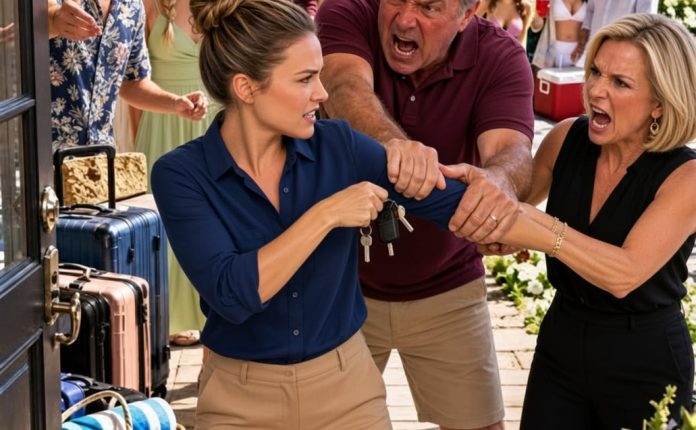
A gray SUV stopped behind the cruiser.
Tessa looked toward it before the door opened.
The woman who got out had her eyes, her mouth, and none of my mother’s need to announce herself.
She came directly to the gate.
“My daughter’s on the porch?”
“Yes,” I said, and stepped aside.
She went to Tessa and wrapped both arms around her.
For a moment, Tessa leaned into her as though she had been holding herself upright by effort alone.
Her mother didn’t demand an account of what had happened in front of everyone. She didn’t inspect the audience. She didn’t ask whose fault it was.
She held her daughter.
I looked away.
That simple act made the afternoon feel more painful than another argument would have.
Ethan went to the bus.
He retrieved the suitcases and the portable crib, then carried them to the SUV.
Mom followed him a few steps.
“Where do you think you’re going?”
“With Tessa.”
“Her parents don’t have enough room.”
“We’ll make it work tonight.”
“You can come back to ours.”
He set a suitcase down.
“Your management has already told you we can’t stay.”
“We can talk to them.”
“We’ll find our own place.”
Mom looked toward me.
I could almost hear the accusation she wanted to make: that I had created the housing problem by refusing to solve it.
Ethan had been living with them before Saturday.
The restrictions existed before Saturday.
His child was due before Saturday.
All I had done was decline to let their solution become my children’s displacement.
He lifted the suitcase again.
Mom didn’t stop him.
The guests began returning to the bus.
Nobody had opened the gifts.
The cake remained boxed.
People who had arrived expecting an afternoon of games and congratulations now carried their packages with the awkward care of those who wished their hands were free but didn’t know what to do with them.
Mrs. Parker looked at me before climbing the steps.
I nodded.
She nodded back.
There was nothing useful to say in that moment.
Alma Jennings was the last guest to approach the bus.
She stopped at the gate.
“I’m sorry.”
“You didn’t plan this.”
“No.”
She looked down at her cane.
“But I heard your parents’ explanation all those years, and I let it be the whole story.”
I didn’t answer quickly.
She wasn’t asking me to reassure her that she had done nothing wrong. That made her apology easier to receive.
“I appreciate you saying that.”
She glanced toward the roses.
“Your grandmother would have been pleased to see you living here.”
My throat tightened again.
“I wish she could.”
Mrs. Jennings reached toward a bloom, stopping short of touching it.
Then she went back to the bus.
The banner Mom had carried was partly unrolled near the steps.
WELCOME BABY ELLISON.
The driver picked it up.
Mom reached for it, perhaps intending to gather the decorations and recover some final piece of the day.
He folded it into his arm and put it inside.
She stood with her hand extended, then let it drop.
Ethan loaded the last suitcase and came to the gate.
The Christmas card was still visible in his shirt pocket.
“Mara.”
I waited.
“I’m sorry.”
His voice was rough.
“I didn’t know about the money. Or the motel. Not like this.”
“I believe you.”
He looked relieved for half a second.
Then I said, “You could have asked more.”
He lowered his eyes.
“Yes.”
I wasn’t going to tell him he had no responsibility because he hadn’t made Dad’s choices.
At thirteen, he hadn’t.
At twenty-eight, he had been an adult long enough to wonder why his sister never seemed to get the kind of help that appeared for him.
He had thanked me for housing him without speaking to me once.
There were things he hadn’t known.
There were also things he had never tried to know.
“I should have,” he said.
“Yes.”
He glanced toward Tessa.
Her mother was helping her into the SUV.
“Go with her,” I said.
He nodded and left.
There was no embrace.
I didn’t feel ready for one.
An apology didn’t require me to perform relief on command.
Walter’s daughter helped him down the porch steps a few minutes later.
He paused beside me and offered his hand.
I took it.
“Thank you for coming.”
“I’m glad I could.”
“You remembered what you promised.”
“So did you.”
I frowned.
“I didn’t promise anything.”
“You said you wanted to come home someday.”
I looked toward the house.
He squeezed my hand once.
“You did.”
His daughter guided him to the sedan.
Lily waved until they pulled away.
The officer left after confirming that my parents understood the warning.
Dad was already on the bus, sitting near the front with his face toward the windshield.
Mom remained on the sidewalk.
She waited until the cruiser disappeared, then came back to the gate.
The church smile was gone.
So was the voice she used to organize other people into agreement.
She put her fingertips on the latch.
“We are your parents.”
“I know.”
“You don’t treat your parents this way.”
I looked at her hand.
It was the same hand that had passed me a motel address. I remembered the paper held between two fingers, as though the solution was so obvious she couldn’t understand why I hadn’t found it myself.
“You were my parents then too.”
She looked up.
“When?”
“When Noah and I had to leave.”
“That was different.”
“How?”
“Your father had responsibilities.”
“To whom?”
Her eyes moved toward the bus.
I didn’t follow them.
“You told people the house paid for Grandma’s care.”
“Russell handled the money.”
“You knew what happened.”
She didn’t deny it.
She looked down at the latch instead.
I had spent years waiting for one of them to say clearly that they had understood my grandmother’s wishes and chosen something else.
Now I knew the admission might never come.
The absence of it didn’t change what happened.
“On Tuesday,” I continued, “you told me to take my children out of their home.”
“I was trying to help Ethan.”
“You always say that.”
“He needs us.”
“So did I.”
She turned her face away.
For a moment, I thought she might finally stay with those words.
Not explain them.
Not replace them.
Just hear them.
Then she looked back.
“Let me come inside.”
“No.”
“We shouldn’t be discussing this where people can see.”
“We’ve had years to discuss it privately.”
“Mara, please.”
I had wanted that word from her once.
Please listen.
Please tell me how you are.
Please come over because I miss you.
Hearing it now didn’t feel like the repair I had imagined.
It felt like another request for access.
“You don’t get to decide what happens here,” I said.
“I’m still your mother.”
“Yes.”
I let the word settle before continuing.
“You aren’t in charge of my home.”
Her fingers tightened.
“One day, when we’re gone, you’ll wish you’d handled this differently.”
I considered it.
Not because she had frightened me into doubt, but because I wanted my answer to be true.
“I wish we’d handled the years before today differently.”
Her eyes filled.
Behind her, the bus engine grew louder.
Then she tried something else.
“Perhaps you won’t be seeing Ethan’s baby.”
“That’s for Ethan and Tessa to decide.”
“You think they’ll choose you?”
“I’m not asking them to choose.”
She stared at me.
It was almost as though I had answered in a language she didn’t understand.
I wasn’t trying to own the next relationship.
I wasn’t offering a bedroom in exchange for loyalty.
I wasn’t interested in proving that my brother loved me more than he loved her.
I wanted him to become a man who could make his own decisions and respect mine.
The driver leaned toward the open bus door.
“Ma’am, we need to get going.”
Mom’s fingers stayed on the latch.
For one more second, I thought she might push.
Then she released it.
She walked back to the bus without another word.
It was too long to turn around on our street. The driver had to reverse toward the corner, and the warning beeps carried between the houses.
Neighbors stood on their porches.
My parents stared ahead.
I watched until the bus disappeared.
Then I went inside.
Noah held the screen door for me.
Lily stood in the hall with her hands tucked beneath her arms.
“Are they gone?”
“Yes.”
“Are they coming back?”
“I don’t know.”
“Can they come in?”
“Only if I say they can.”
She looked toward her room.
“Can I still paint?”
“Yes.”
“Any color?”
“Within reason.”
“What does that mean?”
“It means you’ll show me before we buy it.”
She considered the fairness of that.
Then she grinned.
The house had been tense for hours. Her smile made it possible to hear the ordinary sounds again: the refrigerator, a car passing, Noah’s shoes squeaking faintly as he moved.
He followed me into the kitchen.
“What are we doing about dinner?”
“Eating it.”
He gave a small shrug.
“I wasn’t sure.”
I opened the refrigerator.
There was leftover pasta, half a loaf of bread, and groceries still waiting to be put away properly.
“We don’t need to go anywhere.”
He looked at me.
I took out the container.
“This is where we live.”
He nodded.
I saw something settle in his face.
The argument had ended outside, but for him the important part might have been this: we were going to heat food, sit down, and stay.
I took off my shoes.
Lily fetched plates.
Noah poured water.
We ate at the kitchen table while the house creaked around us in the heat.
Nobody had to share a bedroom.
Nobody had to pack.
That night, I walked down the hall after the children were asleep.
Noah’s door was partly open. Lily’s stars glowed above her bed.
I stood there longer than necessary.
I didn’t feel triumphant.
I felt exhausted, sad, and steadier than I had felt on Tuesday.
Those feelings could exist together.
Sunday was quiet.
On Monday, my phone began filling with messages.
Some came from church members who had been on the bus. They apologized for arriving without checking with me, or said they had believed the shower was something I wanted.
A few told me they remembered Grandma speaking about the house.
I thanked those I felt ready to answer.
Other messages came from relatives who hadn’t been there.
They wanted me to forgive.
They wanted me to understand.
They wanted private family problems kept private.
I sat at the table reading one of those messages while looking at the gate through the window.
Thirty-seven people had been brought to my home.
I had been expected to leave it.
Apparently, privacy became important only when the plan failed.
I blocked three numbers before breakfast.
Then I went to bed because I still had a shift that night.
Work remained work.
People needed medication whether I had finally confronted my parents or not. Call bells rang. A patient wanted her pillow adjusted. A worried son asked the same question twice.
I found the ordinary tasks helpful.
There were problems I could address without untangling decades of history.
There were facts I could chart and instructions I could follow.
When my phone vibrated in my pocket, I let it wait.
Ethan didn’t call for four days.
When he did, I watched the screen through two rings before answering.
“Hello.”
“Hey.”
He sounded less certain than usual.
“How’s Tessa?”
“She’s okay.”
“The baby?”
“Still making us wait.”
I almost smiled.
“That’s probably good.”
He breathed into the silence.
“We found an apartment.”
“Already?”
“Tessa’s dad knows a property manager. It’s small, but there are two bedrooms.”
“I’m glad.”
“Yeah.”
He paused.
I waited rather than helping him find his next sentence.
“Mara, I looked through some of Dad’s old paperwork.”
I stopped wiping the counter.
“What were you looking for?”
“The house money.”
“Why?”
“Because I wanted to know what he wasn’t saying.”
That mattered.
It didn’t undo Saturday.
It didn’t undo the motel.
But he had taken a question home and done something other than wait for Mom’s preferred explanation.
He told me most of the proceeds had been spent within two years.
Academy fees.
Tournament travel.
Business debt.
Credit cards.
Then there had been another loan.
Dad hadn’t simply sacrificed Grandma’s house once and emerged stable. He had used it to postpone problems while presenting Ethan’s opportunities as things someone else had funded.
“He told me scholarships covered everything,” Ethan said.
“I didn’t know that part.”
“I keep trying to work out why.”
“Because you wouldn’t have had to think about where it came from.”
He was quiet.
Then he said, “I keep picturing Noah in that room.”
“He was little.”
“I don’t remember much from then.”
“I do.”
He exhaled slowly.
“I’m sorry.”
“You said that Saturday.”
“I know. I wanted you to know I’m not calling because I expect you to say it’s fine.”
I leaned against the counter.
“Good.”
He gave one brief, unhappy laugh.
“You’re really going to make me sit with it.”
“I’ve been sitting with it a long time.”
“Yeah.”
Outside the window, a breeze moved through the roses.
“I think we got used to you managing everything,” he said. “It made it easy not to ask.”
I didn’t reassure him.
He wasn’t wrong.
We ended the call without trying to turn it into a scene of reconciliation.
He had found an apartment.
He had read the paperwork.
He had listened to an answer without arguing that I should make him feel better.
For one conversation, that was enough.
Dad sent a message saying I had humiliated my mother so badly she might never recover.
I told him not to contact me about Saturday again.
He stopped.
Mom tried more approaches.
At first, she said I had broken the family over a piece of property.
Then she explained that the years after Grandma died had been financially difficult.
Then she revised what had happened.
They hadn’t put me out, she wrote. They had helped me find somewhere affordable.
I looked at that message for a long time.
Affordable to whom?
The motel had consumed money I needed to build something safer. It had given me no kitchen worth mentioning, no real room for a toddler, no confidence that next week would be easier.
But I didn’t write all that back.
I had explained my life enough.
Another message told me she couldn’t sleep.
Another blamed me because Ethan had stopped calling as often.
Then she said she hoped God would soften my heart.
Finally, she wrote that perhaps some matters could have been handled better.
No one appeared as the person who had handled them.
The sentence seemed designed to apologize without creating responsibility.
I blocked her.
For a few days, I checked the blocked list repeatedly.
I can’t claim I felt immediately free.
Part of me still expected something to happen if I stopped monitoring her. Another part wanted to find evidence that she had tried again.
Both habits had grown from the same place: my mother’s attention had always mattered more to me than was good for me.
By the second week, I checked less.
By the third, I forgot.
The change came quietly.
I made coffee without first looking at my phone.
I went to sleep without rehearsing an argument.
I stopped hearing every arriving car as a possible interruption.
Noah painted one wall dark green.
He stood back with the roller in his hand and looked pleased in a way he tried to conceal.
“It’ll look better when it dries,” he said.
“It looks good now.”
He gave me a small smile.
Lily chose pale blue.
She wanted the room to look like morning, although she still wanted the stars on the ceiling.
We painted around the furniture because none of us wanted to carry everything out again.
There were drips to fix and a patch near the window that needed another coat.
It felt wonderfully ordinary.
On mornings when I wasn’t working, I sat on the porch while Lily watered the roses.
Walter had given her instructions, and she treated them as settled law.
“Early in the day,” she said, turning the hose carefully.
“Why early?”
“Because that’s what he said.”
“That’s a strong start.”
She looked at me.
“He’s had them longer than you.”
I couldn’t argue with that.
Six weeks after the bus arrived, Alma Jennings came to the gate carrying a cardboard box.
I didn’t open the door and wave her straight inside.
I went out first.
“What have you brought?”
“Some things from Evelyn’s class.”
She opened the box.
Photographs lay inside.
Grandma holding Christmas baskets.
Grandma standing with women from church.
Grandma in the yard beside the roses.
Then a picture of the two of us when I was sixteen.
I was squinting into sunlight. She looked amused.
I touched the corner.
“I haven’t seen this one.”
“We thought you ought to have it.”
“Thank you.”
Mrs. Jennings hesitated.
“Your mother stepped down from the women’s ministry.”
I looked up.
“She said she wasn’t well.”
“Is she?”
“Not that I’ve heard.”
I nodded.
There was a time when that news would have sent me into motion. Call someone. Check what she meant. Determine whether I was expected to help.
That day, I accepted the information and left it where it was.
I didn’t want her publicly destroyed.
I didn’t need the women at church to keep punishing her on my behalf.
I wanted a home where her decisions no longer governed my mornings.
Mrs. Jennings handed over the box.
I invited her to sit on the porch for a while.
That invitation felt different from obligation.
I had chosen it.
Two weeks later, a familiar pickup turned onto the street while Noah mowed and Lily watered.
My body tightened before I recognized the driver.
Then I saw Ethan.
Tessa sat beside him, holding a small bundle wrapped in yellow.
Their baby.
Ethan parked at the curb.
He didn’t get out immediately.
I set down my coffee and looked toward him.
Only then did he open the door.
He carried a cardboard box to the sidewalk outside the gate.
“These belonged to Grandma.”
I stood.
“What are they?”
“Albums. Letters. Dad had them in the garage.”
My chest tightened.
“I didn’t know.”
“Neither did I.”
He looked toward the house.
“I found them when I moved the rest of my things.”
“You’re completely out now?”
“Yes.”
“How are Mom and Dad?”
The question felt strange.
Not inviting.
Not particularly painful.
Just unfamiliar, as though I was asking about people who lived a long way away.
“Dad isn’t saying much.”
“And Mom?”
“Enough for both.”
That sounded plausible.
He rubbed the back of his neck.
“She wanted me to get you to unblock her.”
“No.”
“I told her I wouldn’t.”
I looked at him carefully.
“Thank you.”
He nodded.
Lily abandoned the hose.
“Is that the baby?”
Tessa lowered the window.
“It is.”
“Can I see?”
“If your mother says you can.”
Lily looked straight at me.
“Please?”
“Yes.”
She went toward the truck, then slowed herself and tucked her hands behind her back.
I watched Tessa watching her.
That simple referral back to me meant more than she could have known.
“What’s her name?” Lily asked.
Tessa glanced at Ethan.
He looked at me.
“Evelyn.”
I didn’t move.
Then Tessa smiled.
“We call her Evie.”
I walked toward the truck.
The baby had dark hair, a wrinkled face, and a solemn expression entirely out of proportion to her size.
She opened her mouth, considered making a complaint, and closed it again.
“She’s lovely,” I said.
“She’s loud at three in the morning,” Tessa replied.
“That’s compatible with lovely.”
“Good. I was worried.”
We smiled.
For the first time since I had met her on my porch, I saw Tessa without the strain of somebody else’s plan pressing around her.
“Call if you need nursing advice,” I said.
She looked at me.
“Advice?”
“Advice.”
She gave a little nod.
“I can do that.”
Ethan sat on the curb.
He didn’t ask to enter the house.
After a while, I opened the gate.
“You can bring the box to the porch.”
He stood.
“Do you want it inside?”
“Not yet.”
“Okay.”
He put it on the bottom step.
I sat in the wicker chair. He sat below me.
Lily continued her inspection of Evie while Noah mowed the same strip for longer than necessary.
“I was angry with you,” Ethan said.
“After the shower?”
“Before.”
I looked at him.
“For what?”
“I thought you didn’t want us.”
The answer hurt, although it shouldn’t have surprised me.
“Who told you that?”
“Mom didn’t put it exactly that way.”
“She didn’t need to.”
He rubbed his palms together.
“She said you were proud. That you wouldn’t accept help. That you always wanted to do everything yourself.”
I looked toward Noah.
“She told me not to expect help. Then she complained when I stopped expecting it.”
Ethan nodded slowly.
“I’m seeing that.”
“You believed her.”
“Yes.”
He didn’t add that he had been young.
He didn’t say he hadn’t meant anything by it.
He let the admission stand.
“I thought you left us,” he said. “I didn’t understand how much had happened before you stopped coming around.”
I rested my hands on the chair arms.
“I don’t hate you.”
He looked up.
“But you don’t trust me.”
“Not yet.”
“That makes sense.”
“And I don’t want us pretending this is repaired because you’ve brought a box.”
He looked down at it.
“I didn’t bring it for that.”
“Good.”
The conversation was awkward.
It needed to be.
Some relationships had been kept comfortable by leaving one person alone with every difficult truth. I wasn’t willing to do that anymore.
“You benefited,” I said.
“I know.”
“When you were thirteen, you didn’t choose what Dad did.”
“No.”
“But later, you didn’t look very hard at what it cost.”
He nodded.
“No.”
I watched Lily bend carefully toward the baby.
There was tenderness available to us that afternoon.
There was also damage.
Neither erased the other.
After several minutes, Ethan stood.
“Could we bring her by again?”
“You can ask.”
He smiled faintly.
“Right.”
He started toward the truck.
“Ethan.”
He turned.
“Grandma would have liked her name.”
His mouth tightened.
“I hoped so.”
They left without anybody being promised more than I could give.
I carried the box inside.
For two hours, I sat on the living room floor with Grandma’s papers around me.
Church programs.
Letters.
Birthday cards.
Photographs that recorded years I remembered differently because I had been inside them rather than looking at them.
At the bottom was an album with my name on it.
MARA.
I had never seen it.
There was my graduation.
My first car.
My face when I was pregnant with Noah.
Noah asleep against Grandma.
I stopped at a photograph taken in the front yard.
Grandma stood behind me with a hand on my shoulder. The roses were visible nearby.
I turned it over.
She had written that I had finally found a place where I belonged.
I sat with the photograph in my lap.
Then I cried.
Not because the house could bring her back.
Not because the picture made my parents’ choices harmless.
I cried because I had carried so much uncertainty about my place in that family, and here was somebody who had never been uncertain about me.
I had spent fifteen years thinking I was trying to recover a building.
Sitting on the floor, I understood that the building had also given me something I hadn’t known how to name.
I could decide who came in.
I could decide what my children had to give up.
I could answer a demand without asking whether refusing would cost me love.
That evening, after the children were asleep, an unfamiliar number called.
I almost ignored it.
Then I answered.
Mom said my name.
I closed my eyes.
“You’re blocked.”
“Please listen.”
“I gave you a reason I didn’t want calls.”
“I want to apologize.”
I waited.
“For everything.”
I kept waiting.
A proper apology would have been something new. I wanted to give her room to make one.
She drew a breath.
“We were under a lot of pressure. Your father’s business was failing, and Ethan had a chance to do something with his baseball. Your grandmother didn’t understand the expense. We thought you could cope.”
There was the old arrangement again.
Ethan had opportunities.
Dad had pressure.
Grandma had failed to understand.
I had strength.
My strength had always been useful when somebody needed to explain why they had left me without help.
“That isn’t an apology for what you did,” I said.
“I said I’m sorry.”
“You’re explaining why you think it was necessary.”
“What do you want me to say?”
I looked toward the box of photographs.
For years, I had wanted a precise answer to that question. A confession. An acknowledgment. Proof that she understood.
Now I could feel how little I wanted to spend another night directing her toward words she didn’t mean.
“I’m not asking you for anything.”
“You don’t mean that.”
“I do.”
“You want me to beg.”
“No.”
“You want me to call myself a terrible mother.”
“I’m not asking you to call yourself anything.”
“Then what is this?”
I leaned against the kitchen counter.
Rain touched the windows. The house smelled of the lavender detergent Lily had chosen.
“I wanted you to care when I needed you.”
She said nothing for several seconds.
Then, “That was years ago.”
“Yes.”
“We can’t go back.”
“No.”
“So why keep punishing us?”
I considered that.
“I’m not organizing anything against you. I’m not calling your friends. I’m not trying to make Ethan stop seeing you.”
“He barely speaks to me.”
“That’s between you and him.”
“I’m your mother.”
“I know.”
“It ought to count for something.”
“It did. That’s why this hurt.”
She began crying.
I believed the tears were real.
That didn’t mean I had to reopen the door.
People could be distressed by consequences without understanding the harm that made those consequences necessary.
I no longer needed to settle every question about her feelings before acting on my own.
“I love you,” she said.
Once, those words would have made me abandon whatever boundary stood between us.
That night, I heard them.
I didn’t argue.
“I hope you’re all right.”
“Mara.”
“I mean it.”
I looked down the hall.
“But I’m not continuing this conversation.”
She began another sentence.
I ended the call and blocked the number.
For a long time, that was our last direct conversation.
Dad never apologized.
Six months after the shower, an envelope arrived with one sentence inside.
He said Grandma would be ashamed of what the family had become.
I read it twice.
Then I wrote underneath that she had already been unhappy with the way the family treated me while she was alive.
I didn’t send it.
I threw the pages away.
There was no obligation to keep an argument alive simply because he had mailed it to my home.
Ethan and I built a smaller relationship than people expected siblings to have.
He asked before visiting.
Sometimes he came alone.
Sometimes Tessa and Evie came with him.
For the first year, he didn’t move through the house as though every room was available to him. He stayed where he was invited.
Noah noticed.
So did I.
An apology had begun the change.
His behavior made it believable.
Tessa became someone I liked for reasons separate from being my brother’s partner.
She was direct. She could laugh at herself. She didn’t confuse asking for something with being entitled to it.
They struggled financially during Evie’s first year.
Once their water heater failed, Ethan called.
“I need some advice.”
I leaned against the kitchen counter.
“That’s a new opening.”
He laughed.
“Don’t make it a whole thing.”
He explained the problem.
I gave him the name of a plumber.
He thanked me.
That was the end of it.
I wasn’t expected to pay.
I wasn’t expected to offer a room.
There was no delayed accusation that I hadn’t volunteered enough.
Helping could be simple when it wasn’t being used to measure whether I deserved a place in the family.
Two years after the bus arrived, Noah graduated from high school.
At his graduation party, I stood on the porch watching him pose with friends beneath the maple tree.
He looked taller in his gown.
Or perhaps I was finally seeing him without mentally measuring how much protection he still needed.
My parents weren’t invited.
I had expected that absence to hurt more than it did.
There was some sadness.
But there was also a young man laughing in his own yard, with people who had come because they were welcome.
He never asked why his grandparents weren’t there.
He knew.
Lily turned twelve and began treating the roses as her responsibility.
She inspected leaves.
She complained about careless watering.
She informed me that stepping too close to the stems was not helpful.
Walter visited twice before traveling became too difficult.
The second time, he stood beside the mailbox for a while.
“You kept these going,” I said.
He looked at the roses.
“They had a good start.”
“You never knew Grandma.”
“No.”
He smiled.
“I knew enough.”
When he died the following winter, his daughter invited us to the funeral.
Lily brought a rose and placed it beside his photograph.
I watched her smooth the ribbon around its stem.
Walter had kept a small piece of our past alive without knowing whether it would ever matter.
By then, my daughter knew exactly why it did.
My work changed too.
After years of nights, I accepted a daytime supervisory position.
For the first month, I woke at two in the morning certain I had missed a medication round.
I would lie still, listening to the house, until I remembered I wasn’t scheduled.
Then, gradually, my body learned the new hours.
We ate dinner together more often.
I heard about school on the day things happened rather than two mornings later.
I could sit at the table without calculating how much sleep remained before the alarm.
One evening, Noah asked whether I regretted buying the house.
“Why would I?”
“Because it brought everything back.”
I looked around the kitchen.
Lily’s drawings covered part of the refrigerator. College brochures sat near Noah’s elbow.
“I don’t regret it.”
“You had to buy something Grandma wanted you to have.”
“Yes.”
“That still bothers me.”
“It bothers me too.”
He looked surprised.
I hadn’t learned peace by deciding the past was fair.
“It was wrong,” I said. “But I’m allowed to enjoy living here.”
He looked around as though considering the difference.
I reached for my glass.
“I don’t want every good thing we have to be measured against how difficult it was to get.”
He nodded slowly.
There had been years when I would have struggled to say that.
By then, I meant it.
Three years after the party bus, Evie ran through the yard during a Sunday cookout.
Ethan stood at the grill.
Tessa was talking to Noah about college.
Lily was warning Evie not to pull petals from the roses, using a tone she had clearly borrowed from me.
I stood on the porch and watched.
This was a family gathering.
No one had been ordered out of a bedroom to make it happen.
No one had been told where to go.
Everyone there had either asked or been invited.
Ethan glanced up.
“What?”
“Nothing.”
“You’ve got that look.”
“What look?”
“The one you get when you’re deciding whether we all need supervision.”
“You’re standing beside an open flame. It’s reasonable.”
He laughed.
Then his face became more serious.
“Mom asks about you.”
I looked toward Evie.
“I assumed she did.”
“Do you want me to stop mentioning it?”
“Yes.”
He nodded.
“All right.”
No argument.
No explanation that he was only trying to help.
No suggestion that one harmless update shouldn’t bother me.
He accepted an answer he might not completely understand.
That was worth more than a dozen speeches about how much he had changed.
My parents never returned to South Street.
The warning became an old document filed with other papers, but they stayed away.
I heard that Dad sold his truck business.
I heard that Mom began attending another church.
Relatives occasionally tried to tell me what they were saying about Saturday.
Eventually, I stopped those conversations too.
I didn’t need to monitor whether their version had finally become honest.
Their agreement was no longer a condition of my life continuing.
One summer morning, I sat on the porch before work.
Lily, now thirteen, was watering.
Noah was home from college, standing in the doorway with a cup of coffee he claimed was unacceptable.
“You’re welcome to buy something better,” I told him.
“With what money?”
“With the money you’re certain grown adults have in endless supply.”
He smiled into the cup.
A mower started farther down the block.
Somebody’s porch door closed.
The roses stirred when Lily shifted the spray away from them.
I looked at the gate.
For a long time, I had believed the decisive moment that Saturday was when the officer said I controlled the property.
That had mattered.
But another moment stayed with me more.
Mom’s hand on the latch.
Then her fingers opening.
Then my decision to let her leave without following her, reassuring her, or offering enough of myself to make her comfortable again.
My parents had taught me that keeping a family together required someone to surrender.
A room.
Money.
A grievance.
An accurate account of what had happened.
Usually, that someone was me.
My children had seen something else.
They had seen that a person could care about a pregnant woman and still refuse to house her.
They had seen that an apology could be heard without trust being instantly restored.
They had seen that relatives could be told no.
They had also seen Ethan return differently.
Not perfectly.
Differently.
The house hadn’t restored my grandmother.
It hadn’t returned Grant to us.
It hadn’t given me back the years of night shifts or made my parents capable of offering the care I had once waited for.
The plumbing still needed attention.
The mortgage still had to be paid.
Some windows stuck when the weather changed.
It was a house.
But it was ours.
Inside it, Noah had a desk he could leave where he wanted.
Lily had stars nobody could order her to remove.
I had a front door that opened when I chose to open it.
Fifteen years earlier, my mother had handed me an address and told me where to go.
On Tuesday, she had tried again.
This time, I didn’t pack.
When the bus arrived, my children stayed behind me.
When it left, we ate dinner.
And when bedtime came, they slept in their own rooms.
END PART 3