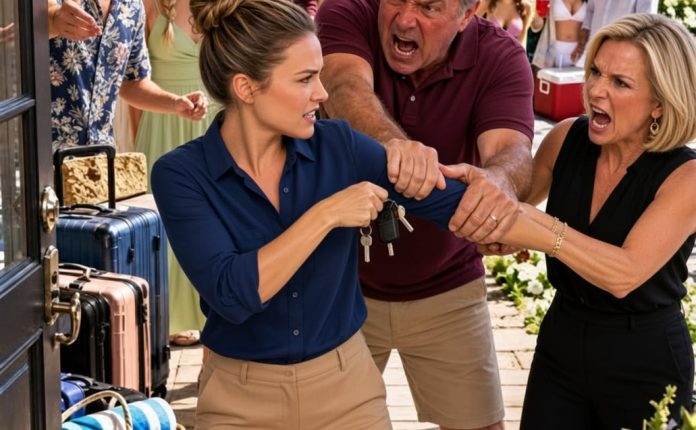
“Book a motel for Friday, Mara. We need your house ready for the shower.”
My mother said it while I stood in my own kitchen, six days after signing the papers that finally gave my children somewhere permanent to live.
The microwave had just finished warming yesterday’s coffee. Behind me, the dryer bumped steadily through a load of scrubs. I could still feel the elastic from my work mask against my face, although I had taken it off more than an hour earlier.
I thought I had misunderstood her.
“What shower?”
“Ethan and Tessa’s. Saturday at one. There are thirty-seven people coming, so we’ll need the backyard as well.”
She sounded mildly impatient, as though I had forgotten an appointment she had already entered on the calendar.
I set my mug down without drinking.
“Mom, you haven’t asked me to host anything.”
“We’re discussing it now.”
“No. You’re telling me to leave.”
There was a small pause. In that space, I heard my father speaking somewhere behind her.
Then Mom continued.
“It’s a motel, Mara. Two nights aren’t going to hurt anyone. We can’t arrange tables and decorations with you all underfoot.”
Underfoot.
My sixteen-year-old son was at his summer job, stocking shelves at the grocery store. My ten-year-old daughter was at the library’s reading program. Neither of them knew that their grandmother had decided their first weekend in our new home would be more useful without them.
For fifteen years, I had worked toward this house.
Not a house in the loose, hopeful way people mention something they might buy someday. This house had lived inside every choice I made. Extra shifts. Shoes worn another season. A car kept long past the point where the mechanic began greeting me with sympathy.
I was thirty-seven, a licensed practical nurse, and a widow with two children. The money in my savings account had accumulated in amounts so small they sometimes embarrassed me.
But six days earlier, a woman at a closing table had slid a set of keys toward me.
Those keys were mine.
Now my mother was explaining where she intended to put the buffet.
“The bus will bring everyone together,” she said. “Ethan arranged that because there isn’t enough parking on those old streets.”
My brother had booked transportation.
Guests had accepted invitations.
Food had been ordered.
Somewhere in all that planning, nobody had found a moment to ask the woman whose name was on the deed.
“How do you even know what space I have?” I asked.
“You posted pictures.”
I had posted one photograph of the keys and a picture of the children sitting on the porch steps. I hadn’t shown the bedrooms. I hadn’t posted the address.
Apparently, that had been enough.
“Put it on speaker,” Dad said.
There was a scrape, a brief change in the sound, and then Russell Ellison joined the conversation with the confidence of a man announcing a decision already approved.
“Ethan and Tessa will stay after the shower.”
I looked toward the hallway.
“Stay for what?”
“To live, Mara. They need somewhere suitable for the baby.”
My hand tightened around the edge of the counter.
“They’re moving into my house?”
“Our community has restrictions,” he said. “Management has already been asking how long Ethan’s been with us. A newborn will make it worse.”
“You’re talking about your housing problem.”
“We’re talking about helping family.”
Mom hurried in before I could answer.
“Noah can share with Lily. Ethan and Tessa will use his room. Your son’s barely home during the day anyway.”
Noah had spent the previous Sunday deciding where his desk should go.
He had moved it twice, stood back, and finally settled it beside the window. He wanted somewhere to study where he could shut a door. In our old place, his desk had doubled as the end of the dining table whenever we needed extra space.
“How long?” I asked.
“Until they’re settled.”
“What does that mean?”
“Mara.”
My mother could make my name sound like a warning and an accusation at the same time.
“You always have to turn help into a negotiation.”
Dad spoke over her.
“You’re asleep half the day after work. What difference will it make? There’s room.”
There was room because I had worked until my feet swelled inside my shoes.
There was room because Noah had learned to be quiet when I slept and Lily had learned the difference between something we needed and something we couldn’t afford yet.
There was room because nobody had offered to create any for us.
I watched a drop of coffee slide down the side of my mug.
At work, I could hold my voice steady while frightened relatives shouted at me. I could explain the same instruction six times. I could pause before answering somebody who mistook exhaustion for indifference.
That morning, I used the same breathing I used beside a difficult patient’s bed.
I didn’t raise my voice.
I ended the call.
For a while, I remained exactly where I was.
The dryer kept turning. The kitchen clock advanced. A delivery truck rattled past the front window.
Nothing about the house had changed, but I felt as though someone had reached through the phone and begun moving our belongings.
I put the phone facedown.
The word motel stayed with me.
It had been fifteen years since my mother first handed me that word as if it were a sensible solution.
Back then, Noah had been small enough to rest on my hip. I had stood in another kitchen watching Dad seal boxes with packing tape while Mom held a scrap of paper.
An address.
A weekly rate.
Somewhere to go.
I had spent years trying to make sure my children would never feel what I felt in that kitchen. Now she had found a way to put the same choice in front of us.
I walked down the hall.
Noah’s door was open. His mattress sat on its new frame, his grocery-store uniform hung over the desk chair, and three posters leaned against the wall waiting to be put up.
In Lily’s room, glow-in-the-dark stars dotted the ceiling.
The first thing she had asked after we moved was whether she could stick them there.
“Will somebody make us take them down?”
“No.”
“Because these are our walls?”
“The bank has an opinion,” I had told her. “But yes.”
She had looked at the ceiling with a seriousness that made me put down the paint roller.
“Then I want stars everywhere.”
We hadn’t managed everywhere. She had fallen asleep before finishing the packet.
A little cluster remained above her pillow.
I stood beneath it and tried to imagine explaining that her brother would be moving into her room because Grandma considered their space available.
I couldn’t do it.
More than that, I wouldn’t.
The answer wasn’t accompanied by a burst of courage. There was no sudden feeling that I had become a different woman.
I was tired. I was hurt. I still wanted, absurdly, to call my mother back and ask why she couldn’t be pleased for me.
But I wasn’t sending my children away.
I returned to the kitchen and took a spiral notebook from the drawer.
Charting had taught me that details mattered most when somebody later insisted they had never happened.
I wrote the date and the time.
Tuesday. 9:11 a.m.
Then I recorded what my mother had said about the shower, the thirty-seven guests, and the motel. I wrote down Dad’s announcement about Ethan and Tessa moving in. I included the instruction that Noah would share Lily’s room.
At the bottom, I wrote that nobody had requested permission.
My handwriting became neater as I went.
That surprised me.
I had expected my hand to shake.
When I finished, I closed the notebook and went to the hall closet.
A faded cardboard box waited on the highest shelf. It had followed me through rented apartments, a duplex, nursing school, and years when unpacking properly seemed pointless because the lease would end before life settled down.
Inside was a Christmas card from my grandmother.
I reached toward the box, stopped, and lowered my hand.
I knew where it was.
For that morning, knowing was enough.
I slept badly.
Every time I drifted off, I saw Noah’s desk being carried into Lily’s room. I heard my father say there was room. I imagined coming home after a shift to find someone else’s belongings on the porch.
By Wednesday, Mom had left three voicemails.
I saved them.
By Thursday, there were seven missed calls, messages from Dad, and a text from Ethan thanking me for helping him and Tessa.
He didn’t ask whether the arrangement worked.
He didn’t mention that our family would be leaving.
His message assumed I had agreed to something generous.
I stared at it longer than I should have.
Ethan was twenty-eight. He had grown up in the space my parents made around him, and most of the time he didn’t seem to notice what had been pushed aside to clear it.
Still, something about that thank-you bothered me differently from Mom’s instructions.
He sounded sincere.
Not entitled in the blunt way Dad had sounded.
Sincere and completely unaware.
I didn’t answer.
Thursday evening, Noah came home wearing his green work apron. Usually he took it off before reaching the kitchen because Lily liked to ask whether he had brought home free snacks.
That day, he stayed in the doorway with it still tied around him.
“Mom?”
I closed the notebook.
“What’s wrong?”
He looked at the table, then at me.
“Uncle Ethan asked me for our address.”
“When?”
“Yesterday.”
I felt the pieces fit together.
“What did he say he needed it for?”
“Grandma said you weren’t answering, and they wanted to send something for the house. A card, I think.”
Noah swallowed.
“I gave it to him.”
His shoulders were drawn up in the same way they had been when he was younger and thought admitting something would make him lose a privilege.
I pushed out the chair opposite me.
“Come sit.”
“Are you mad?”
“No.”
“I didn’t know there was—”
“You answered an ordinary question. You weren’t responsible for guessing what adults intended to do with the answer.”
He sat, but the apology remained on his face.
I hated that.
My mother had used my child to get information she hadn’t asked me for, and now he was the one feeling guilty.
“Why aren’t you answering them?” he asked.
I could have said it was grown-up business.
I could have given him something vague about needing quiet.
But he had already been pulled into the situation. Leaving him without context would only make him easier to use again.
“Grandma has planned Uncle Ethan’s baby shower here on Saturday.”
His eyes moved toward the living room boxes.
“Here?”
“Yes.”
“Did you say okay?”
“No.”
He stared at me.
“She told me we should stay in a motel while they use the house.”
Noah’s face changed.
He knew about the motel from my past. Not all of it. I had never made him carry every detail. But he knew we had once lived in a room that wasn’t meant to be anybody’s home.
“Are we going?”
“No.”
The answer came easily that time.
He sat back a little.
“Then what happens when they get here?”
“We tell them they can’t come in.”
“Grandpa isn’t going to like that.”
“I know.”
Noah rubbed at the seam of his apron.
“Does Uncle Ethan know?”
“I don’t know what he’s been told.”
I didn’t want to give my son certainty I didn’t have. My parents had done enough of that.
He looked around the kitchen as though checking whether anything had already been taken.
“Can they make us?”
“No.”
“Because you bought it?”
“Yes.”
He nodded slowly.
Then he asked, “Why would Grandma think we should leave?”
I could hear several answers forming in my head, all of them angry.
Instead, I said, “She’s used to me accepting whatever she decides.”
Noah considered that.
“You don’t have to anymore.”
I looked at him.
He was sixteen, still wearing an apron from his first job, and he had managed to say the thing I had been trying to understand all week.
“No,” I said. “I don’t.”
For a few minutes, neither of us spoke.
Then he untied the apron.
“Lily doesn’t know?”
“Not yet.”
“Are you going to tell her?”
“Enough so she isn’t frightened if people arrive.”
He folded the apron with more care than it needed.
“I can stay with her.”
“You don’t have to handle this.”
“I know. I can still stay with her.”
I let him have that.
There was a difference between a child being assigned responsibility and a son choosing to stand beside his family. I didn’t want to confuse the two because I was afraid of needing anything.
Later, when Lily asked why I had been quiet, I told her some relatives wanted to visit without asking.
“Like when somebody comes into your room?”
“A little like that.”
“You can say no.”
“Yes.”
She glanced down the hallway.
“Even to Grandma?”
“Even to Grandma.”
That answer required more thought.
She pulled her knees up on the chair and asked whether Grandma would be angry.
“Probably.”
“Does that change the answer?”
I smiled despite myself.
“No.”
She accepted it more readily than I had.
Children who are allowed to have boundaries don’t always find them mysterious.
Friday morning, I came home from my last scheduled shift before the shower and made three calls.
The first was to the police department’s non-emergency number.
I explained that relatives had announced plans to bring a large group to my home despite having no invitation. I wasn’t reporting a crime that had happened. I wanted to understand what to do if they arrived and refused to leave.
The dispatcher asked whether any of them lived there.
“No.”
“Do they have keys?”
“No.”
“Have you given them permission to use the property?”
“No.”
She told me I could refuse entry. If someone came onto the property and wouldn’t leave, I could request help and a formal trespass warning.
I asked whether a patrol car could pass our street around one on Saturday if one was available.
She took the address.
It wasn’t a promise that somebody would be waiting outside at precisely the right moment. I understood that. But saying the facts aloud to a stranger made them sound less like a family crisis and more like what they were.
People intended to enter a house without the owner’s consent.
The second call went to work.
The third would go to Walter Pierce.
Before I made it, I sat at the kitchen table and looked down the hall toward the closet.
Walter was eighty-one and living near his daughter outside Tulsa. Five months earlier, he had called me with an offer I had almost stopped allowing myself to imagine.
He was the man who had bought my grandmother’s house.
The house I now owned.
My parents knew I had bought a place on South Street.
They didn’t know which one.
When I posted the keys, I hadn’t photographed the whole front of the house. I had kept the number out of the picture without thinking much about it. The children were sitting close together on the porch steps, with moving boxes visible behind them.
Mom had seen enough to decide what the house could do for Ethan.
She hadn’t looked closely enough to see what it meant to me.
That had always been the difference between us.
At fifteen, I had been sent to live with my grandmother because Ethan’s baseball schedule had swallowed our family’s time.
My parents explained it as an arrangement that benefited everyone.
Grandma was getting older. I could help her. Ethan needed consistency while they drove him to coaching sessions and tournaments.
I had stood in my bedroom while Mom discussed which clothes I should pack, trying to determine whether I had done something wrong.
“It’s practical,” she said.
That was a favorite word of hers.
Practical meant the decision had already been made and feelings would only complicate it.
Grandma Evelyn opened her door, looked at the bags in Dad’s hand, and then looked at me.
She didn’t ask whether I was excited.
She took the bag from him and said my room was ready.
Later, when my parents had gone, she showed me where she kept the clean towels.
“You don’t have to ask for these.”
Then she opened a cupboard.
“Or food.”
I must have looked surprised, because she stopped with her hand on the handle.
“Mara, you live here.”
I didn’t know yet how much those words would matter.
Grandma had silver hair she trimmed herself and a voice that carried through the house without becoming loud. She ate dinner at regular hours. She noticed if I went quiet. She didn’t confuse being easy to care for with not needing care.
Beside her mailbox grew two rosebushes.
She checked them every morning, sometimes speaking to them while she pinched off a dead bloom.
I used to tease her about it.
“They’re not going to answer.”
“That’s no reason to ignore them.”
I remembered that later more often than I expected.
At my parents’ house, Ethan’s needs produced movement. Money appeared. Schedules changed. People drove across state lines.
My needs produced explanations.
Grandma didn’t make an announcement about correcting any of that. She simply gave me a place where I didn’t have to compete for ordinary attention.
When I became pregnant at twenty, my mother told me immediately that I wouldn’t be bringing a baby into her house.
I wasn’t living there anyway.
Still, she needed me to know that whatever I was about to need, it wasn’t hers to provide.
Grant, Noah’s father, drove long-haul routes. He loved me, but his work meant long stretches away, with calls made from truck stops and plans rearranged around deliveries.
I was frightened in ways I didn’t know how to explain.
Grandma listened.
Then, at Easter dinner, she made her position clear.
Dad was carving the ham when Mom brought up my situation in the strained, disapproving tone she used when she wanted an audience to agree with her.
Grandma put down her fork.
“Mara and the baby have a home with me.”
Dad stopped moving the knife.
“Mother.”
She looked at him.
“You heard me.”
Nobody at the table spoke.
Then she said she wanted the house to remain a home for me and my child after she was gone.
She asked Dad whether he understood.
He said yes.
I believed that yes.
I was young enough to think a promise made across a family table would still mean the same thing when it became inconvenient.
Noah was born in August.
Grandma loved him with the uncomplicated confidence she brought to everything else. She would take him from me when I was exhausted, settle him against her chest, and tell me to lie down before I fell asleep standing.
For eighteen months, there was a rhythm to our lives.
Grant’s calls.
The kettle.
Noah’s feet against the side of his crib.
Grandma humming something from church as she moved through the kitchen.
Then her heart began failing.
During her last week, she refused to leave the house.
She wanted the bedroom window open.
She said she could hear people living outside and that it was better than listening to machines.
I sat beside her before sunrise on the Thursday she died.
For a long time afterward, I remembered small things more clearly than the large fact of losing her. The edge of the sheet. The air coming through the screen. Her hand resting in mine with almost no pressure left in it.
Her will had not been changed.
The old document left the house to Dad.
Four months later, he sold it.
I found out when the contract was already signed.
I argued then. I cried. I reminded him what she had said, what he had agreed to, who had been sitting at that Easter table.
He kept sealing boxes.
“She said things, Mara.”
As if his mother’s wishes were stray remarks he had been kind enough to tolerate while she was alive.
Mom gave me the motel address.
They described it as affordable housing until I could get myself established.
I remember looking at the paper and wondering how the same people who could find tournament fees and travel money had reached the conclusion that their grandson belonged in a weekly room.
Noah’s cheek was warm against my shoulder.
He had no idea the room where he slept had already been sold.
Room 118 smelled of cleaning fluid and old fabric. Its bedspread had brown flowers on it. An ice machine stood just outside, and every few minutes it groaned, rattled, and dropped cubes into a metal bin.
I learned the pauses between those sounds.
Noah learned to sleep through them.
I filled out my first nursing-home application on that bed while he slept beside my leg.
Night work paid a little better. It also let me spend daytime hours with him, provided I learned how to function on sleep broken into pieces.
I told myself it would be temporary.
I didn’t know how long temporary could become.
A month after we moved, I visited a legal-aid attorney with a Christmas card Grandma had sent before she died.
Inside, she had written that the house was intended for me and Noah, that Dad knew, and that I shouldn’t let anyone convince me otherwise.
The attorney read it carefully.
Then he explained the difference between a written wish and a legal document that changed ownership.
He wasn’t dismissive. That almost made it harder.
He believed me.
He still couldn’t turn the card into a deed.
A challenge would require money, time, and a chance of success I couldn’t rely on while trying to keep my toddler housed.
I left carrying the same card I had brought.
For years, I thought of that meeting whenever someone told me everything worked out if you wanted it enough.
Wanting wasn’t the missing thing.
I put the card away and worked.
Nursing assistant became medication technician. Medication technician became licensed practical nurse.
Our rooms changed. Our addresses changed. The money in the house account grew slowly, then shrank when something unavoidable happened, then grew again.
Grant eventually spent less time on the road. We managed, for a while, a life with dinners together and a second child.
Lily was two when he died in a highway accident outside Oklahoma City.
After that, there were no extra hands at the end of a difficult week.
There was me, the children, and a calendar where work shifts determined everything.
I didn’t abandon the savings account.
I renamed it South Street.
Nobody else knew.
Some years, I drove past Grandma’s old house at Christmas. I didn’t stop. I would slow enough to look at the porch and the mailbox, then keep going before one of the children asked why.
I had already stopped once.
That first winter at the motel, I pushed Noah’s stroller to the house and knocked.
Walter Pierce answered.
He recognized me from the sale and looked uncertain about what I might want.
I told him I wasn’t there to argue.
I asked whether I could take cuttings from the roses.
He went inside, returned with pruning shears, and handed them to me.
I took two.
Before leaving, I asked one more thing.
“If you decide to sell someday, would you let me know?”
He said he would.
Both cuttings died in foam cups on the motel windowsill.
I kept watering them longer than I should have.
Perhaps that was why I never quite forgot the promise, even after I stopped expecting it to matter.
Five months before Mom’s call about the shower, my phone rang while I was charting at 4:40 in the morning.
Walter’s voice had aged.
He asked whether I remembered him.
Of course I did.
He was moving closer to his daughter. The house was becoming more than he wanted to maintain.
“You asked me to call you before I sold.”
I sat down.
For several seconds, I couldn’t answer.
He hadn’t promised a discount, and he didn’t offer one. The house was worth what it was worth. I would need a mortgage, an inspection, and nearly everything I had managed to save.
But he gave me the chance to buy it.
That was enough.
At the closing, I tried to listen carefully while the documents were explained. I signed where I was told. I checked the numbers. I asked the practical questions a woman should ask when she is committing herself to years of payments.
Then I walked outside with the keys and cried in my car before going to collect the children.
I had bought the place my grandmother had wanted us to have.
I had paid for it with money earned while everybody else slept.
And six days later, my mother decided it should house Ethan.
On Friday, I finally took the faded box from the closet.
The Christmas card lay between papers I no longer needed but had never thrown away. Its corners were soft. The red bird on the front had faded slightly.
I opened it.
Grandma’s handwriting remained firm.
I didn’t read it as a promise somebody might still fulfill.
I read it as proof that I hadn’t imagined being loved.
Then I called Walter.
He listened without interrupting while I explained the shower, the motel, and the announcement that my brother would be moving in.
When I finished, he was silent long enough that I thought the connection had failed.
Then he asked what time they were coming.
“One.”
“I’ll ask my daughter to bring me before then.”
“You don’t have to.”
“I know.”
That was all.
Saturday morning, I made breakfast.
The children stayed in their rooms as if the day might be ordinary if they behaved ordinarily enough. Noah came out to help with dishes. Lily asked whether we should put away the moving boxes.
“No,” I told her. “We’re still moving in.”
She considered that and went back to finishing her stars.
Near noon, she asked who our visitor was.
“Someone who lived here before we did.”
“Grandma?”
“No.”
“Uncle Ethan?”
“No.”
She frowned.
“That’s not very many clues.”
“You’ll meet him soon.”
At 12:21, a silver sedan stopped at the curb.
Walter’s daughter helped him out. He used a cane now, and his jacket hung more loosely than I remembered.
Lily reached the door first.
“Are you here for the party?”
Walter glanced at me, then bent his head toward her.
“I’m here to see your mother.”
She stepped back.
“That’s okay. She said you could.”
I felt something loosen in my chest.
Walter came inside slowly and looked around the living room.
The boxes were still against the wall. Noah’s shoes were under the table. A stack of Lily’s library books sat beside my coffee cup.
He didn’t look disappointed.
He looked relieved.
His daughter settled him while Lily explained which bedroom was hers and where the roses could be seen from the kitchen window.
I took the Christmas card from the table and slipped it into my pocket.
At 12:56, Noah stopped beside the front window.
“Mom.”
I stood.
He didn’t turn around.
“The bus is here.”
I stepped onto the porch.
A long white bus rolled past the neighboring houses, moving slowly while the driver searched for the number. Dad leaned toward the windshield. Mom sat behind him with a rolled banner across her knees.
The bus stopped directly in front of our gate.
Its doors folded open.
Mom reached for the handrail and looked up.
First she saw me.
Then the porch.
Then the rosebushes beside the mailbox.
Her hand stopped halfway down the rail.
For an instant, I watched recognition pass across her face without anything to soften it.
Then she screamed.
END PART 1