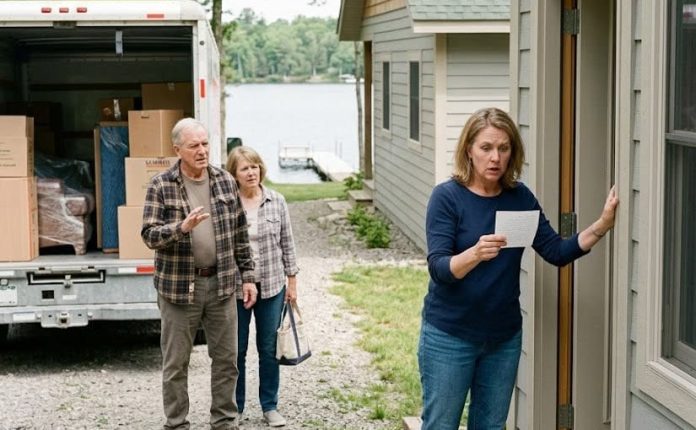
I photographed the page through the glass before my father could pull it away.
He noticed the phone in my hand.
“Don’t send that around.”
“Put it down where I can read it.”
“We can read it at the kitchen table.”
“You’re not coming inside.”
His face darkened.
For a moment, I thought he would press the paper harder against the window.
Instead, he lowered it.
“It’s an informal document.”
“Then why is my signature on it?”
“You’re focusing on the wrong thing.”
“My signature is the thing.”
My mother walked toward the porch.
“Give her a copy,” she said.
My father turned so quickly that she stopped.
“Stay out of this.”
“No.”
The word was quiet.
It was also the first clear refusal I had heard from her since they arrived.
He stared at her.
She held out her hand.
“Give me the folder.”
He kept it against his chest.
They stood there in the gray morning, two people who had shared a home for decades and no longer seemed able to agree about a piece of paper.
I wanted to open the door for her.
I wanted to ask why she had let this happen.
I wanted my father to say there had been a mistake.
Not a misunderstanding.
An actual mistake he could name and correct.
He said nothing.
Finally, my mother reached into her handbag.
She took out several folded pages.
My father looked at them.
The change in his expression was immediate.
“You had no right to take those.”
“I had every right to know what you were doing.”
She walked past him.
At the porch, she bent and placed the pages beside the door.
Then she stepped back.
“Read them,” she told me.
My father moved toward the paper.
“If you take it,” I said through the door, “the camera will record that too.”
He stopped.
My mother walked back down the steps.
I waited until both of them were several feet away before opening the door.
I picked up the papers.
Then I closed and locked it again.
There were four pages.
Two were copies of the agreement.
One was an email printed from my father’s account.
The last was a handwritten list of figures.
I carried them to the kitchen table.
The agreement stated that my parents had advanced me $280,000 toward the purchase and improvement of my lake house.
In return, they were entitled to occupy the property.
The supposed loan could be called due on written notice.
There was language about repayment through refinancing or sale.
There were blank spaces for additional details.
And at the bottom was my name, copied into a signature that was close enough to make me feel ill.
The date was two years earlier.
At that time, I had been living in my house for more than a year.
I remembered the month on the document because the furnace had failed that winter.
I had paid for the replacement in installments.
My parents had not helped.
My father had suggested I should have bought a smaller house.
Now, according to the paper, they had already given me more than a quarter of a million dollars.
I looked at the printed email.
My father had written to someone about arranging a refinance.
He referred to an existing family loan.
He said the original paperwork needed to be updated.
He said the borrowers would be occupying the property and that he expected my cooperation once they arrived.
The response was less encouraging.
The writer needed the owner’s participation.
There had to be proper documentation of any debt.
My father could not arrange a loan against property he did not own.
I read that response twice.
It was not a successful scheme.
Not yet.
It was an attempt stalled at the point where my actual consent was required.
Then I looked at the figures.
$180,000.
$42,000.
$58,000.
The total was $280,000.
Beside the first amount was a short reference to Brianna’s house.
Beside the second was the vehicle.
Beside the third were old balances.
At the bottom, in my father’s handwriting, was a calculation for replacing the full amount.
Replacing it.
Not accounting for it.
Not dividing what remained.
Replacing money that had already gone somewhere else.
I sent photographs of all four pages to Ruth.
Then I called.
Her receptionist put me through.
“Do not contact anyone listed in those documents yet,” Ruth said after I explained. “Let me read them first.”
“Can he use that paper?”
“He can make claims. That doesn’t make those claims true.”
I closed my eyes.
“Is there a loan on my house?”
“We’ll check the actual records. A printed agreement in his folder does not establish that.”
“I need to know.”
“I understand.”
She told me to bring the originals to her office.
She also told me something I needed to hear.
“Don’t sign a correction, replacement, acknowledgment, or anything else he puts in front of you. If you didn’t make the agreement, there is nothing for you to clean up.”
Nothing to clean up.
My father had spent the morning trying to make it sound as though I was obstructing a routine administrative task.
A cleaner signature.
A fresh copy.
A family arrangement.
Those phrases had nearly hidden what he was actually asking.
He wanted me to turn a lie into an obligation.
When I hung up, my mother called.
This time, I answered immediately.
“Was it you?”
She did not ask what I meant.
“Yes.”
I looked at the warning on the table.
“You left the note.”
“Yes.”
“Why didn’t you tell me at the door?”
“I thought I could stop him before he brought it out.”
“You arrived with a moving truck.”
Her breathing changed.
“I know.”
“Did you think I would just let you in?”
“Yes.”
That answer hurt more than an excuse would have.
She had expected me to yield too.
She had counted on the same habit.
“Where are you now?”
“In the car.”
“Is he beside you?”
“No. He went down toward the gate.”
I looked outside.
My father stood near the road with his phone against his ear.
“Tell me what happened.”
My mother was quiet long enough that I thought she might refuse again.
Then she began.
Brianna had debts.
That much was true.
Some had accumulated over years. Some were connected to purchases she had made while assuring our parents she had everything under control.
My mother did not give me a dramatic explanation.
There were balances.
There were overdue payments.
There were arguments.
There was my father repeatedly saying that one final intervention would solve the problem.
Brianna had also been looking at a house.
“She said renting was throwing money away,” my mother said.
I looked at the picture of the enormous white porch.
“So you sold your home to buy hers.”
“Your father said it would give her stability.”
“What did you say?”
“I said we needed somewhere to live.”
“And?”
“He said we had you.”
I pressed my hand flat against the table.
There was a small dent in the wood from when I had dropped a saucepan years earlier.
I stared at it while my mother continued.
The sale had moved quickly.
A buyer had been ready.
My father had pushed to accept.
After the costs of the sale, they had received $280,000.
He had given Brianna $180,000 toward her house.
Another $42,000 had gone toward the vehicle.
The remaining $58,000 had cleared debts.
“There’s none left?” I asked.
“We have our monthly income. Some other savings. But not enough to replace the house.”
“Did you know about all three amounts?”
“Yes.”
I let that answer settle.
She had not been unaware of the spending.
She had been afraid to oppose it strongly enough to stop it.
That distinction mattered.
It did not absolve her.
It did explain why her warning had arrived after the truck.
“Was Brianna about to lose a house she already owned?”
“No.”
“Was she facing some emergency you couldn’t tell me about?”
“She was frightened about the debt.”
“But the new house and the vehicle were choices.”
“Yes.”
The word barely reached me.
“Why couldn’t you stay with her?”
“The house isn’t set up for us.”
“She has a large house.”
“She said she needed time to settle in.”
I looked toward my staircase.
My three upstairs bedrooms had apparently required no such adjustment.
My home had been considered immediately available.
My sister’s had been allowed to remain hers.
“What was Dad planning with the agreement?”
My mother began crying.
I waited.
This was the point where I usually softened the question.
I did not.
“He said you could refinance,” she told me. “That you had equity. He said we could get the money back and still help Brianna.”
“Get it back from me.”
“Yes.”
“Money I never received.”
“He said families don’t keep separate accounts in their hearts.”
I stared at the papers.
The phrase sounded like something he would say while avoiding an account that did exist.
“He wrote a fake loan.”
“I didn’t know about the signature until yesterday.”
“Before you drove here?”
“Yes.”
“And you came anyway.”
“I thought he would listen to me.”
“Did he?”
“No.”
Her voice broke.
“I was scared we would have nowhere to go.”
For a moment, neither of us spoke.
Outside, my father ended his call.
He turned toward the house.
“When did you make copies?”
“Before we left Indiana. I saw the folder on the counter.”
“Why didn’t you call?”
“He was there. Then we were in the car. Then you didn’t answer.”
“You could have put it in a message.”
“I know.”
That answer came without defense.
It made room for the fact that she had failed me.
“I kept thinking I could persuade him,” she said. “He said if you saw it before we arrived, you’d refuse to hear him out.”
“He was right about that.”
“I know.”
“And you helped him keep it from me.”
“Yes.”
I looked at the note again.
“What made you leave this?”
“I saw him practicing.”
My fingers curled against the table.
“Practicing what?”
“Your signature. In the car. While you were inside.”
I could hear a faint sound on her end, fabric moving.
“He had a pad on his knee. He kept looking at the bottom of the page.”
I stood up.
The chair moved behind me.
My mother continued speaking.
“He said the first version wasn’t convincing enough. Then he said it didn’t matter because you would sign the proper one once you understood.”
I went to the sink.
I needed somewhere to stand that did not have the papers on it.
“Was he going to forge the new one too?”
“I don’t know.”
“Did you ask?”
“He said I was making trouble.”
I watched a drop of water slide from the faucet.
It fell into the basin and made a small, clear sound.
My father had not lost money in some hidden catastrophe.
He had given it away.
Then he had written a history in which I owed it to him.
He had driven to my house intending to make that history official.
The truck was not only transportation.
It was pressure.
The wet clothes.
The furniture.
My mother’s exhaustion.
The relatives who would accuse me of cruelty.
All of it made refusing harder.
My mother said my name.
“I’m sorry.”
I believed she meant it.
I also understood that meaning it did not undo the night.
“Tell Diane everything,” I said.
She hesitated.
“Your father will be furious.”
“He’s already furious.”
“He’ll say I’m turning people against him.”
“He turned people against me.”
She was quiet.
Then she said, “You’re right.”
I did not tell her everything would be fine.
I told her I would call after seeing Ruth.
Before leaving, I walked out onto the porch with my phone in my pocket.
My father approached immediately.
“Now that you’ve had time to think—”
“I’m going to have the documents reviewed.”
His eyes narrowed.
“By whom?”
“An attorney.”
He laughed once.
“You’re bringing a lawyer into this.”
“You brought a forged signature into this.”
My mother got out of the car.
My father pointed at her.
“What did you tell her?”
“The truth,” she said.
He looked between us.
“You both have no idea what you’re doing.”
I held his gaze.
“You wrote that you gave me $280,000.”
“It was a family plan.”
“You gave it to Brianna.”
“She needed it.”
“Then say that. Don’t put my name on a loan.”
He lowered his voice.
“You can afford to help.”
“I can afford to decide.”
He stepped closer.
My mother moved between us before I needed to step back.
It was an awkward movement.
She almost caught her handbag on his arm.
But she stayed there.
“Let her leave,” she said.
My father looked at her as though she had become somebody unfamiliar.
I walked to my car.
He did not touch me.
He did not stop me.
As I backed down the driveway, I could see him standing beside the truck.
My mother remained on the porch.
At Ruth’s office, the air smelled faintly of coffee and printer toner.
I had signed the purchase documents for my house in that same conference room.
I remembered being nervous then too.
But that nervousness had been the kind that accompanies getting something you have worked toward.
This was different.
Ruth spread the papers across the table.
She asked about the date.
I explained that I already owned the house then.
She asked about any money my parents had given me.
There had been birthday gifts.
Occasional meals.
Nothing connected to the purchase or mortgage.
She asked whether I had sent them a copy of my signature for another reason.
I could not say for certain.
My father had seen my signature on cards, forms, and checks over the years.
Ruth nodded.
“We don’t need to solve how he copied it today. We need to establish that you did not sign this and did not receive the money it describes.”
I opened my banking records.
I had kept the statements connected to the house purchase, along with the closing paperwork.
Ruth looked through them.
The money came from my savings.
The mortgage was in my name.
My parents were not part of the transaction.
Her office checked the property records.
There was no new recorded claim or mortgage corresponding to my father’s paper.
My own mortgage remained what it had been.
I felt the first real breath I had taken all morning.
“Could he still try?”
“Yes,” Ruth said. “And that’s why we’re documenting this properly.”
She did not promise that a person making a false claim could never cause inconvenience.
She did not turn my father’s behavior into a harmless misunderstanding.
She explained what could be shown.
There was a document purporting to create a debt.
I denied signing it.
My financial records contradicted its account of the money.
My mother had provided information about its creation.
My father had requested a new signature after presenting the supposed old one.
The camera had captured that request.
“It’s good you didn’t let the discussion move inside,” Ruth said.
“Would that have changed everything?”
“Not by itself. But it would have made the practical situation harder. Right now, they have not moved in, and you have made no agreement to let them.”
She prepared a written notice.
It stated that I had not signed the agreement.
I had not received $280,000.
I did not acknowledge a debt.
My parents did not have permission to occupy my property.
Any future discussion about the document would go through her office.
When she handed me the draft, I read it slowly.
There was nothing insulting in it.
No attempt to punish.
It said what was true.
That almost made it more painful.
The truth had become formal because my father had tried to make a lie look formal first.
Ruth also advised me to make a report about the disputed signature.
I did.
I brought the copies, the photographs, and the relevant recording.
The officer who took the information did not announce that my father would be arrested by sunset.
There was no dramatic call.
No immediate verdict.
He asked questions.
He wrote down answers.
He gave me a reference number.
The plainness of it steadied me.
I was reporting what had happened.
I was not deciding every consequence in advance.
When I returned to my car, I sat for several minutes before starting the engine.
Brianna called.
I answered.
“What did you tell everyone?” she demanded.
“I haven’t told everyone anything.”
“Dad says you’re accusing him of fraud.”
“He put my signature on a loan I never took.”
She was silent.
Then she said, “He said it was just paperwork.”
“Paperwork saying I owe $280,000.”
“He was trying to work out how to get them settled.”
“In my house. At my expense.”
“You have room.”
I closed my eyes.
The same argument.
The same measurement.
Rooms instead of consent.
Equity instead of ownership.
My ability to survive an expense treated as permission to impose it.
“Brianna, did you know where the money for your house came from?”
“Yes.”
“Did you know they were selling their home to provide it?”
“Yes.”
“Did you know they planned to live with me?”
“Dad said you were fine with it.”
“Did you ask me?”
“No.”
There was traffic beyond the parking lot.
A delivery truck stopped at a red light.
I watched the driver adjust something on his dashboard.
“Why aren’t they staying with you?”
Brianna exhaled.
“I’ve barely moved in.”
“So had they.”
“You don’t understand the situation.”
“I understand three amounts. One hundred and eighty thousand for the house. Forty-two thousand for the vehicle. Fifty-eight thousand for debt.”
She did not speak.
“That was all their house money.”
“They wanted to help.”
“Yes. And now they need somewhere to live.”
“I can’t take responsibility for everything.”
I looked at my reflection in the rearview mirror.
I appeared older than I had yesterday.
Or just more tired.
“Nobody is asking you to take responsibility for everything,” I said. “I’m asking why responsibility for their choices belongs to me.”
She began to answer.
I stopped her.
“I’m going home. Call Mom.”
Then I ended the conversation.
At the lake house, the truck was still there.
My mother sat on the porch steps.
My father stood when I parked.
He started toward me.
I held up a hand.
“Ruth has sent you a notice. Read it.”
“You’re going to hide behind a lawyer?”
“No. I’m making sure you can’t tell me the paper means something different tomorrow.”
He glanced toward my mother.
She did not look away.
“You’ve embarrassed this family,” he said.
I was tired enough that the accusation nearly made me laugh.
Instead, I asked him a question.
“What did you expect me to do when I saw my signature?”
He shifted his weight.
“You were supposed to understand the intention.”
“The intention was to make me owe money you gave Brianna.”
“The intention was to look after your mother.”
My mother stood.
“Don’t use me for that.”
He stared at her.
She gripped the porch railing.
“You sold our house. We agreed to help Brianna. We did not agree to invent a loan.”
“You knew we needed a way forward.”
“I didn’t know you were going to write our other child into debt.”
He looked toward the road.
For the first time, he seemed conscious that his voice carried.
I unlocked my front door.
My mother took a step toward me.
I stopped and turned.
“You can come in to use the bathroom,” I said. “That is not permission to move in.”
She nodded.
“I understand.”
I did not invite my father.
My mother washed her hands afterward and stood in the kitchen looking at the note.
She touched its corner.
“I wrote it in the car,” she said.
“Why not sign your name?”
“Because I thought if he found it before you did, he wouldn’t know for certain.”
“He would have known your handwriting.”
“I wasn’t thinking clearly.”
I looked at her.
She was exhausted.
Her hair had flattened beneath the rain, and there was a faint red mark where her glasses rested.
For most of my life, seeing her upset had been enough to end my resistance.
Now I could feel compassion without mistaking it for agreement.
“Did you believe I owed you a home?” I asked.
She took a long breath.
“I believed you would make room.”
“That’s not what I asked.”
“No,” she said finally. “You didn’t owe us.”
“Then why did you let him say I did?”
She looked at the floor.
“Because it was easier than facing what we had done.”
That answer did not repair everything.
It gave us somewhere real to begin.
Before she went outside, I handed her the hotel information again.
“I’ll pay for one night. After that, you need a plan that doesn’t depend on me surrendering my house.”
She accepted the paper.
“Thank you.”
It was the first time she had said those words about the hotel.
That afternoon, Diane started a family call.
She asked my parents to join.
She asked me.
She asked Brianna.
She included the relatives who had contacted me overnight.
I agreed because the false account had already spread.
I would not leave it unchallenged while defending myself privately to each person.
My father joined late.
He immediately asked why everybody was making an ordinary family matter so difficult.
Diane did not let him finish.
“You told us you invested in the lake house,” she said. “Did you?”
“We helped our children in many ways.”
“That is not the question.”
He said my name.
I answered.
“You gave me no money toward the purchase. You gave me no money toward the mortgage. I did not sign your agreement.”
A cousin interrupted.
“Why would he have a signed paper, then?”
“Because the signature was copied.”
The call became very quiet.
My father spoke sharply.
“You have no proof of that.”
My mother answered before I could.
“I saw you practicing it.”
Nobody moved for a moment.
On my screen, Brianna looked down.
Diane asked my mother to explain.
She did.
Not every argument.
Not every detail of their marriage.
She explained the sale.
The proceeds.
The three payments.
The document she found.
The warning she left.
My father kept interrupting.
Each time, Diane told him to let her finish.
When my mother reached the end, he said, “I was trying to recover money for our retirement.”
I felt something inside me go still.
There it was.
No family plan.
No forgotten contribution.
No confusion about dates.
He wanted the money back.
And instead of asking the person who had received it, he had tried to collect it from me.
“Then ask Brianna,” Diane said.
Brianna looked up.
“I don’t have that kind of cash.”
“You had it recently,” Diane replied.
“It went into the house.”
“And the vehicle,” my mother said.
Brianna’s face flushed.
For once, no one rushed to protect her from the obvious connection.
She had received the money.
My parents had lost their home.
I had received nothing.
Yet I was the person they had accused of abandoning the family.
A cousin asked whether my father truly expected me to refinance.
“Yes,” I said. “That is in his email.”
My father leaned closer to his camera.
“You could have done it without ruining your life.”
I looked directly at the screen.
“You don’t get to decide how much debt would ruin my life.”
He opened his mouth.
I continued.
“You also don’t get to write my consent for me.”
After that, the call changed.
The relatives no longer asked why I had refused to open the door.
They asked what my parents planned to do.
One offered information about short-term rentals.
Another asked whether Brianna’s spare room was available.
The suggestions were practical.
None required my signature.
My father left the call.
Brianna stayed.
For several minutes, she said little.
Then she told my mother they could come to her house temporarily.
Her tone was stiff.
There were qualifications.
They would have to arrange storage.
She did not want all the furniture inside.
She needed to discuss how long they would stay.
I almost pointed out that she was being allowed every boundary I had been condemned for setting.
I did not need to.
Diane said it for me.
“That’s a conversation you should have had before accepting their house money.”
Brianna swallowed.
Then she nodded.
The call ended without a family embrace.
Nobody announced that we had learned an important lesson.
Diane called me afterward.
“I’m sorry I believed the first version,” she said.
“Thank you for asking about the second.”
“I should have asked sooner.”
“Yes.”
She accepted that.
I was grateful she did not require me to make her feel better about it.
That evening, my parents finally left my driveway.
My mother came to the door before getting into the sedan.
She had accepted the hotel room.
They would drive to Brianna’s the next morning.
“My things are still in the truck,” she said.
“I know.”
“We’ll arrange storage.”
“Okay.”
She looked over her shoulder.
My father sat behind the wheel.
He did not look toward us.
“I’m going to give a statement about what I saw,” she told me.
“Is that what you want?”
“Yes.”
I waited.
She understood what I was asking.
Not what my father wanted.
Not what Diane advised.
What she intended to choose.
“I can’t leave you alone with this,” she said.
“You already did for a while.”
Her eyes filled.
“I know.”
I did not hug her immediately.
Then I did.
Briefly.
Her coat was dry now.
She smelled like the hand soap from my bathroom.
I loved her.
I was angry with her.
Both things were still true when she walked away.
My father left without speaking to me.
The truck moved slowly down the driveway.
Its tires left deep tracks in the gravel.
After they reached the road, I shut the gate.
Then I stood there listening.
No idling engine.
No phone ringing.
Only the lake moving beyond the trees.
The days afterward were not clean or easy.
My father sent messages.
Some were angry.
Some tried to sound practical.
He said I had misunderstood the document.
He said no one had actually lost money because of it.
He said involving outsiders had made everything worse.
I forwarded the messages to Ruth.
I did not argue.
My mother gave her account of the signature and the folder.
I preserved the recordings and the banking records.
The matter did not disappear merely because my parents had moved the truck.
Neither did it turn into the dramatic punishment some relatives seemed to expect.
It became a process.
Statements.
Copies.
Questions.
A file that did not need to be settled at my kitchen table.
Ruth obtained written confirmation that my father was withdrawing any claim based on the purported agreement.
That did not erase what he had done.
It did remove his excuse for treating the paper as a family obligation.
I kept the records anyway.
Trust had once persuaded me to overlook things.
Now keeping evidence felt reasonable.
Brianna sold the vehicle several weeks later.
She did not recover everything that had been spent on it.
What she recovered helped my parents secure a modest rental after their temporary stay with her.
My parents used their regular income to plan around a home they could actually afford.
The white house remained Brianna’s.
The debt she had cleared stayed cleared.
There was no tidy reversal in which every dollar returned and my parents moved back into the home they had sold.
That loss was real.
My mother grieved it.
She missed her garden.
She missed the kitchen window.
She missed knowing which floorboard creaked outside their bedroom.
I listened when she told me.
I did not offer my house as compensation.
Eventually, she began to understand the difference.
Brianna called once to apologize.
At first, she said she was sorry things had become so ugly.
I told her that was not the part I needed her to name.
She was quiet.
Then she tried again.
“I let them give me more than they could afford.”
“Yes.”
“And I assumed you would take care of them afterward.”
“Yes.”
“I shouldn’t have.”
“No.”
We did not become close in that conversation.
We did stop pretending the arrangement had been fair.
My father took longer.
For months, most of what I heard came through other people.
He believed I had overreacted.
He believed my mother had betrayed him.
He believed the family should have handled everything privately.
When he finally wrote directly, the message was short.
He acknowledged that he had written the agreement and signed my name.
He said he had panicked after realizing how little remained.
He said he had expected me to agree.
There was an apology.
There was also an explanation.
I read it without treating one as a substitute for the other.
I answered that I would consider contact when he could accept my boundaries without turning them into an argument.
I did not give him a date.
For a long time, I had measured family loyalty by how quickly I could remove another person’s discomfort.
I paid.
I rearranged.
I opened doors.
Then I resented them in private and called that resentment selfish.
The night of the truck changed that habit because the cost was finally impossible to disguise.
My father had wanted my house to solve a decision he had made for Brianna.
When I refused, he had wanted my signature to solve it instead.
The note had not created the problem.
It had made the problem visible.
I kept it in the drawer beside my purchase documents.
Not displayed.
Not framed.
Just kept.
Sometimes, when I opened that drawer for an insurance paper or a tax form, I saw the folded corner and remembered the gray light on the porch.
I remembered my father looking at the page in my hand.
I remembered that his fear had arrived before his explanation.
Six months later, my mother visited.
She called first.
She asked whether Saturday would be convenient.
She said she would stay for lunch and leave before dinner.
Such ordinary questions.
I had never realized how much peace they could contain.
She brought a small plant from a cutting she had taken before leaving Indiana.
We put it in a pot together.
Then we ate at the kitchen table.
She asked whether I wanted to talk about my father.
I said not that day.
She nodded.
And we spoke about something else.
After she left, I carried my coffee onto the porch.
The lake was clear.
Sunlight moved across the water, breaking into bright pieces where the wind touched it.
Upstairs, three bedrooms remained mine to use.
One held my work.
One held a neatly made guest bed.
The third was still mostly empty.
I no longer looked at that empty room and heard an accusation.
I looked at it and saw a choice I was allowed to make later.
The house had not become safe because every person in my family changed.
It became safe because I stopped leaving its safety to their approval.
That evening, I checked the gate, turned off the porch light, and went inside.
Nobody needed to agree with me before I locked my own door.
END PART 2