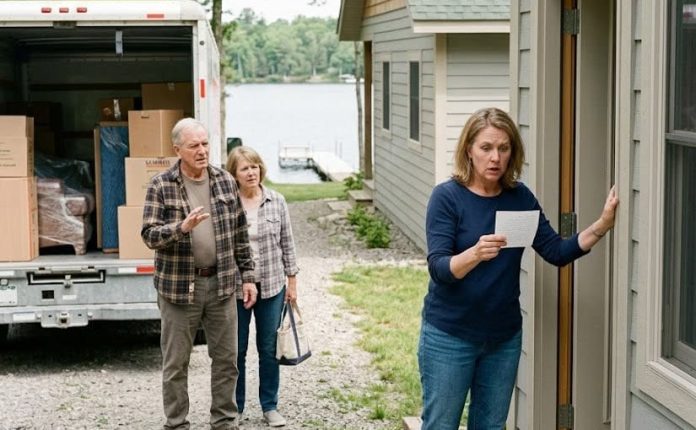
My father reached for the door before I finished telling him he could not move into my house. Behind him, a rental truck sat across my driveway, its rear wheels sinking into the wet gravel.
“Move aside,” he said. “Your mother’s getting soaked.”
I kept one hand on the door.
Rain blew beneath the porch roof and spotted his glasses. Beyond his shoulder, my mother stood beside three plastic storage bins, holding her handbag under her coat.
I had not invited them.
I had not agreed to a visit.
Until five minutes earlier, I had not even known they were coming.
Their headlights had swept across my living room while I was rinsing a dinner plate. I had looked up, expecting someone who had missed the turn farther down the road.
Then I recognized my father’s sedan.
My phone lay on the counter beside the sink. Seventeen missed calls from my mother filled the screen.
Below them were messages I had not seen.
They were close.
They wanted to know whether the driveway could accommodate a truck.
My mother had asked me to leave the porch light on.
Reading those messages afterward, I noticed what none of them contained.
A question about whether they could stay.
“What’s going on?” I asked.
My father glanced past me toward the staircase.
“We’re living here now.”
He spoke with the same certainty he used when announcing that dinner would be at six or that someone had parked in his usual spot.
For a moment, I honestly thought I had misunderstood him.
“Living here?”
“We sold the house.”
My mother stepped beneath the porch roof. Water dripped from the bottom of her coat onto the boards.
“It happened quickly,” she said.
Their house was in Indiana. They had lived there for more than thirty years, and the mortgage had been paid off long ago.
My mother still sent photographs whenever her roses bloomed.
Two weeks earlier, she had complained about a branch hanging over their garage.
Nothing in that conversation had suggested she would soon have neither roses nor a garage.
“You sold it without telling me?”
My father took his glasses off and wiped them with the edge of his shirt.
“Brianna needed help.”
There it was.
My younger sister’s name, placed between us like an explanation that should settle every other question.
“What kind of help?”
My mother looked at my father.
“She was in a difficult situation.”
“That doesn’t tell me anything.”
“Financial,” my father said impatiently. “Obviously.”
The truck’s engine idled behind him. Its low vibration carried through the porch beneath my bare feet.
I looked at the bins.
One held kitchen utensils. Another contained folded towels. Through the translucent side of the third, I could see the blue ceramic bowl my mother kept on her hallway table.
They had packed a life.
They had brought it to my door.
And somehow, in their minds, the conversation about where that life would go had already happened.
“How long were you expecting to stay?”
My father put his glasses back on.
“We’ll discuss that once we’re settled.”
“No. We need to discuss it before anything comes inside.”
His mouth tightened.
“You have three bedrooms upstairs.”
“Yes.”
“Empty bedrooms.”
“They’re part of my house.”
“And we’re your parents.”
My mother rubbed her fingers together. Her wedding ring turned loosely around one knuckle.
I knew that movement. She did it when a restaurant bill was wrong, when a family argument began, when she wanted somebody else to speak first.
I wished she would speak now.
Instead, my father pointed toward the doorway.
“You can make room.”
I bought my lake house after years of saving.
It was not enormous. The bedrooms upstairs were small, with sloping ceilings and windows that rattled in strong wind. One held a desk and boxes of work files. Another was where friends slept when they visited.
The third was simply a bedroom I did not have to justify to anyone.
When I first bought the place, my father walked through it and asked whether I had considered how expensive the roof would be to replace.
My mother said the kitchen needed updating.
Brianna asked whether she could borrow it for a weekend.
None of them asked what it had taken to afford it.
I had not expected a ceremony. I would have settled for a little pleasure on my behalf.
Instead, the house had quickly become another family resource.
A place that could be lent.
A place that could host.
A place whose rooms were apparently available for allocation by people who did not own them.
“I’m not agreeing to this,” I said.
My father stared at me.
“Your sister was in trouble. We did what parents are supposed to do.”
“And then you came here expecting me to solve the consequences.”
“We came to our child.”
“You came without asking.”
My mother made a small sound.
“Can we please get out of this weather?”
I looked at her wet sleeves.
That was the moment when I nearly stepped back.
She had driven hours. She looked exhausted. Whatever my father had decided, she was standing outside with nowhere obvious to go.
I could hear the answer I had always given forming in my throat.
Of course.
Come in.
We’ll figure it out.
But I also knew what would happen after that answer.
The bins would enter first. Then suitcases. Then my father’s chair, because he could not sleep comfortably without it. My mother would unpack her dishes because leaving them boxed would feel wasteful.
A week later, asking about a departure date would become an accusation.
A month later, I would be told this was their home too.
“I can help you find a hotel,” I said. “You can leave the truck here while you arrange somewhere to put your things.”
My father gave a short, disbelieving laugh.
“A hotel.”
“For tonight.”
“You’re putting your mother in a hotel.”
“I’m offering somewhere dry while we talk tomorrow.”
He leaned closer.
“You’re being selfish.”
My mother lowered her eyes.
I had heard that word so often it barely sounded like language anymore.
When Brianna needed money and I asked what it was for, I was selfish.
When I could not leave work to help her move, I was selfish.
When I declined to cover a bill she had forgotten, I was selfish.
Nobody used the word when I paid.
Nobody seemed concerned about my character when I made myself useful.
“I’m allowed to decide who lives here.”
My father’s voice dropped.
“We raised you. We don’t need your permission.”
The rain continued hitting the porch.
Somewhere behind him, water ran steadily from the truck’s roof onto the gravel.
I watched my mother’s hand stop moving around her ring.
That sentence had reached her too.
For once, she could not pretend this was merely a request made badly.
“You do,” I said.
My father’s face changed.
Not dramatically. His jaw shifted, and the muscles beside his nose tightened.
“Say that again.”
“You need my permission to move into my home.”
He stepped forward.
I did not retreat.
He stopped close enough that I could smell rainwater in his coat and the coffee he must have drunk during the drive.
“You’re going to regret treating us this way.”
“Then we can discuss that tomorrow too.”
I closed the door before either of us said something worse.
For several seconds, I stood with my palm against the wood.
My pulse thudded in my wrist.
Outside, my father said my name once, sharply.
My mother said his.
I waited until their voices moved farther away before I locked the door.
Then I called the nearest hotel.
There were rooms available. I wrote down the address and sent it to my mother, along with the number for the front desk.
I told her I would pay for that night.
Her response came almost immediately.
We shouldn’t have to do this.
I looked at the message until the screen dimmed.
Then I put the phone down.
Through the front window, I could see my father opening the truck’s rear door.
He stood beneath it, looking at the furniture packed inside.
My mother remained beside the sedan.
Neither of them left.
I made tea because I needed something ordinary to do with my hands.
The kettle clicked off. I poured water over a bag and watched the dark color spread.
I did not drink it.
Within an hour, the first message from a relative arrived.
My aunt Diane wanted to know why I had turned my parents away during an emergency.
A cousin asked whether I understood how much they had sacrificed for me.
Another relative sent only a sentence about remembering who had fed me as a child.
I read each message once.
Then I set the phone facedown.
My parents had found time to tell people I had refused them.
They had not found time to tell me they were selling their house.
That difference bothered me more than the insults.
I went back to the window.
My mother was now sitting in the sedan. My father stood under the truck’s open door, speaking into his phone.
He looked toward the house between sentences.
I stepped out of sight.
For years, family arguments had followed a familiar route.
Brianna needed something.
My parents made a decision.
I was informed that helping was the decent thing to do.
If I questioned the arrangement, the discussion shifted from money or time to my failings as a daughter.
The original problem disappeared beneath the noise.
I had learned to end those arguments by agreeing.
Sometimes I agreed because I loved them.
Sometimes because I was tired.
Sometimes because paying a smaller bill seemed easier than enduring a larger fight.
Those reasons had become difficult to separate.
At ten that night, my mother called.
I answered.
“Your father is very upset.”
“I know.”
“He thought you’d understand.”
“What exactly was I supposed to understand?”
“That we needed somewhere to go.”
“Why didn’t you tell me before selling?”
Silence.
I could hear the sedan’s ventilation fan.
“Mom?”
“It was complicated.”
“Did you think I would say no?”
Another pause.
“We thought you’d help.”
“That isn’t the same as asking.”
She exhaled.
“Your sister could have lost everything.”
“What does that mean?”
“I can’t explain all of it tonight.”
“Then don’t expect me to agree to something I don’t understand.”
Her voice became softer.
“We’re not strangers.”
“I know who you are. That’s why this hurts.”
She did not answer.
I told her again about the hotel.
She said my father would not go.
After we hung up, I sat at the kitchen table and opened the family messages.
I wrote one response and sent it to everyone who had contacted me.
My parents had arrived without an invitation.
I had offered to pay for a hotel.
I had not been told about the sale of their house before they appeared.
Anyone who wanted more information could ask them why.
Diane called instead of texting back.
“What happened?” she asked.
I told her.
This time, she listened without interrupting.
When I finished, she said, “Your mother made it sound as though you’d changed your mind.”
“I never agreed.”
“She said arrangements fell through.”
“I was apparently the arrangement.”
Diane was quiet.
I could picture her sitting at her dining table, one elbow beside the bowl where she kept her reading glasses.
“Have they told you what Brianna needed?”
“Only that she was in trouble.”
“That girl is always in trouble.”
There was no satisfaction in her voice.
Just fatigue.
Diane loved my sister. She had also watched the same pattern for years.
She told me to keep the doors locked and call if I needed her.
Afterward, I noticed that my shoulders had dropped.
One person believing me had made a physical difference.
I hated that it had taken so little.
Around midnight, I opened the security-camera app.
I had installed the cameras after a fallen branch damaged the gate. Most of the recordings were deer, delivery vans, and my own awkward attempts to carry groceries and unlock the door simultaneously.
Tonight, the driveway camera showed my parents’ arrival.
I watched my father park.
He got out of the sedan, looked toward the house, and stood motionless for a few seconds.
Then he opened the truck.
Before touching a single box, he looked toward the house again.
I rewound.
There was nothing remarkable about checking whether someone was coming outside.
But the way he did it bothered me.
His head moved sharply toward the upstairs windows.
Then toward the porch camera.
Then toward the sedan, where my mother was still sitting.
He said something to her.
The microphone did not catch it.
She shook her head.
He leaned into the car and spoke again.
This time, she looked away.
I watched the exchange three times.
It did not tell me what they were hiding.
It did tell me they had argued before I opened the door.
The footage showed him taking a thin black folder from the sedan and tucking it beneath his coat.
He carried it onto the porch.
I had not noticed it during our conversation.
My attention had been on the truck, my mother, the rain.
Now I could see one corner of it under his arm while he pointed toward my staircase.
After I closed the door, he walked back to the sedan with it.
Later, he opened the folder under the truck’s roof and looked at something inside.
Then he checked the house again.
I stopped the recording.
The black folder could have held anything.
Closing documents.
Insurance papers.
A hotel reservation he had refused to use.
I did not want to turn every movement into evidence simply because I was angry.
Still, I could not get his face out of my mind.
My father had been furious at the door.
On the recording, before he reached it, he looked worried.
I checked the time.
It was nearly one.
I tried Brianna.
The call went to voicemail.
I sent a message asking what had happened and why our parents were in my driveway.
It remained unread.
Outside, the rain weakened to a thin, steady hiss.
My father returned to the sedan.
For a while, I could see both their silhouettes through the windshield.
Then the interior light went out.
I considered going outside.
I could offer my mother dry clothes.
I could make another attempt to persuade them to use the hotel.
I could ask my father to explain the sale properly.
But every option required reopening a conversation he had already turned into an order.
I stayed inside.
At two, I carried my untouched tea to the sink.
At three, I sat on the sofa under a blanket and watched the driveway through the gap beside the curtain.
I must have slept.
The sound that woke me was small.
A scrape near the bottom of the front door.
At first, I thought a branch had blown onto the porch.
Then came a soft tap.
I sat up.
The room was gray with the first light of morning.
My phone said 5:42.
I went to the door without switching on a lamp.
Through the narrow window beside it, I saw an empty porch.
I waited.
Nothing moved.
When I opened the door, a folded piece of paper lay against the threshold.
One edge was damp.
The rest had been protected by the overhang.
There was no envelope.
No name.
I picked it up.
The paper had been folded twice, carefully, into a rectangle small enough to fit inside a coat pocket.
Inside was a single handwritten warning.
I was not to let them enter.
I needed to ask my father what had happened to $280,000.
I read it again.
The number stayed clear while the rest of the sentence seemed to blur.
Two hundred and eighty thousand dollars.
Not an overdue electricity bill.
Not money for an emergency repair.
An amount large enough to explain selling a house.
An amount my parents had somehow omitted from everything they had said.
I closed the door.
My fingers had gone cold.
I laid the note on the kitchen table and flattened its damp corner with the bottom of a clean glass.
Then I opened Brianna’s social-media profile.
I had stopped looking at it regularly.
For a while, every photograph had seemed to come with a separate request for help afterward.
A dinner she could afford to photograph but apparently not afford to pay for.
A trip followed by a problem with rent.
A purchase followed by a demand that nobody judge her.
I had found it easier to keep some distance.
That morning, the photographs were there.
Restaurant tables set with heavy white cloths.
A cocktail beside a plate arranged more carefully than anything I cooked.
A new vehicle with a ribbon tied around the side mirror.
Brianna leaning against its door, smiling.
I checked the date.
The photograph was recent.
So were the comments congratulating her.
Below it was another picture.
My sister stood in front of a large white house.
The porch stretched across the front, with dark shutters and two enormous planters beside the door.
She held a set of keys.
The caption referred to a fresh beginning.
I stared at those keys.
They were not the sort a real-estate agent handed someone for a photograph unless there was something to celebrate.
I scrolled backward.
More restaurants.
Shopping bags.
A close-up of a kitchen with a wide island and pale stone counters.
The edge of Brianna’s handbag appeared in the corner of that photograph.
I knew the bag because she had once complained that I did not understand why quality cost money.
Nothing I saw looked like a person trying to keep the lights on.
But photographs could lie.
A vehicle could be borrowed.
A house could belong to a friend.
A smiling face could conceal an emergency.
I knew that.
What I could not explain was why somebody had approached my front door before sunrise to warn me about the money.
I looked toward the window.
My father stood beside the truck.
He was watching the house.
Not the road.
Not the lake.
The house.
I moved closer to the glass.
He saw me.
For one moment, we simply looked at each other.
Then his eyes dropped to the paper in my hand.
His anger vanished.
His mouth opened slightly, and he took one step away from the truck.
I had seen him embarrassed.
I had seen him angry.
I had seen him trying to pretend he understood something he did not.
I had never seen that expression.
He was afraid.
I stepped back.
My phone rang almost immediately.
Dad.
I let it ring.
Then a message arrived.
We need to talk before you get confused.
I read it twice.
He did not ask why I was holding a piece of paper.
He did not ask whether I had slept.
He did not mention my mother.
Before you get confused.
I photographed the note.
Then I photographed it again beside the clock on my stove, with the date displayed on my phone.
I did not know whether either photograph would ever matter.
I wanted a record before the paper disappeared or somebody told me I had misunderstood it.
Next, I saved Brianna’s photographs.
The vehicle.
The house.
The kitchen.
The dates beneath them.
I made a folder on my computer and copied everything there.
Only then did I answer my father.
Tell me where the $280,000 went.
The typing indicator appeared.
Disappeared.
Appeared again.
He called instead.
I answered with the phone on speaker.
“Who have you been talking to?” he asked.
“You can answer my question first.”
“Your mother is exhausted. This isn’t the time.”
“Then you shouldn’t have arrived here with a moving truck.”
He inhaled sharply.
“You’re making something simple into a scandal.”
“What’s simple about selling your house without telling me?”
“We had to help your sister.”
“How much?”
“That’s private.”
“It stopped being private when you demanded to live here.”
He said nothing.
I watched the driveway.
My mother was standing beside the sedan now, holding a paper cup.
My father had turned his back to the house.
“Did you give Brianna the entire amount?”
“She needed financial support.”
“Dad.”
“You don’t know what she’s been through.”
“I’m asking about the money.”
“You’re obsessed with money.”
It was a familiar maneuver.
My question was no longer a question.
It was proof of a flaw.
I took the phone off speaker and held it against my ear.
“I won’t discuss moving in until you tell me the truth.”
“We have paperwork.”
I went still.
“What paperwork?”
“Something that explains the arrangement.”
“What arrangement?”
“The family arrangement.”
I looked at the black folder on the passenger seat of the sedan.
Its edge was visible through the windshield.
“Send it to me.”
“It’s better if we go through it together.”
“Send photographs.”
“No.”
He answered too quickly.
I let the silence remain.
Finally, he said, “You always were difficult about anything that didn’t benefit you.”
I ended the call.
For a moment afterward, I could hear my own breathing louder than the refrigerator.
Then I called Diane.
This time, I told her about the note.
She asked whether I knew who had left it.
“No.”
“Do you recognize the writing?”
“I’m not sure.”
I looked down at the page.
The handwriting was cramped. Most of the letters slanted slightly to the right.
Someone had pressed hard enough to leave grooves.
It felt familiar.
But familiar was not certain.
Diane asked me to send a photograph.
Then she told me she would call my mother.
“Don’t argue with your father alone,” she said.
“I’m not opening the door.”
“Good.”
By seven, the lake had disappeared behind a low bank of mist.
I made coffee.
This time, I drank it.
I watched my parents argue beside the sedan.
My father pointed toward the house.
My mother shook her head.
He opened the passenger door and removed the black folder.
She reached for it.
He moved it away.
The camera recorded everything.
I saved that section too.
Then I called the attorney who had handled the purchase of my house.
Ruth Bennett’s office did not open until nine.
I left a message with my number and explained that a family member had arrived claiming there was paperwork related to my home that I had never seen.
I tried to keep my voice even.
When I finished, I noticed I was gripping the table hard enough to hurt my fingertips.
At eight, my father knocked.
Not the angry pounding I had expected.
Three measured knocks.
The sort someone used when they wanted to seem reasonable.
I went to the door but did not open it.
“What?”
“I have the documents.”
“You can leave copies on the porch.”
“Don’t be ridiculous.”
“Then send them.”
He looked toward the camera.
I could see him through the side window.
His eyes stayed on it a little too long.
“Can you turn that thing off?”
“No.”
“We’re having a private family discussion.”
“Then you shouldn’t be worried about a camera.”
He adjusted the folder beneath his arm.
“I’m trying to make this easier.”
“For whom?”
He did not answer.
Behind him, my mother stood several steps down the path.
Her cup was gone.
She held her handbag with both hands.
“Let me talk to you,” she said.
My father turned.
“We’re talking.”
“I meant by myself.”
Something moved across his face.
A warning.
I recognized it because I had seen it at dinner tables throughout my childhood.
My mother looked down.
I waited.
She did not try again.
My father returned his attention to me.
“You need to sign a clean copy. That’s all.”
The words seemed to stop the morning around them.
“A clean copy of what?”
“The agreement.”
“I haven’t signed any agreement.”
“It reflects what we discussed.”
“We didn’t discuss anything.”
“Not everything has to be formal.”
“Then why do you need my signature?”
He rubbed the bridge of his nose.
“You’re twisting this.”
My mother made a sound behind him.
Not quite a sob.
Not quite a word.
I looked past him.
“Mom, what is in that folder?”
My father moved enough to block my view of her.
“Leave your mother out of it.”
I stepped away from the door.
He knocked again.
I did not return.
At nine fifteen, Ruth called.
I told her the facts as plainly as I could.
My parents had sold their house.
They had arrived without permission.
Someone had left a warning about $280,000.
My father now claimed an agreement existed and wanted me to sign a replacement.
She asked one question first.
“Have you signed anything?”
“No.”
“Then keep it that way until I’ve read whatever he’s referring to.”
I felt a little foolish for needing someone to say it.
But hearing it without blame helped.
She asked me to send the messages and the note.
Then she asked whether my parents were inside the house.
“No.”
“Have they ever lived there?”
“No.”
“Have they contributed money toward buying it or paying its mortgage?”
“No.”
I looked at the kitchen around me.
The cabinets I had repainted.
The light fixture I had installed with a friend.
The floor I had saved to replace one room at a time.
I knew how every major bill had been paid.
None had been paid by my parents.
Ruth told me to preserve everything and avoid making verbal promises.
She would make time to see me that afternoon.
After we hung up, my mother sent a message.
Please don’t sign anything he gives you.
I stared at it.
Then another message appeared.
I should have told you before we came.
I called her.
She did not answer.
Through the window, I saw her looking at her phone while my father spoke beside her.
She slid it into her handbag.
The note lay on the table.
I picked it up and looked again at the handwriting.
Suddenly, I could see my mother’s grocery lists.
The narrow loops.
The way she crossed a lowercase t so close to the next letter that the two seemed joined.
I still did not know.
But I knew enough to feel my stomach tighten.
A few minutes later, Diane called.
“I talked to her,” she said.
“What did she say?”
“She cried.”
“Did she tell you anything?”
“Not while he was beside her.”
Diane paused.
“Your father told me they had invested in your lake house.”
The room seemed to tilt.
“What?”
“He said their savings helped you buy it.”
“They didn’t.”
“I know. You told me when you were saving.”
“He said that to you?”
“He said there was an agreement. That you were refusing to honor it.”
I sat down.
The chair scraped against the floor.
For the first time, the fragments began to fit.
The unannounced arrival.
The confidence about the bedrooms.
The folder.
The insistence on speaking inside.
The request for a clean signature.
They had not merely assumed I would provide shelter.
My father had brought a story about my house that was not true.
And he had already begun telling it to other people.
At ten, Brianna finally answered my message.
Why are you making this so hard for them?
I looked at the photograph of her holding keys.
Then I replied.
Whose white house is in your pictures?
A minute passed.
Mine.
How did you buy it?
Mom and Dad helped.
How much?
That’s between us.
I typed carefully.
They are in my driveway claiming I owe them money related to my house. I need a straight answer.
Her response came faster.
Dad said you knew.
I read those five words until they stopped looking like ordinary words.
Knew what?
She did not answer.
Instead, my father began knocking again.
This time, he sounded angry.
I left the phone on the table and went to the side window.
He held the black folder against his chest.
“We need to finish this,” he said.
“Leave the documents.”
“No.”
“Then there’s nothing to discuss.”
He looked back at my mother.
She stood beside the truck, motionless.
Then he pulled a sheet from the folder and pressed it against the glass.
I could not read most of it.
The print was small, and his hand covered the bottom corner.
But the heading was clear.
Family Loan and Residence Agreement.
Below it, halfway down the page, was the amount.
$280,000.
At the bottom was a signature that looked like mine.
I had never seen that document.
I had never borrowed that money.
And as my father held the page against my window, he said something that finally told me what he expected from me.
“You just have to make the signature match properly this time.”
END PART 1