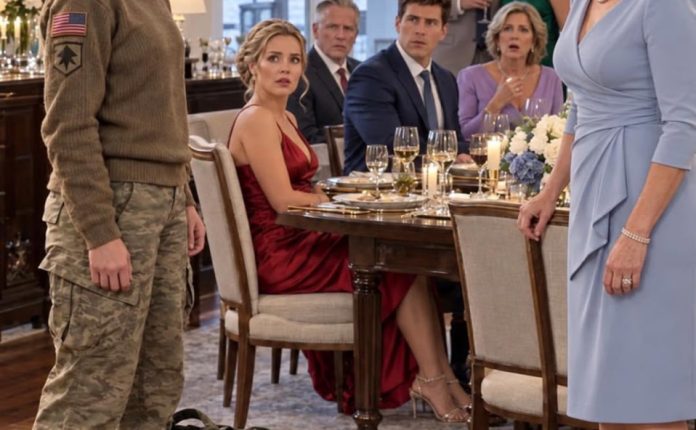
My mother was explaining why I wasn’t really her daughter when I reached the dining room. Before I could step inside, my sister agreed with her.
“Arthur brought Elena into the household,” Diane said. “That doesn’t mean she belongs in every family discussion.”
I stopped with one hand around the strap of my duffel.
Through the doorway, I could see the end of the polished dining table, a silver wine bucket, and Chloe leaning toward our mother to inspect a photograph on her phone.
“Especially financial discussions,” Chloe added. “We handle those ourselves.”
Someone laughed.
I had been awake since the previous morning. My back ached from the flight, and the seams of my boots had rubbed raw places against my heels. For a moment, I concentrated on those small, ordinary discomforts.
They were easier to manage than hearing the word ourselves.
Richard Sterling had asked where I was. I recognized his voice from Chloe’s engagement party two years earlier. He was Marcus’s father, a commercial real estate investor who inspected people as if they were properties with undisclosed defects.
“I thought Arthur had another daughter,” he said.
Diane gave the little laugh she used when correcting someone without appearing unkind.
“Arthur had a generous heart. Elena was rather a personal project of his.”
Marcus smiled into his wine.
“She’s happier around demolition equipment anyway. Asset management might bore her.”
The laughter grew warmer.
Two months before, I had supervised a military infrastructure operation worth $12.8 million. I had accounted for personnel, contractors, equipment, materials, and deadlines in conditions where a careless decision could put someone in a hospital.
Marcus had once overdrawn his business account buying a boat.
I could still remember its name painted across the stern: Financial Freedom.
That memory almost made me smile. Almost.
Diane reached across the table to adjust Chloe’s place setting.
“Move closer to the candles, darling. The photographs will look much better.”
I stood in the hallway long enough to understand that nobody was going to object.
Not my sister. Not her husband. Not his parents.
A server refilled a glass. Someone requested more bread. My absence had become a pleasant subject between courses.
Arthur had adopted me when I was four.
He never introduced me as his adopted daughter. I was his daughter, Elena. If someone pressed for more information, he answered the question and returned to whatever we had been discussing.
Diane treated the distinction as something important that people deserved to know.
At school functions, she would rest a hand on my shoulder and explain how fortunate I had been. At parties, she praised Arthur’s generosity. Whenever I achieved something, she found a way to begin the story with what the family had done for me.
Chloe’s accomplishments belonged to Chloe.
Mine seemed to belong to whoever had provided the roof.
There had been expensive Christmas gifts on one side of the room and practical gifts on the other. Different explanations for mistakes. Different expectations about gratitude.
When Chloe wrecked her BMW at nineteen, Diane said young people needed room to learn.
When I brought home a B-plus in chemistry at sixteen, she suggested that perhaps my ambitions needed adjusting.
Arthur noticed.
Sometimes he would find me afterward in the workshop or down by the dock. He would ask a question about my homework, hand me a tool, or suggest we go fishing before breakfast.
His kindness mattered. It also left the original conversation untouched.
For years, I had been grateful for his comfort and angry that I needed it.
Inside the dining room, Diane was still talking.
“Arthur never learned when to stop helping people.”
I let go of the duffel strap.
Then I walked through the doorway.
Richard saw me first. His fork paused above his plate. Marcus turned, followed his father’s gaze, and lowered his glass.
Chloe’s annoyance arrived before her embarrassment.
Diane stood so quickly that her chair scraped the floor.
“Elena. We thought you were arriving later.”
“I can see that.”
I set my bag beside the wall.
Nobody offered to take it upstairs. Nobody asked how the flight had been.
I looked around the table, acknowledging the guests with a small nod, then pulled out an empty chair near the windows.
From there, I could see the lake.
Arthur used to wake me at five-thirty when we planned to fish. He would knock once, leave the door open, and wait downstairs while I found a sweatshirt.
Diane disliked those mornings. She said the house smelled of bait afterward.
I remembered the damp rope against the dock, Arthur’s thermos balanced between his boots, and the way he let silence last without treating it as a problem.
A server approached my chair.
“May I bring you wine?”
“Coffee, please.”
Marcus glanced at the clock above the doorway.
“With dinner?”
“I’ve been traveling since yesterday morning.”
He spread his hands as though I had misunderstood an innocent question.
“I only meant—”
“I know what you meant.”
The server looked down to hide her expression.
Diane sat again.
“We were discussing arrangements for next week.”
“The gala?”
“Yes. There’s a great deal to organize.”
She spoke carefully now. Each sentence had to step around the fact that I had heard her.
Chloe set her phone facedown.
“You could have called when you reached the airport.”
“I did. You didn’t answer.”
“I was busy.”
Apparently, that settled it.
Dinner resumed in uneven pieces. Richard asked Marcus about a development outside Richmond. Diane praised the floral designer. Chloe complained about an event planner who had suggested fewer candles.
I drank the coffee when it arrived.
It was too hot, and I welcomed having to wait before answering anyone.
Marcus described a promising market correction. Richard asked a short question about financing. Marcus gave a long answer that never quite reached it.
I watched him turn his empty wrist beneath the table.
He used to wear a heavy watch that he made sure people noticed. That evening, the pale band where it had rested was more conspicuous than the watch had ever been.
Outside, the last light settled on the water.
I had imagined coming home would involve sleep, familiar rooms, and perhaps a few difficult conversations about Arthur.
Instead, I was listening to people discuss his legacy in the house he had built while making his daughter feel like an administrative error.
When dinner ended, Diane asked whether I remembered which guest room I usually used.
I told her I did.
Upstairs, I put my duffel on the luggage bench and stood in the middle of the room without turning on the overhead light.
Nothing had changed.
The curtains were still tied back with pale cords. The bed was dressed so precisely that lying on it felt like disturbing a display. A framed landscape hung over a dresser where I had never been encouraged to leave anything.
I took off my boots.
There was a sealed envelope in the side pocket of my bag. I touched it through the canvas, then withdrew my hand.
Arthur had given it to me six days before he died.
I had carried it through deployment.
Until that night, keeping it unopened had allowed me to pretend there was still one conversation with him waiting somewhere in the future.
I slept four hours.
At six-eighteen the next morning, I was barefoot in the kitchen, waiting for a second cup of coffee to finish brewing.
The house was easier to recognize before Diane woke.
There were no voices directing staff, no telephone calls about appearances, no television murmuring from rooms where nobody watched it.
I opened the refrigerator looking for creamer.
Six bottles of champagne occupied the upper shelf. There was imported cheese, a bowl of berries arranged by size, and an almond milk carton that had expired.
I drank the coffee black.
Chloe came in wearing silk pajamas and carrying her phone.
“You’re up.”
“My body hasn’t caught up with the flight.”
She glanced at my mug, then at the windows.
“Did you sleep?”
“A little.”
That was the closest we came to discussing the fourteen months I had spent away.
She sat at the island and began scrolling.
A moment later, Diane appeared in an ivory robe, her hair already smooth and pinned.
“Good. You’re both here.”
Something in her voice made me look at Chloe.
My sister locked her phone immediately.
Diane nodded toward a stool.
“Sit down, Elena. We need to discuss a family opportunity.”
Last night, I had been outside the family.
This morning, there was apparently a vacancy.
I sat.
Chloe slid a folder toward me. It had a dark cover, thick paper, and gold dividers. A pen had been placed neatly across the first page.
I left it there.
“Marcus is expanding the company,” Diane said. “Mixed-use commercial properties. A considerable step forward.”
Chloe leaned on her elbows.
“The lender wants additional collateral. It’s a temporary arrangement.”
“What arrangement?”
“Just read it.”
Marcus entered before I reached the second page.
He was already dressed, though his collar looked as if he had pulled on the shirt without checking a mirror.
His phone vibrated. He glanced at the screen and silenced it.
“Morning, Elena.”
“Morning.”
He sat beside Chloe.
I turned the folder so the kitchen light fell across the print.
Ridgemont Capital Bank.
Commercial loan guarantee.
Four million dollars.
There was a clause concerning my fifteen percent interest in Wright Industrial Holdings, the regional construction business Arthur had left me. Diane had always described that share as a modest provision.
The company’s reported annual revenue was around $2.3 million.
A modest provision was suddenly substantial enough to rescue Marcus.
I read the definitions first.
Then the guarantee.
Then the recovery provisions.
Diane watched my face.
“There are always complicated sections in these things. The attorneys can explain them later.”
“Then they should explain them before I sign.”
“No one is trying to rush you.”
Marcus’s phone vibrated again.
He pushed it farther from his elbow.
On page seventeen, the language changed.
Debt restructuring disclosures. Delinquent obligations. Personal guarantees. Valuation concerns.
I read the page twice, then checked the schedule attached behind it.
Twelve condominium lots outside Richmond. Purchased near the top of the market. Adjustable-rate commercial debt.
The proposed new financing wasn’t supporting expansion.
It was holding off the consequences of the old financing.
“How long have you been behind on interest?”
Marcus rubbed a thumb along the edge of the folder.
“The timing of the market has been difficult.”
“That isn’t a length of time.”
“We’re working through it.”
I pointed to the default warnings.
“These creditors don’t seem to agree.”
Chloe shifted on her stool.
“You don’t understand the whole situation.”
“I’m trying to. That’s why I’m asking.”
Diane placed her hands together.
“Sometimes a family has to help someone through a strategic moment.”
I looked at the four-million-dollar figure again.
“How did you arrive at twelve lots?”
Marcus’s head lifted.
“What?”
“Outside Richmond. The acquisition schedule is here.”
He stared at me as if the folder had betrayed him.
“You know those properties?”
“I know how to read a schedule.”
For a few seconds, nobody spoke.
Then Chloe gave a sharp little sigh.
“This is what you do. You make everyone feel stupid.”
“I haven’t asked anyone to risk four million dollars.”
“You’re making it sound ugly.”
“The guarantee is ugly.”
I turned to the recovery section.
The lender would pursue the pledged interest in Wright Industrial Holdings before certain assets held by Sterling Urban Development.
My property would stand in front of his.
The wording was dry, but the result was plain.
If Marcus failed, I would lose what Arthur had left me while parts of Marcus’s business remained behind the shield they wanted me to provide.
I tapped the paragraph.
“Explain this.”
Marcus leaned forward.
“It’s standard priority language.”
“Priority for whom?”
“The bank needs confidence.”
“And you need distance.”
His mouth tightened.
Diane cut in.
“Your father never wanted you to become suspicious of your own family.”
I looked at her.
She held my gaze for a second, then glanced toward Chloe.
Arthur had spent years listening to Marcus talk about money. I remembered the way he would turn his glass slowly against the table without taking a drink.
He had rarely contradicted him in front of guests.
That didn’t mean he had believed him.
“Arthur isn’t here to tell me what he wanted,” I said. “So I’m going to read what I’m being asked to sign.”
Diane’s voice cooled.
“You should remember everything this family gave you.”
I sat back.
“What does that have to do with this loan?”
“It has to do with loyalty.”
“Then say what you mean.”
She looked offended by the request.
“We took you in, Elena. We gave you a life you would never have had otherwise.”
The room felt suddenly colder.
I could hear the refrigerator motor running behind me.
“Arthur brought me home.”
“We raised you.”
“And now you’re presenting the bill?”
Chloe looked away.
Marcus began to speak, but Diane raised a finger without looking at him.
“You cannot spend your whole life accepting the advantages of this family and refuse to help when you’re finally useful.”
There it was.
Finally useful.
I had spent years becoming dependable enough that nobody needed to worry about me. I had mistaken the absence of worry for trust.
Diane had mistaken it for a resource.
I picked up the pen.
All three of them relaxed.
Marcus let out a breath. Chloe uncrossed her arms. Diane’s expression softened into the pleased patience she used when someone returned to the role she had assigned them.
I turned the pen once between my fingers.
Then I laid it back across the folder.
“I’m not signing.”
Marcus’s hand stopped halfway toward the paper.
“Elena.”
“No.”
“We can change the structure.”
“Then change it without my name.”
Chloe stood.
“You really came home to do this?”
“I came home yesterday. You brought me the contract this morning.”
“You know what I mean.”
“Yes,” I said. “I do.”
Diane rose more slowly.
“If you insist on separating yourself from this family, we may have to formalize that separation.”
I felt an old impulse to explain.
To tell her that refusing a loan didn’t mean I didn’t care. To remind her of birthdays, hospital visits, calls from overseas.
That impulse had cost me years.
I left it unanswered.
Diane continued.
“You will not attend the Wright Heritage Gala. I won’t have this attitude in front of Arthur’s friends.”
Marcus stared at his phone.
Another call was coming in.
“And if necessary,” Diane said, “our attorneys will make your position absolutely clear.”
I carried my mug to the sink.
The porcelain touched the steel basin with a small click.
“Then put it on paper.”
Diane blinked.
“What?”
“If you’re removing me from the family, I want to see exactly what you’re removing me from.”
Chloe looked at Marcus.
For the first time that morning, neither seemed certain what to say.
I went upstairs, put on my boots, and zipped my bag.
Nobody followed me.
In the driveway, the space where Marcus’s leased Aston Martin had usually stood was empty.
I had noticed the missing watch at dinner.
Now I noticed the missing car.
The family had been losing pieces of its display while insisting nothing important had changed.
I drove until I reached a gas station off Route 17.
Rain began before I shut off the engine.
Marcus called three times. Then came two messages.
We need to discuss this properly.
Don’t make a permanent decision over a difficult morning.
I turned the phone facedown.
For nearly ten minutes, I watched water gather at the bottom of the windshield.
I had said no.
The world had not ended. My truck still smelled of leather and old coffee. A man at the next pump was struggling with a receipt dispenser. Rain made a dark patch on the concrete beneath the awning.
The ordinary world continued.
My hands, however, were shaking.
I took the envelope from my duffel.
Arthur’s handwriting looked familiar enough to hurt.
When he had given it to me, he was sitting near his bedroom window with a blanket over his legs. The illness had narrowed him, but his fingers still closed firmly around my hand.
“Keep this somewhere private,” he had said.
“What is it?”
“Something I should have handled sooner.”
“Then handle it now.”
He smiled a little.
“Just promise me.”
I had wanted to argue. Instead, I promised.
His condition for opening it had been specific: if Diane ever asked me for money.
I had wondered whether he meant a household expense, a contribution, something small that would feel ridiculous beside such a serious instruction.
Four million dollars removed that uncertainty.
I opened the envelope carefully, avoiding the fold where his name had been written.
There was a short note with an address beneath it.
Elena, I hope you never need this. If Diane has asked you to put your money or your name at risk, speak to Victor before you agree to anything. Go without warning her. I owe you more of an explanation than I managed to give you.
At the bottom, in heavier ink, he had added another instruction.
Do not sign.
I held the page against the steering wheel.
He had known.
Not the exact morning. Not the particular folder.
But he had known enough to leave a route out.
I read the address, started the engine, and drove west.
The roads narrowed beyond the busy shopping centers. Wet fields opened between stands of pine. Farmhouses sat back from the pavement with muddy trucks beside their barns.
The farther I drove, the less I thought about Diane’s kitchen.
I began thinking about Arthur at his bedroom window.
How much had he understood?
Why had he left me to find out this way?
Victor’s office occupied the second floor of an old building with an insurance agency below it.
The hallway smelled of damp coats and copier paper.
He opened his door before I knocked.
He was sixty-five, lean, silver-haired, and wearing a cardigan over a shirt that had been pressed without much enthusiasm.
He looked at my duffel.
“Long trip?”
“Fourteen months overseas. Then a family breakfast.”
His expression changed.
“Come in.”
I had met Victor several times while Arthur was alive. He had never been part of Diane’s dinners. Arthur trusted him with matters that didn’t require a chandelier or a photograph.
Inside, filing cabinets stood along one wall. Navy certificates hung behind the desk. A gray safe was partly concealed by a bookshelf.
Victor put a mug of coffee in front of me.
I handed him Arthur’s note.
He read it without surprise.
“What did she ask for?”
“A four-million-dollar guarantee. They want my interest in the company pledged ahead of Marcus’s assets.”
“Did you sign?”
“No.”
He nodded once.
“Good. Start at the beginning.”
I told him about dinner, the folder, the missing watch, the default notices, and Diane’s threat.
He listened without interrupting.
When I reached the part about being excluded from the gala, he removed his glasses and rubbed the bridge of his nose.
“Did she say she would put the separation in writing?”
“I asked her to.”
Victor looked at me for a moment.
“That may be useful.”
He went to the safe.
The lock clicked, and he brought out folders, certified binders, and a cedar box.
I recognized the box before he placed it on the desk.
Arthur had built it the summer I turned fifteen.
The panels were cedar, the corners walnut. Near one hinge was a shallow scratch I had made when I dropped a screwdriver while helping him clean the workshop.
He had refused to sand it away.
“Now we’ll know which one is ours,” he had said.
I rested my fingertips on the lid.
Victor let me sit with it before opening the first folder.
“Arthur began keeping records three years ago.”
“Records of what?”
“Attempts to change the structure of his property holdings without his informed approval.”
I looked up.
“Diane?”
“Yes.”
There were bank statements, internal messages, proposed transfers, and notes in Arthur’s handwriting.
Dates had been circled.
Some pages carried annotations so precise that I could hear him explaining them at the workshop bench.
He had spent his working life building things that had to support weight. He checked foundations, fasteners, loads, and measurements.
Apparently, he had begun checking his family the same way.
“During treatment?” I asked.
Victor nodded.
“She assumed he was distracted.”
I turned another page.
“And Marcus?”
“Private restructuring eighteen months ago. Arthur learned about it before his second surgery.”
I remembered Marcus beside Arthur’s hospital bed, speaking warmly about new projects while Arthur watched him without answering.
At the time, I had thought my father was too tired to talk.
Perhaps he had been choosing not to.
Victor opened a certified binder.
“This is the part you need to understand before you speak to anyone else.”
The document heading concerned an irrevocable property trust.
I read the first page, then the designation beneath it.
Wright Lake Estate.
I looked at Victor.
He waited.
“What does this mean?”
“The estate was transferred into the trust eighteen months ago. You are its beneficiary. Under the controlling documents, the rights Diane has been presenting as ownership are not hers.”
I looked down again.
My full name appeared in the text.
Elena Mary Wright.
The house. The docks. The guest buildings. The adjoining lake access parcels.
I read the list a second time.
“The lake house?”
“Yes.”
“All of it?”
“All the property listed there.”
He turned to the valuation.
Seventeen million, two hundred forty thousand dollars.
I put the page flat on the desk.
Money that large felt almost unreal. The house itself did not.
I knew where the hallway floor creaked. I knew which workshop window stuck in August. I knew the dock board Arthur always meant to replace and the patch of kitchen wall where sunlight rested at seven in the morning.
Diane had made those places feel conditional.
Arthur had left them to me.
“Why didn’t he tell me?”
Victor’s face softened.
“He expected to have more time.”
I looked away.
“That doesn’t answer all of it.”
“No,” Victor said. “It doesn’t.”
I appreciated him more for leaving the answer incomplete.
Arthur had loved me. He had also avoided conversations that should have happened while we could still have them together.
Both facts were sitting on Victor’s desk.
He moved another folder toward me.
“Now we need to discuss what Diane and Chloe have been doing with the guest houses.”
Inside were six rental agreements.
Dates, payments, occupancy schedules.
I had thought the buildings were mostly used by visiting friends.
Instead, Diane and Chloe had been renting them as luxury accommodations and directing the money into accounts they controlled.
The records covered nearly two years.
Victor showed me the preliminary audit.
Unauthorized receipts: $142,850.
The trust’s recovery provision included interest at seven percent annually.
I ran a finger beneath the figure.
“Chloe too?”
“Her account received several payments.”
I remembered her changing the subject whenever I asked whether the estate was busy while I was away.
She had called me incurious.
Apparently, she had preferred me that way.
“Does Diane know about the transfer?”
“She knew Arthur had restricted several assets. She did not understand the final transfer. Or she assumed she could work around it.”
“So when she told everyone I had no place in estate decisions—”
“She was wrong.”
The simple answer caught in my throat.
I had spent so long hearing complicated explanations for why I belonged less.
Victor had answered in two words.
He placed the cedar box closer.
“Arthur wanted this delivered when you came to me.”
“Is there something inside?”
“Another letter.”
I did not open it yet.
For the moment, the first note had already changed more than I could comfortably hold.
Victor tapped a financing proposal.
“There is one more problem.”
I looked at the property description.
Marcus had included the estate in a recovery financing plan.
“The house?” I asked.
“The house and grounds. Diane has been helping him represent them as available collateral.”
I glanced between the proposal and the trust document.
“They’re trying to borrow against property they don’t own.”
“Yes.”
The rain struck the office window harder.
For the first time since arriving home, I stopped thinking about how to defend myself at Diane’s table.
There was a different task now.
I had to prevent them from using Arthur’s property to conceal Marcus’s debts.
That night, in a motel room in Fredericksburg, I covered the bed with documents.
The television played quietly above the dresser. Someone on a cooking show was arguing about pastry.
I sat with a yellow legal pad and made a timeline.
Marcus’s restructuring began eighteen months earlier.
The rentals reached back twenty-two months.
Gala fundraising had increased six months ago.
Three venture capital firms were scheduled to attend the following Saturday.
The gala was not simply a celebration.
It was an audience.
Near midnight, Victor sent additional proposals.
Each described the estate as collateral available to support Marcus’s financing.
I called him.
“Have any of these been signed?”
“We’re checking. Some representations have already been transmitted.”
“Diane knew he was using the property?”
“She helped prepare the material.”
I looked at the dates.
She might not have understood that Arthur had transferred ownership. She had certainly understood that she was offering the estate to cover Marcus’s problems.
That distinction mattered.
“What do we do first?”
“Protect the record,” Victor said. “Then preserve the money trail.”
I wrote down the steps as he explained them.
Notice of ownership enforcement.
Trust audit activation.
Recovery demand for the diverted rent.
Certified copies of the relevant documents.
“What about the gala?”
“We’ll address it with verified material.”
“I want the investors to know before they sign anything.”
“So do I.”
His voice grew firmer.
“But you must be accurate. Don’t accuse beyond what the documents show. Don’t turn this into a contest of tempers.”
I looked at Arthur’s cedar box on the bedside table.
“I understand.”
“Good. Let them be responsible for their own behavior.”
By two-fifteen, I had the papers arranged in separate stacks.
For the first time that day, I could see the next step without hearing Diane’s voice over it.
Three days before the gala, I went to the county office.
I waited beneath fluorescent lights with people holding permit applications, deed requests, and folded notices.
Nobody asked who my mother was.
When my number appeared, I carried the packet to the counter.
The clerk checked the forms, asked two practical questions, and stamped the copies.
The sound was ordinary.
I found that comforting.
After years of carefully managed impressions, there was something almost restful about a date, a seal, and a document that could be verified by someone who had never attended one of Diane’s dinners.
I returned to the estate that afternoon.
Event workers were unloading equipment near the ballroom entrance. Boxes of candles occupied the foyer. Marcus stood by the bar speaking into an earpiece.
Chloe was arguing about the height of a floral arrangement.
Diane saw me near the staircase.
“I didn’t expect you.”
“I needed the workshop.”
She looked at my bag.
“For what?”
“Arthur’s things.”
Her mouth tightened, but she stepped aside.
The workshop smelled of cedar, oil, and settled dust.
His measuring tape was still on the bench. A square hung from its familiar hook. There was a pencil worn flat on one side where he had sharpened it with a knife.
I placed the box on the bench and put the certified papers inside.
The scratch beside the hinge caught the light.
I remembered Arthur adjusting my grip on a saw when I was fifteen.
“Give yourself time to see what you’re doing,” he had said. “Hurrying won’t correct a bad measurement.”
I closed the lid.
At four-oh-seven, an unfamiliar number called my phone.
A courier had restricted correspondence for Lieutenant Elena Wright.
Twenty minutes later, he arrived with a flat envelope and a signature tablet.
Diane watched from the porch.
I showed my identification, signed, and opened the envelope beside my truck.
Her attorney’s letter described a formal separation from family affairs. There were exclusions, financial provisions, and a prohibition against attending the gala.
I read it once.
Then again.
The wording was expensive and cold.
Even so, a few of its details were surprisingly useful.
Diane called from the steps.
“You insisted on documentation.”
I folded the papers.
“Yes,” I said. “I did.”
Back in the workshop, I sent photographs to Victor.
His reply arrived a few minutes later.
Keep the original. Bring it Saturday.
I looked toward the house through the dusty window.
Diane believed she had closed a door.
I was beginning to understand that she had also placed something important on the other side of it.
On Saturday evening, I adjusted the cuffs of my Army dress uniform in the truck mirror.
Rain slid down the windshield. Valets guided cars through the circular driveway. Light spilled from the ballroom onto the wet stone path.
The cedar box rested on the passenger seat.
Victor called.
“Ready?”
“As ready as I’m going to be.”
“The technician has the verified documents. The originals remain with you.”
“I know.”
“And Elena?”
“Yes?”
“You don’t have to win every exchange.”
I looked at the lit windows.
“I only need the truth to be clear.”
“That will do.”
Inside, a jazz quartet played beneath the hum of conversation.
There were more than two hundred guests. Champagne moved through the room on silver trays. Flowers obscured half the tables.
Diane stood at the podium speaking about Arthur.
She described legacy, responsibility, and the importance of family.
I crossed the foyer before she noticed me.
An older man near the staircase glanced at my uniform and straightened. At a central table, three men stood as I approached, acknowledging the ribbons before they recognized my face.
Other heads turned.
The conversations nearest me thinned.
Diane stopped in the middle of a sentence.
Marcus looked toward the entrance.
I watched recognition arrive in his face, followed by something much closer to fear.
Diane recovered first.
She smiled at the room, then gestured sharply toward two security guards.
“Please escort her out.”
One guard approached with his hands open.
“Ma’am, can we speak outside?”
I stopped beneath the chandelier.
Diane’s voice carried over his.
“She is not on the guest list.”
I could feel the room waiting for me to become embarrassed.
It was a familiar expectation.
I set my feet, held Arthur’s box against my side, and looked directly at her.
“Your guest list doesn’t determine whether I can stand in this house.”
“Elena,” she said, “don’t make this worse.”
I thought of the coffee mug in her kitchen. The four-million-dollar guarantee. Arthur’s handwriting against the steering wheel.
Then I answered her clearly enough for the nearest tables to hear.
“You can ask a guest to leave, Diane. But this property belongs to me.”
END PART 1