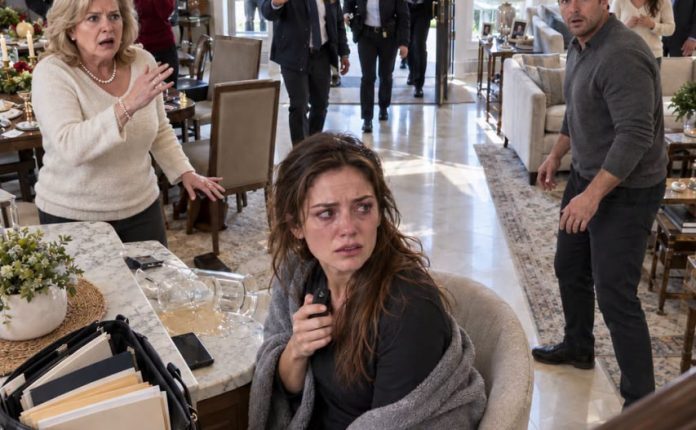
She slid the pages toward us. The top message read: Frank is getting stubborn. Don’t challenge him directly. I read the next. Elliot thinks the cabin may be too much. Another. Once everyone settles there, he’ll realize city living makes more sense. My hands began trembling. Finally. Not on the porch. Not during the confrontation. Now.
Because property was one thing. This was another. This was not entitlement alone. She had begun building a story about me. A story where resistance could be dismissed as decline. Elliot pulled out a chair. “Dad.” “I’m fine.” “You’re shaking.” “I know.” I sat. Beverly was crying now. “I am so sorry.” I looked at her. “.
Did she ever say I agreed?” “Yes.” “Repeatedly?” “Yes.” “Did she say Elliot wanted me moved?” “Yes.” Elliot turned away. He put both hands on the kitchen counter. His shoulders trembled. I realized he was crying. Quietly. The way I had taught him. My old mistake. I stood. Then walked to him. He turned.
For one second, neither of us knew what grown men do with grief like this. Then I hugged my son. He folded into me. Not like thirteen. Not like seventeen. Like thirty-nine. Like a husband whose marriage was cracking. Like a son realizing his silence had been weaponized. “I didn’t know.” He kept saying it. “.
I didn’t know.” “I know.” “I swear, Dad.” “I know.” “I never thought that.” “I know.” His breathing broke. I held him tighter. Behind us, Beverly cried quietly. Eventually Elliot pulled away. His face was red. He wiped it openly. That mattered too. He looked at Beverly. “Send me everything.” “I will.” “Don’t delete anything.” “.
I won’t.” “And please.” He swallowed. “Don’t confront her yet.” Beverly nodded. “I understand.” He looked at me. “I’m filing.” I knew what he meant. Not paperwork alone. A decision. Still, I asked. “Are you certain?” He nodded. “This isn’t one argument.” “She tried to rewrite reality.” “She used my name.” “She used yours.” “.
She told people you were declining.” “She took your key.” “She listed your home.” His voice became steadier. “And I don’t know where our money went.” He looked toward the messages. “I can love someone and still leave them.” I felt that sentence settle into the room. Beverly closed her eyes. Maybe she needed it too.
Later that afternoon, we changed every lock. Front door. Back door. Boathouse. Storage shed. Elliot worked beside me. No speeches. Just screws. Measurements. Metal plates. The ordinary language we had always spoken best. At one point, he stripped a screw. He cursed softly. I handed him another. He smiled. “You still carry extras.” “I know you.”
He laughed. The sound felt good. At 5:42, the final lock clicked. Elliot tested it twice. “Secure.” I nodded. “Secure.” That night, Sienna arrived. Alone. No warning. She stopped outside the new front lock. Then knocked. Three hard strikes. Elliot and I looked at each other. I walked to the door. Opened it.
But remained in the frame. Sienna stared past me. “I need to speak to my husband.” Elliot stepped into view. “You can speak here.” Her eyes moved between us. “You changed the locks.” “Yes,” I said. She laughed bitterly. “Of course.” Elliot remained calm. “What do you need?” She looked at him. “Come home.” “No.”
Her face tightened. “So that’s it?” “You hide here while your father poisons you?” I almost answered. Elliot beat me. “Dad didn’t show me your bank transfers.” “He didn’t create the rental listing.” “He didn’t copy the cabin key.” “He didn’t tell your parents I thought he was declining.” Her expression froze. That last one landed. “.
Who told you that?” “Your mother.” Sienna stared. Then she laughed once. “So Mom betrayed me too.” “No.” Elliot’s voice sharpened. “She corrected a lie.” Sienna looked toward her car. Then back. “Can we talk privately?” Elliot hesitated. Then stepped outside. I started closing the door. He touched it. “Stay.” Sienna’s face hardened. “Seriously?” “Yes.”
He looked at her. “I want a witness.” That sentence changed her. Not dramatically. Her shoulders simply dropped. “What do you think I’m going to do?” “I don’t know anymore.” She swallowed. For the first time, I saw fear. Not theatrical outrage. Real fear. The fear of consequences becoming larger than persuasion. She looked at me. “.
I never said you were incompetent.” I remained silent. “I said you were adjusting.” Elliot shook his head. “We have screenshots.” Her eyes flashed. “My mother had no right.” “Stop.” His voice was louder. Not shouting. But final. “Stop blaming everybody else.” She stared at him. “You want accountability?” He asked. “Start with one sentence.”
She said nothing. “Say you lied.” Her lips parted. Then closed. “Elliot.” “Say it.” “That’s manipulative.” He almost laughed. “No.” “It’s four words.” She looked away. The lake reflected the last evening light. She folded her arms. “I exaggerated.” Elliot nodded slowly. “Try again.” Her eyes filled. “I was trying to solve problems.” “.
Try again.” “I thought your father—” “Try again.” She glared at him. Then at me. “I lied.” The words came through clenched teeth. Nobody moved. Elliot breathed out. “About what?” She shook her head. “You’re enjoying this.” “No.” His eyes were wet. “I’m watching my marriage end.” “Nothing about this feels good.” That quieted her.
She looked suddenly smaller. Not innocent. Human. That made everything harder. “I lied to my parents.” She whispered it. “I told them Frank agreed.” I waited. She continued. “I used the cabin address.” “I copied the key.” “I made the rental listing.” Her voice cracked. “I used your name when talking about Frank.” Elliot asked, “Why?”
She closed her eyes. There it was. The question underneath everything. When she opened them, anger had weakened. Something uglier remained. Shame. “Because I needed money.” “How much?” She looked away. “Sienna.” “Forty-three thousand.” Elliot staggered half a step. I felt my stomach drop. “What?” His voice sounded hollow. She began crying. Not loudly. “I made investments.” “.
What investments?” “Online.” “What kind?” She wiped her face. “Trading.” Elliot stared at her. “You don’t trade.” “I started.” “When?” “January.” He laughed once. In disbelief. “With whose money?” “Ours.” “How much did you lose?” She covered her mouth. Elliot waited. “How much?” “Thirty-eight.” “Thirty-eight thousand?” She nodded. His face emptied. “And the credit cards?” “.
Trying to cover things.” “And my cabin?” She looked at me. I felt something inside turn to stone. “The rentals were supposed to replace some money.” “Without telling me?” Elliot asked. “Yes.” “And your parents?” “They needed somewhere.” “So I thought—” I interrupted calmly. “You thought my house could solve your consequences.” She looked down. “.
Yes.” There it was. Finally. Not confusion. Not concern. Not family sacrifice. A calculation. My unused rooms could conceal her losses. My silence could conceal her lies. My age could explain resistance. My son’s avoidance could protect the arrangement. I had been useful. Exactly as she said. Elliot stepped backward. He looked physically ill. “.
Is there anything else?” She shook her head. He stared at her. “Think carefully.” Silence. Then she whispered, “I borrowed from Mom.” Beverly. “How much?” “Ten.” “Did Dad know?” “No.” Elliot closed his eyes. “So fifty-three thousand.” “Approximately.” He opened his eyes. “Approximately?” She flinched. “There are fees.” He looked toward me. I had no advice.
Nothing useful. Some truths leave no shortcut through pain. He faced her again. “I’m filing for separation.” She broke then. Not violently. Her knees seemed to lose strength. She sat on the porch step. “Please.” Elliot looked wrecked. “I can’t trust anything.” “We can fix it.” “I don’t know what ‘it’ is.” She cried harder. “.
I was scared.” “So you lied.” “Yes.” “You could have told me.” “I thought you’d leave.” His face twisted. “And now?” She covered her face. Nobody spoke. Because there was no answer that did not hurt. Finally, Elliot crouched a few feet away. He did not touch her. “I hope you get help.” “I mean that.”
She looked up. “Come with me.” “No.” “Please.” “No.” His voice broke. “I love you.” Her face crumpled. “But I can’t come home.” The words hurt everyone. Even me. Especially because they were not cruel. She stood slowly. Then looked at me. “I’m sorry.” I watched her. The apology mattered. But it was not magic. “.
I hear you.” Her eyes searched mine. Perhaps she expected forgiveness. Perhaps punishment. I gave neither. “Dana will handle the property issue.” She nodded shakily. “I’ll cooperate.” “You should.” She turned toward Elliot. He remained still. Then she walked away. Her car disappeared between the trees. Long after the sound faded, Elliot stood in darkness.
I joined him. Neither of us spoke. Then he whispered, “I meant it.” “I know.” “I still love her.” “I know.” “Does that make me stupid?” “No.” I looked toward the road. “It makes this harder.” He nodded. We stayed there until mosquitoes drove us inside. The weeks afterward did not become easy.
That would be dishonest. Real consequences rarely arrive with satisfying music. They arrive through emails. Bank statements. Appointments. Forms. Awkward phone calls. Canceled reservations. Legal consultations. Apologies that cannot repair everything. Dana resolved the rental-platform issue quickly. The listing vanished permanently. The guests received refunds. The platform documented the unauthorized account activity. No strangers arrived.
No luggage crossed my porch. No one used my dock without asking. Gordon redirected every shipment. Beverly changed their mail. The banker’s box never returned. Sienna reimbursed the two booking deposits from her remaining personal funds. Dana made certain the paperwork stated clearly that ownership had never transferred. No tenancy existed. No agency existed.
No ambiguity remained. I kept the blue folder. But eventually, I moved it from the kitchen table into a drawer. That felt important. A boundary should protect life. It should not become life. Elliot rented an apartment thirty minutes away. Small. Clean. Almost empty. The first evening I visited him, he owned one chair.
One mattress. One frying pan. And six coffee mugs. I stared at them. “Why six?” He shrugged. “They came in a set.” “That sounds suspiciously domestic.” He smiled. “I’m rebuilding.” He attended counseling. Alone. Later, Sienna did too. Their lawyers worked through financial disclosure. The losses were real. So were the debts. So was the deception.
But another truth emerged. Sienna had not spent everything on luxury. Some went to trading losses. Some went toward helping Beverly secretly during a medical scare Gordon had not understood fully. Some covered panic with more panic. That context mattered. It did not erase anything. Sienna had lied. Copied a key. Used my address. Misrepresented my condition.
Listed property she did not own. Understanding why did not transform wrong into right. But understanding prevented anger from becoming hatred. I was grateful for that. Two months later, Beverly returned to the cabin. She called first. Then texted. Then laughed when I told her one permission request sufficed. She brought lemon cake. Gordon brought sandpaper. “.
I hear your dock needs work.” I looked at him. “Who told you?” “Elliot.” “That boy leaks information.” Gordon smiled. “May we help?” There was that word. May. I looked toward the dock. Then handed him an extra sanding block. “You may.” We spent six hours repairing boards. Beverly sat beneath an umbrella and read a mystery novel.
Occasionally she shouted advice none of us requested. Gordon shouted back. They sounded married. Ordinarily married. Imperfectly. Comfortingly. At lunch, we ate sandwiches on the dock. Beverly looked embarrassed again. “Frank.” “Yes?” “I told my sister the truth.” I waited. “And the friends.” “The ones I spoke to.” “I corrected everything.” “Thank you.” “.
She asked whether you were still angry.” “Who?” “My sister.” “What did you say?” Beverly smiled slightly. “I said you were sanding.” I laughed. “Accurate.” Her smile faded. “I’m ashamed I believed Sienna.” I looked at the lake. “You believed your daughter.” “That isn’t a crime.” “No.” “But repeating concerns without asking me was wrong.”
She nodded. “Yes.” “So you corrected it.” “Yes.” “Then we keep moving.” Her eyes watered. “You make that sound easy.” “It isn’t.” I took another bite. “It’s just necessary.” By autumn, the cabin changed. Not ownership. Never that. But atmosphere. My porch acquired a second rocking chair. Then a third. Not because anyone demanded them.
Because I invited people. A retired welder named Dennis came fishing Wednesdays. My old shift supervisor, Ray, visited twice and complained about everything. He said the lake was too quiet. Then fell asleep in a chair for three hours. I never let him forget it. Elliot came most Sundays. He always called first.
At first, the calls sounded formal. “Would Sunday work?” “May I come by?” Eventually I teased him. “You’re my son.” “Stop requesting diplomatic clearance.” He laughed. “Trauma.” “Fair.” Still, he never assumed. That mattered. Sometimes respect looks like asking even when you know the answer will be yes. His separation from Sienna lasted through winter.
There were no dramatic reunions. No sudden villain transformation. Sienna sold jewelry. Closed trading accounts. Started repaying her parents. She took a second job doing remote bookkeeping. The irony was not lost on anybody. Elliot attended two mediated sessions with her. Then four. Then stopped for almost a month. He never told me everything.
I never asked. That was his marriage. Not my cabin. I was learning boundaries too. In January, he came over alone. Snow covered the dock. The lake had frozen near the shoreline. He carried two coffees. We sat near the fireplace. He looked nervous. “I’m going to try again.” I knew immediately. “With Sienna?” “Yes.”
I felt complicated things. Concern. Disappointment. Hope. Fear for him. But his life was not mine to occupy. “What does trying mean?” “Separate homes.” “Financial controls.” “Counseling.” “Full disclosure.” “No shared credit yet.” He rubbed his hands. “And boundaries with family.” I raised an eyebrow. “Including me?” “Especially you.” I smiled. “Good.” He looked surprised. “.
You mean that?” “Yes.” “You’re building a marriage.” “Not an annex.” He laughed. Then became serious. “If she lies again, I’m done.” I nodded. “That’s yours to decide.” He looked toward the fire. “She asked whether she could apologize here.” My body tightened. He noticed. “You can say no.” That sentence alone told me he had changed.
I thought for several seconds. Then nodded. “One visit.” “With you here.” “Okay.” “And she asks herself.” He nodded again. Two days later, my phone rang. Sienna. I let it ring twice. Then answered. “Hello.” Her voice was quiet. “Frank.” “Would it be alright if I visited Saturday?” I looked through the kitchen window.
Snow rested on the porch rail. “Yes.” “Two o’clock.” “Thank you.” She hesitated. “I’ll understand if you change your mind.” “I won’t.” Saturday arrived cold and brilliantly clear. Sienna came alone. No suitcase. No sunglasses. No instructions. She carried nothing. That mattered. Elliot arrived separately. He stayed near the kitchen doorway. Sienna sat across from me.
For several seconds, she simply breathed. Then she said, “I practiced this.” I smiled faintly. “That sounds dangerous.” A tiny laugh escaped. Then vanished. “I owe you a real apology.” I waited. “I treated your work like something beneath me.” “I treated your silence like permission.” “I treated your home like a resource.” “.
I lied about your memory.” “I lied to my parents.” “I lied to Elliot.” “I copied your key.” “I used your property without permission.” Her voice trembled. “And when you resisted, I tried making you look unreasonable.” Tears filled her eyes. “That was wrong.” No excuses followed. I noticed. She continued. “I was terrified about the money.” “.
I kept thinking one more solution would fix the previous lie.” “So I made larger lies.” “I told myself I was protecting everyone.” “I was protecting myself.” Elliot remained silent. I looked at her. “What do you want from me?” She swallowed. “Nothing.” That surprised me. “I wanted you to hear me say it.” “.
If you never trust me again, I understand.” “If you never invite me here, I understand that too.” I studied her. Months earlier, she would have negotiated. Explained. Redirected. Now she waited. Maybe accountability is partly learning to survive someone else’s answer. “I accept the apology.” Her face crumpled. I lifted one hand. “.
That doesn’t restore trust.” She nodded immediately. “I know.” “It doesn’t erase consequences.” “I know.” “And this house will never become a marital bargaining chip.” “It won’t.” “Or your parents’ solution.” “It won’t.” “Or rental income.” A small, embarrassed smile appeared. “Definitely not.” I nodded. “Then we start there.” She wiped her cheeks. “Thank you.”
I stood. “So.” Both of them looked at me. “I made soup.” Elliot smiled. Sienna laughed through tears. “You made soup?” “I retired.” “I have hobbies now.” That afternoon, we ate together. Not reconciliation. Not yet. Something quieter. A beginning with rules. I discovered I preferred that to grand emotional promises. Promises sound beautiful.
Patterns matter more. Spring returned slowly. Ice disappeared. The dock darkened with rain. Loons returned. So did fishermen. So did mosquitoes, unfortunately. Elliot and Sienna continued counseling. They remained separated until May. Then they rented a smaller place together. Both names on every account. Both with access. Spending alerts enabled. No hidden cards.
No secret transfers. Not romantic. Necessary. Trust sometimes rebuilds with spreadsheets before flowers. Sienna repaid Beverly. Then Gordon. Then the final platform fees connected to my cabin. She mailed the last check with a note. No speech. Just: This closes what I owed. I deposited it. Then shredded the note. Not angrily. It was finished.
One Saturday in June, I woke before sunrise. Old habits. I made coffee. Then walked toward the dock. The boards felt smooth beneath my bare feet. Gordon’s sanding had held. Mist hovered above the water. I sat alone. Exactly as I once imagined. And discovered something unexpected. The silence did not feel empty.
It felt chosen. That was different. At 7:22, my phone buzzed. Elliot. I smiled. His message read: Awake? I typed: Unfortunately. Three dots appeared. Then: Can we come by later? I looked at the lake. We. Not an assumption. A request. I answered: Lunch. Bring bread. He replied: Yes, sir. At noon, their car arrived.
Sienna stepped out holding a paper bag. Elliot carried something wrapped in cloth. I pointed at it. “What’s that?” “Retirement present.” “You’re ten months late.” “Supply-chain issue.” Sienna laughed. “He forgot where he hid it.” “Marriage requires discretion.” He glared playfully. She lifted both hands. “Accountability.” I smiled. That word had changed in our family.
Once it sounded punitive. Now it sounded safe. We ate outside. After lunch, Elliot brought the wrapped object onto the porch. “Open it.” I pulled away the cloth. My breath caught. It was the old watch. The one from the wooden box. Restored. New leather band. Cleaned face. Working hands. Ticking. I looked at him. “.
You repaired this?” He nodded. “It took months.” “Parts were hard to find.” I turned it over. The back had been engraved. Four words. Time given matters most. My throat closed. “Where did that come from?” He looked embarrassed. “Something you said once.” “I said that?” “Sort of.” “When?” “When I was sixteen.” “You said money returns.” “.
Time doesn’t.” I remembered. Barely. Probably after overtime. Probably exhausted. Probably while lecturing him about missing curfew. Strange what children preserve. I ran my thumb over the engraving. “You gave this back.” “I know.” He smiled. “I’m giving it back again.” This time, I placed it on my own wrist. The fit was imperfect.
So was everything valuable. “Thank you.” He hugged me. Sienna watched quietly. Then she stood. “I brought something too.” I raised an eyebrow. “If it’s a lease application—” She groaned. “Frank.” Elliot laughed. “Too soon?” “It has been ten months.” “Still too soon.” She reached into her bag. Then handed me a small framed photograph.
It showed the cabin. Not the listing photo. A new one. Winter morning. Smoke from the chimney. Snow along the roof. My porch lights glowing. I frowned. “When was this taken?” “January.” “The day I apologized.” “I stopped down the road.” “The light looked beautiful.” I studied it. No people. No claim. Just the house.
At the bottom of the frame was a tiny brass plate. I read it. FRANK’S PLACE. Nothing else. Not family retreat. Not shared cabin. Not future inheritance. Not available rooms. Frank’s Place. I looked at her. Her eyes were nervous. “If you hate it, I can remove the plate.” I touched the words. “.
No.” I looked again. “It stays.” She smiled. Small. Grateful. That photograph eventually went beside the blue folder. Then one day, I moved the folder into the bottom drawer. The photograph stayed out. By my first retirement anniversary, the porch steps no longer complained. I had repaired them. The boathouse door opened smoothly.
The siding wore a fresh coat of stain. The dock shone after another sanding. The cabin still needed work. Good. So did we. That truth no longer frightened me. We celebrated with a small cookout. Dennis came. Ray came. Gordon and Beverly came. Elliot and Sienna arrived last. Everyone brought something. Nobody moved in.
That became the running joke. Gordon held up a grocery bag. “Permission to enter?” “Denied.” He nodded solemnly. “I’ll eat everything outside.” Beverly shoved past him. “Ignore him.” I pointed at her. “That sounds dangerously familiar.” Everyone laughed. Even Sienna. Especially Sienna. Later, as evening settled, Ray asked whether I regretted retiring.
I looked around. Gordon argued with Dennis about fishing knots. Beverly cut pie. Sienna collected plates. Elliot stood at the end of the dock. The old watch ticked against my wrist. “No.” I said it easily. “Not once.” Ray nodded toward the house. “Nice place.” “Yes.” “It is.” He looked at me. “.
You leaving it to Elliot?” A year earlier, that question might have tightened everything. Now I smiled. “Someday isn’t today.” Ray laughed. “Fair enough.” But I had thought about it. Quietly. Carefully. I had updated my estate plan. Not from anger. From clarity. The cabin would enter a protected family trust after my death.
Elliot could use it. His children could use it, if children ever came. It could not be sold to cover personal debts without strict trustee approval. It could not be pledged against another obligation. No spouse could claim ownership through marriage alone. No one could convert my peace into leverage. And there was another clause.
One Dana had smiled when I requested it. Every future family member using the cabin must receive one simple written statement. The statement contained only eleven words. I kept it inside the blue folder. Months later, Elliot found it accidentally. He was searching for the boathouse warranty. He unfolded the page. Then began laughing. “.
What?” I asked. He handed it to me. I read my own sentence. This home is shared only through respect, never through assumption. Elliot shook his head. “You put that in the trust?” “Essentially.” “You’re unbelievable.” “Documentation matters.” He laughed again. Then became quiet. “I like it.” “So do I.” He put the paper back.
Exactly where he found it. That evening, after everyone left, I walked down to the dock alone. The lake was glass. A few porch lights reflected behind me. Somewhere across the water, a radio played softly. Then faded. I sat at the edge. My boots rested above the dark water. For years, I had measured life in shifts.
Hours worked. Overtime earned. Bills paid. Repairs finished. Meals provided. School events attended. Sacrifices made. I thought retirement would simply be the absence of work. I was wrong. Retirement had taught me something forty-one years of labor never had. Peace is also work. You build it. You protect it. You decide who enters it.
You stop apologizing for doors with locks. You stop confusing love with unlimited access. You let people knock. You listen. Then you choose whether to open. Behind me, the screen door creaked. I turned. Elliot stood on the porch. He had forgotten his phone charger. He held it up. “Permission to retrieve property?”
I laughed. “Granted.” He started inside. Then stopped. “Dad?” “Yes?” He looked toward me. “I’m glad you bought this place.” I smiled. “So am I.” He disappeared inside. A moment later, the screen door closed. Softly. No slam. No demand. No suitcase rolling across my porch. No one explaining what my empty rooms should become.
Just my son retrieving something he had left behind. Then asking before taking anything else. I looked back across the lake. The last light rested over the water. The old watch ticked against my wrist. Steady. Quiet. Mine. The cabin stood behind me. Also mine. But something had changed. Ownership no longer felt like the most important part.
Choice did. I could share without surrendering. Forgive without forgetting. Love without disappearing. And finally, after forty-one years of noise, I understood exactly what I had bought. Not three bedrooms. Not a dock. Not cedar walls or a green metal roof. I had bought the right to hear my own life clearly. The lake touched the rocks.
A loon called once beyond the reeds. I lifted my coffee. It had gone cold again. This time, I laughed. Then I stayed exactly where I was. Nobody needed me elsewhere. Nobody had reassigned my peace. Nobody had decided what my life was useful for. And as darkness settled over Frank’s Place, I finally heard myself breathe.