I had been retired for less than forty-eight hours when my daughter-in-law called my new lake cabin “the best solution” for her parents’ summer plans, told me to have the rooms ready, and casually suggested I could list the place if that did not work for me—as if forty-one years of savings.
Quiet mornings on the dock, and my name alone on the deed meant nothing once she decided my home was useful. I did not argue, did not remind her who owned it, and did not raise my voice. I just made one calm call, prepared a slim folder, and waited on the porch until.
Their SUV rolled into my driveway like they already belonged there… I retired at sixty-four and bought the cabin because I wanted to hear myself breathe. That was the whole dream. Not luxury. Not some rich-man escape. Just pine boards under my boots, lake air coming through the screen door, coffee cooling in my hand.
And mornings quiet enough that the hum in my ears from forty-one years at the steel mill could finally begin to fade. For most of my life, I had lived by noise. Furnace roar. Forklift beeps. Metal shrieking against metal. Men shouting over machines because softness never got anything poured, cut, lifted, or fixed.
Even after my last shift, I woke up twice in my city apartment thinking I heard the plant whistle. There was no whistle. Only the refrigerator humming and the neighbor upstairs dragging something across the floor at 12:38 a.m. So when I found the little timber cabin with three bedrooms, a green metal roof.
A stone chimney, and a dock that needed sanding, I did not hesitate long. The place smelled like cedar dust, old lake water, and work. Honest work. The siding needed stain. The boathouse door stuck. The porch steps complained under my weight. I liked that. A house that needs care tells the truth about itself.
My son, Elliot, knew what that cabin meant. I raised that boy alone after his mother left when he was thirteen, and I never made him choose sides. I packed lunches before dawn, sat through cold school games in my work boots, taught him to change oil in an old pickup.
And showed up to parent-teacher nights still smelling faintly of the mill because overtime and fatherhood rarely left room for pride. When he married Sienna seven years ago, I tried with her. I let the little comments pass. My apartment was “industrial vintage without the intentional part.” My restored maple table was “very rustic.”
My work was “charming,” in the tone people use when they mean useful but not impressive. That was the trust signal I kept giving her: Silence. Silence can look like permission to people who never paid for what they are taking. Thirty-six hours after I moved in, Sienna called at 6:17 p.m.
On a Thursday while I was sitting on the dock. “Your son and I have decided my parents are moving into your cabin for the summer,” she said. “If that’s a problem for you, list it and move back where you can actually be useful.” The lake kept touching the rocks. A loon called from somewhere beyond the reeds.
My coffee had gone cold in my hand. I asked one question. “Has Elliot agreed to this?” “My husband understands family sometimes has to make sacrifices,” she said. “Unlike some people.” Then came the instructions. Her parents would arrive Friday. I could pick them up if needed. Beverly had back issues, so she would need the main bedroom.
Gordon needed room for his files. I should clear out the closets and not make this difficult. Not ask. Told. That word matters. People who ask still see you. People who tell have already turned you into furniture. I did not argue with her. A clean no works with reasonable people.
With entitled people, no is only the starting whistle. So I planned clarity. At 7:04 p.m., I called the county clerk’s office and confirmed the recorded deed. At 7:41, I printed the closing disclosure, the property tax receipt, and the page showing one owner: Me. I added a screenshot of Sienna’s message from 8:12 p.
M., the one where she wrote, “Don’t embarrass everyone over empty rooms.” Then I wrote one sentence across the top of a legal pad in black ink: My home is not available for reassignment. By Friday afternoon, the beds were not made for guests. The closets were not cleared. The main bedroom door was closed.
On the kitchen table sat a slim blue folder, clipped in order: Deed. Tax bill. Insurance page. Printed text messages. And one blank rental agreement with market-rate terms I knew they would never accept. I was not shaking. That surprised me. For one ugly second, I wanted to shout. I wanted to make Sienna hear every furnace hour.
Every missed weekend, every time I ate dinner standing at the sink because I was too tired to sit down. I wanted to tell her that a man does not survive four decades on concrete so someone else’s parents can treat his peace like spare storage. But rage is expensive when you have already bought peace.
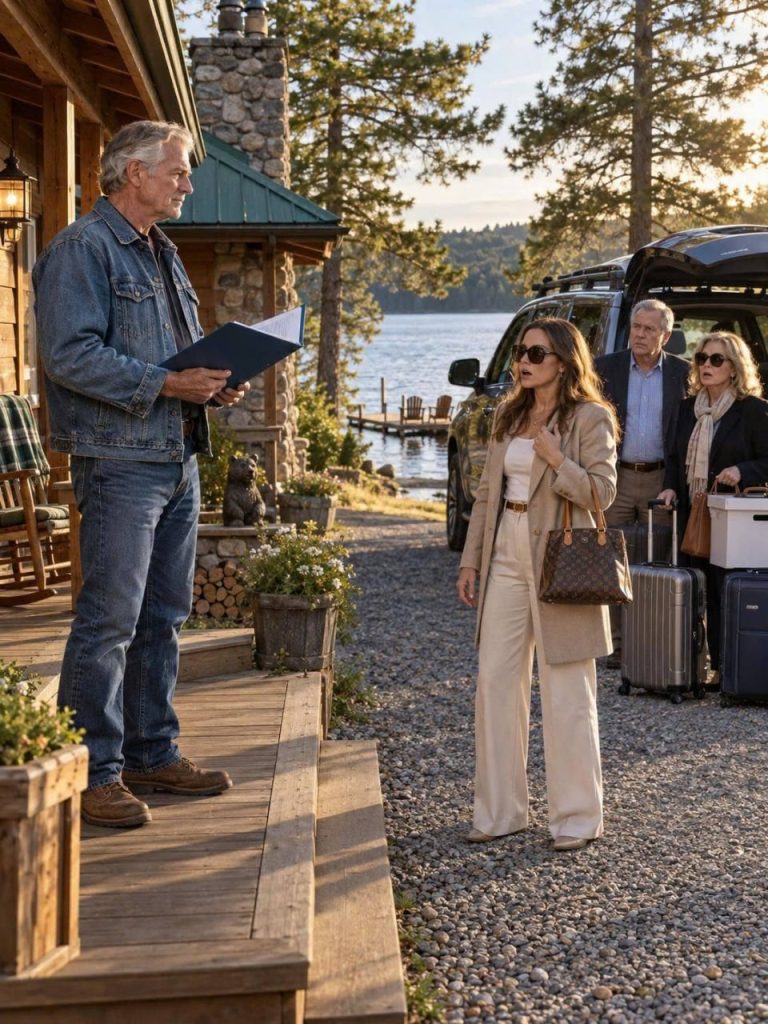
So I put on my old denim jacket, set the folder under my hand, and walked out to the front porch. The driveway was still warm from the afternoon sun. A small American flag beside the mailbox snapped once in the breeze. Somewhere behind me, the screen door creaked on its spring. At 4:26 p.
M., the SUV turned off the road. Sienna was in the passenger seat, sunglasses on, smiling before the tires even stopped. Beverly sat behind her with a travel pillow around her neck. Gordon had a banker’s box on his lap, the kind people use when they think someone else has already made space for them.
The trunk popped open. Two suitcases rolled into view. Sienna stepped out, looked past me toward the cabin, and said, “Good. You’re ready.” I opened the blue folder on the porch rail. And for the first time since I had known her, Sienna’s smile dropped before she knew what I was about to say…”
I watched her eyes move toward the folder. Then back to me. Beverly opened her door slowly. Gordon stayed behind the wheel. Nobody touched the suitcases. I slid the deed forward. “This cabin belongs to me.” Sienna gave a small laugh. It sounded too sharp. “We know that.” “No,” I said. “I don’t think everyone does.”
Her jaw tightened. I looked toward Beverly. Then Gordon. “You were told you’re moving here?” Beverly glanced at Sienna. “Well, for the summer.” “That wasn’t my question.” The breeze lifted one page. I held it down. Gordon finally stepped outside. His expression had changed. “What exactly are you saying?” “I’m saying nobody asked me.”
Sienna removed her sunglasses. “Don’t start performing, Frank.” That was my name. She rarely used it. Usually I was “your dad” when speaking to Elliot. Or simply “he.” Today I had become Frank. That meant she felt challenged. I pointed toward the folder. “There’s the deed.” “There’s the tax bill.” “There’s the insurance.” “All in my name.”
Sienna crossed her arms. “You’re being incredibly dramatic.” “Possibly.” “But I’m being accurate.” Beverly stared at the papers. “You said he knew.” Her voice was quiet. Sienna turned quickly. “He does know.” “He’s standing right here.” “No.” Beverly looked at me. “You said Frank agreed.” Silence reached the driveway. Even the trees seemed still. I looked at Sienna. “.
Did you tell them that?” She rolled her eyes. “Oh, come on.” “That’s a yes-or-no question.” She turned toward the cabin. “We discussed this already.” “You discussed it.” “I listened.” “There’s a difference.” Her cheeks colored. Gordon shut the SUV door. Harder than necessary. “Sienna.” She looked at him. “What?” “What did you tell us?”
Her mouth tightened. “That Elliot handled it.” Gordon looked at me. “Did Elliot handle it?” “No.” A muscle moved in his jaw. Beverly slowly removed the pillow from her neck. She placed it inside. Then closed her door. Something about that small movement told me plenty. She was no longer unpacking. Sienna saw it too. “.
Mom, don’t encourage this.” Beverly stared at her. “Encourage what?” “Him making us feel unwelcome.” I almost laughed. Instead, I breathed once. “You are unwelcome as residents.” The sentence landed cleanly. Nobody misunderstood it. “You’re welcome to visit.” “With an invitation.” “You’re welcome to eat here.” “With an invitation.” “You’re welcome on my dock.” “With an invitation.” “.
But you are not moving in.” Sienna stepped toward me. “This is exactly why Elliot worries about you.” That one interested me. “What does he worry about?” “That you’re becoming isolated.” “I’ve lived here thirty-six hours.” “That’s not the point.” “What is?” She opened her mouth. Nothing arrived immediately. I waited. Steel mills teach patience.
Sometimes machinery gives warnings. Sometimes people do too. Finally, she said, “You don’t need three bedrooms.” I nodded once. “There it is.” She frowned. “What?” “The part you believe.” I closed the folder. “You think unused means available.” Her voice hardened. “They’re empty.” “So is my toolbox tonight.” “That doesn’t make it yours.” Gordon looked away.
Beverly studied the porch boards. Sienna laughed again. “You’re comparing bedrooms to tools?” “I’m comparing ownership to ownership.” “That’s the entire comparison.” She glanced toward her father. “Dad, say something.” He rubbed his forehead. “I’m trying to understand.” “There’s nothing to understand.” “There is for me.” He pointed at the cabin. “You told us Frank suggested this.”
My eyes shifted toward her. That was new. Sienna went very still. Beverly looked sick. “You told me,” Gordon continued, “that he wanted company.” Sienna’s voice dropped. “He did.” I shook my head. “I never said that.” “You implied it.” “When?” She hesitated. I waited again. “Christmas.” “Which sentence?” Her eyes flashed. “God, Frank.” “No.”
I kept my voice level. “Which sentence?” She looked toward the lake. I remembered Christmas. Elliot had asked whether retirement frightened me. I had told him quiet might take adjustment. Sienna had been nearby. That was apparently enough. She lifted her chin. “You said you might get lonely.” “I said quiet felt unfamiliar.” “Same thing.” “No.” “.
They aren’t remotely the same.” Beverly whispered, “Sienna.” She ignored her. “You’re twisting everything.” “I printed what you wrote.” That stopped her. I reopened the folder. Her message sat near the top. Don’t embarrass everyone over empty rooms. Below it sat another. Mom needs the lake air. You can stay upstairs. The third one was worse.
If privacy matters that much, maybe retirement living suits you better. Gordon read that twice. Then looked at his daughter. “You sent him this?” She reached for the page. I moved the folder back. “Those are my copies.” Her hand froze. Beverly’s face went pale. “You told us he offered.” “I was trying to simplify things.” “.
For whom?” Gordon asked. Sienna exhaled sharply. “For everybody.” “No,” I said. “For yourself.” She looked at me. There was anger now. Real anger. The kind that appears when entitlement meets documentation. “You have always disliked me.” Elliot had warned me that sentence might come someday. Not because he expected conflict. Because Sienna used it often.
Any boundary became rejection. Any disagreement became hostility. Any silence became proof. I looked at her carefully. “I disliked some things you did.” “That isn’t the same thing.” She folded her arms tighter. “Like what?” I could have made a list. I didn’t. “This.” She stared at me. “This is enough.” Beverly pressed her lips together.
Gordon walked toward the porch. He stopped below the first step. “Frank, I owe you an apology.” Sienna spun toward him. “Dad.” “No.” He lifted one hand. “We arrived under false information.” “That’s what happened.” Beverly nodded faintly. “We truly believed you invited us.” “I believe you.” Sienna gave an incredulous laugh. “Oh, wonderful.” “.
Now everyone gangs up on me.” Nobody answered. That seemed to anger her more. She reached into her purse. “Fine.” She pulled out her phone. “I’ll call Elliot.” “I already did.” Her thumb stopped. The lake moved softly behind us. “What?” I leaned against the rail. “I called him last night.” Color left her face.
Just slightly. But enough. “What did you tell him?” “The truth.” “That’s not an answer.” “It’s the only one needed.” My son had answered on the fourth ring. He sounded tired. Not surprised. That hurt more. I had asked him the same question again. Had he agreed? There had been silence. Then a long exhale.
He said Sienna mentioned her parents needing somewhere temporary. He said he told her she should ask me. He said he assumed she had. I asked whether he knew she ordered me backward into my old life. Another silence. Longer. “No,” he had said. Then I asked something harder. “Would you have stopped her?” That silence lasted longest.
I knew my answer before he gave his. “I should have.” Not I would have. Not yes. I should have. Sometimes four words tell the whole truth. I looked at Sienna now. “He knows you’re here.” Her eyes narrowed. “He was supposed to come.” “He still is.” That changed everything. She stepped backward. Her parents noticed.
I did too. Gordon looked toward the road. Beverly whispered, “Oh, Sienna.” “What?” She snapped the word. Beverly shook her head. “You didn’t tell us Elliot objected.” “He didn’t object.” “He told you to ask.” “That isn’t objecting.” “No,” I said. “It’s recognizing I exist.” The gravel crackled. A dark sedan appeared through the trees.
Sienna stared toward it. Elliot pulled into the driveway. He parked behind their SUV. For several seconds, he remained inside. I saw his hands resting on the wheel. My son looked older than he had yesterday. Not physically. Something behind his eyes had finally become visible. He stepped out. No jacket. Sleeves rolled up.
Phone in one hand. He looked at me first. Then Sienna. Then her parents. “I’m sorry.” Nobody knew who he meant. Maybe everybody. Sienna marched toward him. “What did you tell your father?” Elliot didn’t answer immediately. “Exactly what happened.” “You took his side.” The sentence sounded automatic. Elliot closed his eyes briefly. “This isn’t about sides.” “.
It clearly is.” “No.” He looked toward the folder. “This is about Dad’s house.” Sienna stared at him. “He doesn’t need three bedrooms.” Elliot’s face changed. Not anger. Recognition. Like hearing something clearly after years of background noise. “That isn’t our decision.” She laughed. “Unbelievable.” He walked closer. “I told you to ask.” “I did ask.” “.
No.” Dad held up your messages. “You announced.” She looked at me. Then back at him. “You showed him our texts?” “I showed him yours.” “I’m your wife.” “And he’s my father.” “That doesn’t answer me.” “It does today.” Gordon stepped away. He gave them space. Beverly joined him. I stayed where I was.
This part belonged to them. Sienna lowered her voice. “You’re humiliating me.” Elliot’s shoulders sagged. “You brought your parents here.” “To a house Dad never offered.” “You told them he did.” “You told Dad we agreed.” “What exactly should I defend?” Her eyes filled. For one moment, I almost mistook hurt for accountability.
Then she pointed at me. “He set this up.” There it was. The escape hatch. Elliot looked toward me. I said nothing. He turned back. “No.” “He absolutely did.” “He made a folder.” “Because you kept pushing him.” “That proves my point.” “What point?” “That he wanted a confrontation.” I finally spoke. “I wanted clarity.”
She glared. “Same thing.” “No,” Gordon said quietly. Everyone looked at him. He had opened the SUV trunk. Now he was removing nothing. Just standing there. “Those are not the same.” Sienna stared at her father. He continued carefully. “A confrontation needs two people.” “Clarity only needs facts.” She looked betrayed. “Seriously?” “Yes.”
He nodded toward me. “He owns the cabin.” “We were not invited.” “That should end it.” Beverly touched his arm. Then she looked at me. “I am deeply embarrassed.” “You don’t need to be.” “I do.” “We should have called you.” “You trusted your daughter.” Her eyes flickered. “That isn’t always wise.” Sienna inhaled sharply. “.
Mom.” Beverly turned. “No.” Her voice remained quiet. But something hardened underneath. “You involved us in this.” “You let me pack medications.” “You let your father forward his business mail.” I looked at Gordon. He looked uncomfortable. “You forwarded mail here?” He nodded once. “Temporary forwarding.” “Sienna gave us the address.” My eyes returned to her. “.