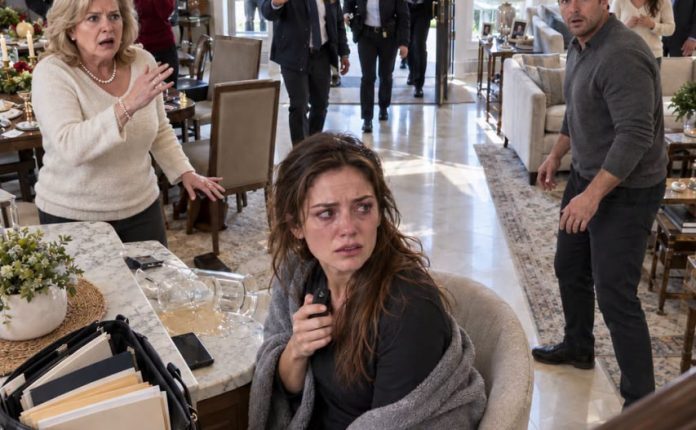
First, the ring belonged to her family. Then it belonged to Evan. Finally, she admitted it belonged to me but insisted she had “borrowed” it. “I texted her,” she said. “Before or after you removed it?” Lauren had no useful answer. When the representative told her the insured value, Celeste said Lauren actually leaned against the wall. “Three million dollars?”
“Approximately.” “No. Diane doesn’t own anything worth three million dollars.” That sentence reached me later and hurt in a way the theft itself hadn’t. Not because she thought I lacked money. Because the contempt inside those words confirmed what I had suspected for months. To Lauren, my possessions were available precisely because she considered me insignificant.
The ring was secured in a protective case and transferred according to the insurer’s procedure. No one handcuffed Lauren, and no one dragged her through the ballroom, but several guests had watched her disappear with security and watched her return without the spectacular diamond she had spent the evening displaying. For Lauren, that was apparently worse.
At 9:18, my phone began ringing. Evan. Then again. Then Lauren. I let both calls go unanswered. Patricia watched the screen light up for the fifth time. “Are you going home?” “Yes.” “You sure?” “I’ve been avoiding confrontation in my own house for fourteen months. I’m finished avoiding it.” I drove home around ten-thirty. The house was empty.
I checked my bedroom first. The door showed no obvious damage, but when I examined the lock closely, I saw a thin bright scratch near the latch plate that hadn’t been there before. My stomach tightened. Inside the closet, the safe was closed. Nothing else appeared missing, yet I no longer trusted appearances. I called Michael again.
“Have the insurer inventory everything tomorrow,” I said. “Already arranging it.” I brewed tea, changed into pajamas, and sat in my reading chair with a novel I didn’t absorb. At 11:47 p. m. , headlights swept across my curtains. A car door slammed. Then another. The front door opened hard enough to strike the wall. “Mom!” Evan’s voice sounded panicked.
Lauren came in behind him with streaked makeup, loose hair, and an expression I had never seen on her before. Not embarrassment. Rage. “What did you do to me?” she shouted. I closed my book, placed it carefully on the table, and looked at both of them. That was the moment I stopped trying to preserve a version of our family that no longer existed.
“I secured my property,” I said. Lauren stared at me. “You sent police to a charity gala.” “I reported an asset taken from my home without permission. What happened afterward was determined by the value of the asset and its insurance requirements.” “It was an old ring!” “No, Lauren. It was an extremely rare pink diamond set in platinum, insured for approximately three million dollars.”
Evan stopped pacing. The house became so quiet I could hear the refrigerator humming from the kitchen. “Three million?” he said. “Yes.” His eyes moved toward Lauren. “You told me it was some old ring Mom never wore.” “That’s what I thought!” I watched them both carefully. “And because you believed it was worthless, you believed you were entitled to take it?”
Lauren’s mouth opened and closed. “I texted you.” “After you had already taken it.” “You said, ‘Have fun. ’” “Because by then the ring was already at the gala and my priority was recovering it safely, not arguing with you by text.” Evan dragged both hands through his hair. “Mom, you could have called me.
We could have brought it back.” “You were already at the event?” “No, I was home until she called me.” “Then perhaps you should ask your wife how she got into my locked bedroom and opened my safe.” His head snapped toward her. Lauren folded her arms. “Lauren?” She looked away. “Answer him,” I said. “It wasn’t a big deal.”
A laugh escaped me before I could stop it. Evan’s voice became sharper. “How did you get into the safe?” Lauren stared at the carpet. “I saw Diane enter the code earlier this week.” “You watched her?” “I walked past the room.” “And the bedroom?” Another silence. Eventually she muttered, “I used a small tool to release the old latch.”
My chest tightened even though I had already suspected something similar. Evan looked physically sick. “You broke into Mom’s room?” “I didn’t break anything.” “That distinction will be fascinating to Michael,” I said. Lauren glared at me. “Who is Michael?” “My estate attorney.” The phrase changed something in her expression.
For months, she had treated me like a woman surviving on a pension and sentimentality. Now she was beginning to realize that there were entire parts of my life she had never bothered to understand because dismissing me had been easier. “You have an estate attorney?” she asked. “Yes.” “And a three-million-dollar ring?” “Yes.”
“How much money do you actually have?” That question erased the last grain of sympathy I might have possessed. Evan said, “Lauren.” “No, I want to know. We’ve been struggling for fourteen months, and she’s sitting here with millions in jewelry?” I rose slowly from the chair. “You have not been struggling.” Her eyes narrowed. “You live here without rent.
You do not pay electricity, water, property tax, insurance, internet, or groceries unless you choose to pick something up. I opened an emergency credit card for Evan years ago, and I have watched charges for restaurants, beauty appointments, premium deliveries, wine, and subscriptions appear on it for months.” Evan went pale. Lauren turned toward him.
“You told me she didn’t look at those statements.” “I said I didn’t think she cared.” “I cared,” I said. “I simply hoped you would eventually become embarrassed enough to stop.” Evan lowered his head. The anger I had expected to feel was gone. In its place was something firmer and much more useful.
“You came here to save for a home,” I continued. “Instead, you used my generosity to finance a lifestyle you cannot afford. Lauren has ordered me around, entered my private space, treated my possessions as communal property, and tonight she bypassed a lock to remove a three-million-dollar asset.” Lauren’s voice shook. “So what, you’re going to have me arrested?”
“I have not decided what further action I will take. The ring is safe, which was my immediate concern.” She looked toward Evan as if expecting him to attack me on her behalf. He tried. “Mom, I know she crossed a line, but can we not destroy the family over this?” I looked directly at my son.
“I’m not destroying anything. I am finally acknowledging what the family has become.” His shoulders sank. “You spent more than a year telling me, ‘That’s just how Lauren is. ’ Every time she crossed a boundary, your solution was for me to move mine.” “Mom—” “No. You don’t get to soothe this away tonight.” Lauren’s humiliation suddenly sharpened into fury.
“You wanted this to happen. That’s why you didn’t warn me.” “I did not place the ring on your hand.” “You could have told me what it was.” “You could have asked before entering my bedroom, bypassing a lock, observing my safe combination, opening the safe, and taking property that did not belong to you.”
She had nothing to say to that. I walked toward the staircase. Evan stepped forward. “Where are you going?” “To bed.” “We need to figure this out.” “I already have.” Lauren’s eyes narrowed. “What does that mean?” I put one hand on the banister. “It means tomorrow we discuss your new living arrangements.”
For the first time since she had moved into my house, Lauren looked frightened instead of offended. Evan whispered, “Mom, please don’t do anything drastic.” I turned and looked at him. “The drastic thing was allowing this to continue for fourteen months.” I climbed the stairs while they remained in the living room.
Behind me, neither spoke until I reached the landing. Then I heard Lauren hiss, “You said she would never kick us out.” And Evan answered with a sentence that told me more than he probably intended. “I didn’t think she ever would.” That was when I understood they had not merely become comfortable in my home.
They had counted on my inability to say no. I woke shortly after six the next morning and felt lighter than I had in months. Nothing outside had changed. Rain still silvered the backyard windows, the furnace clicked on with its familiar thump, and the floorboards outside my bedroom still creaked beneath my feet.
What had disappeared was the exhausting obligation to pretend everyone else’s comfort mattered more than mine. I made tea and went directly into my home office. The first thing I did was freeze the emergency credit card. I had opened the account when Evan was twenty-four because he traveled frequently for work and once became stranded after his debit card was compromised.
Over the years, the card became something he used occasionally and repaid, but after he and Lauren moved into my house, the repayments stopped while the charges multiplied. Restaurants. Meal delivery. Beauty services. Premium streaming plans. Wine clubs. Clothing. Nothing resembling an emergency. I printed fourteen months of statements. Then I reviewed my utilities and calculated the average increase since they moved in.
Water usage had nearly doubled. Electricity was up substantially. Internet charges had grown because Lauren insisted we upgrade the service package. At eight-thirty, I changed the Wi-Fi password. At nine, Evan appeared in the kitchen looking as if he hadn’t slept. He poured coffee, looked at his phone, frowned, and wandered toward the router. “Is the internet down?” “No.”
He looked at me. I slid a printed sheet across the island. “What’s this?” “Your share of the household utilities for the previous six months. I could calculate all fourteen months, but I’m choosing not to.” He stared at the total. “Mom, seriously?” “Yes.” “We don’t have this sitting around.”
“That surprises me, considering you have lived without rent for over a year.” “We’re saving for a house.” “No, Evan. You have been saying you are saving for a house.” He opened his mouth. I placed the credit card statements on top of the utility invoice. His face changed. “Mom.” “I froze the card this morning.”
“You went through our spending?” “It is my account.” He rubbed his forehead. “Some of that stuff is Lauren’s.” “I’m aware.” “She thought I was paying it.” “With what?” He didn’t answer. That was perhaps the saddest moment of the entire experience, because my son was not stupid. He simply had spent years solving discomfort by postponing it.
I softened my tone without softening the message. “Evan, you are thirty-five years old. I love you, but I am finished financing your adulthood.” Lauren walked in wearing an oversized sweatshirt and yesterday’s exhaustion. “What are you talking about?” “The card has been frozen.” She stared at me. “What card?” “The one paying for a remarkable amount of your lifestyle.”
She turned on Evan. “You said that was your backup card.” “It is in Mom’s name.” Her eyes swung back to me. “Unbelievable.” “Yes,” I said. “I had a similar reaction when I reviewed the charges.” Lauren pulled open the refrigerator with unnecessary force. “So this is punishment.” “No. Punishment would be doing something to hurt you because I am angry.
This is me refusing to continue paying expenses that were never my responsibility.” “You’re doing this because of the ring.” “The ring removed my last excuse for avoiding the problem.” She slammed the refrigerator door. “I made one mistake.” “You entered my locked bedroom.” “Fine.” “You observed the combination to my safe.” “Fine.”
“You opened it and removed property worth three million dollars.” “I didn’t know what it was!” “That sentence does not help you.” Evan stepped between us verbally before Lauren could answer. “Can everybody just calm down?” “I am calm.” That was true, and I think my calmness frightened them more than shouting would have.
I handed Evan another sheet containing the new Wi-Fi password. He reached for it. I kept my fingers on the page. “The password becomes active for you when you transfer your share of this month’s household expenses.” His jaw tightened. “Mom, I work from home two days a week.” “Then I recommend paying promptly.” Lauren gave a bitter laugh.
“You’re treating us like tenants.” “No. Tenants have contracts and legal rights to exclusive space. You are family members I allowed to stay here temporarily who somehow decided temporary meant indefinitely.” I released the paper. Neither spoke. Over the next several days, the house changed rapidly. Without access to my credit card, packages stopped appearing on the porch.
Lauren began checking prices at the grocery store. For the first time since moving in, Evan transferred money toward utilities without my reminding him. On Thursday, a locksmith arrived at two in the afternoon. I had keyed deadbolts installed on my bedroom, office, and the small basement wine cellar where Henry’s collection remained stored.
I also changed the bedroom lock entirely because Lauren had already demonstrated that the old interior latch offered little protection. The locksmith was finishing downstairs when Lauren returned. She watched him pack his tools into a case. “What is going on?” “I’m securing private areas.” Her eyes moved immediately to the basement door. “You locked the wine cellar?” “Yes.”
“But Jessica and I were going to open that Oregon pinot this weekend.” “No, you were going to take a bottle that belongs to me without asking.” “I always take wine from downstairs.” “That arrangement is over.” She grabbed the new doorknob anyway and rattled it. The metallic clack echoed through the kitchen. “This is insane.” I continued slicing vegetables.
“You are treating us like prisoners.” I set the knife down. “This is not your home, Lauren.” She froze. “It is my home. You are a guest who has drastically overstayed her welcome, and after what happened with the ring, I no longer trust you with unrestricted access to my property.” She stared at me with pure hatred.
Then something shifted. Her expression became almost smug. “You can lock whatever you want,” she said. “Evan told me you’d never actually make your own son leave.” I looked at her for several seconds. Then I smiled. “Did he?” That evening, I called Michael and asked him one simple question.
“What is the cleanest legal way to end their residency here?” By Friday morning, he had prepared the answer. Michael’s advice was straightforward: document everything, follow the applicable notice requirements, and avoid improvising simply because the dispute involved family. I had no intention of throwing their belongings onto the lawn or changing the exterior locks while they were still legally occupying the house.
I wanted them gone, but I wanted them gone properly. That weekend, I began a full inventory of my valuables with an insurer representative. Nothing else appeared to be missing. That should have reassured me. Instead, seeing a stranger photograph drawers, verify serial numbers, and compare documents inside a home that had once felt completely private reminded me exactly what Lauren’s behavior had cost.
The ring had been recovered unharmed, but trust could not be returned to a velvet box and locked away intact. Monday evening, Evan and Lauren were sitting at the dining table when I entered carrying a white envelope. Their dinner plates sat untouched. I placed the envelope in front of Evan. He looked at it but didn’t touch it.
“What is this?” “Written notice that you need to move out.” Lauren’s chair scraped backward. “You’re evicting us?” “I am ending the temporary living arrangement.” Evan pulled out the paperwork and read the first page. “Thirty days?” “Yes.” “Mom, we can’t find somewhere in thirty days.” “You can.” “We don’t have a down payment.”
“You do not need a down payment to rent an apartment.” Lauren laughed once, sharply. “So you want us to throw money away on rent after we’ve spent fourteen months trying to save?” I sat opposite them. “How much have you saved?” Neither answered. “That is what I thought.” Evan looked exhausted. “Could we have ninety days?” “No.” “Sixty?” “No.”
“Mom.” “You told me six months when you moved in. I voluntarily gave you eight additional months. I will not voluntarily give you another.” Lauren pushed the papers back across the table. “I’m not signing anything.” “You don’t have to sign it to make me change my mind.” Her face hardened. “You’re a cold woman.”
“I have been called worse by people whose opinions mattered more.” Evan flinched. I hadn’t intended to hurt him with that sentence, but I also wasn’t going to rescue him from the consequences of fourteen months of silence. Lauren stood. “You know what your problem is? You enjoy controlling people with money.” That accusation almost impressed me.
For more than a year, I had paid most of their living expenses, cooked meals, surrendered rooms, tolerated disrespect, and asked for almost nothing in return. Now the first moment I stopped providing those things, Lauren decided my refusal constituted financial manipulation. “No,” I said. “I enjoy controlling my own money.” “You have more than enough.”
“That does not create an entitlement for you.” “We’re family.” “Family is not a financial instrument.” She turned toward Evan. “Say something.” He stared at the notice. I watched a battle move across his face. Finally he said, “Lauren, we have to find an apartment.” She looked as if he had struck the table. “You’re taking her side?”
“I’m saying it’s her house.” “That didn’t bother you when we were living here.” “No,” he said quietly. “And that’s the problem.” For the first time in months, my son had said something I respected. Lauren left the room without another word. The following weeks exposed their finances with brutal efficiency.
Once Evan stopped relying on my card and began comparing rental prices, he realized how little they had actually saved. Lauren had imagined they possessed a substantial house fund because she counted expected bonuses, unused credit, and money they had already spent as though all three were cash. They were nowhere near a purchase. Several evenings I heard arguments upstairs.
I never intervened. One Saturday morning, Evan found me trimming herbs on the patio. “Can I ask you something?” “You can.” “Did you know we weren’t saving?” “I suspected.” “Why didn’t you say anything?” “I did. You explained it away.” He looked toward the yard. “I thought things would get better.” “So did I.” “She says you’ve always disliked her.”
“That isn’t true.” “Do you hate her now?” I considered the question. “No.” He looked surprised. “Hate requires more energy than I’m willing to spend on Lauren. I simply do not trust her, and I will not live with her.” He nodded slowly. Then he said, “I should have defended you.” “Yes.” I didn’t add, “But it’s okay.”
It wasn’t okay. He waited as though expecting the comforting sentence mothers are supposed to provide, the one that would erase the guilt before he had learned anything from it. I let the silence remain. A week later, Lauren attempted a different approach. She came into the kitchen while I was making lunch and placed both palms on the counter.
“I want to apologize.” I waited. “I shouldn’t have taken the ring.” “No.” “I honestly thought it was cheap.” “That is not the defense you think it is.” Her jaw tightened before she recovered. “I’m trying here.” “Then continue.” She inhaled. “I’m sorry I entered your room.” “Thank you.” She visibly relaxed.
Then she said, “So maybe we could revisit the move-out deadline.” There it was. I almost smiled. “No.” Her apology vanished from her face so quickly that it told me exactly what it had been worth. “You’re impossible.” “And you have twenty-one days.” She stormed away. That afternoon, I heard her upstairs telling Evan that if I truly loved him, I would never force him into a “terrible apartment.”
For once, he did not agree. “We put ourselves here,” he said. The argument that followed lasted nearly an hour. When it ended, a bedroom door slammed. I continued reading downstairs. But three nights before the deadline, I discovered Lauren had made one last attempt to use my family against me. And this time she had chosen an audience.
My phone began vibrating during breakfast. The first message came from my cousin. Then an old neighbor. Then a woman from the church book group I had not spoken to in nearly a year. “Diane, is everything okay with Evan?” “Call me when you can.” “I heard there was some kind of misunderstanding.”
By the fifth message, I knew exactly what had happened. Lauren had posted a carefully edited version of the story online. According to her. She and Evan had sacrificed for fourteen months while caring for a grieving widow. Only to be suddenly “thrown into the street” after Lauren accidentally wore a family ring without understanding its significance.
There was no mention of rent-free housing, the credit card, the lock she bypassed, the safe combination she watched me enter, or the three-million-dollar valuation. She did mention that I was “choosing money over family.” I finished my toast before doing anything. Then I sent one message to Evan. “Please come downstairs.” He appeared five minutes later holding his phone.
“I just saw it.” “So did half the county, apparently.” His face reddened. “I told her to take it down.” “I’m not asking you to manage her for me.” “What are you going to do?” “Nothing publicly.” He blinked. “I have legal documentation, property records, card statements, insurance reports, and her own text admitting she took the ring.
I don’t need to argue with your wife on the internet.” “People are going to think—” “People are permitted to think whatever they like.” That realization had taken me sixty-five years and fourteen miserable months to learn. I had spent too much of my life confusing being understood with being right.
By afternoon, the post had begun collapsing under its own contradictions. Someone who had attended the gala apparently commented that the “old family ring” was worth millions and that security had recovered it because it had been removed without the owner’s permission. Another person asked why someone caring for a grieving widow needed to be evicted after fourteen months.
Lauren deleted the post before dinner. She didn’t speak to me for the remaining three days. On moving morning, a rented truck arrived shortly after eight. Rain had cleared overnight, leaving the driveway damp and the sky bright behind thin clouds. I carried my Earl Grey onto the porch and sat in Henry’s old wooden chair while Evan and Lauren moved boxes from the house.
I did not help. Not because I wanted them to struggle, but because I had spent fourteen months helping enough. Lauren passed me repeatedly without making eye contact. Her expensive decorative pieces looked strangely ordinary stacked in cardboard boxes. The gray table runner appeared near the top of one container until she noticed me looking at it and pulled it out.
“You can keep this,” she said coldly. “No, thank you.” She dropped it on a porch bench. Around noon, the upstairs rooms were empty. Evan carried the last suitcase outside, then came back alone. He stood at the bottom of the porch steps. “Lauren’s waiting in the truck.” “All right.” He placed his hands in his pockets.
“We found a one-bedroom apartment.” “I’m glad.” “It’s small.” “You’ll survive.” A faint smile appeared, then vanished. “Mom, I’m sorry.” I said nothing. “I’m sorry about the money, and the way we treated this place like it belonged to us. Mostly, I’m sorry I kept asking you to tolerate things because I was scared of fighting with my wife.”
“That hurt more than the money.” “I know.” “No, Evan. I don’t think you did know. But perhaps you do now.” He swallowed. “I should have stood up for you.” “Yes.” His eyes filled slightly. This was the point where the old version of me would have stood, wrapped my arms around him, and said everything was forgiven before he had even finished apologizing.
I remained seated. “I love you,” I said. “That hasn’t changed.” He looked relieved. “But love does not erase consequences. I will not give you money for the apartment. I will not reopen the credit card. You will not move back here if things become uncomfortable. You need to learn how to build a life you can actually afford.”
His expression tightened, but he nodded. “That’s fair.” “I hope someday you understand that I’m saying this because I love you, not because I don’t.” He looked toward the truck. “I think I already do.” Maybe he did. Maybe he simply wanted to believe he did. Either way, it was his work now. He hugged me briefly.
I hugged him back because boundaries did not require cruelty. Then he walked to the truck. Lauren never came over to say goodbye. I watched them pull away until the vehicle disappeared beyond the trees. The silence that followed was astonishing. Not lonely. Quiet. Pure. I called the locksmith as soon as the truck turned the corner.
By late afternoon, every exterior lock had been changed, the garage codes had been reset, and the alarm system contained no access profile except mine. I also arranged for the pink diamond and Henry’s other significant pieces to be moved permanently into a secure private vault away from the house. Then I walked upstairs.
Their bedroom was empty except for faint rectangles on the carpet where furniture had stood. I opened the window. Cool air carried the smell of wet cedar into the room. For the first time in fourteen months, I did not hear Lauren’s music, Evan’s apologetic voice, footsteps above my head, cabinets being slammed, or another delivery arriving at the door.
I heard rainwater dripping from the gutters. I heard a bird somewhere in the backyard. I heard my own house breathing again. When I went downstairs, the gray runner was still sitting on the porch bench. I carried it inside. Then I dropped it into the trash. Afterward, I went upstairs to the cedar chest and lifted the lid.
My grandmother’s lace tablecloth lay exactly where I had placed it. As I carried it downstairs, I realized something that surprised me. I had told Evan and Lauren I planned to sell the house. At the time, I had meant it partly as practical motivation and partly because I truly wondered whether the place had become too large for me.
Standing in the dining room with that lace in my hands, I finally knew the answer. I wasn’t going anywhere. I spread my grandmother’s tablecloth across the dining room table slowly, smoothing every wrinkle with my palms. The lace was old-fashioned. So was I, according to Lauren. For the first time in a long while, neither fact bothered me.
I moved Henry’s photograph back into the living room. Restored my flowered mugs to the front cabinet. Returned the lemon soap to the kitchen sink. And spent an entire Sunday rearranging rooms exactly as I wanted them. By evening, the house looked less fashionable than it had under Lauren’s supervision. It also looked like mine.
Michael called the following week to confirm the ring had been inspected and showed no damage. After discussing everything that had happened, I chose not to pursue additional action against Lauren once the property had been safely recovered and the incident fully documented. That decision was not forgiveness. It was economy. Lauren had already consumed enough of my time.
I had no desire to organize the next year of my life around punishing her. Evan called occasionally. At first, nearly every conversation contained some variation of financial panic. Their apartment required a security deposit. The parking fee was higher than expected. Groceries were expensive. Electricity cost more than he remembered. I listened without offering my checkbook.
One evening he said, “I finally understand what it costs to run a house.” “I’m glad.” There was an embarrassed pause. “You paid all of that while we were there?” “Yes.” “For fourteen months?” “Yes.” “I was an idiot.” “You were comfortable.” “That sounds worse.” “It probably should.” He laughed weakly. Over the next few months, something unexpected happened.
Evan changed. Not dramatically, and not overnight. He canceled subscriptions. He stopped ordering food every evening. He built an actual budget. He sold a car he could barely afford and bought something used. The process seemed to infuriate Lauren. Whenever Evan mentioned her, there was tension beneath his words. Eventually, he stopped mentioning her very much at all.
Five months after they moved out, he asked whether he could come over alone. I said yes. He arrived carrying a bakery box and looked thinner than before. We sat in the kitchen beneath afternoon sunlight while rainclouds gathered beyond the windows. “Lauren moved out,” he said. I waited. “We’ve separated.” “I’m sorry you’re hurting.” He looked surprised. “That’s all?”
“What would you like me to say?” “I don’t know. Maybe that you knew this would happen.” “I suspected you had problems. I did not wish for your marriage to fail.” He looked down at his coffee. “She still says everything changed because of the ring.” “No. The ring revealed what was already there.” He nodded. For the next hour.
Evan described things he had ignored for years: secret credit card balances. Pressure to impress people they barely knew. Resentment whenever he resisted spending money. And the constant assumption that somebody else would eventually rescue them. I listened. I did not say, “I told you so.” I also did not say, “Move home.” Eventually he glanced around the kitchen.
“It’s weird being here.” “Why?” “It feels like your house again.” “It is.” He smiled slightly. “Would you ever trust me enough to live here again?” “No.” The answer came easily. His smile disappeared. I reached across the table and touched his hand. “That doesn’t mean I don’t love you.
It means we learned something expensive about what happens when our lives overlap too much.” He absorbed that. Then he nodded. “Fair.” That word mattered more to me than another apology. Evan and I slowly rebuilt something different from what we had before. He came for dinner, but he went home afterward.
He helped with gutters in the fall, and I paid a professional when he was busy instead of treating parenthood as an endless claim on his labor. When he talked about Lauren, I refused to make myself judge, messenger, or mediator. Their separation became permanent the following spring. Lauren sent me one message during that period.
It said, “I hope one day you realize how much damage you caused.” I read it twice. Then I deleted it. I did not answer. Perhaps the old Diane would have written five paragraphs explaining herself, hoping that perfect wording might finally make Lauren understand. The woman sitting at the kitchen table that morning no longer needed her understanding.
A year after the gala, I hosted Thanksgiving. Patricia came with her husband. Evan brought a pie he had baked himself, with an uneven crust that Henry would have teased him about for weeks. A few old friends joined us. The dining table was crowded again. Before dinner, I stood near the doorway and watched everyone talking over one another while sunlight spilled across my grandmother’s lace tablecloth.
Someone laughed loudly in the kitchen, dishes clinked, and the house felt alive without feeling invaded. Evan came beside me. “You look happy.” “I am.” He glanced toward the table. “I’m glad you didn’t sell this place.” “So am I.” He gave me a sheepish look. “Did you ever really plan to?” “For approximately three days.” He laughed.
“What changed your mind?” I looked around the room. “I realized the house was never the problem.” That night, after everyone left, I washed the final wineglass and carried my tea into the living room. Henry’s photograph rested where it belonged. My book waited beside my chair. The television was tuned to the evening news at the volume I liked.
Nothing about the scene looked luxurious. No one seeing me through the window would have guessed I owned rare gemstones or significant investments, and I preferred it that way. The most valuable thing in the house was not the pink diamond. It was the right to decide what happened inside my own front door.
For years, I had believed keeping peace meant swallowing irritation, making allowances, and asking less of other people so they would remain comfortable around me. Lauren taught me the flaw in that philosophy. Peace purchased with self-respect is not peace. It is surrender. I never forgave Lauren in the way people sometimes expect mothers to forgive anyone connected to their children.
I did not wish her harm, I did not follow her life, and I did not spend my evenings angry with her. She simply stopped mattering. As for Evan, I loved him without rescuing him. That turned out to be healthier for both of us. The pink diamond remains secured away from my house now, protected exactly as an asset of that value should be.
Occasionally Michael sends an updated appraisal, and I glance at the number before filing it away. I still wear Henry’s plain gold wedding band. It is scratched. It has no impressive gemstone. Most people would walk past it in a jewelry case without a second look. I wouldn’t trade it for the pink diamond.
Sometimes value has nothing to do with what strangers can see. And sometimes the people who mistake kindness for weakness only understand your value after they finally discover the locked door. That evening, I switched off the lamp, carried my empty cup into the kitchen, and ran my fingers once across my grandmother’s lace tablecloth. The house was quiet.
Not the tense silence of people waiting for another argument. The kind of quiet I had once feared after Henry died and eventually learned to treasure. My quiet. My house. My life. And this time, no one was taking any of it without my permission.
THE END!
Disclaimer: Our stories are inspired by real-life events but are carefully rewritten for entertainment. Any resemblance to actual people or situations is purely coincidental.