Then another 9-year-old saw him through the window. Elliot Mercer stopped eating. His father, James, followed his stare through the glass of Brennan’s Grill. Outside in the Texas heat, a thin boy in a torn shirt and shoes splitting at the toes was carefully peeling back a greasy wrapper he had pulled from the public trash. People kept passing. One man moved around Connor without even turning his head. A couple laughed over something on a phone.
Inside, plates arrived loaded with burgers, chicken and fries. Connor took another bite. Elliot put down his fork. “Dad,” he whispered, “we can’t just sit here.” James looked at his son for one second, then placed his phone face down. “Come with me.” They walked outside together. Connor saw them coming and immediately tightened his grip on the wrapper.
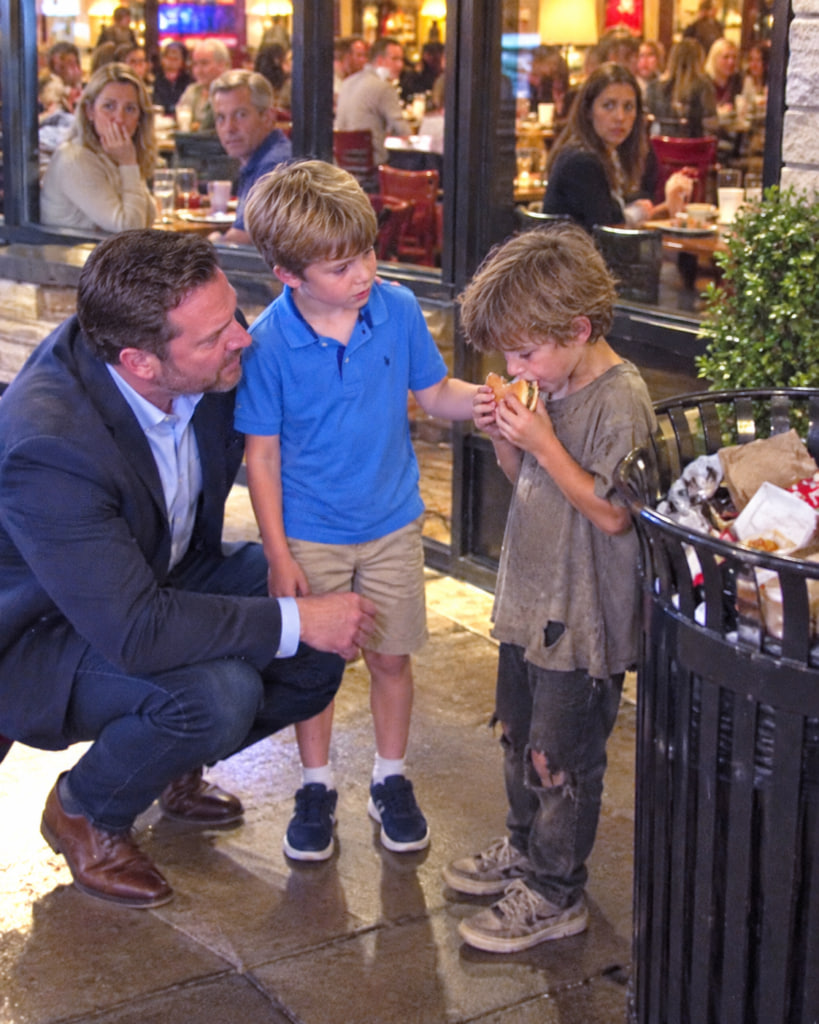
His pale blue eyes flicked toward the street, calculating whether he needed to run. James stopped several feet away and lowered himself slightly so he wasn’t towering over him. “Hey,” he said. “What’s your name?” The boy hesitated. “Connor.” “I’m James. This is my son, Elliot.” Elliot gave him a small nod.
No staring. No pity. James glanced at the burger in Connor’s hands. “Are you hungry?” Connor looked at the pavement and nodded once. “Then you’re coming inside with us.” Connor froze. Through the restaurant window he could see spotless tables, cold drinks, families in clean clothes. Then he looked down at his torn shirt and broken shoes.
He didn’t move until Elliot stepped beside him. “Come on,” Elliot said quietly. Like Connor belonged there. Inside, conversations dipped for a moment. A woman glanced at Connor’s clothes and quickly turned away. A man at the counter stared too long. Connor saw every look, and his shoulders pulled inward.
James acted as if none of them mattered. He pulled out a chair at their table. “Sit here.” Connor perched on the edge, hands pressed against his knees. When the waitress approached, James said, “Please bring him a full meal. Grilled chicken, mashed potatoes, vegetables and a large lemonade.” Elliot quietly slid the basket of dinner rolls toward Connor.
Connor grabbed one and finished it in three bites. Then he stopped, embarrassed. Elliot deliberately turned toward the window, giving him the dignity of pretending he hadn’t noticed. When Connor’s plate arrived, he stared at it before touching anything. Then he looked at James. “Why are you doing this?” James answered without lowering his voice.
“Because no little boy should have to eat discarded food outside a restaurant while the rest of us pretend not to see him.” Connor’s jaw tightened. He picked up his fork. James asked nothing while he ate. Only when Connor had slowed down did he gently ask where he lived.
“With my uncle Tommy,” Connor said. “Near the old rail yard.” “Does he know you’re here?” Connor shook his head. “He works double shifts on Saturdays.” “And your parents?” The boy’s fingers tightened around his lemonade glass. “My mom got sick. She died eight months ago. My dad left when I was little.”
Elliot went completely still. Connor stared at the table. “Uncle Tommy tries. He really does. But sometimes there’s food at home, and sometimes there isn’t.” James didn’t offer pity. Instead, he pulled a clean napkin toward himself and took a pen from his jacket. “Do you know your uncle’s number?”
Connor recited it from memory. James wrote it down. What Connor didn’t know was that James Mercer owned a successful logistics company and that while everyone else in that restaurant saw a hungry child, James had already started thinking about the problem waiting behind the hunger. He dialed. Four rings later, a tired man answered.
James explained who he was, where Connor was and that the boy was safe. There was a long silence. Then Tommy’s voice cracked through the phone. “Is he okay?” “He’s okay,” James said. “Can you come here when your shift ends?” “Seven,” Tommy answered quickly. “I get off at seven.”
James looked at Connor, then at the number written on the napkin. “Good,” he said. “We’ll wait.” But before James ended the call, he asked Tommy one more question. Tommy’s answer made James reach for a second napkin and write down an address. James kept the phone to his ear. “Tommy, what kind of work do you do?”
Connor looked up sharply. There was a pause before his uncle answered. Warehouse loading, temporary shifts, whatever hours he could get. No benefits. No guaranteed schedule. Some weeks the rent swallowed nearly everything. James wrote quietly while Tommy spoke. Then the restaurant door opened and a manager stepped toward their table, looking uncertainly from Connor’s torn clothes to James.
Before he could say anything, James slid the napkin into his pocket and asked for three meals to go. Connor stared at him. “Three?” “One for tonight,” James said. “Two for tomorrow.” Connor’s eyes filled, but James wasn’t finished. He unlocked his phone, opened his company contacts and selected a name Connor couldn’t see.
Then he typed one sentence and pressed send. Less than thirty seconds later, his phone rang. James answered immediately. “Mercer.” A woman’s voice came through the speaker. “Mr. Mercer, this is Rachel from human resources. I just saw your message. Are you sure you want me to do this tonight?”
James glanced at Connor. “Yes.” Connor watched him carefully. James turned slightly away from the table. “I need the warehouse position opened under emergency hiring. Full-time. Starting Monday. Eight hours a day, guaranteed schedule. Benefits from day one.” Rachel hesitated. “And the hourly rate?” “Twenty-eight dollars.” There was silence. “That’s significantly above the normal starting rate.”
“I know.” “And you want him hired without the usual interview?” “I want him interviewed tomorrow morning,” James said. “But I already know he can work.” Rachel paused. “Who is he?” James looked at Connor. “His name is Tommy Alvarez.” Connor’s eyes widened. He had never heard an adult talk about his uncle like that.
Not as someone who needed charity. Not as someone who had failed. But as someone who deserved an opportunity. James ended the call. Elliot leaned closer. “Is my dad helping him get a job?” James nodded. “A real job?” “A real job.” Connor stared at the table. “You don’t have to do that.”
James looked at him. “I know.” “Then why?” James took a slow breath. “Because sometimes people don’t need someone to rescue them. They need someone to open a door.” Connor swallowed hard. For the first time that evening, he looked directly into James’s eyes. “My uncle won’t take money.” “I figured.”