Part 1: The Girl Who Vanished at the Beach
My daughter Nora disappeared when she was sixteen years old, in the middle of a crowded beach where hundreds of people were walking, swimming, and laughing around us. Eight years later, nearly six hundred miles from home, the first real clue I found was not a phone call from the police or some miraculous message.
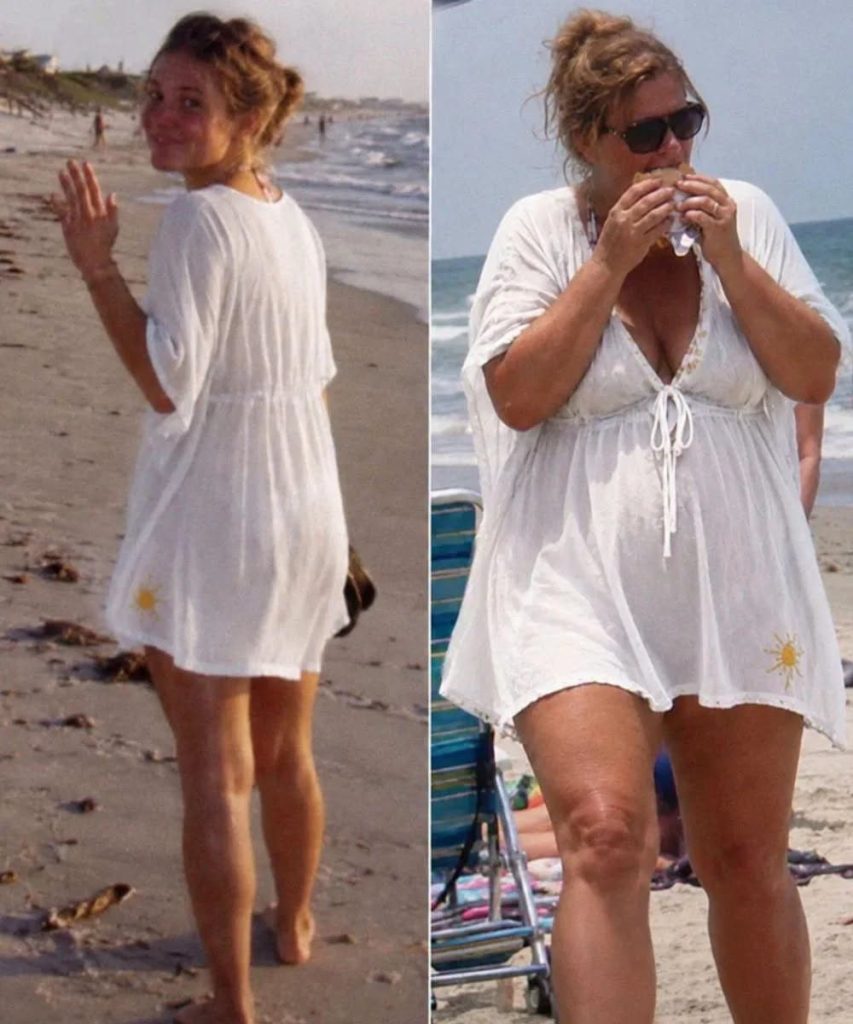
It was a faded turquoise cover-up being worn by a complete stranger.
The day Nora vanished had started like any ordinary family vacation. She was lying beside me in the sand when she suddenly stood and said she wanted ice cream from a stand farther down the beach.
I watched her walk away and remember thinking how tall she had gotten that year. Twenty minutes later, however, she still had not returned.
Her towel remained beside mine, with her sandals sitting neatly on top of it. More frighteningly, her phone was still inside her beach bag.
At first, I was annoyed because I assumed she had wandered off without telling me. Irritation quickly became confusion, and confusion turned into terror when another twenty minutes passed without any sign of her.
Lifeguards searched the water while police officers checked bathrooms, parking lots, nearby hotels, and every road leading away from the beach. They eventually located the ice cream stand, but none of the employees remembered seeing Nora.
There was no useful surveillance footage and no reliable witness. It was as though my daughter had simply stepped out of the crowd and disappeared.
The last thing she had been wearing was a turquoise cotton cover-up my mother had sewn for her that spring. Nora had torn one corner on driftwood during the first day of our vacation, and instead of hiding the repair, Grandma had stitched a tiny yellow sun over the damaged fabric.
The sun was slightly crooked.
“It looks weird now.”
My mother had laughed.
“It looks one of a kind.”
Nora rubbed the stitching between her fingers and smiled.
“I think I like it better this way.”
Those words stayed with me for eight years.
The photograph taken forty minutes before Nora disappeared showed her standing barefoot in the sand wearing that same cover-up. Police enlarged the image, news stations broadcast it, and volunteers printed thousands of flyers, but eventually the organized searches stopped and the calls became less frequent.
Life continued for everyone else. For my husband Michael and me, life simply reorganized itself around Nora’s absence.
Michael grew quieter while I became obsessed with every missing-person report, every unidentified young woman, and every stranger who claimed to have spotted Nora somewhere. Eventually, I stopped going near beaches altogether because even the sound of waves could drag me back to that afternoon.
Then, eight years after Nora vanished, Michael convinced me to spend a weekend in a coastal town nearly six hundred miles from home. I resisted until I saw how exhausted he looked and finally agreed, although I refused to go anywhere near the water.
We spent our first afternoon walking along the boardwalk. Michael had just bought coffee when we passed a café with outdoor seating and I noticed a woman near the railing.
She appeared to be around fifty and was wearing a faded turquoise cover-up.
There were probably thousands like it in the world, so I told myself it meant nothing. Then the wind lifted the bottom edge of the fabric.
A tiny yellow sun appeared near the hem. Crooked. Hand-stitched. Exactly where my mother had sewn it.
I crossed the café terrace before realizing I had started moving.
“Excuse me. Where did you get that?”
The woman looked down at the cover-up.
“I’ve had it for years.”
My hands began shaking as I pulled out my phone and found the old photograph of Nora. When I held it toward her, the woman stared at the picture, then at me, before suddenly grabbing my wrist.
“Put that away.”
Her voice dropped to a whisper.
“She can’t know you’re here.”
My heart seemed to stop.
“Who?”
The woman looked past my shoulder.
Then she whispered the name I had been waiting eight years to hear.
“Nora.”
Part 2: The Daughter Behind the Café Window
I turned so quickly that Michael nearly spilled the coffee in his hand. At first, all I could see were tourists moving along the boardwalk and servers weaving between tables, but then my eyes reached the café window.
A young woman in a black apron was carrying two plates toward a table. Her dark hair was tied into a low ponytail, her face was thinner and older than the sixteen-year-old girl preserved in every photograph I owned, but none of that mattered.
I knew her. A mother knows.
My knees weakened, and Michael caught my arm before I could stumble.
“What is it?”
I could not answer. The woman in the turquoise cover-up grabbed my other hand and spoke urgently.
“Please don’t go in there.”
“That’s my daughter.”
“I know.”
My heart slammed against my ribs.
“She’s alive?”
“Yes.”
Michael finally followed my stare through the glass, and his entire body went rigid.
“Oh my God.”
He immediately started toward the entrance, but the stranger stepped in front of him.
“No.”
Michael stared at her.
“Move.”
“Please. If you surprise her, she might panic.”
“That is our daughter.”
“I know exactly who she is.”
I said Michael’s name before he could push past her. Something in the woman’s expression stopped me because she did not look like someone trying to keep Nora away from us.
She looked terrified that Nora might run if she saw us without warning.
“Who are you?”
“My name is Elaine.”
She glanced through the window where Nora was laughing at something a customer had said. Hearing that laugh through the glass after eight years nearly broke me.
“How do you know my daughter?”
Elaine lowered her voice.
“I used to run a small women’s shelter about forty minutes from here. Nora came to us four years ago.”
The number hit me harder than I expected.
“Four years ago?”
“She was twenty.”
I stared at her.
“Where was she before that?”
Elaine closed her eyes briefly.
“With a man she couldn’t easily leave.”
Michael’s expression hardened immediately, while my stomach turned cold.
“What man?”
Elaine looked toward the café again.
“I think you should sit down.”
We moved to a small patio around the side of the building where Nora could not easily see us. Every instinct in me screamed to run inside, wrap my arms around my daughter, and refuse to let go.
Elaine kept repeating the same warning.
“If you surprise her, she may panic and leave.”
That possibility was the only thing strong enough to keep me in the chair.
Elaine explained that Nora had arrived at the shelter late one night with almost nothing. She had no phone, barely any money, no bag, and at first she refused even to give them her real name.
Weeks passed before she admitted that she had family somewhere else. Months passed before she finally confessed that she had disappeared as a teenager.
“She told you about us?”
“Eventually.”
“Then why didn’t you call the police?”
Elaine met my eyes.
“Because by then Nora was an adult, and she begged me not to contact anyone.”