I was twenty-nine and still trying to find my way through the grief of losing my mother.
Volunteering at a hospital became the only thing that made that pain feel like it had some purpose.
For almost a year, I spent time with patients who had no family beside them during their final days.
That’s how Julian came into my life.
He was seventy-two, frail, and dying from heart failure.
He always looked exhausted, but somehow he still smiled gently whenever I came to see him.
We began talking.
And within just a few days, our conversations became something both of us looked forward to.
Then one afternoon, Julian reached for my hand.
“Marry me, Nora,” he whispered.
My heart started pounding.
“Julian… you’re seriously ill. We barely know each other.”
“I don’t want the state handling my final hours,” he said, touching my fingers. “My last wish is to leave this world as a husband, not as a nameless file.”
I knew how strange the request was.
Still, two days later, a hospital chaplain married us.
I wore a yellow sweater.
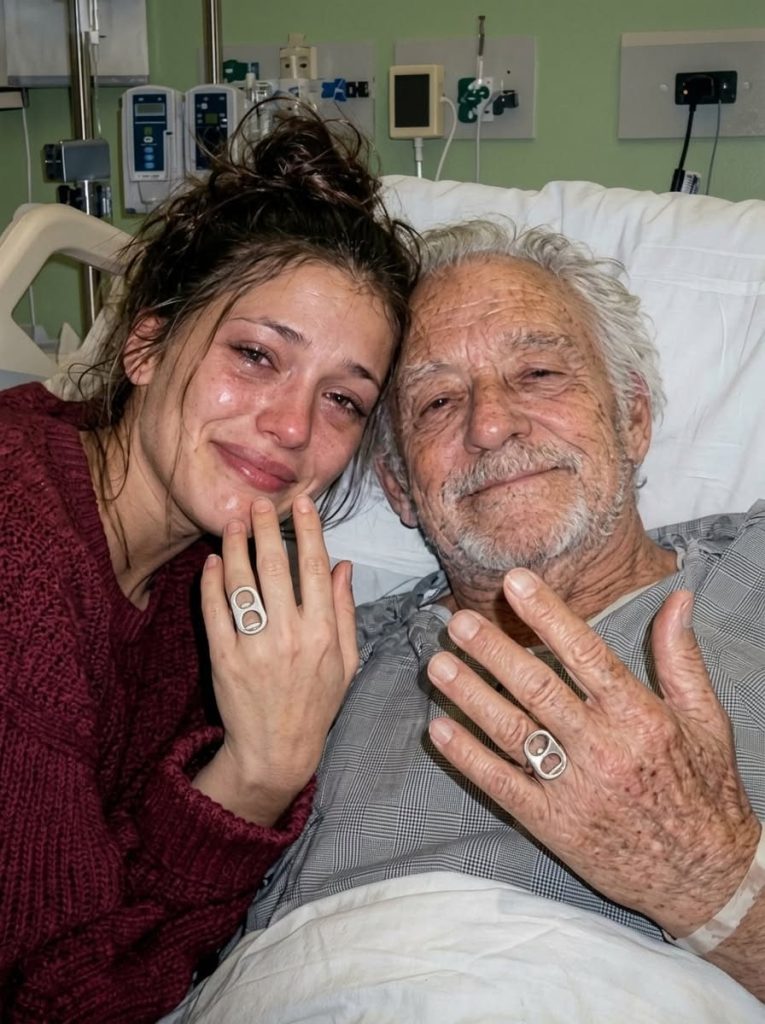
We didn’t have a wedding ring, so Julian slipped a soda can pull tab onto my finger instead.
For the next seven days, I never left his side.
I held his hand through every difficult breath until his heart stopped.
Afterward, I sat alone in his empty room, stunned by how much silence someone I’d known for such a short time could leave behind.
Then an elderly man walked in carrying a green backpack.
“Nora?” he asked. “I’m your husband’s attorney. He left this backpack for you.”
He placed it in my hands.
I immediately noticed how heavy it was.
The lawyer watched my face for a moment, then lowered his voice.
“Julian wasn’t who you thought he was, Nora,” the old man whispered. “He wanted you to know the truth.”
Part 2: The Red Dress and the Ledger
I unzipped the heavy green backpack with trembling fingers while the lawyer, an elderly man named Arthur Pendelton, stood by the window of the empty hospital room, watching me in solemn silence.
Inside rested three distinct items: a worn, leather-bound notebook, a legal deed wrapped in oilskin, and a folded piece of bright red silk fabric.
I pulled out the red silk first. As it unfolded in my lap, I realized it was a handmade vintage dress, small enough to fit a young child. The stitching was delicate, executed with meticulous care, though the hem was slightly frayed from age.
“What is this?” I whispered, my voice echoing in the quiet room.
“Forty-five years ago,” Arthur explained softly, “Julian was a master tailor in Chicago. He lived a quiet life with his first wife and his five-year-old twin children—a boy named Caleb, and a girl named Lily.”
My heart gave a sudden, painful lurch. Julian had never mentioned a family. He had presented himself to the hospital staff as a man completely alone in the world, a forgotten soul with no living kin.
“Lily’s favorite thing in the world was that red dress,” Arthur continued. “Julian made it for her fifth birthday. But that winter, a tragedy struck their home. A house fire caused by a faulty heating unit swept through their residence. Julian managed to pull his wife and his son Caleb out of the flames, but by the time he went back for Lily…” Arthur paused, clearing his throat against a sudden swell of emotion. “…it was too late. All he could save from her room was that red dress.”
I touched the soft silk, tears welling in my eyes. The grief I had carried for my own mother seemed to reach out and touch the ancient, agonizing sorrow sewn into every thread of the garment.
“After the tragedy,” Arthur said, “Julian’s marriage collapsed under the weight of grief. His wife moved away with young Caleb, cutting off all contact. Julian spent the next four decades living like a recluse, pouring every penny he earned from his tailoring business and quiet investments into a private trust fund.”
“Why did he marry me, Arthur?” I asked, looking up from the red dress. “Why a stranger he met in a hospital room?”
Arthur reached into his coat pocket and pulled out a sealed envelope, handing it to me. “Because Julian knew his time was short, and he knew his estranged son, Caleb—now a ruthless corporate developer—was searching for him. Caleb didn’t want reconciliation. He had discovered that Julian owned a prime piece of commercial real estate downtown—the original building where his old tailor shop stood—now worth millions. Under state law, if Julian died unmarried and intestate, the entire estate would automatically revert to Caleb.”
My breath caught in my throat. “And if he was married…?”
“Under the explicit terms of your marriage certificate and the deed in that backpack,” Arthur smiled faintly, “the entire estate, valued at over fourteen million dollars, belongs exclusively to you, Nora. Julian didn’t marry you just to avoid dying alone. He married you because he spent eleven months watching you comfort dying strangers, and he knew you were the only person who would use his legacy to do good.”
Arthur pointed to the leather notebook. “Open it. Julian wrote his final instructions to you on the last page.”
I opened the journal to the marked page, recognizing Julian’s neat, flowing handwriting:
My dear Nora,
If you are reading this, my heart has finally found its peace. Forgive me for keeping the truth from you during our short week together. I needed to know that your kindness was genuine, unpolluted by the promise of wealth.
The pull tab on your finger was a placeholder for a promise. The red dress belonged to my late daughter, Lily. The estate is yours. But beware: my son Caleb knows I am gone, and he will come for what he believes is his. Protect Lily’s memory. Protect the shop.
With all my gratitude, Julian.
Before I could process the weight of his words, the heavy wooden door of the hospital room slammed open.