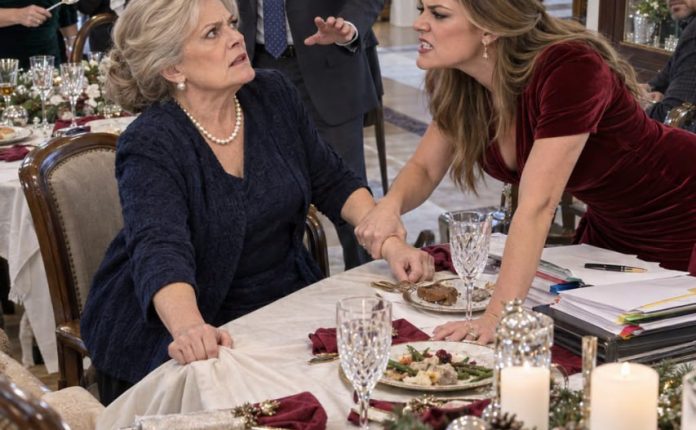
Tessa closed the door behind her and looked directly at Mason. Something passed between them that no lawyer needed to interpret. Luke saw it too. “Answer me,” he said. Mason’s shoulders dropped. Tessa whispered, “Luke, not here.” He laughed once, a broken sound. “My attorney, accountant, mother, wife, and business partner are all in one room. I cannot imagine a more relevant place.” Mason stared at the table. Tessa pressed her lips together. Then Luke asked again whether they were sleeping together. This time Tessa closed her eyes. She did not say yes. She did not need to. I noticed.
Luke stood, and his chair rolled into the wall. I reached for him, but he lifted one hand, asking me not to. His face had gone colorless. “How long?” Tessa whispered his name. “How long?” he repeated. Mason said, “About a year.” Luke turned toward him with an expression I had never seen on my son. There was rage in it, but beneath the rage was grief. Mason had been his friend since college. He had stood beside Luke at his wedding, carried Robert’s casket, and toasted our family at company anniversaries. One year sounded impossibly small beside that history.
Tessa began talking quickly. She said the relationship had started during a trade conference after months of tension at home. She said Luke was always exhausted, always distracted, always thinking about production deadlines. She said Mason listened. Nothing she said was impossible. Marriages can become lonely without either person becoming innocent. Luke listened until she said, “It wasn’t planned.” Then he pointed toward the Northline documents. “Maybe the affair wasn’t planned. This was.” Tessa’s mouth closed. Angela stepped forward before anyone could continue. “Personal issues are separate. We need to preserve records and restrict access before this discussion contaminates evidence.”
Within fifteen minutes, Angela had directed the controller to suspend Tessa’s company credentials and remove Mason’s unilateral payment permissions pending review. Luke had authority to do that as chief executive and majority individual shareholder. Mason protested that the action violated their partnership agreement. Angela replied that temporary controls were permitted when related-party transactions had not been disclosed. I watched Tessa realize the room had shifted away from emotion toward documentation. She had always been strongest when conversations remained personal, where tone and loyalty could blur facts. A ledger did not care who felt misunderstood. Neither did a corporate access log.
Mason insisted Northline had performed real work. Frank asked for deliverables. Mason promised to provide them. Angela asked for contracts. He said some were still being finalized. Luke asked why company funds had gone to an entity controlled by Mason’s sister and Luke’s wife. Mason snapped, “Because we were building something efficient instead of waiting for you to approve every small decision.” There it was again: Luke’s caution reframed as incompetence. I had heard Tessa use the same language. Robert used to say manipulation became powerful when two people repeated the same criticism until it sounded like independent confirmation. Still.
Tessa turned on me. “You must be thrilled.” I felt everyone watching. “No,” I said. “My son learned his wife and best friend betrayed him. There is nothing here I wanted.” Her eyes filled. “You never thought I was enough for him.” “I thought you were smart, ambitious, and sometimes cruel.” She recoiled. “Cruel?” I laughed. “night you entertained your friends with the most detail of my grief because you knew I would stay quiet.” Tessa looked away. “That joke has nothing to do with this.” “It has everything to do with what you believed you could get away with.”
Luke asked Tessa to leave the office and told Mason to remain available to counsel. She stared at her husband. “You’re choosing your mother over me.” Luke shook his head slowly. “No. I’m choosing facts over whatever story you’re trying to make this.” The sentence seemed to surprise him as much as it surprised her. Tessa picked up her purse and walked out without another word. Through the conference-room glass, I watched employees arriving for work, unaware that the company’s leadership had fractured before sunrise. Mason sat motionless at the far end of the table, suddenly looking older than forty.
Angela asked Mason for his laptop and company phone. He refused until she reminded him both devices belonged to the business under the technology policy he had approved himself. That irony made Luke smile. Mason handed them over. Then he stood and said he would retain separate counsel. “You should,” Angela replied. He looked at Luke before leaving. “Whatever you think this is, we built this company together.” Luke answered quietly, “My father built it. We were supposed to protect it.” Mason flinched, then walked out. I heard Robert in Luke’s words so clearly that I had to look away.
After Mason left, Luke sank into a chair. Frank and Angela gave us privacy while they coordinated the review. For several minutes, neither Luke nor I spoke. Machines hummed faintly beyond the office wall as the first production shift began. Finally Luke said, “I brought him into Dad’s company.” I reminded him that Robert had approved Mason’s partnership. “Dad trusted him too.” Luke rubbed his eyes. “Dad trusted him with thirty percent. I trusted him with everything else.” I wanted to tell him trust was not a moral failure. Instead, I said, “The person who violates trust owns that choice.”
Luke went home to collect clothes. Tessa was there. I offered to come, but he said he needed one conversation without witnesses. He called me two hours later from a hotel. His voice sounded scraped raw. Tessa admitted the affair but insisted Northline was not theft. She described it as a venture Mason intended to launch after negotiating an exit from Caldwell and Pierce. Luke asked why his company had paid that venture hundreds of thousands of dollars. Tessa said those payments reflected legitimate consulting. Luke told her the accountants would decide whether that explanation matched the records. That mattered.
I returned to my own house and finally cried. Not the controlled tears I had shed during Robert’s funeral, when people kept bringing casseroles and asking what I needed. I sat on the bedroom floor beside the cedar chest and cried until my throat hurt. The green flannel shirt was still beneath my pillow. I held it and felt foolish for having let Tessa’s joke make me ashamed of the one private comfort that had never harmed anyone. Robert had known every version of me: impatient, frightened, stubborn, lonely. He would have hated seeing tenderness treated as weakness. I noticed.
That evening, I opened Robert’s old files. I had not touched most of them since probate. He kept notes in thick black binders because he distrusted computer folders he could not physically point at. One section contained shareholder correspondence from the year Mason bought into the company. Robert had written comments in the margins. Beside Mason’s proposed expansion plan he had scribbled, Smart, but moves fast when he smells opportunity. Beside another page: Luke sees loyalty before leverage. I traced the handwriting and wondered how much Robert had understood about the two young men long before either one understood themselves.
The forensic review began Monday and consumed the next three weeks. Frank’s team compared invoices, emails, approval chains, vendor records, and bank activity. I attended only the shareholder briefings because I had no desire to hover over Luke while his marriage disintegrated. The first confirmed figure was four hundred twelve thousand dollars paid to Northline over eight months. Some services appeared legitimate. Others had weak documentation, duplicated descriptions, or no evidence that promised work occurred. The review did not label the entire amount stolen. It did establish that the related-party relationship should have been disclosed and had not been. Enough.
The more troubling discovery concerned company performance. Mason had repeatedly warned Luke that margins were tightening and cash reserves were falling. Those reports helped justify outsourcing procurement work to Northline. Frank’s team reconstructed the numbers using underlying project data. The company was not struggling the way Mason had described. Several profitable jobs had been burdened with unusual consulting expenses, making divisions appear weaker on internal summaries than they actually were. Luke sat beside me during the presentation, jaw clenched. “He kept telling me we needed outside capital,” he said. Frank nodded. “The reports would have supported that argument.” I remembered.
Six months earlier, Mason had proposed bringing in a private investor. Luke resisted because Robert had spent decades keeping outside ownership away from the business. Tessa had urged him to reconsider. I remembered a family dinner when she joked that Luke was preserving the company like a museum. At the time, I thought it was ordinary marital disagreement. Now Angela produced a draft transaction from Mason’s files showing a different plan. The “investor” was a holding company connected to one of Mason’s longtime associates. The proposed valuation was significantly below the company’s independent appraisal from the previous year. That mattered.
If Luke had accepted, the new investor and Mason together would have gained substantial voting influence. My twenty percent would still matter, but Luke’s control would have weakened. Angela was careful not to claim intent beyond the documents. Luke did not need her to. He saw how the pieces aligned: depressed internal reports, pressure to accept capital, growing payments to Northline, and a document waiting for his signature. “Was Tessa part of the investment plan?” he asked. Angela paused. “Her company email contains messages discussing how to persuade you. We are still reviewing whether that crossed professional lines.” I noticed.
It had. Tessa had written to Mason that Luke responded better when financial pressure sounded like concern about his health. She suggested emphasizing his long hours, his headaches, and the stress the company placed on their marriage. Reading those words nearly broke him. They were not fabricated concerns; Luke really was exhausted. That made the manipulation worse. Tessa had taken real vulnerabilities from their marriage and converted them into strategy. I understood suddenly why her joke about Robert’s shirt had unsettled me beyond embarrassment. She treated private knowledge as material, something useful if released at the right moment. Luke noticed.
Luke filed for separation before the forensic review ended. He did not announce it to the family. Tessa did. Her mother called me and accused Luke of abandoning his wife during “a business misunderstanding.” I listened until she finished. Then I said, “Your daughter can explain the business records to her lawyer. Luke will explain his marriage to his own.” She asked whether I had poisoned him against Tessa. For once, I did not defend myself. “Believe whatever helps you sleep,” I said, and ended the call. I was learning that not every accusation deserved the dignity of a rebuttal.
Tessa moved into her sister’s townhouse. Luke remained in the marital house because the mortgage and utilities were already tied to accounts he controlled. He told me the silence there was unbearable. I invited him to stay with me, but he declined. “I need to know I can sit in my own house without running from it,” he said. I recognized the instinct. After Robert died, I had kept sleeping in our bedroom for the same reason. Grief changes shape depending on what died. Luke had not lost Tessa physically. He had lost the marriage he believed he had lived.
Mason’s attorney eventually delivered a response denying intentional wrongdoing. He described Northline as an innovative procurement platform, disputed the forensic interpretation of several invoices, and insisted the investment proposal had been a legitimate effort to strengthen the company. Angela did not argue in letters. She prepared for the special shareholder meeting instead. Under the bylaws, Luke and I together controlled seventy percent of voting shares. That was enough to remove Mason as an officer and terminate his management authority, though not enough to erase his ownership. For the first time in four years, my silent twenty percent had a voice.
Before the meeting, Luke asked whether I could vote objectively. The question did not offend me. “Your father left me shares, not instructions to protect your feelings.” Luke nodded. “Good.” I reviewed the forensic report independently, met with Angela without Luke present, and asked every question I could think of. Some Northline work had genuine value. Some decisions were defensible. But related-party transactions had been concealed, approval records were misleading, and Mason’s affair with an employee who helped support those transactions created obvious conflicts. I did not need to hate him to conclude he could no longer manage Robert’s company.
The special meeting lasted three hours. Mason attended with two lawyers. Tessa was not present because she held no shares. Luke read a statement summarizing lost trust and governance failures. Mason accused him of mixing marital anger with corporate judgment. Then I spoke. “My vote has nothing to do with who slept with whom,” I said. “It has to do with concealed relationships, incomplete disclosures, and management decisions that prevented shareholders from understanding where company money was going.” Mason looked at me as though he had forgotten I could speak in a business setting. That mistake was becoming familiar. Exactly.
When the vote was called, Luke voted to remove Mason as president of finance and operations. I voted with him. Mason voted against. Seventy percent carried the resolution. He remained a shareholder pending negotiation of a buyout, but his access to company accounts, staff, and systems ended immediately. Afterward he caught me near the elevator. “Robert would hate what you’re doing to the company,” he said. I looked at him. “Robert wrote the bylaws you just lost under.” Mason’s face tightened. “You think Luke can run this without me?” “I think that question is finally his to answer.” We waited.
The company did not collapse. That surprised people who had mistaken Mason’s importance for indispensability. Luke promoted Denise, the controller, to interim finance director and hired an outside procurement firm with no family connections. Production continued. Clients stayed. A few projects slowed while records were rebuilt, but the predicted disaster never arrived. Luke began leaving work before eight at night for the time in years. “Turns out half my stress came from reports designed to make me feel behind,” he told me. He sounded angry, but also relieved, as if someone had removed a weight he had mistaken for gravity.
The personal evidence arrived more slowly. During discovery in the divorce, Tessa’s attorney produced portions of her communications with Mason. Luke chose not to show me most of them. I respected that. One afternoon, however, he came to my house carrying printed pages and asked me to read a specific exchange. Tessa had sent Mason a photograph from our last Christmas. I was in the background wearing Robert’s old flannel shirt over leggings while helping in the kitchen. Her caption read, She still wears his clothes. I swear grief is her whole personality now. Mason replied with a laughing reaction.
I stared at the page longer than it deserved. Luke apologized as if he had written the message himself. “Mom, I am so sorry.” I folded the paper once. “You did not send it.” “I told her about the shirt originally.” “Because I told you.” “.” The guilt in his face looked painfully familiar. I had spent years blaming myself for trusting people who later mishandled what I gave them. “Listen to me,” I said. “A confidence is not a mistake because someone betrays it. The betrayal belongs to them.” Saying the words to Luke helped me believe them about myself.
There were worse messages. Tessa and Mason had discussed leaving their relationship after Mason’s position improved. She complained that divorce would be easier once Luke stopped believing he could afford to keep both the company and the house. Mason joked that Luke’s mother would “write another rescue check” if things became difficult. That line angered me more than the mockery. I had never written rescue checks. I had invested when Robert asked, lent Luke money for equipment that he repaid, and otherwise stayed financially separate. They had invented a weak version of me because it made their plans feel safer.
Tessa’s explanation came through mediation. She admitted the affair and acknowledged that failing to disclose her relationship to Northline was wrong. She denied helping steal money and maintained that she believed the consulting work justified the payments. She also said she had become resentful after years of feeling like Luke’s company came before their marriage. I believed that resentment was real. Luke believed it too. Neither fact excused deception. People often want motives to function like erasers. They do not. Understanding why someone crossed a line can explain the path without moving the line. I carried that memory for years.
Mason eventually agreed to a negotiated buyout after months of legal pressure and independent valuation. The price reflected his legitimate ownership interest while accounting separately for disputed company claims that remained subject to settlement. I never learned every dollar because Angela advised shareholders not to discuss confidential terms publicly. I did not need the details. What mattered was that Caldwell Millwork ended the year with cleaner books, clearer controls, and no hidden related-party vendors. Luke changed the company name back to Caldwell Architectural Millwork. He worried that seemed petty. I told him names should describe who is standing behind them.
Tessa and Luke’s divorce became final the following spring. They had no children, which spared them the most painful kind of continuing negotiation. She kept several marital assets, Luke kept the house after refinancing, and both walked away with less certainty than they had brought into the marriage. Tessa sent me a handwritten apology two weeks after the decree. She wrote that the birthday joke had been cruel and that she had used my grief to make herself feel powerful in front of friends. It was the first time she named the harm without calling it humor. Luke noticed too.
I read her letter at my kitchen table with Robert’s green shirt folded across the chair beside me. Tessa also apologized for the affair and for assuming I would use my company shares to protect Luke from consequences. She did not ask forgiveness. That mattered. The line said, I kept treating other people’s pain like information I could spend. I am trying to understand why. I believed she meant that, at least when she wrote it. I put the letter in a drawer. I did not respond. An apology can be sincere without creating an obligation to reopen a relationship.
Luke struggled after the divorce in quiet ways. He could handle lawyers, audits, and shareholder meetings. He struggled with grocery shopping for one person and waking in a house where another toothbrush used to stand. He started therapy after pretending that work was enough. One Sunday he came over carrying takeout and said, “I think I understand why you kept Dad’s shirt.” I smiled. “Do you?” He looked embarrassed. “I kept one of Tessa’s coffee mugs because throwing it away felt too final.” “Then keep it until it doesn’t.” Grief does not become dignified because outsiders approve of its object.
My own relationship with the company changed too. I did not become an executive. I had no desire to spend retirement arguing about lumber contracts. But I joined the governance committee Angela created and insisted that related-party transactions, conflicts, and major vendor changes be documented clearly. Luke joked that Robert’s brake pedal had finally been installed. I told him I preferred seat belt. “Less dramatic.” He laughed. For the first time, my twenty percent felt less like a relic from my marriage and more like a responsibility I had consciously chosen to understand. I carried that answer with me afterward.
Several months after the divorce, I attended the company’s annual dinner. I almost skipped it because the previous year’s celebration had included Mason and Tessa at our table, smiling for photographs while carrying secrets. Luke asked me to come anyway. The event was held in a restored warehouse downtown, with long tables made by the company’s apprentices. During his remarks, Luke thanked employees who had kept working through a difficult transition. He did not mention scandal. He did not mention betrayal. Then he thanked me for “asking one uncomfortable question when everyone else was moving too fast.” I remembered afterward.
I laughed with the room, but later I told him that was not exactly what happened. “I used Tessa’s text to retaliate because she embarrassed me.” Luke shook his head. “You said something impulsive. Then we checked whether it mattered.” That distinction stayed with me. I had worried that because my motive in speaking was not noble, the information somehow became less legitimate. Life is messier than that. Sometimes the truth enters a room through anger, jealousy, fear, or accident. What matters afterward is whether people verify it, act responsibly, and resist turning suspicion into certainty before the evidence arrives.
The birthday-party guests disappeared from my life, with one exception. Tessa’s friend Hannah called months later. She had been one of the women who laughed when Tessa imitated my grief ritual. “I’ve wanted to apologize,” she said. “I laughed because everyone else looked like they were waiting for someone to laugh.” I understood that more than she expected. Families and groups create tiny currents of permission. People join cruelty because resisting it feels socially expensive. “Thank you,” I said. “But next time somebody makes private pain the entertainment, make the room uncomfortable.” Hannah promised she would try. We understood later.
The most surprising apology came from Luke. Not for the affair, of course, but for all the years before it. He admitted he had often asked me to ignore Tessa’s comments because challenging her made evenings harder. He remembered jokes about my clothes after Robert died, my refusal to date, my habit of leaving Robert’s chair untouched. “I told you she didn’t mean anything by it,” he said. “I think I meant I didn’t want to deal with it.” I appreciated the honesty. Keeping peace is often deciding whose discomfort counts. For too long, mine had been easiest to spend.
One year after Tessa’s birthday, Luke asked what I wanted to do on Robert’s anniversary. In previous years, I stayed home and cooked his favorite stew. This time I suggested driving to the Blue Ridge overlook where Robert proposed. We brought sandwiches and sat beneath bare trees while wind moved over the valley. Luke asked whether I slept with the flannel shirt. “Sometimes,” I said. He nodded. No joke. No pity. information treated gently. That respect felt more healing than any grand speech could have been. Privacy is not secrecy. It is the right to choose who receives something tender.
That evening, when I returned home, I found Tessa’s apology letter in the drawer and read it once more. Then I placed it inside a box with company documents I planned to archive. I did not tear it up. I did not frame it as evidence of victory. It belonged to a finished chapter. Robert’s shirt went back beneath my pillow. I turned off the lamp and realized I no longer heard Tessa’s party voice when I touched the fabric. Her joke had lost access to the memory. What remained was Robert, cedar, winter, and forty years of being known.
The company’s forensic report arrived a few weeks later. Angela summarized it for shareholders rather than reopening every ugly detail. Some Northline payments were supported by genuine services; others were resolved through the settlement with Mason. No report could measure the damage done by the affair, manipulated pressure, or broken trust. That was not its job. The report did something narrower and more useful. It created a record. Transactions, responsibilities, conflicts, corrections. Robert had loved records because memory changes under pressure. I understood why. Documentation cannot heal a family, but it can stop a lie from becoming the surviving version.