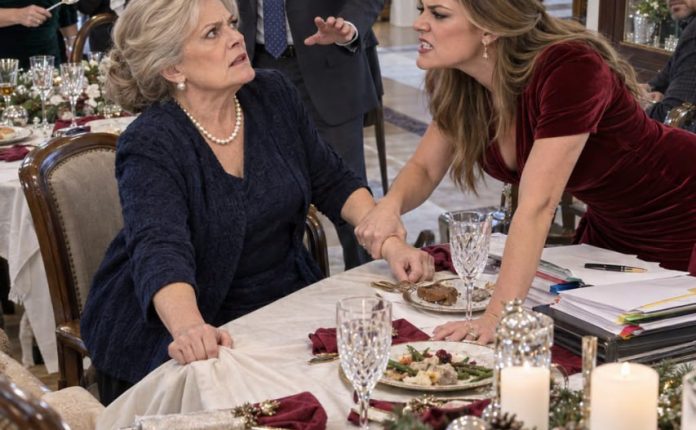
At my daughter-in-law Tessa’s thirty-fourth birthday party, the laughter turned toward me without warning. She had been telling stories about everyone in the room, harmless things at first, until she lifted her wineglass and announced that I still slept with my late husband Robert’s old flannel shirt tucked beneath my pillow. The room went oddly quiet before two of her friends laughed. Tessa imitated the way I supposedly whispered goodnight to it, adding details I had never told anyone except my son Luke. My face burned, not from grief this time, but from realizing she had turned it into entertainment.
Robert had been gone four years, and most days I functioned well. I volunteered at the Richmond literacy center, managed the small investment account he left me, and met friends for coffee without dissolving every time someone mentioned marriage. But some nights, especially around anniversaries, grief arrived with the old force. On those nights I kept Robert’s faded green shirt beneath my pillow because it smelled of cedar from his closet. I had admitted that to Luke during one terrible Christmas Eve after everyone else went home. I never imagined the confession would become a punch line beside birthday cake.
Tessa knew exactly what she was doing. She leaned against the kitchen island in a satin blue dress, smiling while her friends waited for the next joke. “Mom has this whole ritual,” she said, calling me Mom only when it suited her. “Apparently Dad’s shirt gets the better side of the bed.” Someone gave a nervous chuckle. Another guest studied his plate. Luke was across the room talking to his business partner Mason and had not heard the beginning. I asked Tessa to stop. She only widened her eyes, as though my discomfort were the funniest part of the story.
“I’m serious,” I told her quietly. “That was private.” Tessa shrugged and reached for the champagne bottle. “What’s the big deal, Mom? It was just a joke.” The sentence landed with the casual cruelty of someone certain she controlled the room. I could have walked away. For years, I had been the person who swallowed discomfort to keep Luke’s marriage peaceful. Instead, I nodded and said, “Right. And I figured what I saw on your phone screen yesterday wasn’t such a big deal either.” Her hand stopped above the bottle before her fingers touched the glass. Luke understood that too.
Luke returned at the wrong moment, carrying two fresh drinks and smiling because he had missed the tension. “What did you see, Mom?” he asked. Tessa’s face changed so quickly that he noticed. The color left her cheeks, and the smile disappeared. Mason, standing several feet behind Luke, lowered his own glass. I looked from Tessa to my son and realized I had not planned beyond that sentence. I had wanted her to understand how it felt when private information became public. Then I remembered the words that had flashed across her lock screen while we decorated the day before.
“Your phone lit up on the kitchen counter yesterday,” I said. “A message from Mason appeared.” Luke turned slightly, looking toward his partner. Tessa answered too. “We work together. Mason messages me all the time.” That was true. Tessa handled client events for Caldwell and Pierce Architectural Millwork, the company Robert founded before Luke and Mason expanded it. I had never cared who texted whom about business. What bothered me was the preview itself. I could still see the sentence glowing against her screen: Once Luke signs tomorrow, the last transfer clears. Then we can stop pretending everything is normal.
Luke stared at Tessa. “What transfer?” She laughed, but the sound came out thin. “Vendor restructuring. You know about it.” Luke’s brow furrowed. He had mentioned paperwork several times that week, but only as a routine authorization related to consolidating suppliers. Mason stepped forward with his professional smile, the one I had watched charm bankers and contractors for a decade. “Miriam probably saw one piece of a conversation without context,” he said. “There’s nothing mysterious here.” I looked at him. “Then perhaps you can explain why the message ended with, I’m tired of hiding what this really is from him.”
The party noise disappeared as people realized the argument was no longer entertaining. Luke set both glasses on the counter. “Mason?” he said. His partner rubbed a hand over his jaw. “This is not the place to discuss company operations.” Tessa seized the opening. “. Your mother is angry because I made a joke, so now she’s trying to create drama.” I admired how she rearranged the facts. Ten minutes earlier she had treated my grief as harmless public material. Now privacy had become sacred because the information belonged to her. Luke did not look at me. He kept watching Tessa.
“Show me the message,” Luke said. Tessa folded her arms. “Absolutely not. You don’t get to demand my phone because your mother misread a notification.” Luke’s face tightened. They had been married eight years, and I had seen them fight before, but this was different. He was not angry yet. He was calculating. “I’m not asking for your entire phone,” he said. “I’m asking you to show me one conversation with my business partner about a transfer I’m supposed to authorize.” Tessa glanced at Mason. It lasted less than a second, but Luke saw it. So did I. I remembered.
Mason stepped in. “Luke, don’t do this in front of everyone.” Luke laughed once, without humor. “You were comfortable discussing my signature with my wife without me.” Tessa snapped, “Because you never read anything unless someone puts it under your nose.” That sounded more like Tessa, impatient whenever Luke questioned the systems she and Mason had built around him. Luke ran the production side of the company. Mason handled finance and expansion. Tessa coordinated client relations. That division had become efficient enough that Luke joked he could build a staircase blindfolded but could not find his expense reports. That mattered.
I had once admired that arrangement. Robert started Caldwell Millwork in a rented warehouse with three employees and a secondhand planer. When he became ill, Luke left a larger firm to help him. Mason, Luke’s college roommate, joined two years later and transformed the bookkeeping, bids, and commercial contracts. After Robert died, the business became Caldwell and Pierce. Luke owned half. Mason owned thirty percent. I inherited Robert’s remaining twenty percent through a trust. I had never interfered because Robert’s instruction to me was simple: Let Luke run it unless someone gives you a reason not to trust the numbers.
For four years, I had seen no reason. Dividends arrived on schedule. Annual reports looked strong. Luke seemed exhausted but proud. Mason spoke respectfully whenever he called me for signatures on formal shareholder matters. Tessa often teased that I was the “silent investor,” and I preferred it that way. I had spent most of my marriage beside a man whose business filled every dinner conversation. After his death, I wanted distance from payroll, vendor disputes, and quarterly projections. What I did not realize was that my silence had become invisible authority, a legal right everyone assumed I would never use.
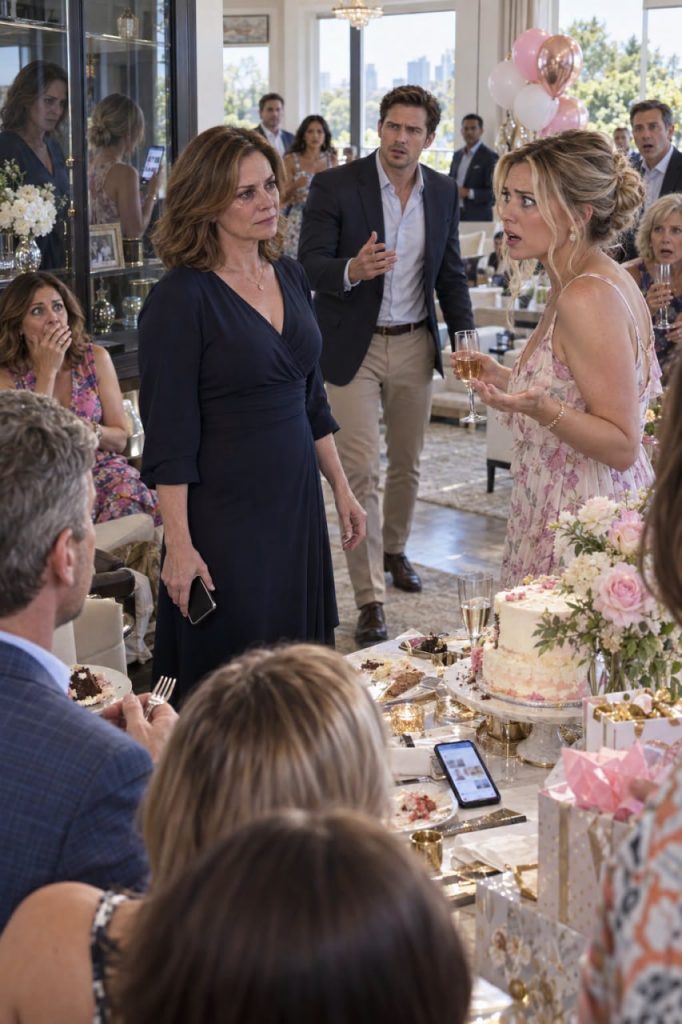
The birthday party ended in fragments. Tessa’s friends collected purses without meeting anyone’s eyes. Luke’s sister-in-law offered to help clean, then decided against it. Mason left after telling Luke they would talk Monday at the office. Tessa disappeared upstairs. I remained in the kitchen because Luke asked me to stay. The half-cut cake sat beneath gold candles spelling thirty-four. A banner sagged across the dining-room doorway. Twenty minutes earlier, Tessa had been laughing at my grief. Now Luke stood beside the sink staring at the dark screen of his phone as though waiting for it to explain his marriage. Enough.
“I should not have said it like that,” I told him. Luke looked up. “Said what?” “The phone message. I used it because I was embarrassed and angry.” He shook his head. “Mom, if you saw something important, I needed to know.” I hated how tired he looked. “I only saw the preview. I did not touch her phone.” Luke nodded. “I believe you.” That simple sentence almost hurt more than the party. He believed me immediately, which meant some part of him was already carrying doubts I knew nothing about. Before I could ask, he opened his banking app.
The company operating account looked normal at first glance. Luke did not have the detailed accounting permissions Mason used, but he could see current balances and major outgoing payments. He scrolled through recent transactions, frowning. “Northline Strategy,” he murmured. I knew the name vaguely from conversations about supplier consolidation. Three transfers appeared over six weeks, each large enough to make me sit straighter. Luke tapped one. “This was supposed to be vendor deposits,” he said. Another carried the same memo. A third had been processed two days earlier. Combined, they represented more money than Robert paid for our first house.
“Who owns Northline?” I asked. Luke kept staring at the screen. “Mason said it was a procurement consultant helping us renegotiate contracts.” “Did you meet them?” He shook his head. “He handled it.” That answer seemed to embarrass him. I placed my hand over his for a moment. “Trusting your partner is not stupidity.” Luke gave me a bitter smile. “Depends what he does with it.” He searched his email and found the authorization Tessa had mentioned. The document would increase Northline’s payment ceiling and allow accelerated disbursements for ninety days. Luke had planned to sign it after the party.
Tessa came downstairs while we were still reading. Her makeup had been removed, and she had changed into sweatpants. For a moment she looked younger, almost frightened. “You’re really going through company records at my birthday party?” she asked. Luke turned the laptop toward her. “What is Northline Strategy?” She stopped two steps above the floor. “Ask Mason.” “I’m asking you because your text conversation mentioned my signature.” Her mouth tightened. “Mason and I coordinate vendor events. I see payment schedules.” Luke pointed at the screen. “Why would a client-relations director be discussing accelerated transfers with the finance partner?” Exactly.
Tessa descended the remaining stairs slowly. “Because I help more than you notice.” That sentence was true, which made everything harder. She had spent years making the company’s luxury residential clients feel important, organizing architect dinners, trade-show booths, and referral events. Robert had liked her ambition. I had too. Luke said, “Then explain it.” Tessa looked at me instead. “You wanted this, didn’t you?” I felt my shoulders tense. “Wanted what?” “A reason to make me look bad.” I stared at her, stunned by the accusation. “You made me the joke tonight. I did not create whatever is happening now.”
“You have never liked me,” she said. I answered defensively, then stopped. The truth was more complicated. I had liked Tessa when Luke first brought her home. I admired her energy, her confidence, the way she could walk into a room of older executives and own the conversation. Over time, admiration became caution. She enjoyed knowing things other people did not. She collected private details and later released them as jokes, observations, or leverage., I had told myself that was personality, not malice. Luke loved her. I wanted to respect his choice. So I learned to ignore the small moments.
Luke said, “This is not about whether Mom likes you.” Tessa’s eyes filled instantly. “Of course it is. She humiliated me in front of my friends.” I felt heat rise through my chest. “You announced how I sleep with my dead husband’s shirt.” She waved one hand. “It was affectionate.” “No,” I said. “It was intimate. Those are not the same thing.” For the first time that evening, Tessa had no quick answer. Luke closed the laptop. “I am not signing anything until I understand Northline. That is not negotiable.” Tessa looked toward the door Mason had used. That mattered.
Her reaction confirmed more than any argument could. “You already promised him,” Luke said quietly. Tessa crossed her arms. “I told Mason you would sign because it makes financial sense.” “Without asking me?” “You asked him to streamline vendors.” “Not to move money I haven’t reviewed.” Tessa’s face hardened. “This is why nothing gets done quickly. Every time Mason tries to modernize something, you want to inspect screws and receipts like your father did.” Luke flinched. Robert’s carefulness had always been both a family joke and the reason the company survived several bad years. Tessa knew that comparison would sting.
I remembered a conversation with Robert from the last summer of his life. We had been sitting on our screened porch while he reviewed company statements despite chemotherapy leaving him exhausted. He pointed to a clause in the trust documents and said, “Miriam, this twenty percent is not a gift. It is a brake pedal.” I laughed and told him Luke would never need me interfering. Robert did not laugh. “Luke trusts people longer than I do,” he said. “That’s one of his best qualities. It can also become expensive. If something ever feels rushed, slow it down.” Luke noticed.
At the time, I thought he was worrying because illness made every future risk seem larger. That night, standing in Luke’s kitchen, I heard Robert’s words with painful clarity. I asked Luke whether the vendor authorization required shareholder approval. He shook his head. “Not normally. It’s within management authority.” “But changes to ownership or borrowing?” “Those do.” Tessa’s head turned toward me. The movement was small but immediate. I noticed. “Why?” Luke asked. “Because your father made me promise I would remember the difference.” Tessa laughed sharply. “Please don’t turn this into some message from beyond the grave.” We waited.
I ignored her. “Do you have the operating agreement?” Luke nodded toward his office. We moved there, leaving Tessa in the kitchen. The office had once been a dining room, now crowded with samples of walnut, oak, brass hardware, and rolled plans. Luke opened a fireproof drawer and pulled out a binder. Robert’s original shareholder agreement had been amended twice since Mason joined. I found the clause I remembered. Any change involving new secured debt above a certain threshold, sale of core assets, or transfer of voting control required approval from holders representing at least seventy-five percent of the company.
Luke read the clause twice. “Mason and I together have eighty percent.” “Yes,” I said. “If you both agree.” Luke looked at me. “And if I don’t?” “Then Mason cannot do it alone.” Tessa appeared in the doorway. “Nobody is changing ownership.” Her voice came too quickly. Luke turned. “Who said they were?” She realized the mistake instantly. “I’m saying Mom is inventing possibilities.” I watched Luke’s face become still. “I didn’t mention ownership,” he said. Tessa looked trapped for one heartbeat, then angry. “This is absurd. You two are interrogating me because of one message.” The silence answered enough.
“Unlock the phone,” Luke said. Tessa stared at him. “No.” “Then tell me why Mason wrote about my signature and said you could stop pretending afterward.” “Because we are planning something for the company.” “What?” “I cannot explain every conversation out of context.” Luke stepped back, as though distance might help him see her more clearly. “You could explain one.” Tessa’s jaw trembled. I realized she was not only angry. She was afraid. The discovery did not satisfy me. It frightened me, because Tessa had never been afraid of disagreement. She was afraid of information. That detail mattered much later.
She grabbed her purse from the entry table. Luke followed. “Where are you going?” “To my sister’s.” “Tessa.” “I am not spending the night being treated like a criminal because your mother saw a text.” She opened the door, then turned toward me. “Congratulations. You finally got what you wanted.” I felt something inside me go cold. “I wanted you to stop humiliating me.” Her eyes narrowed. “Same thing.” Then she left. Luke stood in the open doorway as cold November air moved through the hall, carrying the distant sound of traffic from the main road. That stayed with me.
After she drove away, Luke sat on the bottom stair and covered his face. I wanted to tell him everything would be fine, the way mothers say things they cannot guarantee. Instead, I sat beside him. “Do you think she’s having an affair with Mason?” he asked. The question came out muffled through his hands. “I don’t know.” “You saw the message.” “I saw enough to be concerned, not enough to define what it means.” He dropped his hands. “That sounds like something Dad would say.” “Your father would have already hired three accountants and frightened everyone involved.” We waited.
Luke almost smiled. The moment passed quickly. He opened his phone and called Mason. It rang five times before going to voicemail. He called again. On the third attempt, Mason answered. Luke put the call on speaker. “We need to talk about Northline,” he said. Mason exhaled as though interrupted during something important. “Monday.” “Tonight.” A pause followed. Then Mason said, “You’re letting Miriam turn a stupid birthday argument into a business crisis.” My stomach tightened. Luke’s expression changed. “How do you know what happened at the party after you left?” Mason said nothing for too long. I remembered afterward.
“Tessa called you,” Luke said. Mason replied carefully, “She was upset.” “Where is she?” “How would I know?” The answer came too fast. Luke looked at me. “You just said she called you.” Mason cursed under his breath. “Luke, stop. You’re tired. Your mother dropped half a text message into the middle of a family fight, and now you’re looking for betrayal everywhere.” Luke’s voice became very calm. “Then explain Northline.” Mason said they could review everything Monday with the controller. Luke asked who owned Northline. Mason replied, “A consulting group.” “Whose consulting group?” Silence. That truth stayed with me.
I could hear something in the background on Mason’s end, maybe a car door, maybe a hotel lobby. Luke repeated the question. Mason finally said, “It’s a vendor entity we use for strategic purchasing.” “Registered to whom?” “You don’t understand the structure.” Luke’s face went pale. Robert used to say anyone who answers a simple ownership question with a lecture is buying time. I remembered that now. “Send me the formation documents,” Luke said. Mason laughed once. “At midnight?” “Yes.” Another pause. “Monday.” Luke ended the call without saying goodbye and immediately changed the company banking alert settings. I noticed.
He could not reverse anything from home without the controller and bank authorization, but he could freeze his own pending signature and notify the company’s outside accountant that no accelerated vendor approval would be issued. Then he emailed the company attorney asking for an emergency review thing in the morning. Tessa had once teased Luke for keeping every contact in his phone under titles. That habit became useful now. Within twenty minutes, the attorney replied that she would meet us at seven-thirty. Luke looked at the time and said, “Mom, you should go home.” I shook my head. “Not tonight.”
I slept on Luke’s guest-room sofa under a blanket that smelled faintly of Tessa’s lavender detergent. I barely slept. Around three in the morning, I heard Luke moving through the kitchen and found him standing in the dark with a glass of water. “I keep replaying every late meeting,” he said. “Every conference. Every time Mason and Tessa traveled ahead for client events.” I wanted to protect him from those thoughts, but there was no safe lie left. “Do not build conclusions before evidence,” I said. “That does not mean ignoring your instincts. It means letting facts decide what survives.”
At seven-fifteen, we drove separately to Caldwell and Pierce. The warehouse sat in an industrial park outside Richmond, attached to a newer office wing Tessa had helped design. Luke unlocked the side entrance before employees arrived. The company attorney, Angela Chen, was already waiting with the outside accountant, Frank Delaney. Mason’s parking space was empty. Luke explained the message, Northline transfers, and unsigned authorization. Angela did not react dramatically. She simply asked Frank to pull vendor history and corporate registration records. Watching professionals become quiet was somehow more frightening than watching family members shout. The answer mattered more much later.
Northline Strategy had first appeared in the system eight months earlier. It had received modest consulting payments at first, then larger vendor deposits beginning three months ago. The address on its invoices belonged to a mailbox center in Charlottesville. Frank searched state records and found the registered manager. He turned his laptop toward us. The name meant nothing to Luke. It meant something to me. “Celia Pierce,” I said. Luke looked confused. “Who?” I swallowed. “Mason’s younger sister.” Frank clicked into another record. Northline’s authorized banking contact listed a second person. Tessa Caldwell. Luke stopped breathing for a moment. Still.
Luke stared at Tessa’s name on the banking record as if the letters belonged to someone else. Angela asked Frank to preserve a copy before searching further. Northline’s incorporation date matched a weekend when Luke had been in Chicago supervising an installation. Tessa had told him she was spending those days with her sister. Mason had supposedly been attending a supplier conference. I watched the timeline form and hated how ordinary every date looked. Betrayal rarely announces itself with thunder. Sometimes it hides inside calendar entries, vendor codes, and weekends nobody had considered important until someone starts asking questions. Later.
Frank pulled the underlying invoices. Several described consulting work nobody in production remembered receiving. Others referenced supplier introductions that had never led to contracts. Luke called the controller, Denise, who arrived early and looked increasingly alarmed as she reviewed them. “Mason approved these,” she said. “Tessa sent the supporting documents.” Luke asked whether he had ever approved Northline himself. Denise shook her head. “Not directly. Mason said it fell under his procurement authority.” Angela leaned toward the screen. “And the document Luke was supposed to sign?” Denise opened the pending file. “That would have increased the ceiling substantially.” Luke noticed.
The proposed authorization did more than Luke had understood. Buried beneath vendor language was a clause allowing Northline to receive advance retainers tied to projects not yet awarded. Angela read it twice, then asked whether Luke had received independent advice before being asked to sign. He laughed bitterly. “Mason said legal had cleared it.” Angela’s expression hardened. “My office never reviewed this version.” The room went silent. Someone had attached an old approval page from a different vendor agreement to make the package look routine. We did not know who had assembled it, but the document was no longer suspicious.
At eight-twelve, Mason finally arrived. He walked through the conference-room door carrying coffee and wearing the same navy coat he had worn to Tessa’s party. When he saw Angela, Frank, and me beside Luke, he stopped. “What is this?” Luke turned the laptop toward him. Northline’s registration record filled the screen. Mason’s eyes moved first to his sister’s name, then to Tessa’s. “You went digging overnight?” he asked. Luke’s voice stayed level. “You asked me to sign a document using an entity managed by my wife and your sister. Start explaining.” Mason set the coffee down without drinking. I remembered.
Mason claimed Northline had been created to simplify confidential vendor negotiations and that Tessa’s name appeared only because she coordinated events. Angela asked why the entity had not been disclosed as related-party business. Frank asked why invoices lacked normal supporting documentation. Luke asked why nobody had told him Celia owned it. Mason answered every question with another explanation until Luke finally held up one hand. “Stop.” Then he asked the simplest question of all. “Are you sleeping with my wife?” Mason did not answer. His face changed. Behind us, the conference-room door opened, and Tessa walked in wearing yesterday’s coat.