“You would have had significant problems until the fraud was uncovered.” I looked down at my hands. Adrian had known I would eventually prove I was innocent. He just needed time. Time to travel. Time to move money. Time to disappear behind enough lawyers and jurisdictions that my innocence became irrelevant. The Vienna itinerary had served more than one possible outcome. I began noticing how many choices had once required Adrian’s invisible approval. Rachel celebrated the return of a version of me she had missed for years. He had heard enough to worry, but not enough to prove a crime.
Natalie told investigators that Adrian had discussed remaining in Europe if scrutiny around Halcyon intensified. The Austrian account had been built as a financial escape route. As for the insurance policy, her statements were more disturbing and less precise. Adrian had told her that if “the Claire problem” resolved during the anniversary trip, their financial exposure would become easier to manage. Traveling alone taught me that quiet and loneliness were not the same thing. His choice to intervene had carried risk he received nothing for taking. Clients saw a scrap of paper; I saw the moment I stopped complying blindly.
Natalie claimed she had believed he meant divorce until he insisted on increasing the policy and began discussing the private mountain drive. Whether she believed that story or simply wanted a better deal from prosecutors was not my problem. I did not need to decide which liar was lying less. Rachel celebrated the return of a version of me she had missed for years. The note worked because it gave me permission to pause before obeying. The worst alternate futures no longer deserved permanent space in my life. His consequences belonged to him, not to the future I was building.
Serena advised me to file for divorce immediately. I signed the petition in a conference room overlooking Grand Avenue. Ten years of marriage fit into boxes for date of separation, property, and grounds. California did not need the dramatic story. Irreconcilable differences was enough. I stared at the phrase and thought how polite it sounded. Evelyn’s letter could not reopen a relationship I no longer wanted. That distinction freed me from rewriting the marriage into something simpler. Bennett Strategic grew because I returned with sharper boundaries than before. The framed note turned fear into a reminder rather than a wound.
There should have been a checkbox for “My husband tried to turn my identity into financial camouflage.” Adrian sent messages through attorneys. First he wanted reconciliation. Then mediation. Then privacy. He offered me the Bel Air house if I signed a broad confidentiality agreement and agreed not to make “unnecessary statements” to Halcyon investors. He had heard enough to worry, but not enough to prove a crime. Adrian’s plea did not create the satisfaction revenge stories promise. I began teaching others that comfort can sometimes hide gradual dependence. Every new contract reinforced that my professional life belonged to me again.
Serena slid the offer across her desk and waited. “What do you think?” I asked. “I think he’s offering you property that may already be partly traceable to funds in dispute.” I pushed it back. “No.” Two weeks later, Halcyon’s lead investors commissioned their own forensic audit. Once they did, the collapse came fast. Capital commitments were frozen. The board suspended Adrian. Reopening Bennett Strategic returned more than income to my life. Good memories remained true without cancelling what followed them. Knowing every password became a small ritual of ownership. Knowing every policy mattered even more after what had happened.
Three partners retained separate counsel. Employees started sending résumés. The man who had warned me that telling the truth might cost two hundred people their jobs had apparently spent years creating the exact conditions that threatened those jobs. That was Adrian’s favorite trick: turn the consequences of his choices into the moral responsibility of the person who exposed them. I began noticing how many choices had once required Adrian’s invisible approval. His choice to intervene had carried risk he received nothing for taking. Clients saw a scrap of paper; I saw the moment I stopped complying blindly. I trusted myself.
Evelyn tried a version of the same thing. She called from a number I didn’t recognize. “Claire, I know you’re angry, but destroying him won’t restore your marriage.” “I’m not trying to restore it.” “He is still your husband.” “Only legally.” “You loved him once.” “I loved who I thought he was.” Her voice sharpened. “And what about me? It restored a professional identity I had nearly allowed to disappear. The work felt familiar because my ability had never actually left. Adrian’s plea did not create the satisfaction revenge stories promise. Knowing every password became a small ritual of ownership.
Do you understand what prosecutors are threatening because I carried a few documents to the airport?” “You removed my business records from my house.” “I was helping my son.” “Yes. That’s the problem.” She began crying then, but even the tears came with accusation. She said Adrian was under unbearable stress. Natalie had manipulated him. I had embarrassed the family. The note worked because it gave me permission to pause before obeying. The worst alternate futures no longer deserved permanent space in my life. His consequences belonged to him, not to the future I was building. I refused to guess.
The press would destroy their name. At no point did she ask whether I had been terrified discovering an insurance policy on my own life. “You could tell prosecutors you misunderstood why I had the documents,” she whispered. I looked across my temporary apartment at a stack of boxes waiting to be unpacked. “No.” “Claire, please.” “No.” Her crying stopped instantly. Learning Daniel’s identity finally gave the airport warning a human face. The framed note turned fear into a reminder rather than a wound. Every new contract reinforced that my professional life belonged to me again. I let evidence lead.
“After everything we did for you.” I laughed softly. “Evelyn, I had a career, a company, a home, and a life before Adrian. Your family spent ten years convincing me those things mattered less than being useful to him.” “That isn’t fair.” There was that word again. “I’m not discussing fairness with people who forged my name.” I hung up. Rachel celebrated the return of a version of me she had missed for years. I kept it because those four words represented independent judgment returning. Evelyn’s letter could not reopen a relationship I no longer wanted. The silence answered enough.
Adrian was indicted four months after the airport. Seven federal counts included wire fraud, conspiracy, financial crimes connected to the smuggling scheme, and other charges tied to the fraudulent documents. Natalie accepted reduced exposure in exchange for extensive cooperation. Evelyn faced charges related to the stolen records and conspiracy, though her attorneys ultimately negotiated a conditional plea requiring cooperation and restitution. That distinction freed me from rewriting the marriage into something simpler. Bennett Strategic grew because I returned with sharper boundaries than before. Clients saw a scrap of paper; I saw the moment I stopped complying blindly. I wanted proof.
I never attended their hearings unless Serena said my presence was necessary. The divorce negotiations were uglier than the criminal headlines. Adrian’s attorneys argued some Bennett Strategic transfers were legitimate marital transactions. Rachel dismantled that claim line by line. She had reconstructed years of account activity using bank records, tax returns, metadata, emails, and entity filings. Traveling alone taught me that quiet and loneliness were not the same thing. Reopening Bennett Strategic returned more than income to my life. I began teaching others that comfort can sometimes hide gradual dependence. Knowing every policy mattered even more after what had happened.
One afternoon she dropped a binder on Serena’s conference table and said, “There. Every dollar.” The final tracing showed just over two million dollars had been diverted from my company. All of it was restored through negotiated restitution, frozen assets, and settlement offsets. I received sole title to the Bel Air property because Adrian’s competing claims collapsed under the financial findings. I began noticing how many choices had once required Adrian’s invisible approval. Rachel celebrated the return of a version of me she had missed for years. He had heard enough to worry, but not enough to prove a crime.
I sold it before the divorce was final. On closing day, I walked through the empty house alone. Without furniture, every sound echoed. In the kitchen, I ran my hand over the spot where Adrian had placed the Vienna itinerary. In his former office, pale rectangles marked where paintings had hung. I expected grief to crush me. His choice to intervene had carried risk he received nothing for taking. The note worked because it gave me permission to pause before obeying. The worst alternate futures no longer deserved permanent space in my life. That changed everything. I could breathe again.
Instead, I felt relief. The new owners arrived after I left. I never looked back. That autumn, while Adrian’s case moved forward, I booked a trip. Not Vienna. Santa Fe. I went alone. And for the first time in ten years, nobody else knew my room number, my schedule, or what was packed inside my suitcase. His consequences belonged to him, not to the future I was building. The framed note turned fear into a reminder rather than a wound. Every new contract reinforced that my professional life belonged to me again. I trusted the record. I kept my distance.
Santa Fe smelled like cold stone, roasted chile, and piñon smoke. I stayed in a small hotel near the plaza where the floors creaked and the front desk clerk remembered which guests liked extra coffee. Every morning I hiked before breakfast, sometimes along dusty trails where the sky seemed impossibly large. I kept waiting to feel lonely. Returning to LAX tested whether the airport still controlled the memory. Instead, the terminal looked ordinary once I arrived on my own terms. The security questions felt completely different when every answer was truly mine. I no longer confused shared access with intimacy.
Instead, I felt quiet. There is a difference. Loneliness is absence you want filled. Quiet is space you finally stop apologizing for taking. I ate dinner alone without checking my phone. I bought a turquoise ring from an elderly woman who told me not to wear jewelry because it matched an outfit but because “your hand likes it.” My suitcase contained nothing selected, locked, or explained by somebody else. That simplicity felt more luxurious than the Vienna trip ever could have. Every account and document now had boundaries I personally understood. The life I built afterward depended on deliberate knowledge.
I laughed harder than the advice deserved, then bought it anyway. For two weeks, I ignored most calls except Rachel, Serena, and Agent Mercer. Adrian attempted to contact me through his lawyers several times. I refused every personal message. I had spent a decade listening to him explain himself before I listened to my instincts. The life I lost had depended on me remaining partially uninformed. I stopped measuring recovery by whether Adrian regretted what he had done. The people around me knew my competence without needing to control it. I learned that forgiveness was optional and access was separate.
I was finished giving explanations more value than evidence. When I returned to Los Angeles, Bennett Strategic Advisory reopened its doors. Not metaphorically. Literally. I leased space on Wilshire Boulevard with broad windows and terrible parking. I hired two partners, both women I had worked with before my marriage, and took on three clients in the first month. My rebuilt company gave me work that did not require shrinking. Daniel’s warning remained proof that courage can come from unexpected people. Adrian had expected loyalty to override evidence one final time. Instead, evidence became the thing that returned me to myself.
I expected my old professional instincts to feel rusty. They didn’t. The first time I sat across from a founder and walked her through a restructuring problem, I felt something settle back into place. The work was clean, precise, demanding. Nobody asked me to be smaller so they could feel larger. Rachel came to the office one Friday carrying champagne and tacos. Indifference became more valuable than any imagined revenge. Some endings became stronger because reconciliation never happened. Putting it down became symbolic only after I understood everything around it. I travel now without wondering who else controls the itinerary.
“You’re very sophisticated,” I told her. “I contain multitudes.” She walked to the window, looked around, and nodded approvingly. “Much better than Bel Air.” “My old house had a pool.” “Your old house also had Adrian.” “Fair point.” We ate sitting on unopened boxes because my conference chairs had not arrived. Halfway through dinner, Rachel raised her glass. The suitcase was only one object inside a much larger pattern. I make decisions without checking whether they preserve someone else’s image. My name appears only where I have chosen to place it. That is what freedom looks like to me now.
“I want to hear the airport-note story again.” “You have heard it twenty times.” “Twenty-one has a better ending.” I smiled. By then I had learned the skycap’s name. Daniel Reyes had worked baggage services at LAX for eleven years. Investigators identified him through terminal footage after I described what happened. Returning to LAX tested whether the airport still controlled the memory. My suitcase contained nothing selected, locked, or explained by somebody else. I no longer confused shared access with intimacy. Every account and document now had boundaries I personally understood. The life I built afterward depended on deliberate knowledge.
Months later, once the criminal filings became public and Serena confirmed speaking to him would not interfere with anything, I contacted him. We met at a coffee shop near the airport. Daniel looked uncomfortable accepting my thanks. He kept folding and unfolding the cardboard sleeve around his cup. “I wasn’t sure whether to say anything,” he admitted. Instead, the terminal looked ordinary once I arrived on my own terms. The security questions felt completely different when every answer was truly mine. The life I lost had depended on me remaining partially uninformed. Indifference became more valuable than any imagined revenge.
“Your husband was outside on the phone while I was moving luggage. He was angry. Kept saying somebody had to make sure ‘she carries it herself.’ Then he said something about the paperwork already being under your name.” “You heard all that?” “Pieces. Enough that when I saw you walking behind him, something felt wrong.” “Why didn’t you tell security?” My rebuilt company gave me work that did not require shrinking. I learned that forgiveness was optional and access was separate. Some endings became stronger because reconciliation never happened. Daniel’s warning remained proof that courage can come from unexpected people.
“I didn’t know what was in the suitcase. I didn’t even know if there was a crime. And if I accused some rich traveler because I overheard half a phone call, I could lose my job.” He looked down at the table. “I almost decided it wasn’t my business.” “What changed your mind?” “My daughter is thirty-four.” That simplicity felt more luxurious than the Vienna trip ever could have. Adrian had expected loyalty to override evidence one final time. Instead, evidence became the thing that returned me to myself. The suitcase was only one object inside a much larger pattern.
I understood without needing more. “I thought if she were walking into something dangerous and somebody knew, I’d want them to warn her.” My throat tightened. “So you ran into me.” He smiled. “You nearly dropped everything.” “You did that on purpose.” “I needed a reason to get the note into your hand without your husband seeing.” I stopped measuring recovery by whether Adrian regretted what he had done. The people around me knew my competence without needing to control it. I travel now without wondering who else controls the itinerary. That is what freedom looks like to me now.
I had carried that note in my wallet throughout the investigation. The paper became soft at the folds, the blue ink slightly smudged. Four words had changed the direction of my life, not because they told me exactly what was happening, but because they gave me permission to question the person I trusted most. Instead, the terminal looked ordinary once I arrived on my own terms. Putting it down became symbolic only after I understood everything around it. I make decisions without checking whether they preserve someone else’s image. My name appears only where I have chosen to place it.
At dinner in Silver Lake later that year, Rachel asked, “Do you ever think about what would’ve happened if Daniel hadn’t seen you?” “Yes.” “And?” “I stop thinking about it.” That was true. There were too many possible versions. Maybe I would have carried the suitcase through security and spent days or weeks proving I didn’t know what was inside. The security questions felt completely different when every answer was truly mine. That simplicity felt more luxurious than the Vienna trip ever could have. I stopped measuring recovery by whether Adrian regretted what he had done. I accepted the discomfort.
Maybe Adrian would have reached Vienna without me. Maybe I would have boarded the flight. Maybe I would have sat beside him for eleven hours believing we were still married in any meaningful sense. Maybe I would have gotten into the black Mercedes waiting in Austria and followed the itinerary he had designed. I refused to live inside the worst version of a future that never happened. Returning to LAX tested whether the airport still controlled the memory. My suitcase contained nothing selected, locked, or explained by somebody else. The life I lost had depended on me remaining partially uninformed.
The version that did happen was enough. Adrian eventually accepted a plea agreement after Natalie’s cooperation and the forensic evidence made a trial increasingly dangerous for him. The sentence did not give me satisfaction. Neither did seeing Halcyon dismantled, his photograph in business articles, or Evelyn selling the Hancock Park house she had once treated like proof of superiority. I no longer confused shared access with intimacy. Every account and document now had boundaries I personally understood. My rebuilt company gave me work that did not require shrinking. The people around me knew my competence without needing to control it.
Revenge would have required me to keep centering my life on their suffering. I wanted something better. Indifference. When Evelyn mailed me a five-page handwritten letter asking whether I could someday “find room for forgiveness,” I read only the first page. Serena confirmed there was nothing legally significant in it, and I put it through the shredder at the office. The life I built afterward depended on deliberate knowledge. I learned that forgiveness was optional and access was separate. Daniel’s warning remained proof that courage can come from unexpected people. Adrian had expected loyalty to override evidence one final time.
I did not write back. Adrian sent one message through counsel after our divorce became final: “I hope someday you remember the good years too.” I told Serena no response was necessary. There had been good years. Pretending otherwise would have made me dishonest too. There were birthdays, road trips, stupid jokes, Sunday mornings, evenings when I believed I was loved. Indifference became more valuable than any imagined revenge. Some endings became stronger because reconciliation never happened. The suitcase was only one object inside a much larger pattern. Putting it down became symbolic only after I understood everything around it.
But good memories are not coupons you redeem against betrayal. Ten years of marriage did not create a debt requiring me to forgive a man who forged my name, stole from my company, turned my identity into legal cover, and insured my life without my knowledge. I remembered the good parts. I simply stopped allowing them to excuse the rest. Instead, evidence became the thing that returned me to myself. I travel now without wondering who else controls the itinerary. I make decisions without checking whether they preserve someone else’s image. That is what freedom looks like to me now.
Bennett Strategic grew faster than I expected. Within eighteen months we moved into a larger suite. I started mentoring younger consultants and attorneys who were returning to work after long breaks. I never told them my story unless they asked. I did tell them something I wished I had understood earlier: dependence can arrive disguised as comfort. Instead, the terminal looked ordinary once I arrived on my own terms. The security questions felt completely different when every answer was truly mine. My name appears only where I have chosen to place it. I knew what mattered. The distinction became important.
Someone takes over one responsibility because they are “helping,” then another because they are “better at it,” and eventually you realize you no longer know the passwords to parts of your own life. I know all my passwords now. I know every company account, every policy, every document, every signature attached to my name. I eventually framed Daniel’s note. Returning to LAX tested whether the airport still controlled the memory. That simplicity felt more luxurious than the Vienna trip ever could have. I stopped measuring recovery by whether Adrian regretted what he had done. I chose not to soften it.
It sits in a small silver frame on the windowsill of my office. Morning light hits it around nine and makes the creases visible. Clients sometimes ask what it means. “Long story,” I usually say. But to me, it means several things. A stranger can show more courage in ten seconds than someone who slept beside you showed in ten years. My suitcase contained nothing selected, locked, or explained by somebody else. The people around me knew my competence without needing to control it. Putting it down became symbolic only after I understood everything around it. I understood the difference.
Being quiet is not the same as being powerless. Trust should never require you to stop verifying where your own name is being used. And when someone hands you a trap disguised as responsibility, loyalty, marriage, or even a suitcase, you are allowed to put it down. I travel often for work again. The first time I returned to LAX after everything, I expected some dramatic wave of anxiety. The life I lost had depended on me remaining partially uninformed. The life I built afterward depended on deliberate knowledge. My rebuilt company gave me work that did not require shrinking.
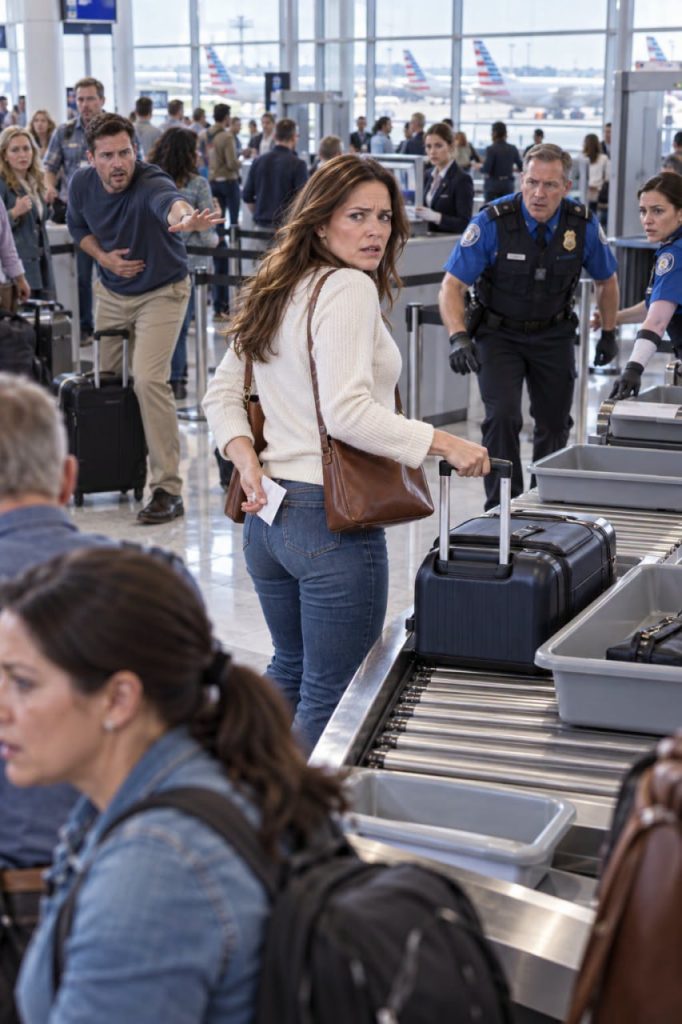
Instead, the terminal looked exactly as terminals always do: fluorescent lights, tired children, rolling bags, coffee that costs too much. At security, an agent pointed toward my suitcase. “Did you pack this yourself?” I looked down at it. My bag. My lock. My clothes. My documents. My choices. “Yes,” I said. “Has it remained in your possession?” I smiled. “Yes.” He waved me forward. Daniel’s warning remained proof that courage can come from unexpected people. The suitcase was only one object inside a much larger pattern. I make decisions without checking whether they preserve someone else’s image. I knew better.
I walked through the scanner, collected my suitcase on the other side, and wrapped my hand around the handle. For years I thought losing Adrian meant losing the life I had built. I had been wrong. The life I lost was the one he had quietly built around me. The one I have now is mine. Every account. Every key. Every departure. And every bag I carry. Instead, the terminal looked ordinary once I arrived on my own terms. Every account and document now had boundaries I personally understood. My name appears only where I have chosen to place it.
THE END!
Disclaimer: Our stories are inspired by real-life events but are carefully rewritten for entertainment. Any resemblance to actual people or situations is purely coincidental.