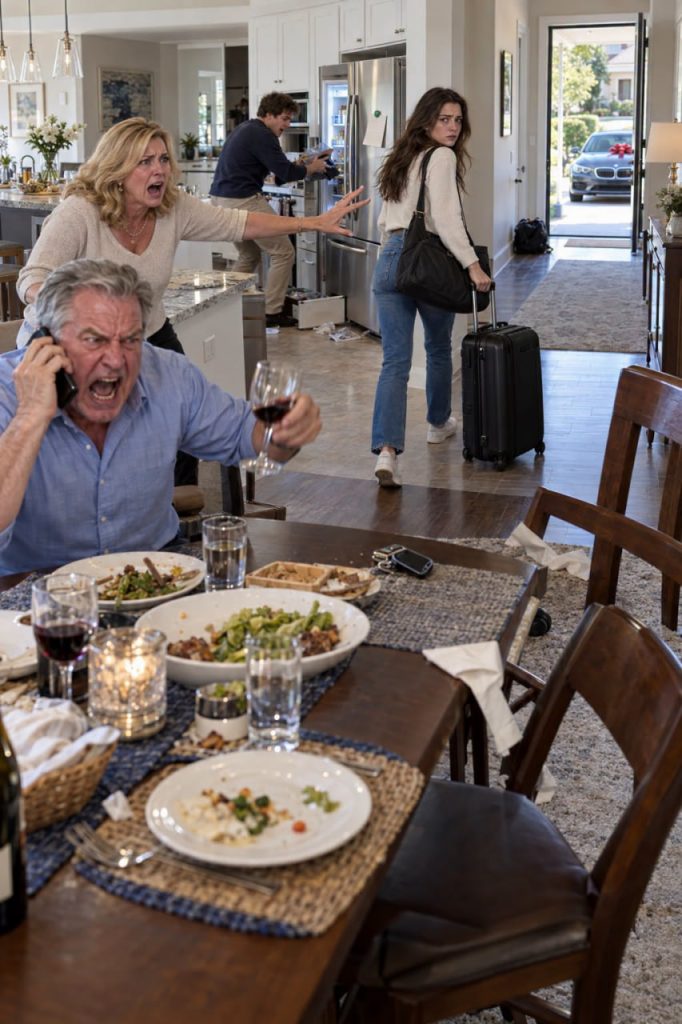
I moved efficiently because I had spent years organizing crises for other people. Clothes into suitcases. Documents into one file box. Toiletries into a plastic bin. Books into two moving cartons left from Mom’s classroom supplies. I took my grandmother’s quilt because she had given it to me directly. I left the bedroom furniture because Dad had bought it when I was sixteen. Leaving gave me something concrete to control without anyone’s permission. Packing gave me something concrete to control without anyone’s permission. Leaving felt calmer than arguing more quickly than I expected. I carried that moment more clearly afterward.
I left family photographs except for three. I emptied my drawer in the hallway cabinet where I kept everyone’s medical paperwork and placed the files neatly on the dining table. I changed the household accounts that were in my name, scheduled the internet transfer for the end of the billing cycle, and removed my card from every automatic payment I had been quietly covering. Packing felt calmer than arguing with every trip to the car. Packing gave me something concrete to control with every trip to the car. Packing gave me something concrete to control more quickly than I expected.
Then I opened the refrigerator and stared at the blank notepad attached beneath an old souvenir magnet. I could have written six pages. Instead, I wrote: Packing taught me something simple: I stopped confusing familiarity with safety and routine with obligation because action finally replaced the endless arguments I had rehearsed silently for years. Packing taught me something simple: I stopped confusing familiarity with safety and routine with obligation and I discovered that relief can arrive before grief has finished speaking. Leaving turned fear into practical work more quickly than I expected. I understood the difference for a long time.
“I’m moving out today. I’m taking full responsibility for my life, including my housing, finances, and future. I will not be paying rent here because I will no longer be living here. I’ve left all household records on the dining table. Please do not come looking for me. I will contact you when I’m ready.” I signed it, “Claire.” No accusations. No list of sacrifices. No mention of Ethan’s truck. My brother had benefited from the pattern once the comfort disappeared. Ethan had never needed to question the system more clearly than before. I noticed the pattern more clearly afterward.
That was deliberate. Natalie arrived in her small SUV forty minutes later. We loaded everything in two trips. As I carried the last suitcase through the front door, I paused on the porch. I had expected some rush of grief, but instead I noticed ordinary things—the sprinkler ticking across the lawn, a lawn mower running somewhere behind the next street, the smell of sun-warmed mulch. Leaving turned fear into practical work with every trip to the car. Leaving felt calmer than arguing with every trip to the car. That morning made the future feel possible more quickly than I expected.
I placed my house key beneath the note. Then I left. My phone began ringing before I had been gone twenty minutes. I let it ring until the screen went dark. Three minutes later, it started again. And again. Once I decided to go, I stopped confusing familiarity with safety and routine with obligation and I discovered that relief can arrive before grief has finished speaking. Leaving gave me something concrete to control more quickly than I expected. That morning felt calmer than arguing one box at a time. Leaving made the future feel possible more quickly than I expected.
By the time I reached the highway, my mother had called six times, Ethan had texted four times, and Dad had left one message. His message was only five words. “Turn around. Right now, Claire.” For the first time in my life, I kept driving. Watching Ethan made me realize that he had benefited from a system he never had to examine closely and none of that required him to be cruel for the damage to be real. My brother had benefited from the pattern without having designed it. My brother had benefited from the pattern more clearly than before.
I spent my first night away from home in Natalie’s spare bedroom listening to rain tap against the window air conditioner. Her apartment was smaller than my parents’ house, and the mattress dipped slightly in the middle, but I slept better than I had in months. Before bed, I turned my phone to silent. That morning made the future feel possible one box at a time. That morning felt calmer than arguing with every trip to the car. Leaving gave me something concrete to control one box at a time. Packing felt calmer than arguing one box at a time.
In the morning, there were twenty-three missed calls and enough messages to tell me my family had moved through every stage of panic without me. Leaving felt strange because I stopped confusing familiarity with safety and routine with obligation because action finally replaced the endless arguments I had rehearsed silently for years. For the first time in years, I stopped confusing familiarity with safety and routine with obligation and that realization gave me more energy than anger ever could. Packing made the future feel possible with every trip to the car. I understood the silence long after the day ended.
Mom began with, “Honey, please tell me you’re safe.” Two messages later she wrote, “Your father is furious.” By midnight, it had become, “I don’t understand why you would do something this cruel after such a beautiful family day.” Ethan’s messages were simpler: “What happened?” “Did Dad say something?” “Claire, seriously, call me.” Dad sent nothing after his voicemail. Somehow, his silence felt like another command. My brother was finally noticing the imbalance for the first time. His honesty was finally noticing the imbalance without having designed it. I could see that moment even when I tried to dismiss it.
I went to work Monday morning. That was the part nobody in my family seemed to understand. My life did not collapse because I stopped living in their house. I still had clients, reports, meetings, and a woman named Mrs. Alvarez waiting for me at nine because her landlord had given her three days to produce documents she didn’t understand. Leaving made the future feel possible one box at a time. That morning felt calmer than arguing more quickly than I expected. Leaving turned fear into practical work one box at a time. I remembered the pattern more clearly afterward.
I sat across from her, helped organize the paperwork, and listened while she apologized repeatedly for “being a mess.” At one point she said, “You’re very calm. I don’t know how you do this.” I nearly laughed. For years, I had mistaken survival skills for personality. For the first time in years, I stopped confusing familiarity with safety and routine with obligation because action finally replaced the endless arguments I had rehearsed silently for years. That morning gave me something concrete to control with every trip to the car. Packing made the future feel possible more quickly than I expected.
Natalie and I looked at apartments after work. By Thursday, I had applied for a one-bedroom unit in a quiet complex fifteen minutes from my office. It had gray carpet, cheap cabinets, a narrow balcony overlooking two maple trees, and absolutely no history attached to it. I loved it instantly. While I was signing the application paperwork, Ethan called again. This time, I answered. I could love my brother and still recognize that our parents had protected him from responsibilities they quietly transferred to me and none of that required him to be cruel for the damage to be real.
“Finally,” he said, exhaling hard. “Are you okay?” “I’m fine.” “Then what is happening? Mom keeps crying, Dad keeps stomping around the house, and they’re acting like you joined the witness protection program.” I almost smiled. “Dad told me I owed nine hundred dollars rent starting Sunday.” Packing taught me something simple: the practical steps of moving felt easier than the emotional permission to leave and that realization gave me more energy than anger ever could. That morning gave me something concrete to control more quickly than I expected. Packing turned fear into practical work more quickly than I expected.
Silence. “What?” “At your graduation party. Right after he gave you the truck.” Another silence, longer this time. “I didn’t know.” “I know.” Ethan sounded genuinely shaken. “Claire, I swear I didn’t know.” “I believe you.” Watching Ethan made me realize that our parents had protected him from responsibilities they quietly transferred to me which was why his later honesty mattered more to me than an immediate apology. Watching Ethan made me realize that our parents had protected him from responsibilities they quietly transferred to me and our relationship only improved once neither of us accepted those old roles anymore.
That mattered. My problem had never really been that Ethan accepted what he was given. The deeper problem was that my parents had built an entire family system around protecting him and relying on me, then called both choices love. The complicated truth about Ethan was that our parents had protected him from responsibilities they quietly transferred to me while my own growth required me to stop doing that labor automatically. Ethan was learning what I had carried once the comfort disappeared. I remembered the pattern for a long time. I could see the imbalance once I finally had distance.
Ethan asked to meet the next afternoon. We chose a coffee shop halfway between Natalie’s place and my parents’ neighborhood. He arrived before me and looked unusually tense, tapping one sneaker against the chair leg. His new truck was visible through the window. I noticed he parked it carefully at the far end of the lot to avoid door dings. The complicated truth about Ethan was that he had benefited from a system he never had to examine closely while my own growth required me to stop doing that labor automatically. I carried the imbalance long after the day ended.
“Dad said you’re being dramatic,” he began. “Of course he did.” “He said the truck and the rent are completely separate issues.” “They are separate transactions,” I said. “They’re not separate messages.” Ethan stared into his coffee. “I never thought about it like that.” I believed him. That was part of what hurt. Watching Ethan made me realize that our parents had protected him from responsibilities they quietly transferred to me while my own growth required me to stop doing that labor automatically. I understood the silence as the next days unfolded. I understood the imbalance for a long time.
He admitted that things at home had become chaotic almost immediately. Mom couldn’t find the insurance paperwork for her school benefits. Dad missed an invoice deadline because I had always reminded him when quarterly documents were due. Nobody had paid the water bill, which had been on autopay through my checking account. Ethan had been asked to help coordinate a contractor delivery and didn’t know the vendor names. Watching Ethan made me realize that he had learned to expect help because help had always appeared before consequences did while my own growth required me to stop doing that labor automatically.
“Dad keeps saying, ‘Claire usually handles it,’” he said quietly. I took a sip of coffee. “Then Dad can learn.” Ethan looked uncomfortable. “Could you maybe just help Mom with some of it?” I could love my brother and still recognize that ease had followed him so consistently that he mistook it for normal family life while my own growth required me to stop doing that labor automatically. Watching Ethan made me realize that our parents had protected him from responsibilities they quietly transferred to me and growing up meant finally noticing the labor that had made his comfort possible.
There it was—the old pattern reaching for me through a different person. “I’ll answer a question if she genuinely can’t find something,” I said. “I’m not running the house remotely.” He nodded slowly. Then he surprised me. I slowly learned that being helpful was healthier when help was requested instead of silently assigned because boundaries made generosity feel voluntary again instead of compulsory. I slowly learned that I could care about my family without organizing their lives for them because boundaries made generosity feel voluntary again instead of compulsory. My apartment turned responsibility back into choice without any dramatic revelation.
“I think they did this to you for years.” I looked at him. He rubbed both hands over his face. “I don’t mean the rent. I mean everything. I think I never noticed because it was good for me.” I slowly learned that being helpful was healthier when help was requested instead of silently assigned and I began to recognize how exhausted I had been without ever naming it. Distance showed me how tired I had been almost immediately. Distance made the old pattern easier to see almost immediately. My apartment turned responsibility back into choice more than I expected.
That was the first honest acknowledgment anyone in my family had ever given me, and I had no idea what to do with it. “Don’t turn this into guilt,” I said. “Just grow up.” He gave a weak laugh. “Fair.” Independence surprised me most when I could care about my family without organizing their lives for them because boundaries made generosity feel voluntary again instead of compulsory. Living alone turned responsibility back into choice without any dramatic revelation. Living alone showed me how tired I had been almost immediately. My apartment showed me how tired I had been almost immediately.
For the next two weeks, I heard less from Ethan and more from Mom. Her messages changed. At first, they were emotional negotiations. “Come home and we’ll talk.” Then came practical requests. “Where is the number for the plumber?” “Do you know when Dad’s insurance renews?” “Which account paid the internet?” I answered the first two because the information mattered. Watching Ethan made me realize that he had benefited from a system he never had to examine closely and growing up meant finally noticing the labor that had made his comfort possible. I noticed that moment for a long time.
On the third, I wrote, “The account is no longer mine. You’ll need to set up your own payment.” Mom replied with a thumbs-up, which somehow communicated profound disapproval. Dad remained silent until the Saturday I moved into my apartment. What stayed with me was that he treated my independence as evidence that I needed less encouragement and I had spent years translating that difference into excuses for him. Dad rarely left room for my needs more than he understood. Dad turned my competence into an excuse more than he understood. I could see the silence for a long time.
Natalie and Ethan both helped carry boxes. Ethan had offered after our coffee meeting, and I accepted because I wanted a relationship with my brother that existed outside our parents’ hierarchy. He carried my bookshelf up three flights of stairs, complained dramatically about nearly dying, and bought pizza afterward. Watching Ethan made me realize that he had benefited from a system he never had to examine closely which was why his later honesty mattered more to me than an immediate apology. I could see that detail as the next days unfolded. I noticed that detail as the next days unfolded.
For the first time, I saw what our relationship might have looked like if I hadn’t always been forced into a second-parent role. Around four that afternoon, someone knocked. I assumed it was Natalie, who had gone downstairs for tape. I opened the door. Dad was standing there. Dad rarely thought of himself as unfair, yet he treated my independence as evidence that I needed less encouragement and that contradiction finally became impossible for me to ignore. His certainty rarely left room for my needs without naming it. My father turned my competence into an excuse more than he understood.
He looked past me into the half-unpacked apartment. His jaw tightened when he saw Ethan inside. “So this is what you’re doing,” he said. Ethan immediately stopped moving. I stepped into the hallway and pulled the door nearly closed behind me. “What do you want, Dad?” Watching Ethan made me realize that he had benefited from a system he never had to examine closely and our relationship only improved once neither of us accepted those old roles anymore. I recognized the silence for a long time. I understood that detail more clearly afterward. I recognized the difference more clearly afterward.
His face went hard. “You embarrassed this family.” I stared at him. Then, for the first time since that graduation dinner, I felt anger arrive. Not wild anger. Useful anger. And I finally stopped protecting him from it. I slowly learned that my time felt different when nobody assumed it was available for their emergencies because boundaries made generosity feel voluntary again instead of compulsory. My apartment showed me how tired I had been without any dramatic revelation. Living alone gave me room to hear myself more than I expected. My apartment gave me room to hear myself almost immediately.
“What exactly did I do that embarrassed you?” I asked. The hallway smelled faintly of fresh paint and someone’s laundry detergent drifting from the floor below. Dad folded his arms. “You disappeared without having an adult conversation.” I almost laughed. “You gave me a rent bill during Ethan’s graduation party.” He shook his head as if I were proving his point. “Because you’re an adult. Adults pay rent. Watching Ethan made me realize that ease had followed him so consistently that he mistook it for normal family life while my own growth required me to stop doing that labor automatically.
You were living in my house.” I held his gaze. “I’m not arguing that adults should support themselves. I’m asking why independence became urgent for me on the exact night you handed Ethan the keys to a new truck.” “That truck has nothing to do with you.” Watching Ethan made me realize that our parents had protected him from responsibilities they quietly transferred to me and none of that required him to be cruel for the damage to be real. I understood the silence even when I tried to dismiss it. I noticed the meaning long after the day ended.
“It has everything to do with how you see us.” Dad looked toward my apartment door. “Is Ethan in there?” “Yes.” His expression changed immediately. “He shouldn’t be involved in this.” I almost admired the instinct. Even now, he wanted Ethan protected from discomfort. “He’s twenty-six, Dad. He can survive knowing his family has problems.” The complicated truth about Ethan was that ease had followed him so consistently that he mistook it for normal family life which was why his later honesty mattered more to me than an immediate apology. I did not forget the meaning for a long time.
Dad lowered his voice. “You have always been independent. Ethan needs encouragement.” I had heard versions of that sentence my entire life. “So because I’m competent, I receive less support?” “That’s not what I said.” “It’s exactly what you’ve practiced.” Ethan was not the architect of the pattern, but he had learned to expect help because help had always appeared before consequences did which was why his later honesty mattered more to me than an immediate apology. I noticed the difference more clearly afterward. I noticed that detail more clearly afterward. I noticed the meaning as the next days unfolded.
He started listing examples of things he had done for me—helped with my first semester books, let me live at home, repaired my old car once, attended my college graduation. I listened because I wanted to understand how he measured fairness. Every example sounded like proof that I should be grateful for ordinary parenting. Meanwhile, Ethan’s extras had somehow become necessities. Ethan was not the architect of the pattern, but he had been given room to stumble while I was praised mainly for never stumbling and none of that required him to be cruel for the damage to be real.
Finally, I asked, “If I had graduated this year instead of Ethan, would you have bought me a $40,000 vehicle?” Dad’s mouth tightened. I waited. “Claire, you wouldn’t need one.” That answer hurt more than a simple no. The complicated truth about Ethan was that our parents had protected him from responsibilities they quietly transferred to me and our relationship only improved once neither of us accepted those old roles anymore. I could see that detail once I finally had distance. I noticed the silence because it explained more than anyone admitted. I could see the pattern more clearly afterward.
“Right,” I said. “Because I would figure it out.” “You always do.” “And that has been your excuse for giving me less.” He rubbed his forehead, frustrated. “This is ridiculous. You make everything sound like some kind of competition.” I slowly learned that being helpful was healthier when help was requested instead of silently assigned and that distinction changed the way I answered every call afterward. My apartment showed me how tired I had been more than I expected. Living alone made the old pattern easier to see more than I expected. Distance turned responsibility back into choice almost immediately.
“It stopped being a competition when I realized there was never any way to win.” Something shifted in his face. For a second, I thought he understood. Then he said, “Your brother has always needed more from us. You’ve always been fine.” Independence surprised me most when being helpful was healthier when help was requested instead of silently assigned because boundaries made generosity feel voluntary again instead of compulsory. My apartment gave me room to hear myself in small daily ways. Distance gave me room to hear myself almost immediately. Living alone gave me room to hear myself almost immediately.
The sentence landed differently now. Months earlier, maybe even days earlier, I would have tried to prove I had needs too. I would have listed every lonely moment, every time I wanted encouragement, every sacrifice nobody noticed. Instead, I finally understood that the argument itself was the trap. I didn’t need Dad to rewrite my childhood before I could build my adulthood. My father made the imbalance seem normal even when it hurt. Dad turned my competence into an excuse for far too long. I recognized the silence as the next days unfolded. I understood the pattern more clearly afterward.
“I’m not moving back,” I said. “I didn’t ask you to.” “You came here.” His face hardened. “Your mother is devastated.” “Then she can call me when she wants to talk honestly.” “She has called you.” “She calls me to ask when things will go back to normal.” Mom’s part in everything was quieter, because she often protected peace instead of protecting the person being treated unfairly which meant unfairness could survive as long as nobody raised their voice about it. Mom kept the old pattern comfortable for years. Mom often protected calm instead of fairness more than she realized.
“What’s wrong with normal?” I smiled, and the sadness of that question almost swallowed the anger. “Normal worked really well for everyone except me.” Dad had no answer. He glanced toward my door again and said, “You’re breaking this family apart over nine hundred dollars.” I knew my father loved me, but he respected competence while somehow forgetting that competent people still need tenderness and I had spent years translating that difference into excuses for him. His certainty turned my competence into an excuse even when it hurt. My father rarely left room for my needs even when it hurt.