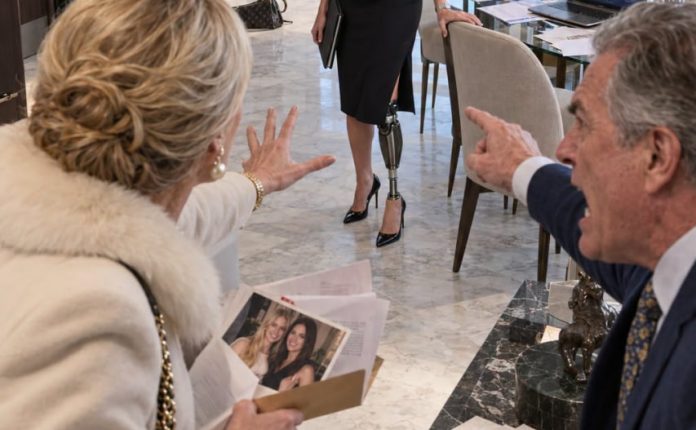
Howard’s expression changed for the first time. His voice rose. “No. What is dramatic is jeopardizing an acquisition affecting thousands of employees because your daughter waited beside luggage for fifteen minutes.” Caroline flushed. “I didn’t ask him to jeopardize anything.” “You demanded he fire her.” “I was angry.” “And he obeyed.” Howard looked at Jonathan. “That is worse.” Silence. Then he looked at the file in Melissa’s hands. “May I?” I had not accused anyone; I had asked for review. I let the moment stand. I refused the old role. I no longer felt trapped. I could see the pattern.
Melissa glanced at Jonathan. Then at me. I nodded. She handed it over. Howard flipped past the termination page. Then slowed. I watched him read my performance history. Six annual reviews. Five top ratings. One leadership award. No disciplinary actions. He reached the acquisition work section. His eyes narrowed. “She worked on integration planning?” Jonathan gave a reluctant nod. Howard looked at me. “You designed the operating model?” My record showed years of trust destroyed by one impulsive command. The vendor payments were unusual because the documentation did not match the money. I let that settle. I trusted my judgment.

“Yes.” “Did you know Holloway Capital was the buyer?” “No.” “Good.” He closed the file halfway. “Then your analysis was independent.” He asked whether I still had copies. “Everything belongs to Vale Dynamics.” Jonathan seemed to relax. It was tiny, but I noticed it. Then Melissa said, “Not everything is only in Claire’s working files.” Jonathan froze again. I turned toward her. “What do you mean?” The misconduct notation frightened me more than losing the job itself. Jonathan now had to defend both his judgment and his process. The question was no longer simply whether I deserved my job back.
“You submitted an independent risk memorandum to the board two weeks ago.” I had almost forgotten about it in the chaos. Not because it was unimportant. Because Jonathan had dismissed it so quickly. I had flagged a cluster of acquisition expenses I couldn’t reconcile. Unusual vendor payments. Repeated exceptions. Missing documentation. Nothing that proved wrongdoing. Only enough irregularity that I believed the board should review it before signing a major transaction. That question exposed how casually Jonathan blurred company and family boundaries. I let them react. The truth remained simple. I let the evidence lead. I did not rescue anyone.
Jonathan had called it “administrative noise.” Howard’s attention sharpened. “What vendor payments?” Jonathan answered too quickly. “Nothing material.” I looked at him. And something clicked. He had not looked that nervous when Howard revealed he controlled the buyer. He had not looked that nervous when the acquisition itself seemed threatened. But the moment Melissa mentioned my memorandum, he changed. Howard saw it too. “What did Claire find?” Jonathan said, “Routine consulting expenses.” The vendor payments were unusual because the documentation did not match the money. Jonathan’s anxiety became most visible when the memorandum entered the room. I did not apologize.
Melissa looked at me. I answered. “Four hundred eighty thousand dollars across eighteen months.” Howard stopped moving. “Paid to whom?” “Three consulting vendors tied to acquisition readiness.” “And what did they do?” “That was the problem.” I put the cardboard box down. “I couldn’t verify it.” Jonathan’s face turned hard. “I told you those relationships were outside your scope.” “You told me they were executive consulting relationships.” The personnel process looked worse each time Melissa answered honestly. Melissa’s disclosure about my risk memorandum changed the conversation completely. I had not accused anyone; I had asked for review. I stopped explaining.
“They were.” “Then where were the deliverables?” Caroline shifted near her father. Her confidence had disappeared completely. Howard looked at Jonathan. “I’d like to see Claire’s memorandum.” “No.” The word came out before Jonathan seemed to think about it. Every person in the room noticed. Howard’s eyebrows lifted. Jonathan corrected himself. “I mean, there’s no reason to turn a personnel dispute into an audit.” Howard looked toward Melissa. I had heard enough. I chose clarity instead. The old doubt surfaced. I held the boundary. I knew better now. I could finally breathe. I let reality speak. I stayed calm anyway.
“Call the board chair.” Jonathan’s voice sharpened. “Melissa, don’t.” Melissa didn’t move. I watched Jonathan’s face. The man who had fired me for poor judgment suddenly looked less like a CEO defending his authority and more like someone hearing footsteps outside a locked door. And for the first time, I stopped wondering why he had fired me. I started wondering what he had hoped firing me would prevent. Howard’s questions forced everyone to examine what Jonathan had treated as obvious. The question was no longer simply whether I deserved my job back. The answer became obvious. I trusted the process.
The board chair arrived twenty-three minutes later. Her name was Margaret Sloan, which had always amused people because Caroline’s middle name was also Sloan. There was no relationship between them, but Jonathan once joked that his daughter had “the better claim to the name.” Nobody laughed about it that morning. Margaret was sixty-two, thin, sharp-eyed, and famous inside Vale Dynamics for never carrying paper unless she intended someone to sign it. The boardroom turned my old concerns into a formal investigation. Margaret asked the questions Jonathan had repeatedly avoided. The three vendors looked ordinary until their patterns were compared together.
That day, she carried only a laptop. She walked into the conference room, looked at me, then at Howard, then at Jonathan. “I’ve reviewed the memorandum.” Jonathan’s face didn’t change. His hands did. He laced his fingers together. Too tightly. Margaret placed her laptop on the table. “There are three vendors we cannot substantiate.” Jonathan leaned forward. “I can explain that.” “Good.” Margaret sat. “Explain.” The room had changed. Caroline’s involvement explained part of the procurement confusion. Her father had taught her that controls were obstacles instead of protections. Jonathan’s attempts to stop her only made the room more attentive.
Twenty minutes earlier, I had been an ex-employee collecting coffee mugs and framed photos from my office. Now I was sitting at the long walnut conference table with the CEO, the board chair, Human Resources, and the man whose family controlled our potential buyer. My empty cardboard box sat beside the glass wall outside. Caroline remained near the door. Margaret looked at her. “Ms. Vale, please wait outside.” Caroline stiffened. “This involves me.” Each exception was small enough to seem harmless alone. Together, the exceptions formed a structure nobody could ignore. I appreciated that outside counsel separated suspicion from proof.
“That is precisely why you should wait outside.” “I’m not a child.” “Then you should understand the request.” Caroline looked at Jonathan. He gave the smallest nod. For once, she obeyed. The door shut. Margaret turned the laptop around. Three vendor names appeared on the screen. Briarpoint Advisory. Northgate International. Lumen Bridge Consulting. I knew all three. Briarpoint had received the largest total: roughly $230,000. Northgate received about $140,000. Lumen Bridge received the rest. Margaret asked the questions Jonathan had repeatedly avoided. Splitting payments below review thresholds was not accidental paperwork. Margaret moved quickly to preserve evidence without declaring conclusions.
The invoices described things like “European positioning analysis,” “cross-border acquisition support,” and “strategic market intelligence.” Professional language. Almost meaningless. I had tried to locate reports. Presentations. Market studies. Meeting notes. Anything. There were fragments from Briarpoint. A few slide decks. Some market data. The other two were nearly empty. Howard leaned toward the screen. “Why were they approved?” Jonathan replied evenly. “They came through international referrals associated with Caroline’s academic network.” Caroline’s involvement explained part of the procurement confusion. The reimbursement issue changed the investigation from governance to personal benefit. The firing suddenly looked connected to questions he needed silenced.
I looked at him. “Her academic network?” He gave me a warning look. Howard noticed. “What?” I said, “That wasn’t what I was told when I asked.” Margaret looked at Jonathan. “What was she told?” Jonathan answered before I could. “That the vendors were confidential executive relationships.” Howard leaned back. “Which is it?” Jonathan’s jaw tightened. “Both.” Margaret tapped the screen. “All three vendors were approved through executive exception procedures.” “Yes.” Each exception was small enough to seem harmless alone. Together, the exceptions formed a structure nobody could ignore. Jonathan blamed me because accepting responsibility would have required looking inward.
“By you.” “Yes.” “Why?” “They were time-sensitive.” “Every time?” “We were preparing for an acquisition.” Howard said, “For eight months?” Jonathan turned toward him. “International work doesn’t happen overnight.” “No,” Howard said. “But usually it leaves evidence.” That landed. Margaret opened another file. “This is what Claire’s original review did not identify.” My stomach tightened. She enlarged the registered-address field. All three vendors used the same business center in London. Same building. Her father had taught her that controls were obstacles instead of protections. I no longer doubted whether I had been right to escalate the risk. The distinction mattered.
Different suite numbers. I leaned closer. “That wasn’t in our procurement system.” “No,” Margaret said. “Outside counsel pulled registration records this morning.” Jonathan exhaled. “That proves nothing. Shared office facilities are common.” He was right. Technically. Howard looked at me. “Is that suspicious?” “By itself? No.” Jonathan gave me a look that almost said thank you. I continued. “But all three also used the same exception route. All three lacked normal procurement review. I appreciated that outside counsel separated suspicion from proof. Splitting payments below review thresholds was not accidental paperwork. Margaret moved quickly to preserve evidence without declaring conclusions.
Two had no documented work product. And each invoice stayed below the threshold that would trigger additional finance approval.” Margaret’s eyes shifted toward me. “You noticed that?” “After I filed the memo. I didn’t have enough access to confirm it.” Jonathan leaned back. “This is exactly why operations people shouldn’t play auditor.” I looked at him. “I wasn’t playing anything. I asked why the controls were bypassed.” His voice hardened. “And I answered.” The three vendors looked ordinary until their patterns were compared together. I no longer doubted whether I had been right to escalate the risk. I watched carefully.
“You told me not to worry about it.” “I told you it was handled.” Howard said quietly, “Apparently not.” The conference-room door opened. Caroline stood there. Her face looked different. Not angry now. Terrified. “I have the reports.” Jonathan stood. “Caroline.” She looked at him. “I have them.” Margaret didn’t raise her voice. “Come in.” Caroline entered slowly. She closed the door behind her. “I can explain Briarpoint.” Jonathan’s posture went rigid. The boardroom turned my old concerns into a formal investigation. Margaret asked the questions Jonathan had repeatedly avoided. The firing suddenly looked connected to questions he needed silenced.
Howard asked, “Only Briarpoint?” She nodded. “My friend helped set it up.” “What friend?” “Emily Harper. We studied together in London.” Margaret’s fingers rested motionless on the laptop. “And Northgate?” Caroline swallowed. “And Lumen Bridge?” She looked at her father. Jonathan said, “You don’t need to answer anything without counsel.” Caroline stared at him. That told me more than any answer. Margaret said, “Nobody is accusing you of a crime in this room. Jonathan’s attempts to stop her only made the room more attentive. The reimbursement issue changed the investigation from governance to personal benefit. I did not look away.
We are establishing facts. You may leave and speak to counsel if you prefer.” Caroline sat. “I didn’t think it was illegal.” Howard’s expression sharpened. “What did you think was happening?” She pressed both hands against her knees. “Briarpoint did real work.” “What work?” “Market research. Competitor analysis. Expansion options.” “Where is it?” “On my laptop.” Jonathan closed his eyes briefly. Margaret asked, “Why wasn’t it stored in Vale’s repository?” The boardroom turned my old concerns into a formal investigation. Each exception was small enough to seem harmless alone. Jonathan blamed me because accepting responsibility would have required looking inward.
“I didn’t know it had to be.” “You weren’t an employee.” “No.” “Then why were you managing company vendors?” Caroline’s breathing became shallow. “My dad asked me to help.” Jonathan cut in. “She was providing informal support.” Margaret turned toward him. “Using corporate funds?” Jonathan didn’t answer. Caroline continued. “Briarpoint was supposed to be one vendor. Then Dad said the payments were getting too large and Finance would start asking for more documentation.” The three vendors looked ordinary until their patterns were compared together. I no longer doubted whether I had been right to escalate the risk. That changed everything.
Jonathan said, “Caroline.” She flinched. Not because he shouted. Because he didn’t. Margaret’s voice stayed calm. “What happened next?” “Emily created the other entities.” The room went still. I looked at Jonathan. He no longer looked angry. He looked trapped. Howard asked, “Why?” Caroline’s eyes filled. “Because Dad said procurement rules were slowing everything down.” Margaret shut the laptop halfway. “You split payments among multiple entities to avoid review thresholds?” Together, the exceptions formed a structure nobody could ignore. I appreciated that outside counsel separated suspicion from proof. Her father had taught her that controls were obstacles instead of protections.
“I didn’t think of it like that.” “How did you think of it?” “As paperwork.” Howard rubbed one hand across his jaw. Jonathan stood. “This conversation is finished.” Margaret looked at him. “No.” “I’m invoking counsel.” “For yourself?” He stared at her. The question hung there. Then Caroline whispered, “The extra money wasn’t for me.” Jonathan’s face emptied. “Caroline.” She covered her mouth. Margaret leaned forward. “What extra money?” Caroline’s eyes stayed on her father. Jonathan’s attempts to stop her only made the room more attentive. The firing suddenly looked connected to questions he needed silenced. I kept moving forward.
“He told me it was part of the acquisition expenses.” Howard’s voice went very quiet. “What was?” Caroline wiped at her cheek. “The money Briarpoint sent back.” Nobody moved. Even the city beyond the windows seemed silent. Margaret spoke first. “Sent back to whom?” Caroline didn’t answer. Jonathan did. “There were reimbursable expenses.” Margaret’s eyes never left Caroline. “Sent back to whom?” Caroline whispered, “Dad.” Jonathan’s chair scraped sharply against the floor. Caroline’s involvement explained part of the procurement confusion. Splitting payments below review thresholds was not accidental paperwork. The reimbursement issue changed the investigation from governance to personal benefit.
“That is not an accurate description.” My stomach turned. Three days earlier, this man had signed a misconduct notation against me because I stopped at an accident. Now his daughter was saying a vendor funded by his company had returned money to him. Margaret asked, “How much?” Caroline shook her head. “I don’t know exactly.” “Estimate.” “Maybe seventy thousand.” Jonathan stepped toward her. “That was reimbursement for legitimate costs.” “What costs?” Each exception was small enough to seem harmless alone. Margaret moved quickly to preserve evidence without declaring conclusions. Jonathan blamed me because accepting responsibility would have required looking inward.
Margaret asked. “Travel. Relationship development. Acquisition meetings.” Howard said, “With my organization?” Jonathan looked at him. Howard’s expression was ice. “Because I would remember seventy thousand dollars of acquisition hospitality.” Jonathan’s face tightened. “Not all of it concerned Holloway.” Margaret opened her laptop again. “I want the records.” Caroline pulled out her phone. Jonathan said, “Do not hand over personal communications without counsel.” Caroline looked at him. Something broke in her expression. The three vendors looked ordinary until their patterns were compared together. I no longer doubted whether I had been right to escalate the risk. That mattered to me.
“You told me this was normal.” Jonathan didn’t answer. “You said every company did it.” “Caroline, stop talking.” “You told me Finance made everything harder than it needed to be.” “Stop.” “You said the companies were just names.” “Caroline.” “You told me nobody would care.” His voice cracked across the table. “Enough.” She recoiled. And suddenly I understood why she had demanded I be fired. Not the whole reason. But part of it. Her father had taught her that controls were obstacles instead of protections. Jonathan’s attempts to stop her only made the room more attentive. I noticed that immediately.
She had spent years learning from a father who treated rules as obstacles, employees as tools, and inconvenience as disobedience. She hadn’t invented that entitlement at an airport. She had inherited it. Margaret stood. “Melissa, contact outside counsel. Finance preserves every record connected to these vendors immediately. No deletions, no changes, no backdated documentation.” Melissa nodded. “Howard, I understand if Holloway Capital wants to suspend discussions.” Howard looked at Jonathan. The boardroom turned my old concerns into a formal investigation. Together, the exceptions formed a structure nobody could ignore. The reimbursement issue changed the investigation from governance to personal benefit.
“We are not making any decision today.” Then Margaret looked at me. “Claire, I need you to stay.” Jonathan laughed once. A bitter sound. “She doesn’t work here.” Margaret met his eyes. “That may have just become the least important fact in this room.” Jonathan turned toward me. And for the first time since I had known him, there was open hatred in his face. “You caused this.” I looked at him. Margaret asked the questions Jonathan had repeatedly avoided. I appreciated that outside counsel separated suspicion from proof. Jonathan blamed me because accepting responsibility would have required looking inward.
“No.” My voice was steady. “I wrote a risk memo.” “You went around me.” “I used the board channel designed for unresolved risk.” “You undermined me.” “I did my job.” He stared at me. Howard said, “And apparently lost it for doing that too.” The sentence changed something inside me. Until then, I had still wondered whether I had somehow overreacted. Whether I should have taken the firing more quietly. Her father had taught her that controls were obstacles instead of protections. Splitting payments below review thresholds was not accidental paperwork. Margaret moved quickly to preserve evidence without declaring conclusions.
Whether executive judgment meant knowing when not to push. That doubt disappeared. Margaret instructed Melissa to remove the misconduct notation immediately and place my termination under board review. Then she turned to Jonathan. “Effective now, you are stepping away from all acquisition decisions pending outside review.” Jonathan’s face went completely still. Caroline covered her mouth. Howard slid the sealed acquisition folder toward Margaret. “Our offer assumed leadership stability.” He looked at me. I no longer doubted whether I had been right to escalate the risk. The firing suddenly looked connected to questions he needed silenced. I knew what it meant.
“Before my family signs anything, I want Claire’s memorandum reviewed line by line.” Then he looked at Jonathan. “And I want her in the room.” Three days earlier, I had been fired for being fifteen minutes late. Now the acquisition Jonathan had spent eight months chasing would not move forward until I spoke. And the part that frightened him most wasn’t that Howard Holloway had found me. It was that I had already found something first. The three vendors looked ordinary until their patterns were compared together. I no longer doubted whether I had been right to escalate the risk.
I barely slept that night. Not because I felt triumphant. I didn’t. There was nothing satisfying about watching a company I had helped build discover that its CEO might have bypassed controls for personal benefit. People like to imagine moments like that as revenge. They aren’t. Mostly, they are fluorescent lights, stale coffee, legal pads, nervous phone calls, and the slow realization that every answer creates two more questions. The investigation was tedious, exact, and far more serious than public drama. Outside counsel followed the evidence rather than the personalities. She had believed employees existed to obey her father’s authority.
The next morning, I returned to Vale Dynamics carrying the same cardboard box. I had never taken it home. Melissa had placed it in an empty office because the conference-room chaos started before I finished packing. The absurdity made me smile when I stepped out of the elevator. Yesterday: fired employee. Today: invited witness. Same box. Different door. Outside counsel occupied two conference rooms. Finance staff were already pulling records. I had always believed boring details were where large failures hid. The board’s leave decision was cautious rather than theatrical. The acquisition pause protected thousands of employees from rushed decisions.
IT had locked retention controls on executive accounts. Margaret met me in the boardroom. “You are not being reinstated today,” she said. “I understand.” “You are here because your original analysis is relevant.” “I understand that too.” She studied me. “Do you want counsel?” “Am I under investigation?” “No.” “Then not yet.” She almost smiled. Howard sat near the windows. The bandage above his eyebrow had been replaced with a thin strip. Yet trust had become more important than any promotion. Declining the role felt frightening and strangely peaceful. Northstar offered a future without asking me to forget what happened.
“You look better,” I told him. “I feel worse.” “That’s encouraging.” He laughed. It was the first normal sound I had heard in that building since the elevator opened the day before. Outside counsel began with my memorandum. I walked them through it slowly. How acquisition-related spending had increased. How certain vendors bypassed normal review. How invoice descriptions were vague. How three entities had no clear accountable owner inside Vale. Margaret’s offer gave me everything I once thought I wanted. Howard’s ambulance report gave the original decision new weight. I walked out knowing I would make the same choice again.
Nothing dramatic. No secret ledger. No anonymous envelope. Just ordinary controls being bent so often that the bending became visible. That was the part Jonathan seemed never to understand. Large problems often hide inside boring details. Purchase orders. Approval timestamps. Missing attachments. A vendor code created on a Friday evening. An invoice approved six minutes after submission. The investigation went deeper than my original review. Briarpoint had done some legitimate work. Most of the truth appeared inside timestamps, approvals, invoices, and missing attachments. Outside counsel followed the evidence rather than the personalities. Declining the role felt frightening and strangely peaceful.
That mattered. Their researchers had prepared market summaries and competitor analysis. The invoices, however, exceeded the reasonable value of what had been delivered. Northgate and Lumen Bridge had almost no independent substance. Shared administrative address. Overlapping contacts. Similar invoice language. And several payments flowed through accounts later connected to consulting reimbursements Jonathan had received. Outside counsel was careful. They never called it theft. They never called it fraud. I had always believed boring details were where large failures hid. Caroline’s apology could not erase what she had demanded at the airport. The board’s leave decision was cautious rather than theatrical.
They said “potential conflict,” “control circumvention,” “undisclosed benefit,” and “requires investigation.” That precision mattered to me. I had been punished without review. I did not want Jonathan punished the same way. Around noon, he entered with his attorney. He did not look at me. Caroline was interviewed separately. When she emerged from another conference room, her face was pale and exhausted. For a second, she stopped beside me. I expected an apology. She had believed employees existed to obey her father’s authority. Yet trust had become more important than any promotion. Howard’s ambulance report gave the original decision new weight.
Instead she said, “You must be enjoying this.” I looked at her. “No.” She frowned. “You expect me to believe that?” There it was again. The exact tone she used at JFK. I thought about saying something cruel. I had several options. Instead I said, “Your father fired me in a lobby because you were angry. Then he put something false in my file that could have damaged my career. The investigation was tedious, exact, and far more serious than public drama. I did not want Jonathan punished without the review I had been denied. I stayed with the facts.