After a full day teaching at the public school, I saw a new lock on the pantry. “It’s so you don’t touch our things,” said my daughter-in-law. I smiled, and the next day, the lock was gone. And in its place, I left a letter that made her hands tremble.
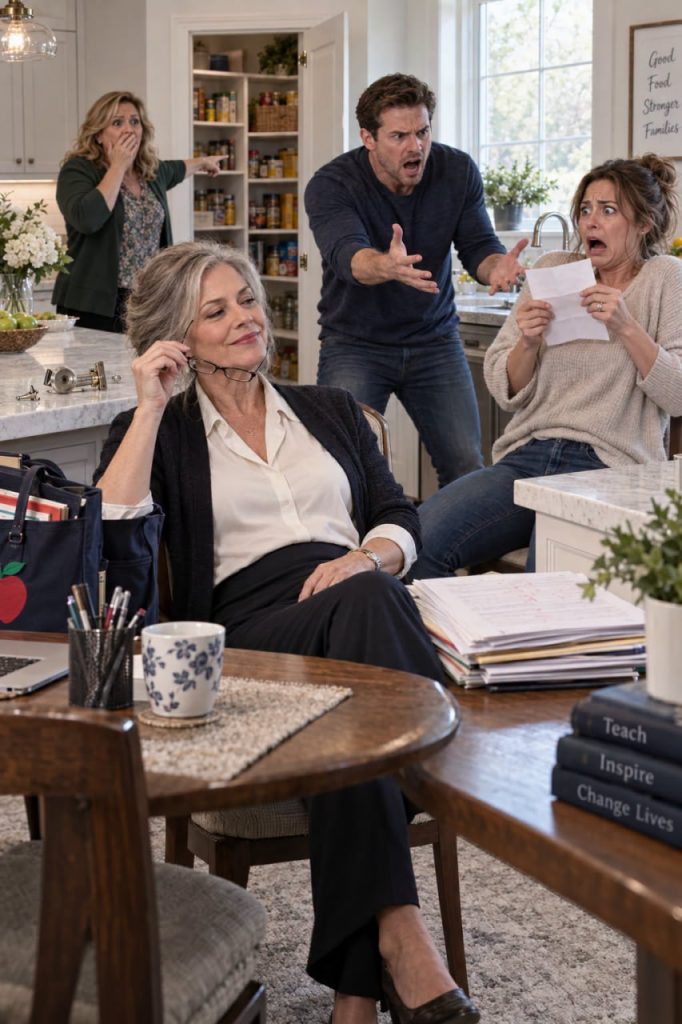
My name is Eleanor Whitaker. I am sixty-eight years old, and until the morning I found a padlock on my pantry door, I believed humiliation announced itself loudly. I thought it came with shouting, slammed doors, cruel words, maybe someone pointing a finger in your face. I was wrong. Sometimes humiliation is a small piece of polished steel hanging from a door you have opened every day for forty-one years. I realized patience had protected everyone except me. Deep down, I could feel the balance inside our home beginning to shift, even before I knew how far things would go.
I had just come home from tutoring at the community center. My canvas grocery bag was cutting into my wrist, there was a carton of eggs balanced against my hip, and my knees were complaining about the front steps the way they always did after rain. I pushed through the kitchen door expecting to hear my orange cat, Murphy, complaining about being abandoned for three hours. Instead, I heard nothing. Then I saw the pantry. A silver padlock hung through a new metal latch screwed into the old oak door. I understood how easily silence could be mistaken for permission.
For several seconds, my mind refused to understand what I was looking at. That door had been built by my husband, Thomas, in the summer of 1984. He had measured the frame wrong the first time, cursed under his breath, then spent an entire Saturday correcting it while our children ran through the kitchen stealing slices of watermelon. There was still a pencil mark inside the frame where Thomas had written E + T and drawn a crooked heart. Now someone had drilled two bright screws into the wood. For once, I could no longer pretend the pattern was harmless.
My grocery bag slipped off my arm. A jar of tomato sauce struck the tile but did not break. The eggs were less fortunate. The crack sounded sharp in the quiet kitchen. Vanessa appeared from the hallway. My daughter-in-law was wearing cream-colored workout clothes that probably cost more than my first monthly mortgage payment. Her dark hair was twisted into a perfect knot, and she was drying her hands on one of the embroidered towels my sister had given me for Christmas. I understood that kindness without boundaries could become surrender, and the realization followed me from room to room.
She glanced at the mess on the floor. Then she smiled. Not warmly. Patiently. The way people smile at toddlers who have dropped their cereal. “Oh, Eleanor. You startled me.” I pointed at the pantry. “What is that?” She followed my gaze as though she had forgotten the lock was there. “Oh. That.” “Yes. That.” “We bought some specialty groceries yesterday. Imported coffee, supplements, expensive oils, things like that. Caleb thought it would be easier if we kept our food separate.” I felt grief and anger beginning to separate inside me, because every compromise had made the next one easier.
My son Caleb had thought that? I stared at her. “That is my pantry.” Vanessa’s smile thinned. “We all live here, Eleanor.” “It is still my pantry.” “And we’re grateful you let us stay here. Obviously.” She folded the towel carefully over the oven handle. “But adults need boundaries. We’ve talked about this.” “No. You talked. I listened.” For the first time, irritation showed beneath her pleasant expression. “Please don’t turn a pantry lock into some dramatic family issue.” I realized my memories mattered as much as anyone else’s preferences, while old memories kept colliding with what I saw now.
I almost laughed. Instead, I looked at the screws. Someone had used Thomas’s drill. It was still hanging in the basement where he had left it before his final illness. That detail hurt worse than the lock. “Where am I supposed to keep my groceries?” “The cabinet beside the refrigerator is empty.” “That’s where I keep cleaning supplies.” “Then we can reorganize.” We. That word had become one of Vanessa’s favorite weapons. We should replace the curtains. We need more storage. I felt the old house becoming unfamiliar around me, because the smallest indignities had begun to form a pattern.
We should really clear out Thomas’s things. We think you’re taking on too much. We are worried about you. Little by little, “we” had come to mean Vanessa made decisions and Caleb avoided looking me in the eye. I bent down and picked up the broken eggs. My fingers were trembling. Vanessa watched for a moment. “Do you want me to help?” “No.” “Eleanor—” “I said no.” She left. Her perfume remained in the room, sweet and floral and strangely aggressive. By then, I realized patience had protected everyone except me, because every compromise had made the next one easier.
I cleaned the floor, put the groceries away wherever I could fit them, then walked outside to the porch. The afternoon sun made the yard look almost painfully beautiful. Thomas’s maple tree had begun turning red at the edges. Somewhere down the block, a lawn mower coughed to life. I sat in the porch chair Thomas had made. Through the kitchen window, I could still see that silver lock. It looked small from outside. Almost harmless. That was the dangerous thing about it. More than anything, I knew I was being asked to disappear one small compromise at a time.
Three years earlier, after Thomas died, this house had become so quiet I sometimes left the television running in another room just to hear a human voice. I had been married forty-two years. Grief made ordinary objects dangerous. His coffee mug. His slippers under the bed. The shallow dent in his side of the mattress. For six months, I kept his voice on our answering machine because deleting it felt too much like killing him a second time. Then Caleb called. I understood how easily silence could be mistaken for permission, and that truth hurt more than the lock itself.
“Mom, Vanessa and I were talking. You shouldn’t be alone in that big house.” I should have noticed how easily “shouldn’t” entered the conversation. But I was lonely. Caleb was my youngest. My gentle child. The boy who used to climb into my bed during thunderstorms and tell me he was only there because he thought I might be scared. He and Vanessa were renting an apartment at the time. Caleb said they wanted to move in “for a few months” while they saved for a house. Standing there, I knew I had been explaining away too many warning signs.
I said yes before he finished asking. At first, having them there felt like someone had opened windows after a long winter. Caleb repaired the loose porch step. Vanessa bought fresh flowers. We ate dinner together. She made salads involving grains I couldn’t pronounce, and I cooked roast chicken on Sundays. They laughed. I laughed. For a while, I mistook noise for healing. The changes began so gently I blamed myself for noticing. For the first time, I knew the pantry lock was only the visible part of the problem, while old memories kept colliding with what I saw now.
One Saturday, I came home from lunch with my friend Marjorie and discovered Thomas’s leather recliner missing from the living room. The chair where he had read the newspaper every Sunday for thirty years. The chair where he rocked our first grandchild. The chair still shaped slightly like his shoulders. Vanessa had replaced it with a gray designer chair. “We donated the old one,” she said brightly. I couldn’t speak. Caleb came up behind her. “Mom, it was pretty worn out.” I felt grief and anger beginning to separate inside me, inside the home Thomas and I had built together.
“You donated your father’s chair?” His face changed. Only for a second. “Vanessa thought—” “I know what Vanessa thought.” He hugged me. “It’s just furniture, Mom.” That sentence stayed with me. It’s just furniture. Later it became: “It’s just the dining room.” “It’s just some dishes.” “It’s just one closet.” “It’s just easier this way.” My sewing room became Vanessa’s “meditation studio.” My Blue Ridge china went into boxes in the basement because she said the pattern made the kitchen look cluttered. I could no longer pretend the pattern was harmless, even before I knew how far things would go.
The cast-iron skillet Thomas seasoned for decades vanished downstairs after Vanessa read something online about cooking surfaces. Then my daughter Rachel came over one Sunday carrying an apple cake. She had always come on Sundays. For twenty years, Sunday meant family dinner. Vanessa opened the door. “Oh. Rachel. I didn’t realize you were coming.” Rachel blinked. “It’s Sunday.” “We have people coming over.” She meant her people. Four couples from her fitness group arrived carrying sparkling water and expensive-looking appetizer trays. I felt the old house becoming unfamiliar around me, while old memories kept colliding with what I saw now.
Rachel stood in my kitchen holding that cake like she had walked into the wrong house. She looked at me. “Mom?” I should have said, “Put your cake down. You’re my daughter. You never need an invitation.” Instead, I said, “Maybe next Sunday.” I will regret those three words until I die. Rachel left. Vanessa closed the door. Two months passed before Rachel visited again. My older daughter, June, called me after that. “Mom, something isn’t right.” “I’m fine.” “That’s not what I asked.” For the first time, I realized the word family had been doing too much dishonest work.
I changed the subject. That was my specialty back then. Changing the subject. Making excuses. Keeping peace that did not exist. My friends disappeared next. Marjorie used to come every Thursday afternoon. We drank coffee and complained about our knees, our neighbors, and television shows with plots neither of us understood. One Thursday she arrived to find six yoga mats covering my living room floor. Vanessa barely glanced toward her. “Oh. Eleanor didn’t mention company.” Company. Marjorie had known me since we were twenty-three. Without saying it aloud, I felt Thomas’s absence most sharply when nobody defended what we built.
She stayed twelve minutes. That evening Vanessa said, “Could you check with me before inviting people over? Thursdays are difficult.” I remember staring at her phone in her hand. “Inviting people over?” She sighed. “You know what I mean.” I did. I simply did not want to admit it. The pantry lock came months later. By then, I had already been trained to doubt my own outrage. I sat on the porch that afternoon until the shadows stretched across the lawn. I understood that kindness without boundaries could become surrender, while old memories kept colliding with what I saw now.
When Caleb came home, I heard Vanessa speaking before he entered the kitchen. Their voices were low. Then Caleb stepped outside. He would not sit down. “Mom, Vanessa told me about the pantry.” “I assume she did.” “It’s just food.” There it was again. Just. “It’s a lock, Caleb.” “We’re trying to simplify things.” “For whom?” He rubbed the back of his neck. “Things have been tense.” “Your wife drilled a lock into your father’s pantry.” His jaw tightened. I understood that being polite had not kept anyone from hurting me, while I kept pretending patience would somehow repair everything.
“Please don’t bring Dad into everything.” The sentence struck me so hard I stopped breathing for a moment. Caleb seemed to realize it. “Mom, I didn’t mean—” “Go inside.” “Can we talk?” “Not tonight.” He went in. I stayed outside until the porch light came on automatically. Later, sometime after midnight, I woke thirsty. As I passed Caleb and Vanessa’s bedroom, I heard my name. Old houses have thin walls. Vanessa’s voice carried through the door. “This can’t keep going on.” I understood how easily silence could be mistaken for permission, because every compromise had made the next one easier.
Caleb murmured something I couldn’t hear. Then she said clearly, “She’s getting worse.” My hand tightened around the hallway railing. “She’s grieving,” Caleb replied. “For three years?” Silence. “She forgot the oven last week.” “I turned it off.” “Exactly. You had to turn it off.” My stomach went cold. I remembered the oven. I had been roasting potatoes. Vanessa had called me outside because a delivery driver needed a signature. By the time I returned, she had turned the oven off herself. Without saying it aloud, I knew I was being asked to disappear one small compromise at a time.
I had never forgotten it. Behind the door, Vanessa lowered her voice. “We need to start thinking about what happens next.” “What does that mean?” “You know what it means.” Another pause. Then three words I would remember forever. “Somewhere with supervision.” I waited for Caleb to object. I waited for my son to laugh at the absurdity. I waited for the boy who once protected worms from sidewalks after rain to protect his mother. He said nothing. Even then, I knew every small choice was becoming part of something larger, and the realization followed me from room to room.
That silence told me more than any answer could have. I walked back to my room, closed the door, and sat on the edge of the bed. Thomas’s photograph stood on the nightstand. For months I had wondered when I would finally stop missing him so violently. That night, I wished for him with such force it hurt my chest. “They’re trying to make me disappear,” I whispered. Then something happened. Not dramatic. Not magical. I simply stopped crying. I looked around the room. As I watched, I knew the pantry lock was only the visible part of the problem.
My room. Inside my house. On land Thomas and I had paid for one paycheck at a time. And suddenly one question became more important than my fear. If Vanessa believed I was becoming incapable of controlling my own life, what exactly was she planning to control for me? The next morning, I did not confront her. I did something far more dangerous. I started paying attention. The first thing I discovered was that people become careless when they think you are weak. I realized patience had protected everyone except me, inside the home Thomas and I had built together.
Vanessa had stopped hiding her impatience around me months earlier, but after the conversation I overheard, something subtle changed. She became helpful. Aggressively helpful. “Eleanor, I’ll get the mail.” “Eleanor, let me handle the electric bill.” “Eleanor, why don’t I organize your prescriptions?” “Eleanor, Caleb and I should probably have access to your accounts in case of an emergency.” Every offer came wrapped in concern. Every concern pointed toward control. So I smiled. That was the first move I made. Not because I was frightened. Inside that house, I realized the word family had been doing too much dishonest work.
Because I wanted Vanessa to believe I still was. On Sunday morning, while Caleb and Vanessa were at brunch, I pulled a blue metal box from beneath my bed. Thomas used to tease me about that box. “You trust twenty pounds of steel more than banks,” he would say. Inside were forty years of our life reduced to paper. The original deed. Tax records. Insurance documents. Our wills. Bank statements. The agreement from when we refinanced the house twelve years earlier. I felt grief and anger beginning to separate inside me, while I kept pretending patience would somehow repair everything.
I spread everything across my quilt. Dust and old paper have a particular smell, dry and faintly sweet. The scent reminded me of the elementary school library where I taught third grade for thirty-four years. I read every page. Then I read them again. The house belonged to me. Not “the family.” Not Caleb. Not all of us. Me. Thomas and I had held the property jointly. After his death, ownership had passed fully to me. More than anything, I realized my memories mattered as much as anyone else’s preferences, because the smallest indignities had begun to form a pattern.
The realization should not have felt revolutionary. But after years of hearing “we” in every corner of my house, seeing my own name printed alone on the deed felt like meeting an old friend. Eleanor Mae Whitaker. Owner. I touched the letters. Then I opened the desk drawer and found a green notebook. On the first page I wrote: HOUSEHOLD LEDGER. Under it, I listed the previous twelve months. Property taxes. Electricity. Water. Home insurance. Internet. Repairs. Groceries. Lawn service. I knew every small choice was becoming part of something larger, and I could no longer ignore what it meant.
Then I listed the amount Caleb and Vanessa had contributed. Most months, two hundred dollars. Some months, nothing. I stared at the columns. When they moved in, Caleb told me living together would help all of us. I had never bothered doing the math. Now the numbers said what I had been too embarrassed to say out loud. I wasn’t being cared for. I was subsidizing two healthy adults while they gradually took over my home. Then I remembered the money. I could no longer pretend the pattern was harmless, while old memories kept colliding with what I saw now.
Two years earlier, Caleb had sat at my kitchen table with his face in his hands. He and Vanessa had supposedly found a small house outside the city. They needed help with the down payment because another buyer had made an offer. “I hate asking you, Mom.” I had transferred seventy-eight thousand dollars from the account Thomas and I built over decades. Caleb promised to repay it after they closed. Three weeks later he told me the sale had collapsed. I could feel the balance inside our home beginning to shift, and the realization followed me from room to room.
I assumed the money was being returned. Then Thomas’s death anniversary came. Then holidays. Then ordinary life. I never asked. Now Vanessa drove a luxury SUV purchased around that same time. My stomach tightened. I opened my online banking. The transfer was there. $78,000. No repayment. No partial refund. Nothing. That afternoon, I called Marjorie. She answered with, “If you’re calling to cancel Thursday again, I’m replacing you.” Despite everything, I laughed. “Can we meet somewhere?” Her tone changed instantly. I knew I had been explaining away too many warning signs, while the familiar rooms seemed to hold their breath.
“Of course.” We met at a coffee shop beside the old courthouse. The place smelled like espresso and cinnamon. Students typed on laptops around us while Marjorie watched me over the rim of her mug. I told her about the lock. Her face hardened. “She did what?” “Keep your voice down.” “Why?” “I don’t know yet.” I told her what I had overheard. I told her about the deed. The household expenses. The seventy-eight thousand dollars. Marjorie slowly set down her coffee. I felt the old house becoming unfamiliar around me, inside the home Thomas and I had built together.
“Eleanor, I have been trying very hard not to tell you what I think of your daughter-in-law.” “I know.” “May I stop trying?” “Not yet.” That surprised her. I leaned closer. “I need someone who understands property law.” Marjorie was quiet. Then she said, “Daniel Mercer.” The name took me back thirty-five years. Daniel had been one of my students. Third row, second desk. Quiet boy. Serious eyes. Finished every assignment early and spent recess reading books far above his grade level. I understood that kindness without boundaries could become surrender, while the familiar rooms seemed to hold their breath.
He had become an attorney. I remembered seeing him at Thomas’s funeral. He had hugged me and said, “Mrs. Whitaker, if you ever need anything, call.” I had assumed people said things like that at funerals. Two days later, I was sitting in his office. Daniel was fifty now, silver beginning at his temples. When I explained the situation, he did not interrupt once. Then he asked a question. “Has anyone asked you to sign anything?” “Not yet.” I felt Thomas’s absence most sharply when nobody defended what we built, while old memories kept colliding with what I saw now.
“Has anyone discussed power of attorney with you?” “Not directly.” His expression sharpened. “Yet?” “I heard Vanessa mention supervision.” Daniel folded his hands. “Mrs. Whitaker, I don’t want to frighten you.” “I’m past frightened.” “Good.” That one word made me sit straighter. He reviewed the deed. “The house is yours. Completely.” “The money?” “If it was clearly a loan, documentation matters. Texts, emails, any promises to repay.” I remembered Caleb texting me the week I transferred it. By then, I understood that being polite had not kept anyone from hurting me, while I kept pretending patience would somehow repair everything.
Thank you, Mom. As soon as we’re settled, we’ll set up repayment. I still had the message. Daniel read it. “Save this.” I did. He advised me to secure copies of every important document somewhere outside the house. He also suggested I make sure my estate plan reflected my current wishes and that no one could produce some conveniently signed paper later claiming I had suddenly changed everything. Then he asked, “Do you have any reason to think they’re building a case that you’re mentally incapable?” By then, I realized the word family had been doing too much dishonest work.
I thought of the oven. “Yes.” His face became grim. “Then don’t argue about it. Establish the truth independently.” That Friday, I met with my longtime physician and completed an evaluation documenting that I was fully capable of managing my own affairs. The process irritated me. Questions about dates, numbers, memory, judgment. At one point, I almost snapped, “I taught children to read for three decades. I know what month it is.” But Daniel had explained why it mattered. I knew every small choice was becoming part of something larger, because the smallest indignities had begun to form a pattern.
So I answered every question. When I left, I had documentation confirming what I already knew. My mind was mine. The next stage was harder. I began watching. Caleb still left for work before eight. Vanessa worked from home, which meant she treated the dining room as her office and every other room as an extension of it. One afternoon she found me searching for my glasses. They were on my head. For a second, genuine embarrassment warmed my face. I could feel the balance inside our home beginning to shift, while the familiar rooms seemed to hold their breath.
Then I saw her expression. Not amusement. Interest. “You lose things a lot lately,” she said. “Do I?” “Kind of.” That was when I made a decision I am not proud of, but I would make it again. I let her underestimate me. The following week I asked Caleb twice what day the trash went out. I left a coffee cup in the microwave. I called Vanessa by Rachel’s name once and apologized. Each time, she watched me closely. I realized my memories mattered as much as anyone else’s preferences, because the smallest indignities had begun to form a pattern.
Each time, Caleb looked more uncomfortable. At dinner one evening, Vanessa said gently, “Eleanor, have you considered giving Caleb limited authority over your finances? Just for emergencies.” I kept my face blank. “What kind of authority?” “Nothing dramatic. We could talk to someone.” “We?” “All of us.” Caleb stared at his plate. I turned toward him. “Do you think I need that?” He looked at Vanessa. Then at me. “I think we should plan ahead.” As I watched, I knew the pantry lock was only the visible part of the problem, because every compromise had made the next one easier.