For ten years, I helped turn my husband’s sleepy family jewelry store into the most successful business it had ever been, while my mother-in-law never missed a chance to remind me that I would never truly belong. Then $250,000 disappeared, she blamed me in front of the entire family, and I played one piece of security footage that changed everything. What we discovered afterward was worse than theft, worse than an affair, and far bigger than any of us could have imagined.
The first thing that bothered me wasn’t the missing money. It was a deposit slip. I was sitting alone in the upstairs office of Whitmore Family Jewelers on a rainy Tuesday evening, surrounded by the familiar smell of velvet display trays, coffee that had gone cold two hours earlier, and the faint metallic scent that seemed to cling to every jewelry shop no matter how carefully it was cleaned. I stopped thinking about the total as one shocking number and started seeing the individual decisions required to create it. I did not need revenge; I needed the pattern to stop.
The sales floor below me had gone quiet after closing, but rain tapped against the front windows hard enough that I could hear it upstairs. I had been reconciling our monthly numbers when I noticed a deposit from our downtown location that should have been $18,640. The bank showed $13,640. Exactly $5,000 missing. Each transaction looked small by itself, which was exactly why the pattern had survived for so long without forcing anyone to ask harder questions. I stopped thinking about the total as one shocking number and started seeing the individual decisions required to create it.
At first, I assumed someone had entered the figures incorrectly. Mistakes happened. We operated three stores now, employed more than thirty people, handled custom orders, repairs, estate jewelry, private appointments, and enough daily transactions that a clerical error was hardly shocking. So I checked the original sales records. $18,640. Then I checked the deposit paperwork. $18,640. Then the bank statement again. $13,640. The business mattered because dozens of employees and generations of customers had trusted us with money, memories, heirlooms, engagements, and family milestones. I could care about everyone involved without volunteering to absorb the consequences again.
I leaned back in my chair and stared at the numbers. Five thousand dollars doesn’t evaporate between a deposit bag and a bank account. I opened the previous month. Another discrepancy. Then another. Small enough that no single transaction would have triggered panic, but once I started looking for them, they appeared like footprints in wet cement. Two thousand here. Seventy-five hundred there. The missing money was no longer a bookkeeping problem; it had become a map showing where trust had been converted into access and access into theft. I was finally learning that patience has limits when respect disappears.
A missing wire transfer. A vendor payment that had been recorded twice but received only once. By midnight, I had counted nearly $41,000 that I could not explain. That was when Ethan found me. My husband came upstairs carrying two paper cups of coffee and wearing the gray quarter-zip he always threw on after removing his jacket. “You’re still here?” “Close the door.” Watching Ethan confront his mother was painful because loyalty had shaped him since childhood, and every new fact forced him to redraw the meaning of family. Every new fact made the earlier explanations harder to believe.
He stopped smiling. Ethan had grown up inside that store. His grandfather had opened the original Whitmore Jewelers decades earlier, when the downtown block still had a shoe repair shop, a hardware store, and a diner where customers paid in cash and everyone knew everyone else’s children. Ethan’s father, Harold, expanded the business slowly. Then I came along. Vivian liked to describe that part differently. Whitmore Jewelers could survive losing money, but it could not survive pretending trust still existed if we refused to confront what had happened. I did not need another promise before deciding what I would protect.
According to my mother-in-law, the family business had been perfectly successful before “all those modern ideas.” Those modern ideas included online appointments, redesigned inventory systems, social media campaigns, private bridal events, modern accounting software, and opening two additional locations. Revenue more than doubled within six years. Vivian still introduced me at charity dinners as, “Ethan’s wife, Claire.” Never “our business partner.” Vivian had spent years controlling rooms through confidence, status, and family history, so watching those tools fail against documented facts changed the balance immediately. The truth did not become cruel simply because someone disliked hearing it spoken without excuses.
Never “the person running operations.” Just Ethan’s wife. I turned the laptop toward him. “I think money is disappearing.” He frowned. “What do you mean?” I showed him the transactions. At first, he reacted exactly the way I expected. Confusion. Then denial. “There has to be an explanation.” “I hope so.” “Mom handles most of the daily deposits at downtown.” I said nothing. Money had moved quietly through accounts because nobody imagined the person authorizing those movements would ever use family trust against the family. Every boundary felt more natural once I stopped treating someone else’s disappointment as an emergency.
He looked at me. “No.” “I didn’t say anything.” “You were thinking it.” “I’m thinking somebody with access is moving money.” “Claire, my mother has handled the books since before we were married.” “And that makes her immune to math?” His jaw tightened. That sentence hung between us. Ethan loved me, but Vivian occupied a strange untouchable place in his life. The more evidence appeared, the clearer it became that Vivian had not made one reckless choice; she had built a pattern around secrecy and entitlement. The more calmly I looked at the facts, the less complicated the situation became.
She could insult me over dinner and he would explain that she was “traditional.” She could override an employee decision I had made and he would say she was “used to being involved.” She could introduce herself to clients as the woman who built Whitmore Jewelers, despite having never written a business plan in her life, and Ethan would squeeze my knee beneath the table and whisper, “You know the truth.” Saving the business meant protecting customers first, even when doing so threatened the balance sheet we had spent years strengthening. The truth needed no dramatic speech to remain true.
I was tired of quietly knowing the truth. “I’m not accusing her,” I said. “Not yet.” “Then what are you doing?” “Finding out where the money went.” Over the next three weeks, I audited everything without telling Vivian. I stayed late. I came in early. I compared timestamps, deposit records, inventory logs, customer receipts, and authorization codes until numbers followed me into my dreams. The missing money was no longer a bookkeeping problem; it had become a map showing where trust had been converted into access and access into theft. That distinction became more important with every decision that followed.
And the number kept growing. $86,000. Then $143,000. Then $211,000. By the time I reached $250,000, there was no longer any possibility that we were dealing with sloppy bookkeeping. Someone was stealing from us. And somewhere during those three weeks, I started watching Vivian instead of just watching the books. I noticed the handbag first. Her certainty had once made everyone hesitate, but confidence stopped being persuasive the moment receipts, footage, signatures, and account records began speaking for themselves. That detail stayed with me because it connected too many earlier moments I had once explained away.
Cream leather, structured, expensive. She carried it into work one Thursday morning and set it on the counter like she wanted people to notice. Lauren, Ethan’s younger sister, touched it and laughed. “Mom, when did you buy that?” Vivian gave a little shrug. “A woman is allowed to treat herself.” Then came the diamond earrings. They weren’t from our inventory. Vivian had spent years controlling rooms through confidence, status, and family history, so watching those tools fail against documented facts changed the balance immediately. Once I saw the pattern clearly, I could no longer pretend the latest incident stood alone.
I knew every major stone we had sold during the previous year. When I asked where she found them, she smiled. “Estate sale.” “What dealer?” “I don’t remember.” Vivian remembered the florist who had delivered the wrong shade of roses at Lauren’s engagement party eleven years earlier. She remembered the name of every donor at every charity event she attended. Her certainty had once made everyone hesitate, but confidence stopped being persuasive the moment receipts, footage, signatures, and account records began speaking for themselves. I no longer believed that keeping the family together was a job assigned only to me.
She remembered exactly which neighbor had failed to send a condolence card when her mother died. But she didn’t remember the dealer who had sold her several thousand dollars’ worth of diamonds? I started paying attention to when she came and went. Some afternoons she disappeared for hours. She called them client meetings. There were no appointments on the schedule. Then one Friday, I walked into the back office and found her shutting the safe. I stopped asking what explanation would keep the peace and started asking what the evidence actually showed. Nothing improved when I translated betrayal into misunderstanding.
She spun around so fast her pearls bounced against her blouse. “You startled me.” “What are you doing?” “Counting the weekend reserve.” “I already counted it.” Her expression changed for half a second. Not fear. Annoyance. The kind of annoyance people show when a locked door they expected to stay locked suddenly opens. The more evidence appeared, the clearer it became that Vivian had not made one reckless choice; she had built a pattern around secrecy and entitlement. I had spent too long treating Vivian’s contempt as something I needed to overcome, when the real problem was never my worth.
“I’ve been counting cash in this store since you were probably learning multiplication,” she said. Then she walked past me. Her perfume lingered after she left, sharp and floral. That evening, I called a security company. I told Ethan we were upgrading the cameras because of the missing money. He agreed reluctantly. Vivian complained for two days. “Are we running a jewelry store or a prison?” The store had been built on reputation, but I was learning that reputation without accountability is only a polished surface waiting to crack. Nothing about the situation improved when everyone avoided the obvious question.
“A jewelry store with a quarter of a million dollars missing,” I replied. She stared at me. I stared back. The showroom cameras were obvious. The new back-office camera wasn’t. Neither was the exterior unit mounted above the service entrance. I didn’t want a confrontation. I wanted proof. Nine days later, I got it. The notification came at 2:11 in the morning. Motion detected. The business mattered because dozens of employees and generations of customers had trusted us with money, memories, heirlooms, engagements, and family milestones. I wanted honesty more than appearances, because appearances had hidden too much already.
I was awake before I understood why my phone was vibrating. Ethan slept beside me while blue light from the screen washed across the bedroom. I opened the security application. For several seconds, I saw only the dark showroom. Then the side door opened. A woman stepped inside. Vivian. I sat upright. She wasn’t wearing pajamas beneath a coat or anything that suggested an emergency. Vivian still believed family loyalty meant shielding her from consequences, even after she had used that same family as cover for years. I had learned how expensive it could be to ignore my own uneasiness.
She wore black trousers, heels, a fitted coat, full makeup, and the same cream handbag she had displayed at work. She knew exactly where she was going. First the office. Then the safe. I watched her enter the code. She removed the previous day’s cash deposits. My pulse thudded in my ears. I should have woken Ethan. I didn’t. Not yet. Ethan did not lose his mother in a single conversation; he lost the version of her he had protected each time another piece of evidence appeared. I could care about everyone involved without volunteering to absorb the consequences again.
Vivian slipped the cash into her handbag. Then she walked onto the showroom floor. That confused me. Until she unlocked one of our premium display cases. She selected a diamond bracelet. Then a loose stone packet. Then a ruby pendant. She placed all three into a velvet pouch and dropped it into her bag. I stopped breathing for a moment. This wasn’t an accounting trick. The more evidence appeared, the clearer it became that Vivian had not made one reckless choice; she had built a pattern around secrecy and entitlement. This time I let the consequences remain where they belonged.
This wasn’t even just embezzlement. She was physically stealing from the store. Then her phone rang. Vivian answered. And smiled. I had known her for twelve years. I had seen her proud, furious, smug, offended, triumphant, grieving, sarcastic, and once spectacularly drunk at a New Year’s party. I had never seen that smile. Soft. Almost girlish. She said something I couldn’t hear, then laughed quietly. I had spent too long treating Vivian’s contempt as something I needed to overcome, when the real problem was never my worth. I wanted honesty more than appearances, because appearances had hidden too much already.
Twenty minutes later, she left through the side door. I switched to the exterior camera. A black luxury sedan waited across the street. A driver opened the rear door for her. Vivian got inside. The car pulled away. I slipped out of bed, carried my laptop into the kitchen, and replayed everything three times. Vivian had spent years controlling rooms through confidence, status, and family history, so watching those tools fail against documented facts changed the balance immediately. Vivian still believed family loyalty meant shielding her from consequences, even after she had used that same family as cover for years.
At 3:04, I checked the vehicle against footage from neighboring businesses I had permission to access through our security partnership. The sedan had appeared several times during the previous month. Always late. Always when Vivian was nearby. By sunrise, I had identified where it usually went. A luxury hotel on the other side of the city. I still didn’t know who was waiting there. But I knew one thing with complete certainty. That moment became another line between the life we had accepted and the one we were rebuilding. Nothing about family made deception safer or entitlement more reasonable.
Vivian had spent years telling me I wasn’t a real Whitmore. Now I had video of her stealing the Whitmore family’s money with one hand and its jewelry with the other. I thought the hardest part would be showing Ethan. I was wrong. Because two days later, Vivian called an emergency family meeting and announced that she had discovered who was destroying the business. Her certainty had once made everyone hesitate, but confidence stopped being persuasive the moment receipts, footage, signatures, and account records began speaking for themselves. The facts were easier to trust than the shifting explanations around them.
Me. Sunday morning smelled like stale coffee and furniture polish. Our conference room wasn’t designed for family confrontations. It was a practical space with a long walnut table, a wall-mounted television, fluorescent ceiling lights, and framed photographs showing every version of Whitmore Jewelers since the original storefront opened. Vivian stood beneath a picture of Ethan’s grandfather. Every repair we made to the company had to be more than cosmetic, because appearances were exactly what had allowed the damage to hide. Saving the business meant protecting customers first, even when doing so threatened the balance sheet we had spent years strengthening.
I remember thinking there was something almost obscene about that. Harold sat at the far end of the table. He had officially retired two years earlier, but Vivian had insisted he attend. Lauren sat beside her husband, Matt, twisting a tissue between her fingers. Ethan’s older brother, Owen, appeared on the television through video call from another state. Ethan sat beside me. I could see how badly Ethan wanted one explanation that would make everything smaller, but the truth kept becoming larger instead. That detail stayed with me because it connected too many earlier moments I had once explained away.
And Vivian stood at the head of the table as if she were chairing a board meeting. “Everyone, please sit down.” No one had been standing except her. That was Vivian. Even when she wasn’t in charge, she needed the room to feel as though she were. She placed a navy folder on the table. “I’ve discovered something extremely troubling.” Ethan shifted beside me. I kept my hands in my lap. I had spent too many years softening facts so other people would not have to feel responsible for them. I had spent enough time negotiating against my own judgment.
“What happened?” Lauren asked. Vivian sighed dramatically. “The business is in serious financial danger.” I almost laughed. We had just posted the strongest quarter in company history. Without the theft, it would have been a record by a ridiculous margin. Vivian opened the folder. “There are irregularities in our accounts. Missing funds. Inventory discrepancies. Unauthorized financial decisions.” Her eyes landed on me. Vivian had spent years controlling rooms through confidence, status, and family history, so watching those tools fail against documented facts changed the balance immediately. Clarity felt harsh only because secrecy had protected the wrong person for too long.
There it was. The performance. “I’ve spent thirty years protecting this family’s business,” she continued. “So it pains me to say this, but many of these problems began after Claire took greater control of financial planning.” Lauren looked at me. Harold frowned. On the screen, Owen leaned closer to his camera. Ethan whispered, “Mom.” Vivian raised one finger. “Let me finish.” The more evidence appeared, the clearer it became that Vivian had not made one reckless choice; she had built a pattern around secrecy and entitlement. Some consequences feel cruel only to people who expected someone else to prevent them.
I felt something inside me become very calm. For years, I had tried to win her approval. I attended luncheons I hated. I smiled when she corrected me in front of employees. I ignored comments about my middle-class childhood, my scholarship, my “ambitious little plans.” I kept believing that someday results would matter more than pedigree. Every repair we made to the company had to be more than cosmetic, because appearances were exactly what had allowed the damage to hide. Saving the business meant protecting customers first, even when doing so threatened the balance sheet we had spent years strengthening.
Now she was sitting in the business I had helped save, preparing to blame me for money she had stolen herself. “Claire has made aggressive investments without proper family approval,” Vivian said. “She has reorganized accounts. She has moved funds. And now we have hundreds of thousands of dollars missing.” “That’s enough.” My voice wasn’t loud. It didn’t need to be. Vivian turned toward me. “I’m speaking.” “I know.” The records made one thing undeniable: the losses were not accidents, and they were not the result of one desperate night. I could feel the difference between compassion and surrender now.
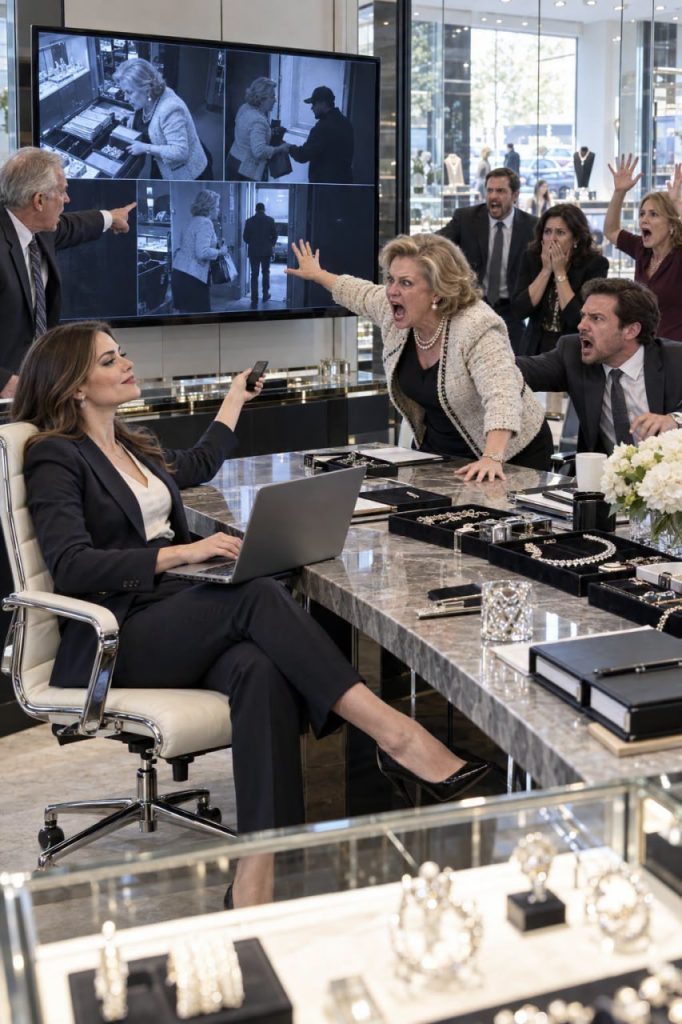
I placed my laptop on the table. “That’s why I think everyone should hear the rest of what you have to say after we watch something.” Her expression tightened. “What?” “Security footage.” The room changed instantly. Vivian didn’t move. Everyone else did. Ethan turned sharply toward me. Harold straightened. Lauren stopped twisting the tissue. Vivian recovered first. “What security footage?” “The new system.” I had spent too long treating Vivian’s contempt as something I needed to overcome, when the real problem was never my worth. The truth did not become cruel simply because someone disliked hearing it spoken without excuses.
“That ridiculous system you installed without consulting me?” “The one I installed after noticing approximately $250,000 missing.” Harold looked at Vivian. “Two hundred fifty thousand?” I connected the laptop to the television. Vivian stepped forward. “This is absurd.” I clicked play. The showroom appeared. 2:11 a.m. Side entrance. Vivian. Nobody spoke as she walked toward the office. Nobody spoke when she opened the safe. I had spent too many years softening facts so other people would not have to feel responsible for them. The silence after a firm answer often revealed more than another hour of arguing.
Nobody spoke when she put our deposits into her handbag. Lauren made a small choking sound when Vivian opened the display case. “Mom?” On screen, Vivian selected the bracelet. The stones. The pendant. Ethan’s hand moved away from mine and gripped the edge of the table. “What are you doing?” Vivian pointed at the screen. “Turn that off.” I didn’t. “You recorded me without permission.” Vivian still believed family loyalty meant shielding her from consequences, even after she had used that same family as cover for years. I had learned how expensive it could be to ignore my own uneasiness.
“It’s company property.” “You had no right.” Harold finally looked at her. “Vivian, why are you taking the money?” She ignored him. The phone call began. That smile appeared on the screen. Lauren whispered, “Who were you talking to?” Vivian said nothing. Then we watched her leave. I switched cameras. The black sedan appeared. The driver opened the door. Her certainty had once made everyone hesitate, but confidence stopped being persuasive the moment receipts, footage, signatures, and account records began speaking for themselves. I stopped asking what explanation would keep the peace and started asking what the evidence actually showed.
Owen’s voice came through the speakers. “Whose car is that?” “I wondered the same thing.” I opened another folder on my computer. Over the previous forty-eight hours, I had done more than sleep badly. The sedan belonged to a private transportation company. One client had booked it repeatedly during the past three months. Julian Mercer. I displayed a photograph. Julian represented everything Vivian had convinced herself she deserved: money, attention, secrecy, and a version of life that looked more glamorous from the outside. That moment became another line between the life we had accepted and the one we were rebuilding.
A man in his late fifties, silver at the temples, expensive suit, practiced smile. “I followed the pattern,” I said. “The car usually drove to the Harbor Crest Hotel.” Vivian’s face had turned gray. Lauren stared at her mother. “Who is he?” “His name is Julian Mercer. He works in real estate development and investment.” Ethan looked at the photo. “Why is Mom meeting him at two in the morning?” Vivian had mistaken Julian’s attention for devotion, but people who build relationships around secrets usually protect themselves before they protect anyone else. Nothing improved when I translated betrayal into misunderstanding.
I opened a second image. Hotel entrance. Vivian stepping from the sedan. Julian waiting beneath the awning. His hand resting at her waist. Her face turned upward toward his. I had expected shouting. Instead, there was silence. The kind of silence that feels heavier than noise. Harold stared at the screen for so long that I became afraid he might faint. What made Julian dangerous was not romance alone, but the network around him and the way respectability could make criminal behavior look ordinary. Once I saw the pattern clearly, I could no longer pretend the latest incident stood alone.
Finally, he said, “Is he married?” “Yes.” Vivian snapped toward me. “You had me followed?” “I followed stolen company property.” “You sanctimonious little—” “Is he married?” Harold repeated. Vivian’s mouth closed. I answered. “Yes. He has a wife and three adult children.” Harold looked down at the table. Something in his face seemed to collapse. For the first time since I had known him, he looked old. I had spent too many years softening facts so other people would not have to feel responsible for them. The hardest part was accepting that one clear fact could expose years of assumptions.