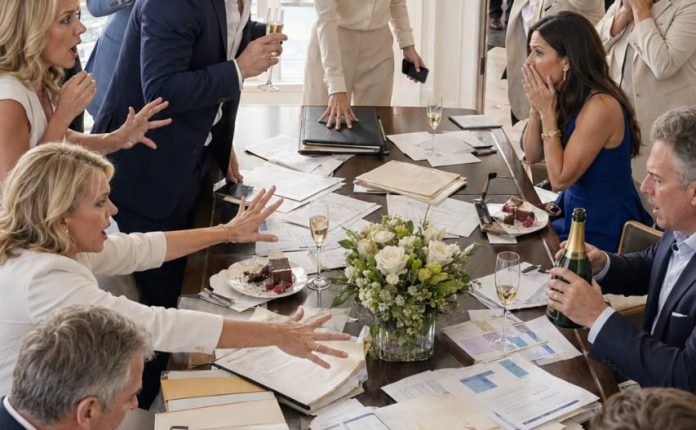
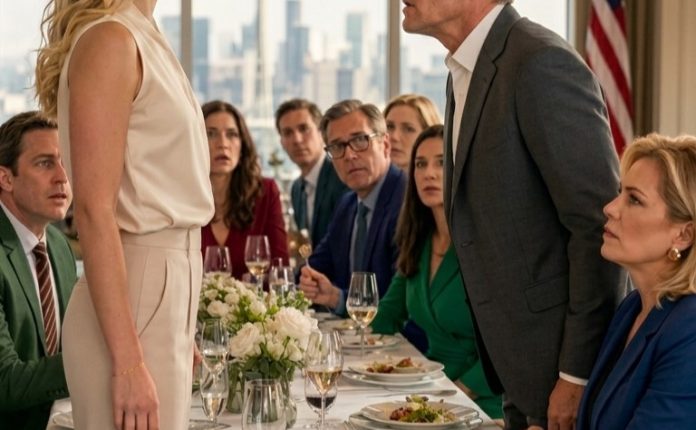
“Wait In The Car,” Dad Hissed, Shoving Me Away From His Business Dinner. “We Need These Investors.” Twenty Minutes Later, The CEO Walked In, Saw Me, And Bowed. “Madam President, I Didn’t Know This Was Your Family.”
### Part 1
The door of my father’s black sedan clicked shut behind me with a sound that felt far louder than it should have.
For a few seconds, I simply sat there in the rear seat, staring through tinted glass at the entrance of Valère, one of those San Francisco restaurants where the host remembered billionaires by name and the flowers in the lobby probably cost more than my first apartment’s rent.
Rain had started falling lightly over Nob Hill, turning the pavement glossy beneath the white entrance lights.
My family was inside.
I had been invited to dinner.
Then, less than three minutes before we reached the private dining room, my father had taken me firmly by the elbow and changed his mind.
“Wait in the car, Nora.”
I had thought he was joking.
My father, Grant Whitmore, almost never joked.
“What?”
“We cannot have another scene tonight.”
“What scene?”
His jaw tightened.
Behind him, my younger sister Paige adjusted the silver bracelet at her wrist and looked away. My older brother Owen didn’t even bother pretending not to listen.
Dad lowered his voice.
“The Hargroves are considering putting substantial capital into Whitmore Capital. This evening matters. I need everyone focused.”
“And my sitting at a table somehow prevents that?”
My mother, Celeste, gave me the look she had perfected over thirty years—the soft, wounded expression designed to make her cruelty look like concern.
“Sweetheart, you’ve been away from the family business for years. You don’t understand how delicate these negotiations are.”
There it was.
The family business.
Their favorite weapon.
Five years earlier, I had left Whitmore Capital after my father told me, in front of six senior partners, that my ideas belonged in “some college incubator, not a serious investment firm.”
I had been twenty-eight.
I never went back.
According to my family, I had been drifting ever since.
“Consulting,” Mom told relatives.
“Playing with startups,” Paige said at parties.
“Burning through her inheritance,” Owen liked to joke.
Nobody had ever asked for details.
That part had become almost funny.
Almost.
I looked at Dad.
“So why invite me tonight?”
His eyes shifted briefly.
Mom answered for him.
“It’s a family dinner.”
I stared at her.
“A family dinner I’m not allowed to attend.”
Paige sighed dramatically.
“God, Nora, why does everything have to become a confrontation with you?”
I laughed once.
It came out sharper than I intended.
“You’re right. Me wanting to attend the dinner I was invited to is incredibly confrontational.”
Owen stepped closer.
“The Hargroves are traditional. They respect continuity, stability, family leadership. Dad is trying to reassure them that Whitmore Capital is solid.”
Something in the way he said solid caught my attention.
Too deliberate.
I looked at my father.
“How bad is it?”
His expression changed.
Barely.
But I saw it.
That was one thing Dad had underestimated about me for years. He had taught me to read people long before he realized I was doing it better than he was.
“What are you talking about?”
“Whitmore Capital. How bad is it?”
“Nora,” he warned.
“You’re courting Hargrove Global at a private dinner, and Owen just used the word stability like he’s presenting to a credit committee. So either you’re chasing a major expansion…”
I watched my brother’s face.
“…or you’re in trouble.”
Paige rolled her eyes.
“This is exactly why Dad doesn’t want you inside.”
Dad opened the car door.
“Enough.”
Cold air rushed in.
He pointed toward the back seat.
“Please. For once in your life, do something for this family without making it about yourself.”
That sentence stayed with me.
I climbed into the car without another word.
Dad closed the door.
My family disappeared beneath Valère’s awning.
Now I sat alone while raindrops slid down the windows.
My phone vibrated.
Paige.
Of course.
How could you embarrass Dad tonight? The Hargroves are already here. If this deal falls apart because you couldn’t control yourself, don’t expect anyone to forgive you.
Another message appeared.
Owen.
Just stay in the car. This is bigger than your feelings.
I stared at those words until I started laughing.
Not because they were funny.
Because twenty minutes earlier, I had received an email confirming that Northstar Capital had secured the final regulatory approval required to consolidate its controlling interest in Hargrove Global.
Northstar Capital.
My company.
My office.
My money.
My board.
And, as of tonight, my controlling stake in the corporation my family was desperately trying to impress.
I opened the email again.
The acquisition structure had taken fourteen months.
Not because I lacked money.
Because Hargrove Global was enormous.
For decades, the company had operated in logistics, commercial property, manufacturing, and infrastructure services. It was profitable but painfully outdated, with divisions that barely communicated and executives who treated technology upgrades like dental surgery.
When Hargrove’s board began quietly looking for strategic capital, Northstar had moved.
We purchased distressed debt from two institutional lenders.
Then convertible preferred shares.
Then stakes from several older shareholders eager to exit.
Eventually, our position became impossible to ignore.
Victor Hargrove, the company’s chief executive, had initially fought me.
Then he saw our restructuring plan.
He stopped fighting.
Within eight months, Hargrove’s margins improved, two failing divisions were merged, outdated systems were replaced, and its market value jumped.
Victor remained CEO.
I became the person he reported to.
My family knew none of it.
They had never once asked what Northstar Capital was.
Mostly because they didn’t know I owned Northstar Capital.
The financial press knew the company’s founder only as N. Wren, the name under which I had made my earliest investments.
Wren was my grandmother’s maiden name.
Dad had once called it “an irrelevant branch of the family tree.”
I had found that appropriate.
My phone rang.
Mara, my chief of staff.
I answered.
“Tell me you’re not still at dinner.”
“I’m technically at dinner.”
“That sounds suspicious.”
“I’m in my father’s car.”
There was a pause.
“Why?”
“He asked me to wait outside.”
Another pause.
Longer this time.
“You’re joking.”
“No.”
“Because?”
“He doesn’t want me interfering with his meeting with Hargrove Global.”
Mara went completely silent.
Then I heard paper rustling.
“Nora.”
“Yes?”
“Victor Hargrove is having dinner with your family?”
“Apparently.”
“Oh.”
That single syllable contained enough amusement to power half the city.
“He didn’t tell me,” I said.
“He probably doesn’t know they’re your family. Grant Whitmore approached one of Hargrove’s capital-relations people weeks ago. I saw the name but assumed it was unrelated.”
That explained something.
My father had spent most of my adult life mentioning the Whitmore name as if it were royal blood.
It apparently hadn’t occurred to anyone that I might deliberately avoid using it in business.
“Board vote?” I asked.
“Twenty-seven minutes.”
“I’m coming.”
“Good. Victor needs to sign the final governance acknowledgment before the vote.”
I looked through the window toward the restaurant.
“Is he carrying the documents?”
“No. I have the originals.”
“Send the secure copies to my tablet.”
“Nora…”
I knew that tone.
“What?”
“Do not do anything reckless.”
I smiled.
“When have I ever?”
“You once bought a software company because its founder insulted your forecasting model.”
“He was wrong.”
“You proved that after purchasing his company.”
“And?”
Mara sighed.
“I’ll send the documents.”
The line ended.
I could have driven away.
That would have been the clean move.
Attend the board meeting remotely from my office, finalize the Hargrove transaction, and let my family continue pretending I was unemployed with expensive hobbies.
For five years, I had protected my privacy because secrecy gave me freedom.
There was power in being underestimated.
But then another message arrived from Paige.
Mom says don’t come inside. You already made things awkward enough. Maybe go get dinner somewhere else.
I looked at the restaurant entrance.
Something inside me went very still.
My parents had not merely underestimated me.
They had built an entire family hierarchy around my supposed failure.
Owen was the heir.
Paige was the polished relationship manager.
I was the cautionary tale.
The daughter who had “thrown away her future.”
Whenever my mother wanted to frighten a younger cousin into obedience, she used me as the example.
Don’t make impulsive choices like Nora.
Whenever Dad discussed discipline, he mentioned the child who had refused to understand responsibility.
Nobody knew I had quietly paid my grandmother’s medical expenses during her final year.
Nobody knew I funded scholarships under her name.
Nobody knew Northstar employed nearly nine hundred people.
They did not know because they had never asked.
And tonight they had placed me in a parked car so I wouldn’t embarrass them in front of a man whose employment contract required my approval.
I opened the door.
The rain had stopped.
Valère’s doorman straightened when he saw me.
Inside, the restaurant smelled of cedar smoke, warm bread, citrus polish, and expensive wine.
The maître d’, Adrian, recognized me immediately.
“Ms. Wren.”
That name sounded very different in this building.
“Good evening.”
“Your usual room?”
“Not tonight.”
I removed my coat.
“My family is dining with Victor Hargrove.”
Adrian blinked.
Then professionalism returned.
“Of course. Private Salon Three.”
“I know where it is.”
I had held Northstar’s year-end executive dinner there four months earlier.
As I walked through the restaurant, I began hearing my father’s voice before I reached the private room.
Smooth.
Confident.
Practiced.
“Hargrove Global needs partners who understand long-term stewardship. Whitmore Capital has managed wealth through three generations.”
I stopped outside the partially closed door.
Owen spoke next.
“We aren’t chasing fashionable technologies that disappear after two quarters. Our clients trust consistency.”
I nearly smiled.
Victor responded politely.
“Technology is becoming fairly central to our restructuring.”
Dad laughed.
“Naturally. Used properly. But there’s a difference between useful modernization and gambling on every new idea that comes along.”
My mother’s voice floated through.
“Our youngest daughter went through that phase.”
My hand tightened around the door handle.
Paige laughed.
“She’s still going through it.”
Then Dad said the sentence that made my decision for me.
“Nora never had the temperament for real finance.”
I pushed the door open.
Eight faces turned toward me.
My father froze with his wineglass halfway to his mouth.
Mom’s smile vanished.
Paige stared.
Owen looked furious.
And Victor Hargrove, silver-haired, perfectly composed, one of the most feared corporate executives on the West Coast, immediately stood from his chair.
Relief crossed his face.
“Boss.”
Nobody moved.
Victor picked up his napkin and smiled at me.
“I didn’t realize the Whitmores were your family.”
The silence became so complete I could hear a waiter setting down silverware in the hallway.
Dad slowly lowered his wineglass.
“What did he just call you?”
I looked directly at him.
Then I pulled out the empty chair beside Victor.
“He called me his boss.”
And for the first time in my life, my father had absolutely nothing to say.
### Part 2
My father recovered first.
He always did.
Grant Whitmore had built his entire reputation on remaining calm when everyone else panicked, and I watched that instinct take control as he placed his wineglass carefully on the table.
“Nora,” he said, almost smiling, “whatever joke you’re making, tonight isn’t the time.”
Victor looked at him.
“Mr. Whitmore, she’s not joking.”
Owen gave a short laugh.
It sounded nervous.
“Victor, you must have mistaken her for someone else.”
Victor’s eyebrows rose.
“I’ve worked with Nora for nearly a year.”
“Worked with?” Paige repeated.
Mom stared at me as if I had somehow changed appearance.
I walked toward the table.
The room was beautiful—cream walls, dark wood, soft white candles enclosed in glass, a long arrangement of pale flowers between the place settings.
There had originally been six chairs.
One for Dad.
One for Mom.
One for Owen.
One for Paige.
Victor.
And Victor’s chief financial officer, Elaine Mercer.
No chair for me.
That detail landed harder than anything else.
They hadn’t impulsively removed me from dinner.
They had never planned for me to sit down.
“Adrian?” I called toward the doorway.
The maître d’ appeared almost instantly.
“Yes, Ms. Wren?”
I watched my father’s expression when he heard the name.
“Could we have another chair?”
“Certainly.”
My mother frowned.
“Wren?”
Adrian glanced between us, realized something complicated was happening, and disappeared.
Dad’s eyes narrowed.
“Why did he call you that?”
“It’s the name I use professionally.”
“Why?”
“Because I wanted my work judged before my last name entered the room.”
Victor gave a quiet, approving nod.
Dad noticed.
That bothered him.
A chair arrived.
Adrian placed it beside Victor.
I sat.
Dad remained at the head of the table.
I let him.
For the moment.
Owen leaned forward.
“Can someone explain exactly what is happening?”
Victor looked to me for permission.
That simple glance changed the atmosphere again.
I nodded.
Victor folded his hands.
“Northstar Capital currently controls approximately fifty-eight percent of Hargrove Global’s voting interest through direct equity, converted preferred shares, and affiliated funds.”
My mother’s lips parted.
Paige frowned.
“So?”
Victor continued.
“Northstar appoints a majority of our board.”
Owen went pale.
Dad’s eyes stayed on me.
“Who owns Northstar?”
Victor did not answer.
He didn’t need to.
Dad understood before the others.
I watched it move across his face.
Disbelief.
Calculation.
Memory.
Then something that looked dangerously close to fear.
“N. Wren,” he whispered.
I said nothing.
His gaze dropped to my hands.
“When you left the firm, your grandmother gave you access to that old Wren family trust.”
“She gave me twelve million dollars.”
Paige made an incredulous sound.
“Twelve million?”
Mom turned toward Dad.
“You told me it was six.”
“Because half was restricted,” I said. “The investable portion available immediately was a little over six.”
Owen stared at me.
“You turned six million into Northstar?”
“No.”
For one heartbeat, relief appeared on his face.
“I turned it into the first Northstar fund.”
That relief disappeared.
Elaine Mercer looked uncomfortable, as though she had accidentally walked into someone else’s funeral.
Victor, meanwhile, looked fascinated.
My father rubbed his thumb slowly along the stem of his wineglass.
“How large is Northstar?”
I could have answered dramatically.
I didn’t.
“Across the holding company and managed funds, approximately eighteen billion in assets.”
My mother actually laughed.
Not because she found it funny.
Because her brain rejected the number.
“Eighteen billion dollars?”
“In assets. I don’t personally have eighteen billion dollars sitting in a checking account, Mom.”
Paige stared at me.
“You’ve been lying to us.”
That irritated me more than I expected.
“Lying?”
“You let us think you were struggling.”
“When did I say I was struggling?”
“You never told us any of this.”
“You never asked.”
“That’s ridiculous.”
“Is it?”
I turned toward her.
“Two Christmases ago, you asked me whether I was still ‘doing the startup thing.’ I said yes. Then you spent twenty minutes telling everyone about your promotion.”
Her cheeks flushed.
I looked at Owen.
“Last year you asked whether I wanted you to introduce me to someone who could give me a junior analyst position.”
Victor covered a smile with his hand.
Owen noticed.
His face hardened.
Dad intervened.
“Enough.”
The old authority returned to his voice.
It used to work instantly on me.
Tonight, it didn’t.
He looked at Victor.
“Whatever Nora’s involvement may be, we’re here to discuss a strategic partnership between Whitmore Capital and Hargrove Global.”
Victor’s expression changed.
Professional now.
“Yes.”
Dad seemed relieved to enter familiar territory.
“Then perhaps we can separate personal matters from business.”
“Absolutely,” I said.
I removed my tablet from my bag.
“Let’s talk business.”
I opened the latest Whitmore Capital report Northstar’s analysts had prepared.
Dad saw the heading.
His face changed again.
“You’ve been investigating us.”
“Due diligence.”
“For what?”
I met his eyes.
“A potential acquisition.”
Paige dropped her fork.
It struck the plate with a sharp metallic crack.
Owen stood.
“No.”
Dad didn’t move.
Victor leaned back.
Elaine looked down at her notes.
Mom whispered, “Nora…”
I continued.
“Whitmore Capital has lost eleven major institutional clients in the last thirty months. Revenue is down nineteen percent. Your operating expenses are increasing. Your compliance systems need substantial upgrades, and three senior portfolio managers have given notice.”
Dad’s face reddened.
“Those numbers are confidential.”
“Two of your lenders approached Northstar.”
That stopped him.
One of the reasons Whitmore Capital was in trouble had nothing to do with investment philosophy.
Three years earlier, Dad had financed an aggressive expansion into commercial real estate advisory work.
Then interest rates shifted.
Projects stalled.
Revenue projections failed.
He borrowed again rather than admit the expansion wasn’t working.
Whitmore Capital remained valuable.
But it had become fragile.
And fragile firms attract predators.
I knew because Dad had taught me that.
“The Hargrove investment,” I said, “was supposed to stabilize your balance sheet.”
He said nothing.
Owen slowly sat down.
Paige looked at Dad.
“Is that true?”
He ignored her.
His eyes stayed on me.
“What do you want?”
Finally.
The correct question.
“I don’t want anything tonight.”
Dad’s brows pulled together.
“You just said acquisition.”
“I said potential acquisition.”
“So this is revenge.”
“No.”
I looked around the table.
“If I wanted revenge, I would let the firm fail.”
Mom flinched.
Dad leaned closer.
“Then what?”
“Northstar has purchased forty-one percent of the senior debt tied to Whitmore Capital’s expansion.”
This time even Victor looked surprised.
Dad’s skin drained of color.
He understood precisely what that meant.
Owen did too.
“You bought our debt?”
“Some of it.”
“Why?”
“Because it was available at a discount.”
“You targeted us.”
“The lender wanted out.”
Dad’s voice dropped.
“How long have you known?”
“About the firm’s position? Seven months.”
“And you’ve said nothing.”
“You didn’t ask.”
His palm struck the table.
Several glasses jumped.
“Stop saying that!”
Nobody spoke.
A waiter appeared in the doorway, saw the room, and quietly disappeared.
Dad pointed at me.
“We are your family.”
I looked at him.
“Twenty-five minutes ago, I was sitting in your car.”
His hand lowered.
“You told me I wasn’t trustworthy enough to attend your dinner.”
“Nora, that wasn’t—”
“You told me I didn’t understand real business.”
His jaw tightened.
“That was years ago.”
“You said it outside this restaurant tonight.”
Mom inhaled.
Paige looked at him.
He had forgotten I heard everything.
I reached into my bag.
Mara had arranged delivery of the original governance documents to the restaurant during our conversation.
A slim charcoal folder now rested inside.
I removed it and placed it beside Victor.
“These are the final Hargrove documents.”
Victor opened them.
Dad watched.
“What happens when he signs?”
“Northstar’s controlling structure becomes permanent under the new board agreement.”
Victor took out his pen.
Dad suddenly placed his hand over the folder.
“Wait.”
Victor looked at him.
My father looked at me.
“Please.”
That word sounded strange coming from Grant Whitmore.
“What happens to my firm?”
I studied him.
For years, I had imagined this moment differently.
I thought proving him wrong would feel like fireworks.
Instead, it felt quiet.
Sad, almost.
Because I finally understood something I hadn’t at twenty-eight.
My father had never rejected my ideas because they were bad.
He rejected them because accepting them would have required admitting his daughter could see something he couldn’t.
And his pride had mattered more to him than I did.
I removed his hand from the folder.
Gently.
“Your firm survives or fails based on what you do next.”
Victor signed.
Then he looked at me.
“Congratulations, Boss.”
I nodded.
The acquisition was complete.
My phone immediately vibrated.
Mara.
BOARD APPROVED.
Then another notification appeared.
This one came from Northstar’s legal department.
Whitmore Capital’s largest lender had just rejected my father’s request for an extension.
The loan was due.
And suddenly I understood why Dad had been so desperate for tonight’s dinner.
Hargrove wasn’t merely an investor he wanted.
Hargrove had been his last lifeline.
And I had just become the person standing between my father and the collapse of everything he had spent his life protecting.