Charles Baldwin stood in my open doorway with his phone held away from his ear, and for the first time that morning, my father looked uncertain. I sat on the porch beneath a gray Syracuse sky, eight months pregnant, while an ambulance siren grew steadily louder.
Only minutes earlier, Charles had walked through my kitchen as though the house already belonged to him. Now he stared at me, then at the folder he had dropped beside Lucas’s desk, as if both had suddenly become evidence he wished he could erase.
I kept Samantha Vance on speaker. “What is he saying?” I asked. My voice sounded calmer than I felt. Samantha answered immediately. “He needs to stop making decisions. Victoria, do not sign anything. Do not hand him your phone. Let the responders document everything.”
Charles swallowed. “The bank froze the account.” Courtney stood behind him, one hand pressed against the counter. My younger half sister had arrived with him wearing a cream coat and the satisfied expression of someone who believed a family argument had already been decided.
“What account?” Courtney asked. Charles ignored her. He kept looking at me. For three weeks, everyone had spoken around me as though grief had made me incapable of understanding numbers, contracts, or property records.
Apparently my father had begun believing his own performance. My husband, Lucas Gallagher, had died three weeks earlier in a highway accident outside Syracuse. Since then, time had become a collection of unfinished tasks.
I woke reaching for his side of the bed, remembered, and spent the next hour trying to become functional again. I was carrying our daughter, Nora, and that fact was the only thing that reliably pulled me forward.
Lucas had painted half the nursery before the accident. A strip of blue tape still bordered one wall because he had insisted the trim needed another coat. The house itself had belonged to Lucas before we married.
On our second anniversary, he added me to the deed. We lived there for six years, argued about kitchen tiles, hosted terrible Thanksgiving dinners, and slowly turned a beautiful building into something that felt ordinary enough to be home.
Charles had never liked that Lucas treated me as an equal owner. My father believed family wealth should remain centralized, preferably somewhere he could see it. He called that stewardship. Lucas called it “Charles wanting every key on one ring.”
That morning, Charles had used an emergency key I had forgotten to reclaim. He arrived with Courtney shortly after nine. Neither knocked. I was drinking tea at the kitchen table when the lock turned and my father walked in carrying a leather folder.
“You can’t stay here anymore,” he said. I thought grief had made me misunderstand him. “Excuse me?” Charles set the folder on the table. “Lucas left obligations. The house needs to be sold, and the company situation has to be stabilized.
I’m handling both.” “You are handling neither.” I pushed myself carefully from the chair. “This is my home.” Charles’s expression tightened. He had spent my childhood treating disagreement as disobedience. At thirty-four, I had finally learned those were not the same thing.
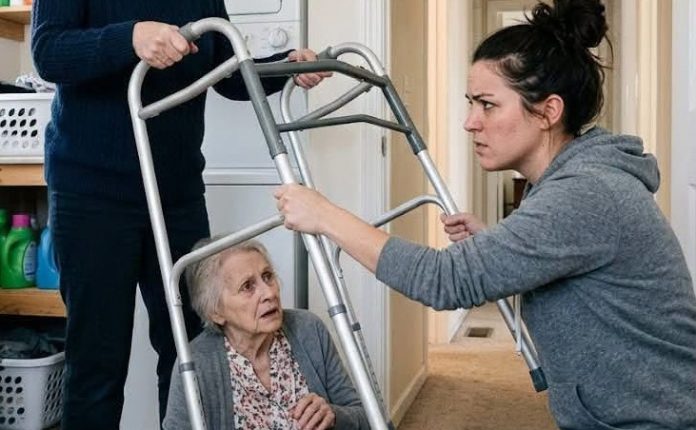
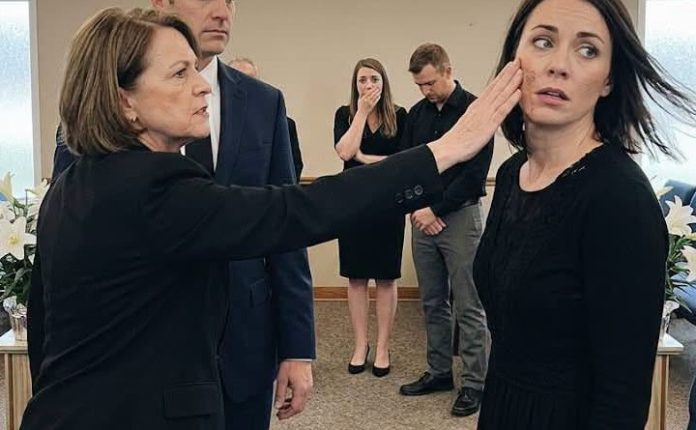
“Victoria, don’t be difficult.” “Get out.” Courtney laughed softly behind him, then stopped when I looked at her. Charles reached for my arm as I moved toward the phone. I pulled away and told him not to touch me. The situation turned physically aggressive.
He gripped my sleeve and tried to steer me toward the front door while insisting I needed to “calm down somewhere else.” I resisted, lost my balance near the threshold, and ended up on the porch before I fully understood what had happened.
I caught myself against the railing and avoided landing on my stomach, but pain shot through one knee. Then I felt a sudden rush of fluid. Every argument disappeared from my mind. “My water broke,” I whispered. Courtney’s face changed.
For one second she looked frightened. Then, perhaps because fear embarrassed her, she gave a strange nervous laugh. Charles tossed my handbag onto the porch. “Call whoever you need. We’ll sort the house out.” So I called Samantha.
Not because I understood the legal crisis yet. I called because Lucas trusted her, and because I needed one person in the world who could think clearly while I was sitting outside my own home trying not to panic about my baby.
Samantha told me to call emergency services first. Then she stayed on the line. “Your father contacted my office yesterday,” she said. I looked through the doorway. Charles was already opening drawers in Lucas’s desk.
“He claimed you authorized him to liquidate estate assets and temporarily exercise your voting rights in Baldwin-Gallagher Logistics.” I tightened my grip on the phone. “I never authorized him.” “I know.” “How do you know?” “Because Lucas prepared for this possibility.”
The words stopped me. Lucas had not prepared for his death. Samantha was careful about that. He had prepared for the possibility that a death, illness, or incapacity might give someone an excuse to interfere with our property.
“The house, the investment trust, and the controlling business shares are protected,” Samantha said. “If Charles submitted an authorization with a signature you did not provide, he may have triggered the disputed-control clause Lucas insisted on adding.” I did not yet know what that clause meant.
Charles apparently did not either. But the bank had already received enough information to restrict one of the accounts he expected to use. That was the phone call in his hand. Courtney stepped closer. “Restricted how?” Charles snapped, “There’s a compliance problem.”
Samantha heard him through my speaker. “No, Victoria. There is a documentation problem, and the bank has noticed it.” The siren grew louder. Charles stared toward the road, then back at me. “You’re making this bigger than it is.”
I nearly laughed. My father had entered my home without permission, tried to remove me, searched my late husband’s desk, and apparently submitted authority I never granted. Yet somehow, my reaction was still the inconvenience. “Don’t engage,” Samantha said. I did not.
When the responders arrived, I answered their questions, accepted medical care, and let their report capture the facts instead of trying to win an argument on the porch. At the hospital, doctors confirmed that my membranes had ruptured early, but Nora’s heartbeat remained strong.
Medication and monitoring bought us time. They hoped to keep the pregnancy stable as long as safely possible. I focused on breathing while Samantha handled everything I could not. The most frightening part was how little I knew.
I had thought the crisis was about the house. By evening, I understood that Charles had also tried to step into Lucas’s business position, gain access to an investment account, and create authority over assets that did not belong to him.
Baldwin-Gallagher Logistics had begun as my grandfather’s regional trucking business. Charles inherited a minority share, expanded aggressively, and nearly lost the company during a debt crisis fifteen years earlier. Lucas joined as turnaround counsel, then invested enough capital to become a major shareholder.
When Lucas and I married, Charles joked that I had “brought the enemy into the family.” He pretended to mean it affectionately. Lucas never laughed. Over the next six years, he helped restructure the company, reduce leverage, and create governance rules Charles complained were unnecessarily strict.
What I had not known was that Lucas also created a marital voting trust. His shares would pass to that trust if he died, with me as lifetime beneficiary and Samantha’s firm acting as independent protector until our child reached adulthood.
My own inherited shares, given to me by Grandpa Baldwin years earlier, were already inside it. Together, Lucas’s shares and mine represented fifty-two percent of the company. Charles owned thirty-one percent. Courtney held five. The remaining twelve belonged to two outside investors.
Charles had apparently assumed Lucas’s death would return practical control to him. Instead, the trust made me the economic beneficiary while preventing anyone from forcing me to sign away voting rights during grief, illness, hospitalization, or another vulnerable period.
Samantha said Lucas had been unusually specific. “If anyone claims Victoria cannot manage her interests, or produces authority signed during a crisis, freeze the voting rights until independent verification.” I closed my eyes. “Why would he write that?”
There was a pause. “Because your father tried something similar during the 2021 refinancing.” I sat upright despite the monitor wires. “What?” Samantha sighed. “Lucas told me not to burden you unless it became relevant.”
In 2021, Charles had asked Lucas to pledge the family house and part of my investment account as collateral for a fleet expansion. Lucas refused. Two weeks later, a draft board resolution appeared stating I supported the plan.
I had never seen it. Lucas stopped the transaction before it reached a lender. Charles called it a clerical misunderstanding. Lucas called Samantha that afternoon and began rewriting our estate plan. He had protected me from a pattern I did not know existed.
That knowledge hurt differently from grief. I loved Lucas for shielding me, but part of me wished he had trusted me with the truth. Samantha seemed to hear that thought in my silence.
“He did not want you living every family dinner as though betrayal was waiting under the plates,” she said. “He hoped the protections would never matter.” I looked toward the dark hospital window. “They mattered three weeks after he died.”
The next morning, Samantha arrived with copies of the documents Charles had submitted. One was a temporary estate authorization supposedly signed by me two days earlier. It gave him power to sell the house, negotiate company shares, and move certain accounts.
The signature looked like mine from across the room. Up close, it was too perfect. My actual signature had become messier during pregnancy because my wrist often ached. This one matched the version I used years earlier on our wedding license.
Samantha placed another document beside it. “This is where they copied it from.” The shapes lined up exactly. Even a tiny break in the ink near the V appeared in both. My stomach tightened. “Who created the authorization?”
“We do not know yet.” “Who submitted it?” “Your father emailed it to my office and uploaded it to the bank portal.” “And Courtney?” “Her name appears as a witness.” I stared at the paper. “She witnessed something I never signed.”
Samantha nodded. “That is what the document says.” I asked to see the bank record. Charles had requested a transfer of one million six hundred thousand dollars from a company reserve account. The payment destination was an entity called Baldwin Strategic Recovery LLC.