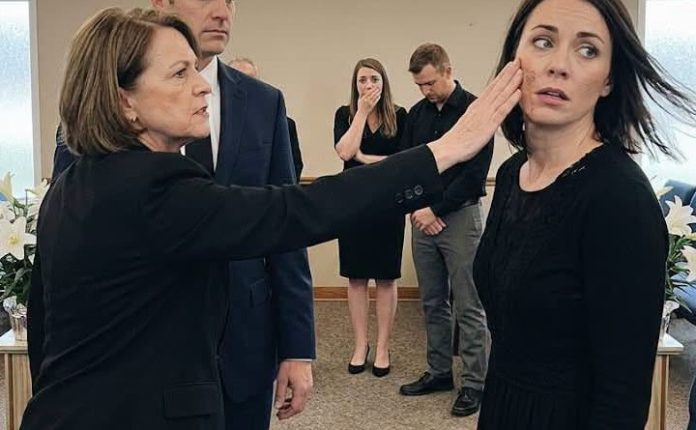
Sophia squeezed my hand as we stepped away from the dining room, but the question she asked next hurt more than anything Patricia had said. “Mom, is Dad ashamed of us because we’re girls?” I stopped walking because I could not answer without breaking.
Chloe was still in my arms, her yellow dress stained with sauce from the tray Patricia had shoved aside. Sophia’s cheeks were clean now, but I knew a napkin could remove food. It could not erase the memory of being told she did not belong.
Behind us, nearly ninety relatives sat beneath chandeliers at an estate outside Charlottesville, celebrating Andrew’s supposed business success. The room glittered with flowers, crystal, and rented luxury. Everyone had watched Patricia remove my daughters’ dinner plates, and almost nobody had challenged her.
Patricia had smiled while doing it. “The boys should eat first,” she said, nodding toward Andrew’s nephews. “They’re the ones who will carry the family name.” Sophia looked at her father immediately. Andrew lifted his glass and told me not to make things dramatic.
That was the moment something inside me changed. Patricia’s cruelty was familiar. Andrew’s silence was not surprising either, but watching my daughter wait for him to defend her made every excuse I had used for years suddenly sound pathetic.
I had spent ten years protecting Andrew from consequences. I covered financial mistakes, corrected documents before investors saw them, paid obligations he could not meet, and allowed his family to believe he was the reason our household lived comfortably.
What none of them knew was that I had founded Vance & Horizon Capital before I married Andrew. I owned sixty-two percent of the company, chaired its investment committee, and controlled a portfolio of developments, debt instruments, and commercial properties across three countries.
The promissory note inside my handbag was more serious than any lie about a venue. Andrew had borrowed 5.4 million pesos through a private bridge loan connected to one of our overseas projects, using his personal guarantee and promising repayment by Monday.
I discovered the note only because the lender contacted our compliance office after Andrew stopped responding. His signature appeared on every page. He had borrowed outside company authority, moved the money into a separate account, and used much of it to cover personal losses.
Sophia tugged my hand. “Mom?” she asked again. I crouched beside her and kept my voice steady. “Your father should have protected you. He didn’t. But there is nothing wrong with you or Chloe, and nobody gets to decide your value because you’re girls.”
We reached the coatroom when Andrew finally followed us. His bow tie was loose, irritation already replacing embarrassment. “Lauren, seriously? You’re walking out because Mom moved two plates?” His choice of words told me he still understood nothing.
“She told your daughters boys mattered more,” I said. Andrew glanced toward the dining room. “She’s old-fashioned. You know how she is.” I almost laughed. For years, that sentence had served as a family pardon for every cruel thing Patricia did.
“I’m taking the girls home.” Andrew blocked the coatroom doorway. “You cannot leave now. My investors are here.” I looked past him toward the ballroom where people believed they were celebrating his latest expansion. “They’re not your investors,” I said.
Patricia appeared behind him before we reached the exit. She looked offended rather than ashamed. “You’re embarrassing Andrew,” she said. “Those children need to learn that every table has an order.” Sophia moved closer to me, and Patricia noticed.
“See?” Patricia continued. “You’ve made them sensitive.” I stared at her. “No. You made them unwelcome.” She waved one manicured hand. “Girls marry out. Boys carry responsibility. That is how families survive.” Her confidence was almost impressive.
Patricia called after me, “If you leave tonight, don’t expect this family to chase you.” I looked back once. “That may be the first useful thing you’ve said to me.” Then I walked into the cold night with my daughters.
At home, after I settled the girls into bed, Sophia whispered, “Are Dad and Grandma mad at us?” I told her adults sometimes get angry when someone refuses bad behavior. “You did nothing wrong,” I said. “And neither did Chloe.”
After both girls slept, I went downstairs and placed the promissory note on the kitchen island. Andrew arrived shortly after midnight. He dropped his keys beside the door and stared at the document before he even removed his jacket.
“So this is about the loan,” he said. I shook my head. “Tonight is about our daughters. The loan is about you.” When I asked when he planned to tell me, Andrew finally muttered, “After the weekend.”
Monday was the repayment deadline, and compliance had already been contacted formally. “They involved the majority owner of the company whose reputation you used to obtain the money.” Andrew called the debt personal. “Then repay it personally,” I said.
He had invested most of the borrowed money into a speculative property deal promoted by an old college friend. The development collapsed when zoning approval failed. The remainder had funded credit cards, travel, and payments intended to preserve the appearance that his finances were strong.
“I can recover it,” Andrew said. “I just need time.” I asked how much he still had. He gave me three different answers before admitting less than seven hundred thousand pesos remained. More than four million had effectively disappeared.
“Are you going to pay it?” he asked. There was no apology in the question, only expectation. I folded the note carefully and placed it back inside my handbag. “No.” Andrew stared as though I had spoken another language.
“You can cover this without even touching operating capital.” I nodded. “I can.” His voice rose. “Then why wouldn’t you?” I thought of Sophia looking toward him while Patricia removed her plate. “Because being able to rescue you doesn’t mean I should.”
Andrew paced across the kitchen. He accused me of confusing marriage with punishment. I told him marriage was not permission to create secret debt and hand the consequences to your spouse. Then I asked whether Patricia knew.
His hesitation answered me. Patricia knew about the loan. More than that, she had helped arrange the lender through a family acquaintance. Suddenly, the dinner made sense. It had not only been a celebration. It had been a performance designed to reassure people Andrew remained powerful.
“I’m calling an emergency board meeting tomorrow,” I said. Andrew froze. “You wouldn’t.” I reminded him that his unauthorized borrowing potentially exposed our company to reputational and compliance risk. “You used our name to support a personal debt.”
His face turned pale. “Lauren, if the board finds out, I’m finished.” I answered quietly, “You should have considered that before signing 5.4 million pesos of debt you could not repay.” He stared at me for a long moment.
By sunrise, I had found something worse than the promissory note. Andrew had used an outdated company letterhead to produce a comfort letter implying Vance & Horizon would stand behind his private obligation if he defaulted.
My signature appeared beneath it. I had never signed the letter. The copied signature came from a shareholder consent I executed eight months earlier. The metadata showed the file had been created on Andrew’s home laptop.
I called Maya Chen, our general counsel, at 6:15. She answered on the second ring. After I explained what I had found, she became silent, then asked me to preserve Andrew’s laptop and send nothing from the original file.