Vale Biotech survived, although the company that emerged looked very different. Daniel returned after nearly a year of recovery, but only after the board approved governance reforms that removed almost every informal privilege the Vale family once possessed.
Procurement oversight became independent. Family members could no longer receive positions without normal qualification reviews. Major related-party transactions required outside approval. Whistleblower protections were strengthened, and an independent compliance committee reported directly to the board.
Daniel also sold a portion of his personal shares into an employee trust. Margaret would have considered that an unforgivable dilution of family control. Daniel considered it one of the best decisions he ever made.
“The company should belong partly to the people keeping it alive,” he told me. I reminded him that statements like that would make his mother furious. He laughed. “I’m developing a tolerance.”
My own life changed too. During the investigation, Vale Biotech’s outside auditors occasionally requested my help understanding historical records. I cooperated as a witness but refused any role that might create conflicts.
After the criminal proceedings ended, I had no interest in joining Daniel’s company. I loved him, but I wanted a professional identity completely separate from the Vale family.
Instead, I returned to forensic accounting through a private nonprofit that helped elderly people and small family businesses identify financial exploitation. The work paid less than my old government position.
It also gave me something I hadn’t realized I missed: the satisfaction of finding truth before a dishonest person could permanently rewrite someone else’s story.
Daniel and I sold the enormous Vale family residence two years after the funeral. Margaret had always treated the property like a monument. Daniel had spent his childhood there and hated almost every room.
We bought a smaller house near a lake, still more expensive than anything I imagined owning when I was young, but quiet enough that mornings belonged to birds rather than staff arriving through side entrances.
The first night there, Daniel carried two glasses of sparkling water onto the back patio. Alcohol had never been important to either of us, and after his medical ordeal, he preferred avoiding anything that made him feel less alert.
We watched the lake turn dark while insects moved through the grass. After a while, Daniel said, “I’ve been thinking about the coffin.” I groaned immediately.
“No.”
He laughed. “Hear me out.” I told him there was no acceptable sentence beginning with those words. He reminded me that he had spent almost an hour listening while relatives accused his wife of adultery and financial fraud.
“I wanted to sit up twenty minutes earlier,” he admitted. I stared at him. “You almost destroyed a criminal investigation because your mother insulted me?”
“I said I wanted to. I didn’t.” Then he tapped two fingers against the table. Once. Twice. Pause. Once. Keep quiet.
I covered his hand with mine. That signal had started as a private joke between newlyweds trapped at boring dinners. Years later, inside a funeral chapel, it had become the one thing keeping me from reacting when everything inside me wanted to scream.
The strangest part of the experience was how many relatives later claimed they had never believed Margaret’s accusations. People who nodded during the funeral suddenly remembered being skeptical.
One cousin insisted she had only whispered because she felt uncomfortable. An aunt claimed Margaret had pressured everyone. Victor’s adult son said he had always suspected his father was hiding something.
I stopped arguing with them. People often rewrite their own behavior once they know which side history has judged. I had spent too many years examining financial records not to recognize retrospective bookkeeping when I saw it.
Some relatives apologized sincerely. Others disappeared. Daniel and I learned to appreciate both outcomes. A smaller circle built on honesty felt far safer than a large family network maintained through obligation.
One person surprised me. Daniel’s cousin Rebecca, who had remained silent during the funeral, asked to meet privately. She didn’t excuse herself.
“I was afraid of Margaret,” she said. “That explains why I stayed quiet, but it doesn’t make staying quiet right.” She apologized directly to me and never asked me to make her feel better.
I respected that. Accountability doesn’t require perfection. It requires telling the truth about your own choices without turning explanations into excuses.
Rebecca gradually became part of our lives again. Several other relatives didn’t. We stopped measuring family by shared surnames and started measuring it by what happened when someone vulnerable needed protection.
Three years after the funeral, Daniel and I attended Vale Biotech’s annual research gala. It was the first large company event we had attended together since everything happened.
The ballroom was filled with scientists, employees, investors, and young researchers receiving grants. No portraits of Vale ancestors hung behind the stage anymore. Daniel had removed them from corporate spaces.
Instead, photographs showed teams developing medicines, technicians working inside laboratories, and patients participating in clinical programs. The company had finally stopped presenting itself as one family’s inheritance.
During his speech, Daniel thanked employees who had protected records, reported irregularities, and cooperated with investigators even when doing so threatened their careers.
Then he said, “Organizations don’t become ethical because leaders claim they are ethical. They become ethical when telling the truth is safer than protecting the powerful.”
I watched several employees applaud. I knew Margaret would have hated the sentence. That no longer mattered.
Afterward, Daniel introduced me to a young financial analyst named Maya who had recently joined compliance. She told me my former cases had been used in one of her university courses.
“That makes me feel approximately ninety years old,” I said. Maya laughed and asked whether I had one piece of advice for someone starting in forensic accounting.
I thought about Margaret standing beside the coffin, Victor whispering about burning files, and all the years I spent watching dishonest people underestimate evidence.
“Don’t become obsessed with catching liars,” I told her. “Become obsessed with protecting the truth. Those sound similar, but they lead you to very different places.”
Later that evening, Daniel and I stepped onto the hotel terrace. Music drifted through the open doors behind us. He asked whether I ever thought about what might have happened if his fingers hadn’t moved inside the coffin.
I admitted I did. I knew intellectually that Daniel was alive before the service began, yet seeing the signal had changed everything. Until his fingers moved, some irrational part of me feared the operation had somehow become real.
Daniel squeezed my hand. “I was terrified too.” That surprised me because throughout the operation he had seemed almost unnaturally calm.
He admitted that lying inside the coffin while hearing Margaret discuss taking the company made him understand something he had resisted his entire life.
“I kept waiting for evidence that she loved me more than she loved control,” he said. “Then I realized I had already spent forty-six years collecting evidence.”
I leaned against the railing. “That sounds dangerously like something a forensic accountant would say.” Daniel smiled. “You contaminated me.”
We stayed outside until the music changed. There was no dramatic revelation after that, no final secret waiting beneath another document. Real recovery became quieter.
Daniel went to therapy. So did I. We argued sometimes, especially when he tried to protect me from information because he thought I had already suffered enough.
I reminded him that secrecy, even protective secrecy, had nearly destroyed our sense of safety. He learned to tell me when he was scared. I learned not to treat every emotional conversation like an investigation requiring immediate conclusions.
We traveled again. The first trip was only three days at a small coastal hotel. On our second evening, Daniel ordered dessert before dinner just because nobody in his family was present to complain about manners.
I laughed until I cried. Ordinary foolishness felt luxurious after years of boardrooms, investigators, lawyers, hospitals, and whispered conversations behind closed doors.
We also created a foundation using money recovered from several civil claims connected with the fraud. Its purpose was simple: provide legal and forensic-accounting assistance to employees who exposed financial wrongdoing and then faced retaliation.
Daniel wanted to name it after me. I refused. I didn’t want another Vale-related institution centered around a person’s surname.
We called it the Clear Record Initiative. The first case involved a bookkeeper at a small manufacturing company who had been fired after questioning payments to the owner’s brother.
Our foundation helped her obtain counsel and preserve evidence. She eventually received a settlement and found another job. When she wrote thanking us, I kept the letter inside my desk.
Not because we had rescued her. We hadn’t. She had already done the brave part by speaking when silence would have been easier.
We had simply made sure telling the truth didn’t leave her standing alone. That distinction mattered deeply to both of us.
Four years after the funeral, Margaret sent Daniel a letter from prison. She had written before, but he never opened those envelopes. This one sat on our kitchen counter for almost a week.
Finally, one rainy Sunday morning, he opened it. I stayed across the room and gave him privacy. He read all six pages without speaking.
When he finished, he folded the letter neatly. I asked whether she apologized. Daniel shook his head. “Not exactly.”
Margaret wrote that Victor had manipulated her, that fear for the company had distorted her judgment, and that losing Daniel’s trust had become the greatest punishment she could imagine.
She said she hoped someday he would understand she had always wanted what was best for him. Daniel stared through the rain-covered window.
“That sentence used to control me,” he said. I knew exactly what he meant. Parents can justify almost anything by claiming their intentions were loving.
“What are you going to do?” I asked. Daniel looked at the folded letter. “Nothing.” He placed it inside a drawer and never replied.
That wasn’t cruelty. It wasn’t revenge. It was the recognition that acknowledging someone’s regret does not require reopening the door through which they repeatedly harmed you.
Victor contacted us only once after sentencing. Through his attorney, he offered additional information about hidden assets in exchange for Daniel supporting a reduction in certain civil claims.
Daniel allowed the lawyers to handle it. He didn’t call Victor, threaten him, or demand an apology. For someone raised in a family where every conflict became personal theater, that restraint represented enormous growth.
The assets were recovered through legal channels. Vale Biotech used part of its recovery to increase employee retirement contributions and fund research grants.
Daniel sometimes joked that Margaret would be horrified to know stolen family money had ultimately strengthened benefits for people outside the family.
I always reminded him not to become too pleased by that irony. He would answer, “I’m not pleased. I’m spiritually amused.”
Years passed. The story occasionally resurfaced online whenever someone discovered the old headline about the executive who sat up during his own funeral.
Most versions exaggerated everything. Some claimed Daniel leaped from the coffin and personally arrested Margaret. Others insisted I had secretly planned the entire operation myself.
One particularly ridiculous article claimed police officers had hidden inside flower arrangements. Daniel printed that one and framed it inside his home office.
Underneath, he wrote, “Never let facts interfere with excellent floral journalism.” I threatened to throw it away. He moved it higher on the wall.
Behind the absurd headline was a truth far less entertaining. We had nearly lost our marriage, our safety, and Daniel’s life because people he trusted believed family connection entitled them to money and control.
Surviving didn’t transform us into fearless people. It made us more careful about where fear was allowed to make decisions.
I stopped attending gatherings where cruelty was disguised as humor. Daniel stopped answering calls simply because someone shared his surname. We both became better at saying no before resentment turned into something larger.
On the fifth anniversary of the funeral, Daniel suggested we visit the chapel. I thought he was joking. He wasn’t.
The building had changed ownership and was now used for community events. The funeral director who cooperated with investigators had retired, but the main room looked almost exactly as I remembered.
We stood near the place where the coffin had rested. Daniel tapped two fingers lightly against a wooden pew. Once. Twice. Pause. Once.
I smiled. “You know, most couples celebrate anniversaries somewhere with champagne.” Daniel looked around. “Technically, this isn’t our anniversary.”
“It’s the anniversary of your funeral.”
“Exactly. Very exclusive.”
I laughed, and the sound echoed through the empty chapel. Five years earlier, that same room had been filled with accusations, police, terror, and relatives waiting to inherit pieces of our life.
Now it was simply a room. Places don’t keep power by themselves. People give memory power, and sometimes healing means returning long enough to discover the memory no longer controls your body.
Before leaving, Daniel stood where Margaret had confronted me. “What would you say to her now?” he asked.
I thought about the question. Years earlier, I might have imagined a brilliant speech about betrayal and consequences. Now the answer felt almost boring.
“Nothing,” I said. “She already heard everything that mattered in court.” Daniel nodded. “Same.”
We walked outside into late-afternoon sunlight. The parking lot was nearly empty. There were no reporters, board members, relatives, or police vehicles waiting.
Daniel took my hand as we crossed toward our car. His fingers were warm and steady.
The first time I saw those fingers move inside the coffin, I thought the miracle was simply that my husband was alive.
I understand it differently now.
The miracle wasn’t that Daniel rose from a coffin while police arrested the people who believed they had defeated us. Justice was important, but justice wasn’t the life we built afterward.
The real miracle was waking beside him years later in a quiet house where nobody had to earn safety, where money was never confused with loyalty, and where family was measured by honesty rather than obligation.
Margaret believed Daniel’s supposed death would give her control over everything he owned. Victor believed destroying files would erase what they had done. Their relatives believed repeating a lie loudly enough could turn it into truth.
They were wrong about all three things. Numbers leave trails. Documents remember. People eventually choose whether silence protects peace or protects wrongdoing.
Most importantly, someone else’s version of you does not become your identity simply because an entire room agrees with it.
At Daniel’s funeral, almost everyone in that chapel looked at me as though I were the woman who had destroyed him. I stood alone while relatives whispered, cameras waited outside, and Margaret demanded my surrender.
Then two fingers moved against white satin.
Once. Twice. Pause. Once.
Keep quiet. Trust me.
I did.
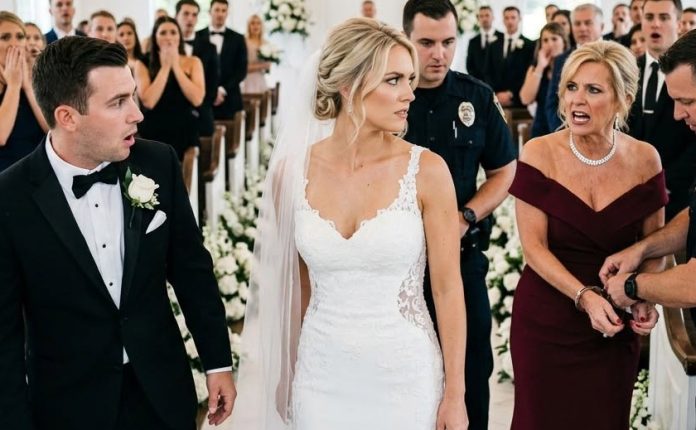
A few seconds later, Daniel sat up, the police moved in, and the people who had gathered to bury our future watched their own carefully constructed story collapse around them.
They believed they were burying Daniel.
In reality, they had gathered beneath one roof to bury themselves.
And Daniel and I walked out alive.
THE END!
Disclaimer: Our stories are inspired by real-life events but are carefully rewritten for entertainment. Any resemblance to actual people or situations is purely coincidental.