At my husband’s funeral, my mother-in-law looked me straight in the eye and coldly said, “It’s better for him to die now than to live with the humiliation she brought upon him.” Several relatives nodded as though she had delivered a eulogy instead of an accusation.
Before I could reply, I saw Daniel’s fingers move inside the open coffin. Two fingers tapped against the white satin lining once, twice, paused, then tapped again. It was our private signal, created years earlier during endless charity dinners: Keep quiet. Trust me.
My heartbeat slammed against my ribs, but I lowered my eyes before Margaret Vale could see my shock. Daniel’s face remained pale beneath funeral makeup, his chest apparently motionless. Anyone watching would have believed my husband had been dead for three days.
The first thing Margaret had done at Daniel’s funeral was accuse me of destroying him. The second was smile when she thought nobody important was watching. That tiny smile told me she believed everything had gone exactly according to plan.
Margaret Vale stood beside her son’s coffin wearing a black designer dress, pearl earrings, and an expression carefully balanced between dignity and grief. There were no tears. She had spent the entire morning accepting condolences as though she were chairing a corporate reception.
My name is Elena Vale. Before marrying Daniel, I spent ten years working as a forensic accountant for the state attorney general’s financial-crimes division. I had traced shell companies, fraudulent charities, offshore transfers, bribery networks, and executives who believed numbers could lie forever.
Daniel knew exactly what I did when we met. He liked telling people I had the least romantic profession imaginable because I could turn a dinner conversation about investments into an interrogation about tax residency and beneficial ownership within five minutes.
We had been married eight years. Daniel was forty-six and chief executive of Vale Biotech, a medical-research company founded by his late father. Margaret controlled a large family trust, while Daniel controlled the voting shares that actually determined the company’s future.
That distinction mattered far more than Margaret liked admitting. She behaved publicly as though Vale Biotech belonged to the entire family, but Daniel had spent years separating corporate governance from family entitlement. Margaret considered every boundary an insult to her authority.
Victor, Margaret’s younger brother, sat in the second row of the chapel. He had been Vale Biotech’s chief procurement officer until Daniel suspended him six weeks earlier after an internal review discovered unusually expensive contracts connected to several unfamiliar consulting companies.
At the time, Victor called the investigation a misunderstanding. Margaret called it betrayal. Daniel called me into his study after midnight one Thursday, closed the door, and placed three folders on the desk between us.
“Elena,” he said, “I think someone inside my family has been stealing from the company.” His voice was calm, but I knew him well enough to notice the way his right thumb kept rubbing against his wedding ring.
The contracts involved laboratory equipment, overseas consultants, and supposed intellectual-property services. Individually, nothing looked extraordinary. Together, however, they formed a pattern of inflated invoices and payments routed through companies with almost no legitimate operating history.
I examined the files for less than twenty minutes before asking Daniel who had approved the vendors. He didn’t answer immediately. He didn’t need to. Every approval chain eventually passed through Victor’s office or a committee chaired by Margaret.
“How much?” Daniel asked. I told him I couldn’t know yet. I needed bank records, beneficial-ownership information, tax filings, and the original procurement documents. Daniel nodded, then said something that made the room feel colder.
“I think they know I found it.” The previous week, somebody had accessed Daniel’s private corporate files using an executive credential after midnight. Two days later, Margaret casually asked whether he was reconsidering Victor’s suspension.
Daniel had told her no. That same evening, somebody tried to remove archived documents from the company’s off-site records system. The attempt failed because Vale Biotech’s compliance software automatically preserved copies whenever restricted material was accessed.
I wanted Daniel to contact police immediately. He refused, not because he wanted to protect Margaret or Victor, but because he feared moving too early would allow whoever was involved to destroy evidence before investigators understood the entire network.
Three days later, Daniel collapsed during a board meeting. Doctors initially believed he had suffered a severe cardiac event. He recovered consciousness briefly in the ambulance, squeezed my hand, and whispered one sentence before the paramedics began working around him.
“Don’t trust my mother.” At the hospital, his condition stabilized unexpectedly. Toxicology results raised questions the doctors could not immediately explain, and investigators were quietly contacted through an attorney Daniel and I both trusted.
That was when the plan changed completely. Detectives believed someone might try again if they knew Daniel had survived. Daniel, stubborn even while attached to monitors, proposed something so theatrical that I initially thought the medication had affected his judgment.
He wanted the people responsible to believe he was dead. The authorities did not simply announce a fake death and hope everyone confessed. The operation required warrants, court approvals, controlled communications, medical coordination, and restrictions I was never allowed to discuss publicly afterward.
What mattered was simple: Margaret and Victor were permitted to believe the worst had happened, while investigators watched what they did next. Daniel’s supposed funeral became the most dangerous meeting either of us had ever attended.
Only a handful of people knew the truth. Daniel’s physician knew. Our attorney knew. Several detectives knew. The funeral director knew enough to cooperate. I knew. Everyone else believed Daniel Vale had died after a sudden medical collapse.
Margaret took control immediately. Before Daniel’s “death” had even been announced publicly, she called the family attorney demanding information about his voting shares, patents, houses, personal investment accounts, and the terms of our prenuptial agreement.
When the attorney refused to discuss private estate matters, Margaret called me. Her voice was soft and almost maternal. She told me I was probably too overwhelmed to think clearly and offered to “manage everything” until I recovered.
I thanked her and declined. She became colder immediately. “Daniel would want the family protected,” she said. I asked whether she meant Daniel’s company, his employees, or herself. She hung up without answering.
The next morning, rumors began spreading that I had drained Daniel’s accounts. By afternoon, someone told a financial reporter that Daniel had discovered I was having an affair. Neither accusation contained even a trace of truth.
The speed told me everything. Grieving relatives do not usually prepare coordinated narratives, contact journalists, and circulate fabricated financial allegations within twenty-four hours. People protecting themselves do.
At the funeral, Margaret had invited almost everyone who mattered to Vale Biotech: board members, senior executives, family shareholders, major donors, and enough relatives to guarantee every accusation against me would travel quickly.
Several reporters waited outside the chapel. Margaret claimed they had arrived without invitation. I knew better because one of the journalists quietly showed our attorney the email her office had received from an address belonging to Margaret’s assistant.
Margaret approached me beside Daniel’s coffin and said, “You drained his accounts. You ruined his company. You drove him into despair.” Victor loudly added from behind her, “Everyone knows Daniel discovered her affair.”
Heads turned. A few relatives looked uncomfortable, but nobody defended me. Margaret had spent three days preparing them to believe that Daniel’s supposed death was the final consequence of marrying a dishonest woman.
I held a white rose in both hands and remained silent. Margaret mistook silence for weakness. She leaned toward my ear until I could smell her expensive perfume and whispered, “When this is over, sign the widow’s waiver.”
“The house, shares, and patents belong to the family,” she continued. “Do one decent thing after what you’ve done.” I looked at Daniel’s motionless face and forced myself not to respond.
Then his fingers moved. Once. Twice. Pause. Once. Keep quiet. Trust me. My knees nearly weakened, although I had known he would be inside that coffin. Seeing the signal transformed the operation from theory into something terrifyingly real.
Margaret stepped away, satisfied. Victor leaned closer to her and whispered, “Once she signs, burn the remaining files.” Margaret answered without looking toward him, “There won’t be anything left to find.”
I tightened my grip around the rose. Hidden microphones had been installed under lawful authorization as part of the investigation. Every word spoken near the designated areas was being recorded.
They thought Daniel was lying helplessly inches away from them. That confidence made them reckless. Victor began discussing a storage unit while pretending to straighten flowers. Margaret told him they would handle it after the reception.
Neither noticed the two unfamiliar men sitting near the rear doors. They looked like middle-aged relatives in dark suits. They were detectives. Another investigator waited inside the adjoining office monitoring the live audio.
The memorial service began. Margaret delivered the first eulogy. She described Daniel as brilliant, generous, and tragically trusting. Then she looked directly toward me before saying that sometimes the people closest to us inflict wounds strangers never could.
Several relatives glanced in my direction. I could almost admire the construction of her performance. She never explicitly accused me during the speech. She didn’t have to. Every sentence guided the room toward the conclusion she wanted.
Victor spoke next. He praised Daniel’s loyalty to “blood and legacy,” a phrase Daniel had always hated. He promised that the family would preserve Vale Biotech exactly as Daniel’s father intended.
I knew what that meant. Victor expected Daniel’s voting power to disappear. Margaret expected to control whatever remained through the family trust. They believed they were hours away from reversing every governance reform Daniel had implemented.
When the service ended, Margaret asked several board members to remain for what she called “an urgent family-company matter.” That wasn’t part of the funeral schedule. It was, however, exactly what investigators hoped she would do.
I remained beside the coffin while mourners filed out. Margaret approached again and handed me a folder. “These are routine estate documents,” she said. “Sign them now, and we can stop embarrassing everyone.”
I opened the folder. The first page was titled Widow’s Consent and Waiver. Beneath the harmless wording were clauses surrendering potential claims, voting rights, intellectual-property interests, and challenges to several trust transfers.
I looked up. “You brought corporate transfer documents to your son’s funeral?” Margaret’s expression tightened. “I brought documents that prevent further damage to what Daniel built.”
Victor joined us. “Sign them, Elena.” His tone contained none of the sympathy he had displayed during the service. I asked whether Daniel had authorized these transfers before his supposed death.
Margaret answered too quickly. “Of course.” I flipped another page and found a signature supposedly belonging to Daniel. I had examined forged signatures professionally for years. This one was good.
It was also wrong. Daniel always connected the final letters of his surname in a particular upward stroke. The signature on the document stopped sharply before the final letter.
“You should sign,” Margaret repeated. “Unless there’s something else you’re hiding.” I closed the folder. “I’d like my attorney to review it.”
Victor stepped closer. “There isn’t time.” That sentence interested me more than anything else he had said. Legitimate estate paperwork rarely becomes invalid because a widow wants her lawyer to read it.
“Why isn’t there time?” I asked. Victor looked toward Margaret. She answered, “Because the board meets tomorrow, and uncertainty could damage the company.”
I almost smiled. Daniel had spent years teaching me that whenever someone used urgency to prevent review, the urgency usually benefited the person demanding the signature.
I placed the folder on a nearby table. “Then the board can wait.” Margaret’s face changed. Her grief disappeared completely, replaced by the expression Daniel had warned me about many times.
“You think marrying him made you one of us,” she said quietly. “It didn’t. Daniel embarrassed this family when he chose you. Everything afterward was merely a consequence.”
Before I could respond, a soft sound came from the coffin. Daniel’s fingers tapped again. Keep quiet. I lowered my gaze while Victor whispered that they should move the reception discussion somewhere private.
That was the signal investigators had been waiting for. Not Daniel’s finger movement—only I understood that—but Margaret’s attempt to relocate the conversation after producing the disputed transfer documents.
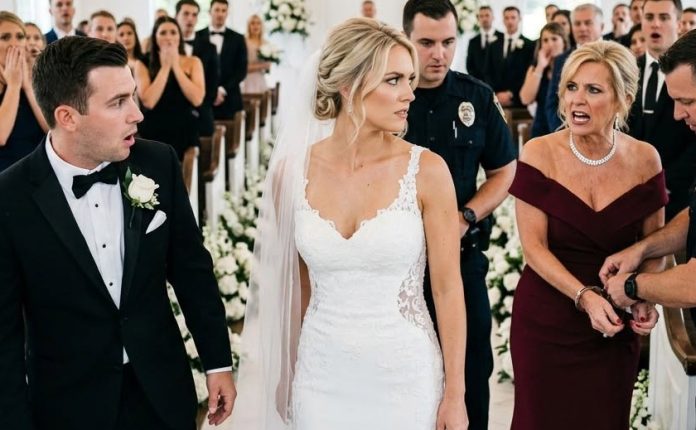
The chapel doors suddenly closed. Two detectives stepped away from the rear wall. Another entered from the side corridor. Victor stopped moving. Margaret turned slowly, confusion crossing her face for the first time.
Detective Lena Ortiz identified herself and told everyone to remain where they were. The remaining board members looked toward one another while relatives began whispering. Margaret immediately demanded to know why police were interrupting her son’s funeral.
Ortiz didn’t answer the question directly. She walked toward the front of the chapel and asked Margaret to step away from the coffin. Margaret refused. “This is obscene,” she said. “My son is lying dead beside me.”
Then Daniel’s right hand moved.
Margaret saw it.
Her face emptied.
For one extraordinary second, nobody made a sound. Daniel lifted his hand, removed part of the concealed monitoring equipment near his collar, and slowly pushed himself upright inside the coffin.
Someone screamed. A chair fell backward. Victor stumbled into the front pew. Margaret simply stared as Daniel sat up, pale and exhausted but unmistakably alive.
“Hello, Mother,” he said.